Classic 03 / 1977
TRS-80:
the computer from the electronics shop
A monochrome computer with 4 kilobytes of memory became a mass-market product through thousands of Radio Shack stores. Its name later lived on in a very different, colourful family: the CoCo.
01 / The surprise of 1977
A complete system, not a kit
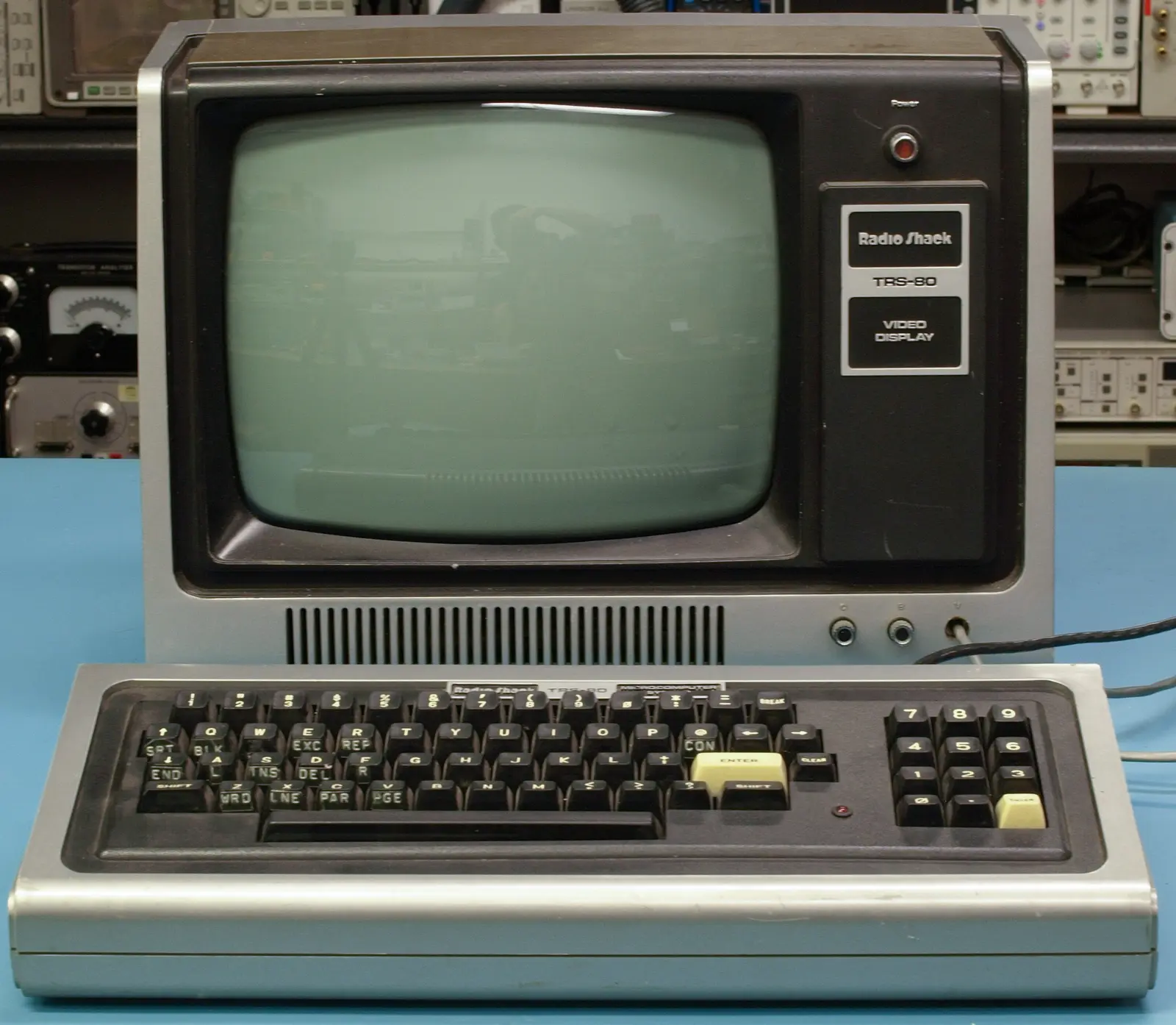
On 3 August 1977, Tandy unveiled the TRS-80. For $599.95, the buyer received a keyboard computer, monochrome monitor, cassette recorder and BASIC: plug in and begin.
The letters in the name simply stood for Tandy Radio Shack and the Zilog Z80 processor. Technically, the computer appeared modest next to the Apple II: no colour, no sound and initially only 4 KB of memory. But it cost far less than many other ready-to-run systems and sat in a retail chain Americans already knew for radios, cables and electronic components.
Tandy cautiously expected to sell a few thousand units. It sold far more. While enthusiasts often had to find a specialist supplier for other microcomputers, visitors could see and order a TRS-80 in thousands of Radio Shack shops, then return later for software or a cable.
Together with the Apple II and Commodore PET, the Model I became one of 1977’s three defining ready-made computers. Its great innovation lay not only in circuitry but in distribution: the personal computer had literally arrived on the high street.
02 / Monochrome and capital letters
Limitations that became a style
The Z80 ran at about 1.77 MHz. Its standard monitor displayed 64 characters on 16 lines, all in upper case.
The Model I had no separate pixel graphics memory. Programmers used block-shaped characters to imitate a grid of 128 by 48 positions. From these came mazes, maps, bar charts and surprisingly recognisable game worlds. The picture was coarse, yet fast enough to acquire a visual language of its own.
Early machines used Level I BASIC, a compact language for beginners. Level II BASIC, based on Microsoft BASIC, later added more commands and became the foundation of a much larger software library. After switch-on, the prompt was ready immediately: curiosity and a first program were separated by a single line.
03 / Listening to data
Cassettes, errors and trying again
Programs were first stored on ordinary cassette tapes. The Realistic recorder beside the computer was as much a part of the system as the monitor.
Loading meant winding the tape to the right position, setting the volume correctly and waiting while squealing data passed into memory. If something went wrong, the ritual began again. Yet cheap tape storage made it possible to preserve your own work and distribute software through magazines, clubs and small publishers.
The combination of an accessible BASIC prompt and a detailed manual encouraged owners to program. Computer shops and user groups exchanged games, administrative tools and advice. A surprisingly mature software culture quickly formed around the simple hardware.
04 / A desk full of expansion
From a 4K machine to a small business computer
- 01
The Expansion Interface
The large box behind the keyboard provided extra memory and connections for floppy drives and printers. A complete system could hold 48 KB of RAM.
- 02
TRSDOS and floppy disks
With 5¼-inch drives and TRSDOS, long cassette waits disappeared. Files, programs and business data became directly accessible from disk.
- 03
Software for work and play
Word processors including Electric Pencil and Scripsit, VisiCalc, databases, adventures and early action games made the TRS-80 useful in bedrooms, schools and small businesses.
05 / Model III and Model 4
The loose components come together
The Model I brought cables, separate power supplies and sensitivity to radio interference. The TRS-80 Model III of 1980 combined computer, monitor and floppy drives in one large enclosure.
The Model III largely continued the Z80 line and could run much Model I software, but it was tidier, faster and better suited to offices and education. The Model 4 followed in 1983 with more memory, an 80-column text display and support for CP/M. The original TRS-80 had grown into a professional microcomputer.
Meanwhile, Tandy used the TRS-80 name on other systems, from business machines to the portable Model 100. It became a family brand rather than one compatible standard. No machine demonstrates that more clearly than the Color Computer.
06 / The colourful cousin
The CoCo was not a Model I in colour
The TRS-80 Color Computer appeared in 1980 and soon became affectionately known as the CoCo. Its shared brand concealed a fundamental difference: this computer was not compatible with the Model I.
The CoCo used a Motorola 6809E and a 6847 video chip. It connected to a colour television, offered sound and joysticks and worked with cassettes, disks and instant-loading Program Paks. Microsoft’s Color BASIC provided straightforward graphics and sound commands. Where the Model I evolved into a text-oriented work machine, the CoCo felt like a true living-room and games computer.
The first version once again began with only 4 KB, although later machines carried 16, 32 or 64 KB. The CoCo 2 of 1983 put similar technology into a smaller white case. Games including Dungeons of Daggorath, Downland and Polaris became fixtures of a loyal community.
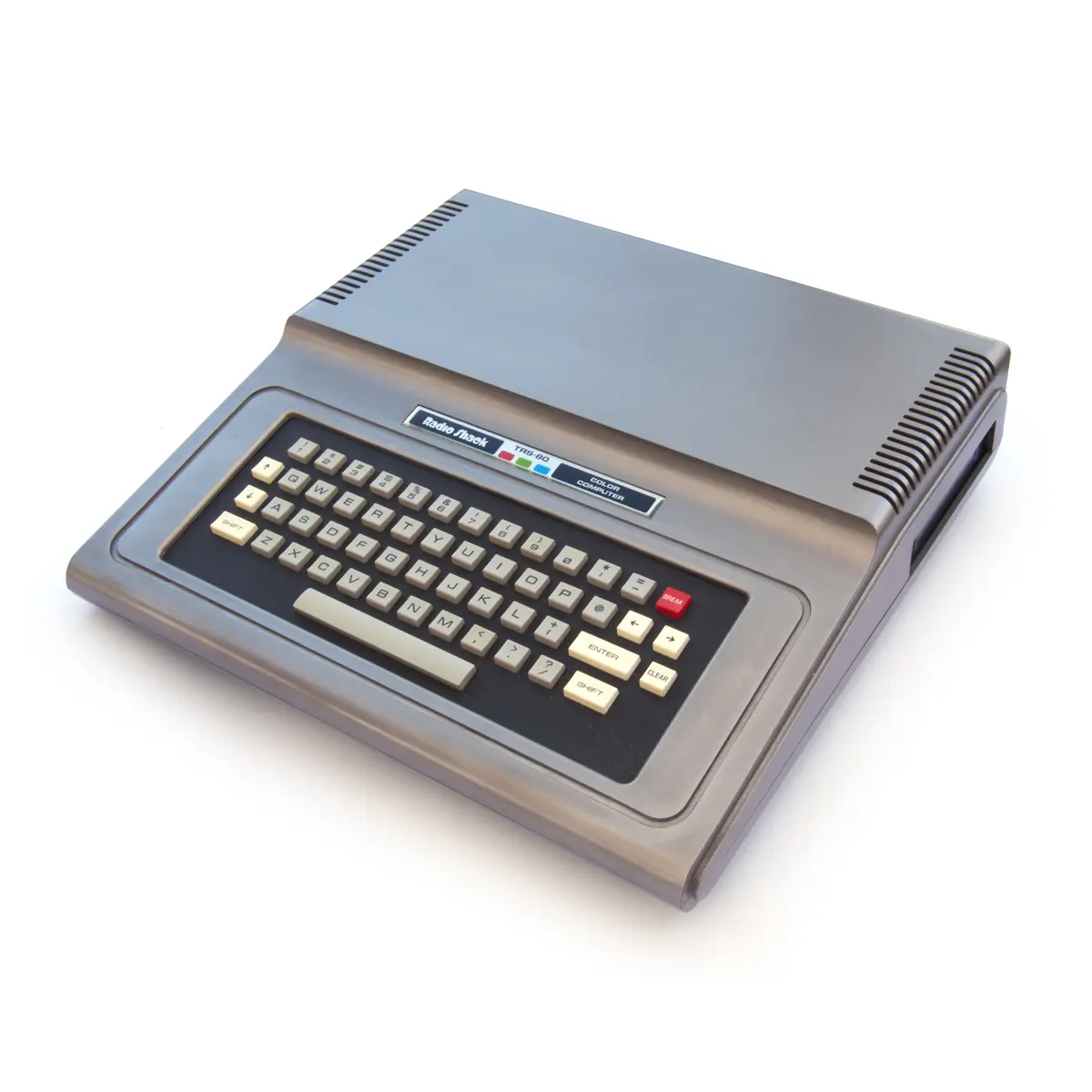
A Motorola 6809, colour, sound and Program Paks in a case that still recalled the Model I.
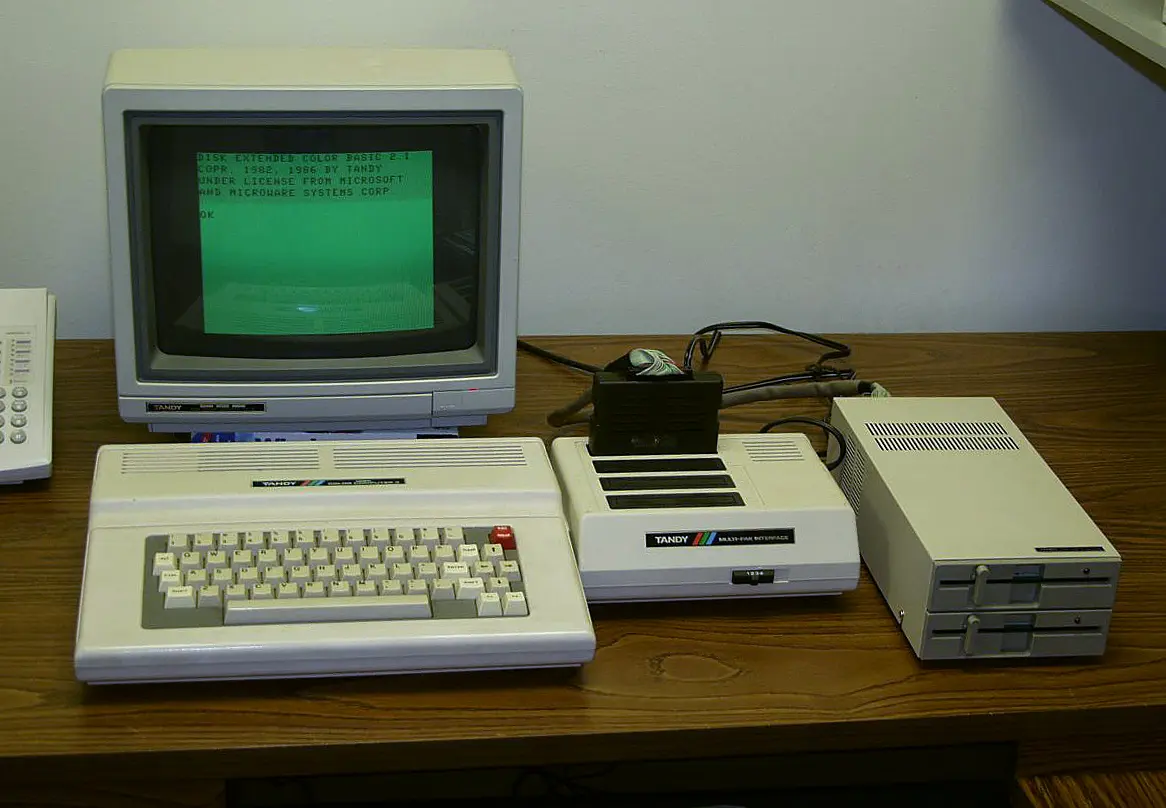
The most capable CoCo, with 128 KB, enhanced graphics and scope for a far more serious system.
07 / CoCo 3 and OS-9
A simple computer with a grown-up operating system
The 1986 CoCo 3 arrived with 128 KB of memory, expandable to 512 KB, a revised graphics chip and a better keyboard.
It remained broadly compatible with earlier CoCo software, but could display higher resolutions and more colours. On a suitable RGB monitor it looked considerably sharper. New games and applications used the expanded abilities while older Program Paks continued to work.
Microware’s OS-9 was particularly remarkable: a modular, multitasking operating system for the 6809. OS-9 Level II turned the CoCo 3 into a machine where windows, multiple processes and serious programming languages existed alongside familiar BASIC. Beneath the simple white keyboard lay a surprisingly mature computer.
08 / One name, many computers
From monochrome prompt to colourful cult machine
The letters TRS-80 eventually appeared on very different computers. That breadth itself reveals how quickly the market changed between 1977 and 1991.
Model I
A complete system with Z80, 4 KB RAM, monitor, cassette and BASIC appears for $599.95.
Disks and TRSDOS
Expanded systems become practical machines for administration and word processing.
Model III and CoCo
Tandy renews the monochrome line and begins a separate, incompatible colour family.
Model 4 and CoCo 2
Both computer families receive successors for their own distinct users and software.
Color Computer 3
More memory, better graphics and OS-9 Level II give the CoCo a powerful final chapter.
The end of the CoCo
Sales end, but user groups and developers keep the computer family alive.
09 / Sources & further reading
Explore further
- Smithsonian — Radio Shack TRS-80 Model I
- Computer History Museum — TRS-80 Personal Computer
- Radio Shack — Level II BASIC Reference Manual
- Radio Shack — Color Computer Technical Reference Manual
Image credits
- TRS-80 Model I System — Dave Jones, CC BY-SA 4.0; resized and converted to WebP
- TRS-80 Color Computer 1 — Bilby, CC BY 3.0; resized and converted to WebP
- CoCo 3 system — Lamune, public domain; converted to WebP


