Classic 02 / 1981
TI-99/4A:
the 16-bit computer that could talk
A gleaming computer with technology from the minicomputer world, colourful games and a voice—but also an architecture full of detours and a price war Texas Instruments could not win.
01 / A colourful welcome
A title screen instead of a blinking cursor
The TI-99/4A did not begin with an empty command line. First came a distinctive title screen with bands of colour and a message announcing that the home computer was ready.
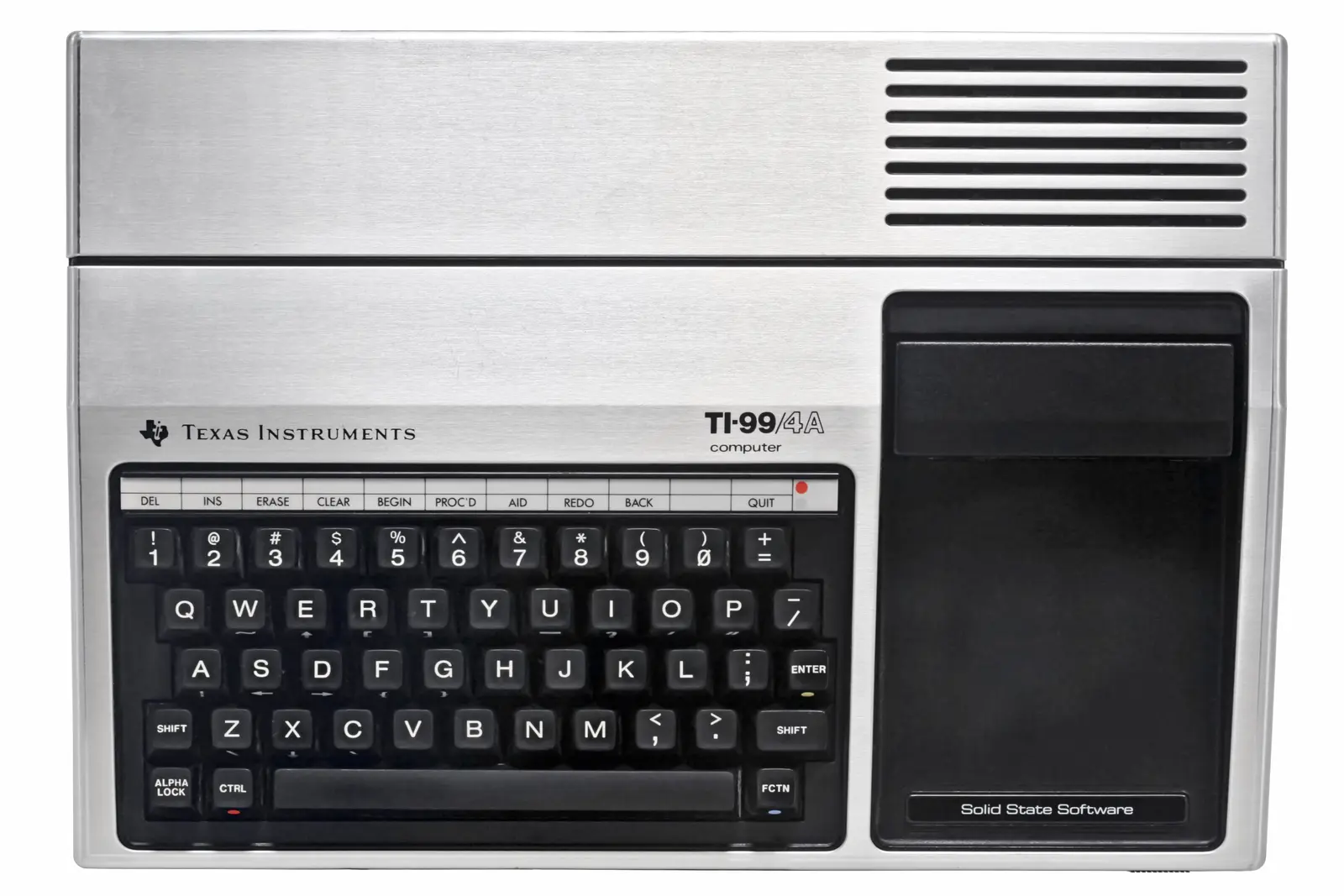
Pressing a key opened a selection menu. Without a cartridge, the user could enter TI BASIC; insert a so-called Solid State Software module and its program appeared as another option. It felt more orderly and more like a finished consumer product than the bare BASIC prompt of many contemporaries.
TI BASIC made colour and sound surprisingly approachable. Commands such as CALL CLEAR, CALL COLOR and CALL SOUND invited experimentation. Programs from books and magazines turned the television, line by line, into a game, a calculator or a moving pattern.
The case reinforced that grown-up impression. Brushed metal, black plastic and a full-travel keyboard distinguished the 4A from the angular TI-99/4 before it. The machine looked both futuristic and solid—as though a piece of laboratory equipment had found a place in the living room.
02 / Sixteen bits by a roundabout route
A minicomputer chip behind the keyboard
Inside the TI-99/4A was a 3 MHz TMS9900: a true 16-bit processor descended from the architecture of Texas Instruments’ own TI-990 minicomputers.
That sounded impressive in 1981, when most home computers used an 8-bit processor. Yet the machine did not automatically feel faster. The CPU had only 256 bytes of fast scratchpad memory directly at hand. The 16 KB that held screen data and BASIC programs belonged to the video chip and had to be accessed through it.
Meanwhile, the TMS9918A video chip delivered a resolution of 256 by 192 pixels, sixteen colours and as many as 32 sprites, with four visible on any one scan line. The sound chip supplied three tone channels and one noise channel. The hardware made lively arcade-style games possible, but forced programmers to work carefully around the unusual memory map.
03 / Software in a slot
Cartridges that started at once
The most characteristic software arrived on flat cartridges. In TI’s own vocabulary these were not simply game cartridges, but Solid State Software Command Modules.
Insert a module, switch on and choose a title from the menu: little more was required. Games including Parsec, Munch Man, Alpiner, TI Invaders, Hunt the Wumpus and Tunnels of Doom showed how much colour and motion the video chip could produce. TI’s tight grip on cartridges and distribution did, however, leave the early selection of independent software narrower than on more open rivals.
Owners could connect an ordinary cassette recorder for their own programs and cheaper software. A disk drive was available, but demanded much more hardware. A line therefore ran through TI-99/4A ownership: the stand-alone console was approachable, while a complete system quickly became large and expensive.
04 / The computer finds its voice
One of the era’s most memorable accessories
- 01
A box on the right-hand side
The Speech Synthesizer slid directly onto the expansion port. The compact sidecar gave compatible software access to a built-in vocabulary.
- 02
Games that spoke to you
In Parsec, the computer warned of enemies and danger; Alpiner delivered spoken remarks during the climb. In an age of beeps and buzzes, it sounded spectacular.
- 03
Technology from the same family
Texas Instruments had already become known for speech synthesis through Speak & Spell. The unmistakable electronic voice gave the TI-99/4A a personality few home computers possessed.
05 / Expansion in steel
From a sideways chain to an expansion box
Individual peripherals could be daisy-chained beside the console. Every extra box made the desk wider and the system less elegant.
Texas Instruments therefore offered the Peripheral Expansion System, usually known simply as the PEB. This heavy metal enclosure had slots for options including 32 KB of extra memory, a disk controller, serial interfaces and a p-code card for UCSD Pascal. A 5¼-inch floppy drive could also be mounted inside.
With a PEB, the compact home computer became a serious, almost professional system. The expansion also exposed the distance between the inexpensive base machine on the shop shelf and the configuration enthusiasts wanted for advanced software.
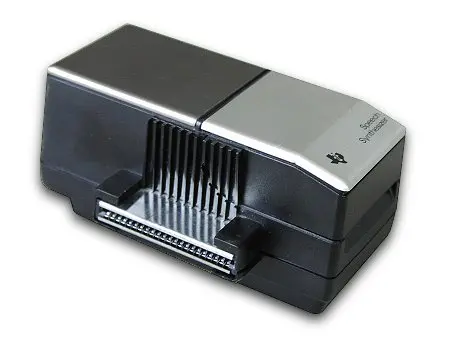
The little sidecar gave games and educational software a distinctive electronic voice.
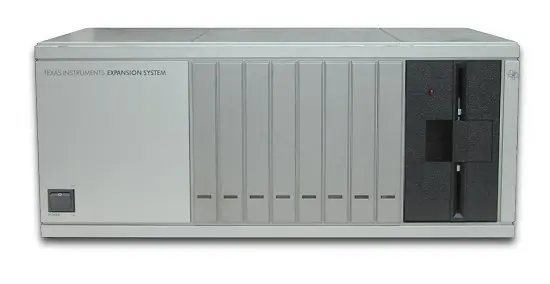
A heavy expansion chassis with room for cards, extra memory and a floppy drive.
06 / The price war
Millions sold, hundreds of millions lost
At its US introduction in 1981, the TI-99/4A cost $525. Two years later the same computer could sometimes be found for less than one hundred dollars.
Commodore aggressively cut the price of the VIC-20 and later the Commodore 64. Texas Instruments responded with discounts, rebates and ever lower retail prices. Sales rose sharply, but the 99/4A was comparatively expensive to manufacture. Every cheap machine deepened the financial wound.
Texas Instruments eventually sold about 2.8 million units, but announced its departure from the home computer market in October 1983. Production stopped in March 1984. For owners, the end was abrupt: a vast electronics company that had sought complete control over chips, computer and software unplugged the entire ecosystem.
07 / A short life, a long aftermath
The silver computer never disappeared
Its commercial life was brief, but user groups, new expansions and modern storage solutions kept the TI-99 family moving.
The TI-99/4
Texas Instruments introduces the predecessor, the first home computer built around the 16-bit TMS9900.
The improved 4A
A better keyboard, revised graphics and a lower price make the machine more attractive.
The battle for the living room
The price war with Commodore accelerates; computers become rapidly cheaper and accessible to many more families.
Texas Instruments pulls out
After enormous losses, TI announces that it will leave the home computer market.
Production ends
The last machines leave the factory, although remaining stock and software continue to circulate for years.
New hardware and software
Enthusiasts create memory expansions, storage interfaces, games and emulators for a platform TI itself abandoned long ago.
08 / Sources & further reading
Explore further
- Smithsonian — Texas Instruments Model 99/4A Microcomputer
- Texas Instruments — TI-99/4A User’s Reference Guide (1981)
- IEEE Spectrum — The Texas Instruments 99/4
- Thierry Nouspikel — The TI-99/4A internal architecture
Image credits
- TI-99/4A — Rama & Musée Bolo, CC BY-SA 2.0 FR; resized and converted to WebP
- TI Speech Synthesizer — Ron Reuter, CC BY-SA 3.0 DE; converted to WebP
- TI Peripheral Expansion System — Ron Reuter, CC BY-SA 3.0 DE; converted to WebP


