Classic 01 / 1982
Commodore 64:
the computer of a generation
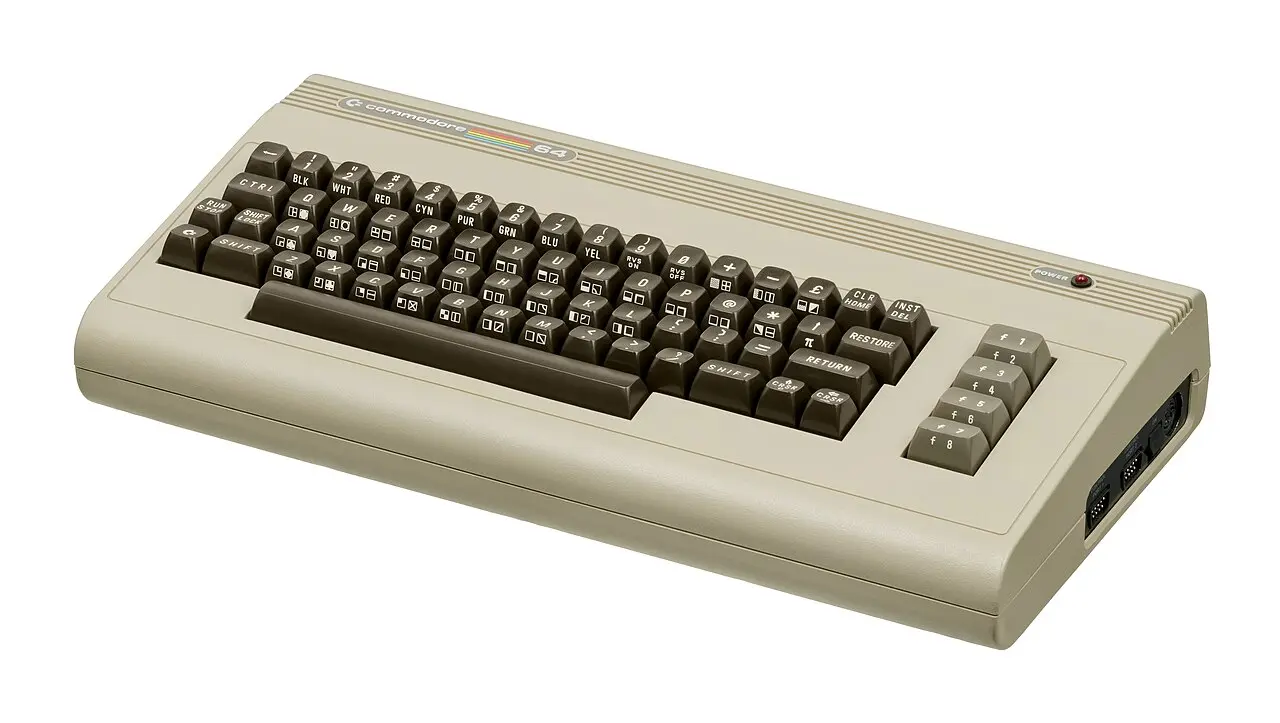
A beige keyboard with 64 kilobytes of memory became a games machine, musical instrument, programming lesson and gateway to an entire digital culture.
01 / The blue screen
Switch on and begin
Turn on a Commodore 64 and no menu appeared. A blinking cursor waited beneath the word READY. on a blue screen.
That sparse display was both reassuring and challenging. You could load a game, but you could also type a line of BASIC immediately. With PRINT, GOTO and RUN, the television became a place where you could make something yourself. Magazines and computer books printed programs for readers to enter line by line.
The built-in BASIC 2.0 was easy to reach, but it did not expose the machine’s graphics and music directly. Sprites and sound often required cryptic POKE commands. That detour taught curious owners how their computer’s memory really worked.
Beneath the message 38911 BASIC BYTES FREE lay much more than the modest text interface suggested. The C64 had been designed to be inexpensive, but its custom chips gave it a personality that many costlier computers lacked.
02 / The chips
Pictures and sound with their own signature
The MOS 6510 processor ran at roughly 1 MHz. It was the partnership with the VIC-II video chip and SID sound chip that made the C64 remarkable.
The VIC-II could display sixteen colours, scroll smoothly and move eight independent sprites around the screen. Programmers did not need the processor to redraw every moving character. Games gained larger figures, steadier motion and animation that was difficult to match on simpler machines.
The SID offered three voices, several waveforms, filters and ample room for experimentation. Composers including Rob Hubbard, Martin Galway and Jeroen Tel each developed a recognisable style. C64 music did not remain a cheap imitation of existing instruments; it became an electronic genre of its own.
03 / Waiting for software
Cassettes, disks and cartridges
Software arrived by three very different routes. Each had its own pace, sound and ritual.
The Datasette was inexpensive and particularly popular in Europe. After LOAD came the instruction PRESS PLAY ON TAPE. Then followed minutes of mechanical chatter, a rising counter and sometimes a colourful loading screen. Turboloaders shortened the wait, but the question remained: would the program start without an error this time?
The 1541 disk drive was faster and provided direct access to several files, although its standard transfer speed was notoriously slow and the unit itself was bulky. It was almost a computer in its own right, with a 6502 processor and memory of its own. Cartridges started instantly, but cost more and represented a smaller part of the software market.
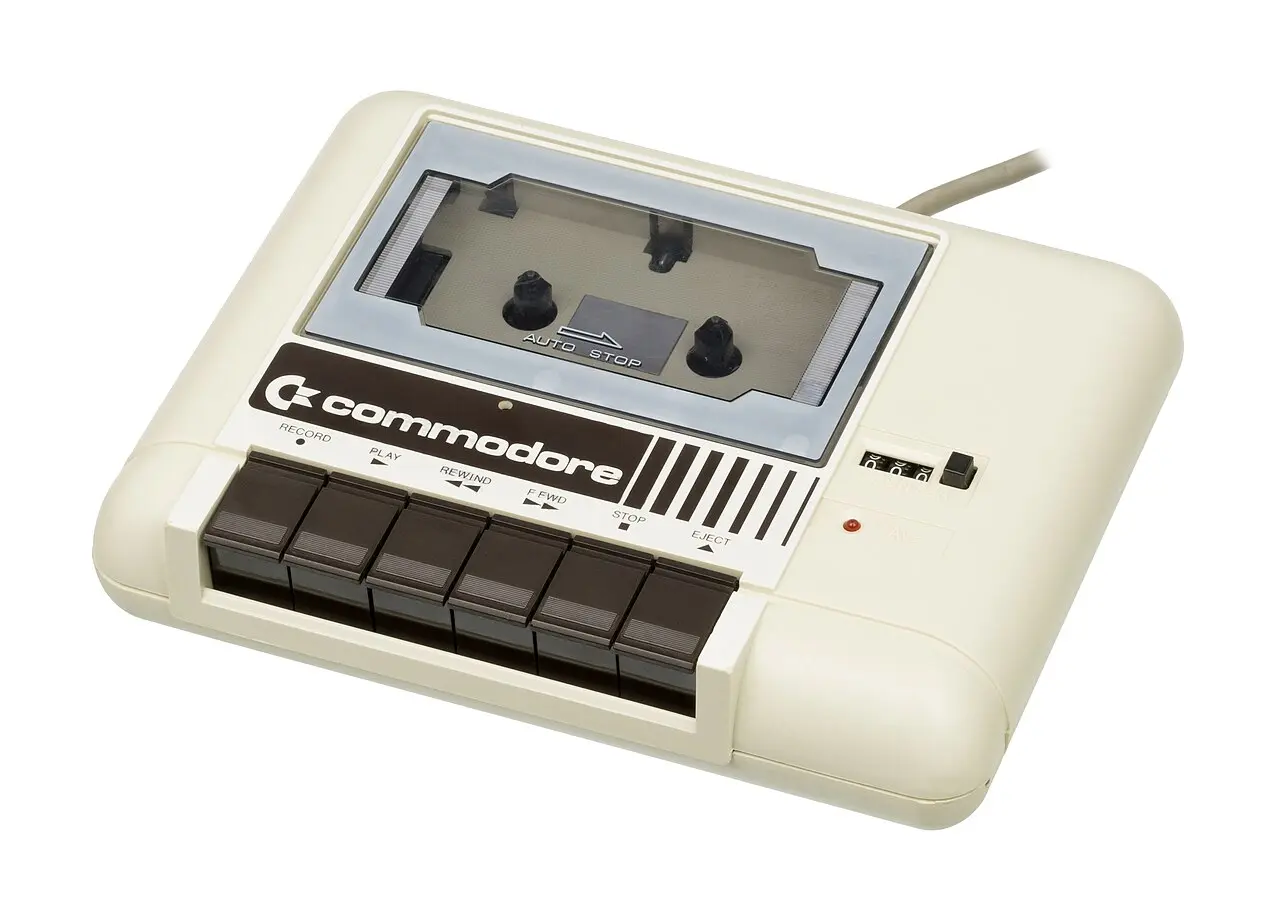
Programs on ordinary cassette tapes made software inexpensive and easy to exchange.
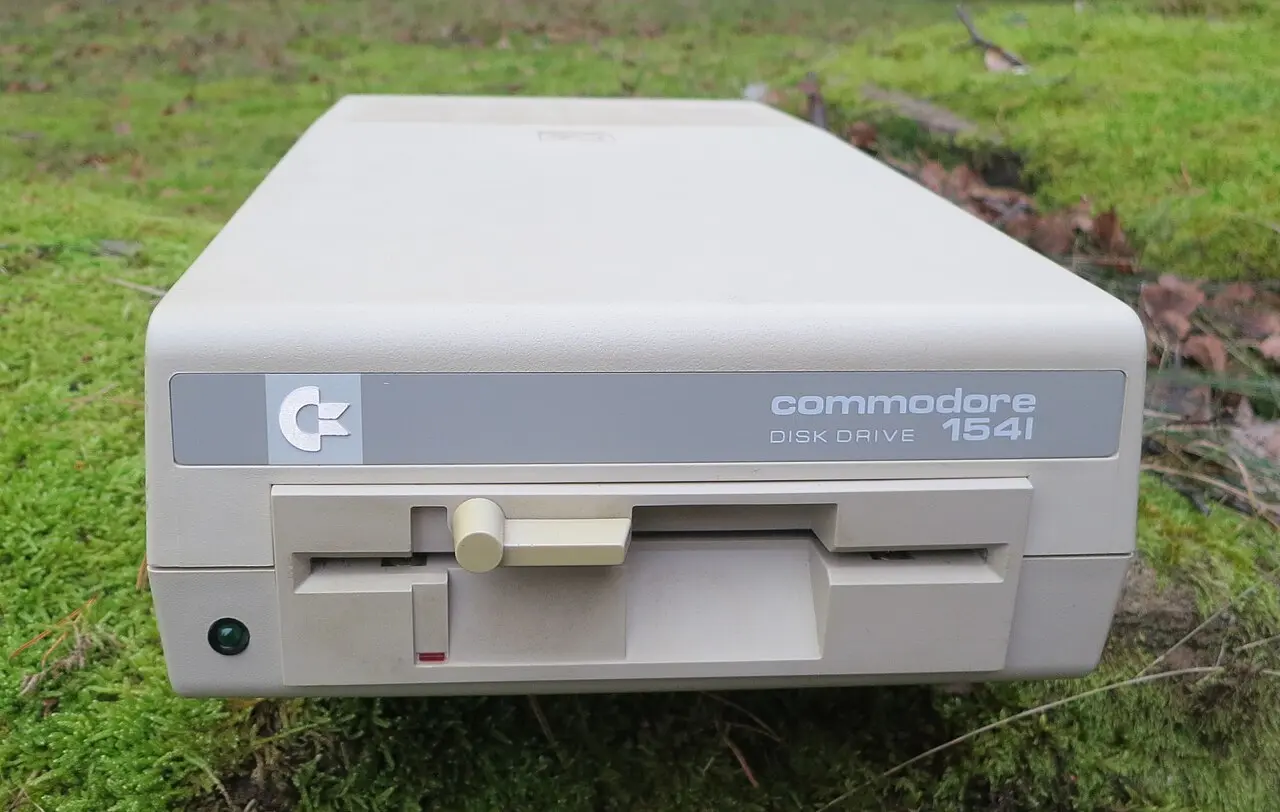
The familiar drive read single-sided 5¼-inch disks and contained its own processor.
04 / Beyond games
Playing, working and making
- 01
An inexhaustible games machine
From International Karate and The Last Ninja to Impossible Mission and Maniac Mansion, thousands of releases revealed a different side of the hardware.
- 02
A serious machine too
Word processors, databases, educational programs and the GEOS graphical environment showed that the C64 could do much more than read joystick movements.
- 03
A ticket to the demoscene
Crack intros grew into independent demonstrations of code, graphics and music. Groups kept pushing the hardware long after its retail life had ended.
05 / The mass market
The computer beside the toys
At its American introduction the C64 cost $595. Commodore then cut the price aggressively and placed the computer in ordinary retail chains.
Commodore held a decisive advantage: it owned chipmaker MOS Technology and could manufacture much of the electronics itself. Jack Tramiel liked to describe his strategy as computers “for the masses, not the classes”. The resulting price war put rivals under severe pressure while proving that a capable computer need not remain a luxury.
The C64 had an unusually long life in Europe. New cases, bundles and inexpensive software kept it selling well into the 16-bit era. Production totals and sales estimates vary between sources, but that debate does not alter the scale of its influence: for millions of people, this was their first computer.
06 / A long second life
The cursor is still blinking
The C64 left ordinary shops but never disappeared from use. New games, cartridges, music, demos and modern storage devices continue to sustain the machine.
The C64 arrives
Commodore introduces the machine with 64 KB of memory, VIC-II graphics and SID sound.
The price falls
Mass retail and fierce price cuts put the computer within reach of a very large audience.
The C64C
A flatter, lighter case gives the familiar hardware a style closer to the Commodore 128.
Games System
Commodore tries to sell the technology as a keyboard-free console. The C64GS is not a success.
Commodore closes
The bankruptcy of Commodore International ends the original product line.
An active community
Developers, musicians, collectors and emulator authors create new work and make the older catalogue easier to reach.
07 / Sources & further reading
Continue exploring
- Smithsonian — Commodore 64 Microcomputer
- Smithsonian — Commodore 64 User’s Guide
- Commodore 64 Programmer’s Reference Guide
- Computer History Museum — Timeline of Computer History
Image credits
- Commodore 64 — Evan-Amos, public domain
- Commodore Datasette — Evan-Amos, public domain
- Commodore 1541 — R. Henrik Nilsson, CC BY 4.0; resized and converted to WebP


