Classic 04 / 1981
Philips P2000T:
the teletext computer
Philips built its first home computer from familiar television and dictation technology. The result was unconventional, robust and unmistakably Dutch in the way it was used.
01 / Philips enters the home
A computer made from technology Philips already knew
When the P2000T appeared in 1981, Philips did not need to begin from scratch. The company knew everything about televisions, teletext and compact tape recorders—the very technologies that gave the new computer its character.
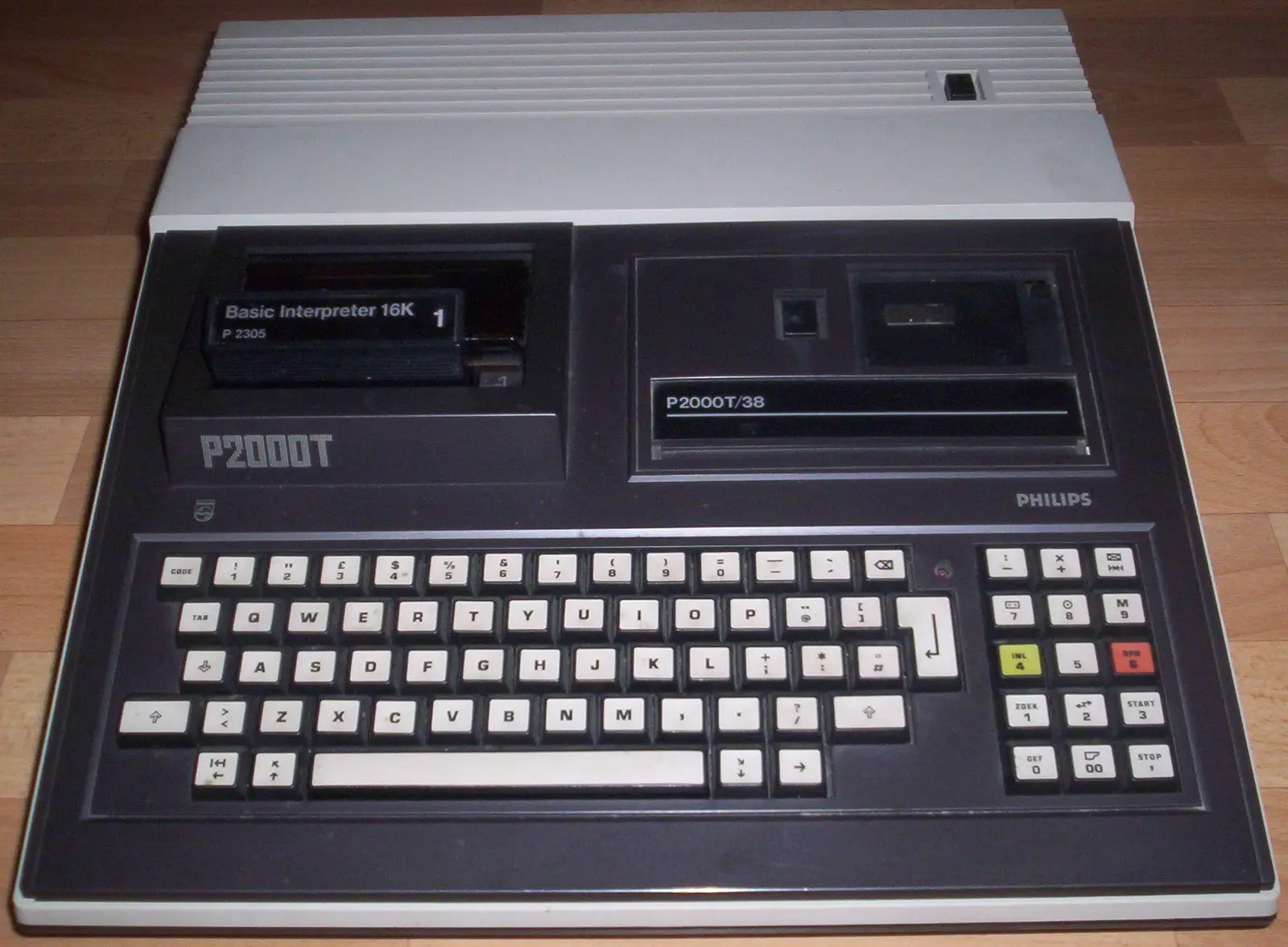
The T stood for television. The computer needed no dedicated monitor and connected to a TV through the aerial socket or a sharper RGB signal. Its wide case contained the power supply, a full keyboard with numeric pad, two cartridge slots and even the data recorder.
That set it apart from many contemporaries. A Commodore VIC-20 or TRS-80 often came with a separate cassette recorder and a tangle of cables. The P2000T felt more like a complete domestic appliance: solid, orderly and ready to use.
A Zilog Z80 ran at 2.5 MHz inside, with models offering 16, 32 or 80 KB of RAM. None of this was revolutionary by itself, but the combination was remarkably coherent—as if Philips had brought a television, dictation machine and microcomputer together in one object.
02 / A screen like page 100
Teletext became a computer display
Philips used the SAA5050 character generator from the world of teletext. It put sharp, colourful text on an ordinary television.
The computer displayed 40 characters on 24 lines, with eight colours and the familiar mosaic blocks used to build simple teletext illustrations. It was an excellent solution for menus, teaching programs, administration and the Dutch Viditel service. Text remained legible while colour could instantly distinguish headings, fields and warnings.
That same choice also set the limit. The P2000T could not freely address individual pixels and had no true high-resolution mode. Developers drew their worlds with block characters. A spaceship, maze or game figure therefore consisted of coarse forms that strongly resembled a teletext page.
PHILIPS HOME COMPUTER
Z80 2.5 MHZ 40 X 24 CHARACTERS
MINI-CASSETTE READY
▮ BASIC INTERPRETER
03 / The cassette with a memory
No separate recorder and no tape counter
A Philips Mini-Cassette recorder sat at the top right of the case. A tape held about 42 KB, while the computer controlled searching, starting, stopping and rewinding itself.
This was very different from the ordinary audio cassettes used by many home computers. There, the user found a program by counter or by ear and pressed Play at the right moment. The P2000T maintained a directory and could approach files much more deliberately. Saving therefore felt more like using a slow disk drive than a music cassette.
The technology came from Philips dictation machines and was faster than conventional cassette storage, while floppy drives remained expensive. The Mini-Cassette was not a makeshift compromise but one of the machine’s strongest design decisions. Its drawback was equally clear: the tapes and mechanism were less universal than standard audio cassettes.
04 / Insert a cartridge first
BASIC was not automatically inside
- 01
Basic Interpreter 16K
The best-known cartridge contained Microsoft BASIC. Once inserted, users could write programs, save them and load them from Mini-Cassette.
- 02
Two different slots
One connector was intended for program ROMs, the other for expansions and data. The cartridge system made the computer modular, but also tied it to Philips’ proprietary format.
- 03
A serious programming machine
With BASIC, Z80 assembly and later a range of tools, enthusiasts created games, educational software, administration and highly specialised applications.
05 / Schools, Viditel and user groups
The community made the computer bigger
Its sturdy case, legible display and built-in storage made the P2000T attractive to education. It also presented a persuasive alternative to a dedicated Viditel terminal.
Viditel was a Dutch videotex service that delivered information over a telephone line to a television. A dedicated terminal cost around 1,000 guilders; according to the HomeComputerMuseum, roughly 200 guilders more bought a fully programmable P2000T. Its teletext-like display fitted that new information world naturally.
Even more important was what users built themselves. Philips’ Nat.Lab formed the Thuis Computer Club, later P2C2. Other groups included GPC and the HCC’s P2000 user group, which approached one thousand members. They shared knowledge, reviewed each other’s programs and copied software at meetings.
Some programs even travelled over the air. The Dutch radio programme Hobbyscoop broadcast computer code as sound; listeners recorded the squealing data and loaded it at home. For a moment, radio became a software distribution network.
06 / Playing with mosaic blocks
No sprite powerhouse, but plenty of ingenuity
The P2000T could not compete with the fluid sprites of an Atari 800 or Commodore 64. Even so, it acquired a software library of its own.
Programmers treated teletext blocks like large pixels. Preserved titles including Brick-Wall, Doolhof, Fraxxon, Ghosthunt and Lazy Bug translated familiar game ideas to the machine’s abilities. Its constraints gave them an immediately recognisable style.
The software catalogue extended far beyond games. Clubs distributed programs for education, book indexes, administration, embroidery patterns and even faxing. The P2000T was at its best wherever text, forms and clear operation mattered more than fast graphics.
07 / T, M and C
A small family with different ambitions
The P2000T was the television model. The P2000M, with its own 80-column monochrome display and floppy connection, was aimed more explicitly at professional users.
The portable P2000C followed later: a substantial all-in-one machine with built-in display and floppy drives. Technically further removed from the original T, it could run CP/M. P2000 thus became a family name for systems serving different audiences.
Philips ultimately chose another route in the home market. From 1984 it sold MSX computers including the VG8000 and VG8020. That international standard offered better graphics and a much larger software ecosystem. The idiosyncratic P2000T therefore received no direct successor.
08 / A Dutch chapter
From teletext chip to living digital heritage
The P2000T did not become an international mass-market machine, but its design and community give it a unique place in Dutch computer history.
The P2000T appears
Philips launches its first home computer with a Z80, colour teletext display and built-in Mini-Cassette.
The professional P2000M
A related model offers an 80-column monochrome display and a floppy-disk connection.
Clubs and classrooms
Education, Viditel and active user groups give the machine a remarkable Dutch software culture.
Philips chooses MSX
The VG8000 and later MSX models connect Philips to an international computer standard.
Preserved and emulated
Volunteers digitise cartridges, Mini-Cassettes, documents and games; modern emulators keep them usable.
09 / Sources & further reading
Explore further
- HomeComputerMuseum — Philips P2000T
- Philips — original P2000 product brochure
- P2000T Software Preservation — cartridges, tapes and disks
- P2000T Documentation Preservation
- Libretro — M2000 emulator
Image credits
- Philips P2000T — Superandi73, CC BY-SA 3.0 DE; resized and converted to WebP
