Classic 05 / 1984
Sony HitBit HB-101:
the red designer computer
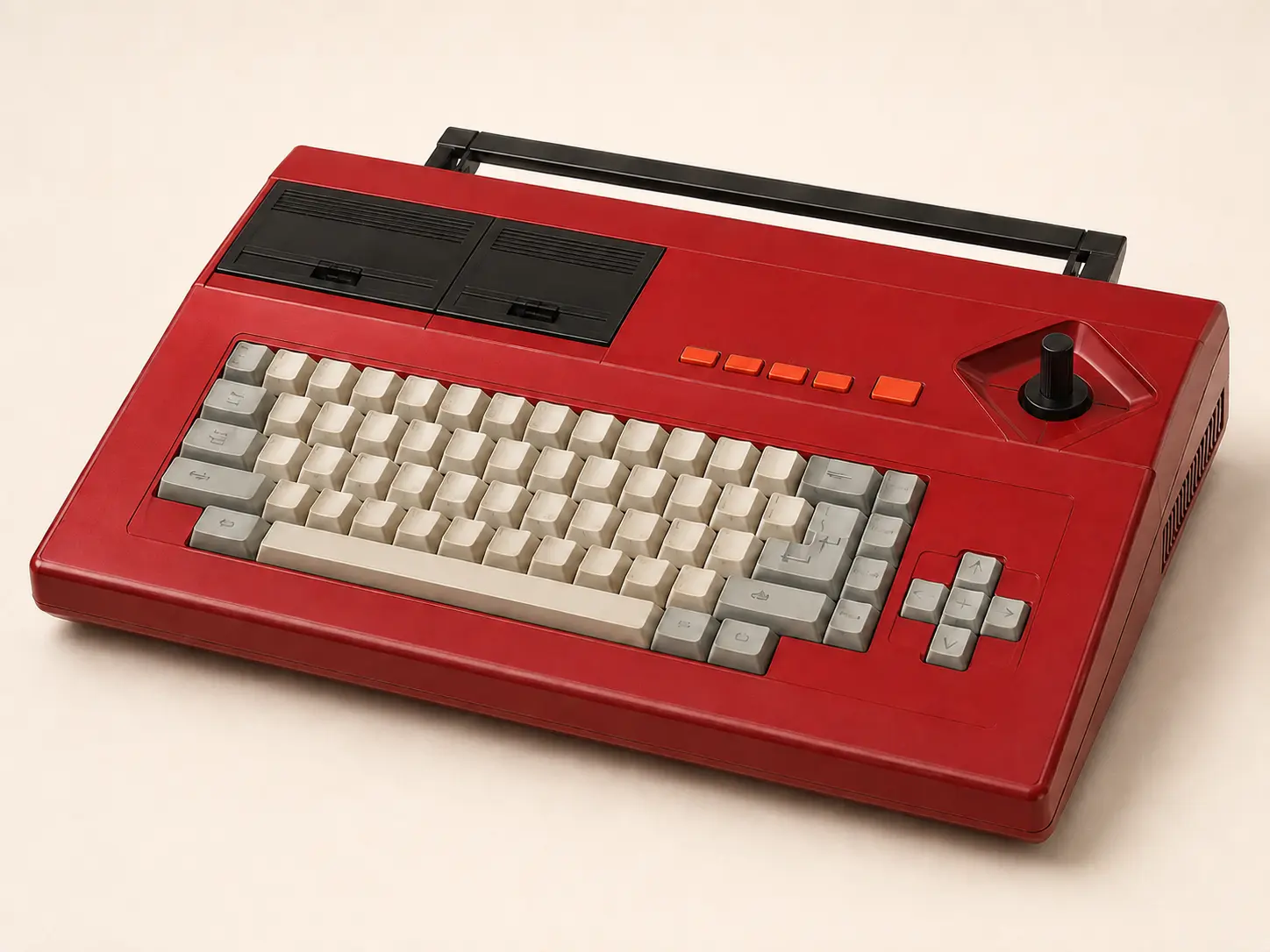
While most home computers were beige, grey or black, Sony turned its Japanese MSX into a glossy red consumer product—complete with carrying handle, miniature joystick and personal databank.
01 / Designed to be seen
A computer as an appealing domestic appliance
Sony called the HB-101 the HitBit Mezzo. According to its design archive, it was deliberately intended to depart from the businesslike styling of many computers. It came in red, black and ivory white.
The glossy red version made the strongest impression. Its broad, low case has bevelled corners, dark cartridge-slot covers and a pale keyboard set deep into the body. Orange function buttons and a joystick in a diamond-shaped recess make it almost playful.
The design reveals Sony’s experience in selling electronics as lifestyle products. A computer did not need to look like a shrunken office machine. It could sit beside a television, Walkman or stereo and say something about its owner’s taste.
The red HB-101 was sold in Japan. Europe’s HB-101P generally received a black or charcoal case and more memory. The model that took the greatest visual risk therefore remained mainly domestic—but later became internationally admired as one of the most photographed MSX designs.
02 / One standard, many faces
MSX gave Sony a technical foundation
The HB-101 was not a closed Sony platform. Its MSX badge promised that software and expansions could also work on computers from Philips, Panasonic, Canon, Toshiba, Yamaha and others.
The first MSX generation combined a Z80A processor running at around 3.58 MHz with a Texas Instruments video processor, 16 KB of video memory and an AY-3-8910 sound chip. Software makers therefore knew which display, sound and cartridge functions were available.
For buyers this offered a new kind of reassurance. A Konami cartridge that ran on a Sony could be placed in a suitable Philips. A standard cassette recorder, joystick or printer did not need to carry the same brand either. Manufacturers competed through design, memory, built-in software and accessories while the core remained familiar.
03 / Three clever details
A computer that could travel
- 01
Fold-out carrying handle
A handle at the rear made the compact computer easy to move. Sony treated it as personal electronics rather than a permanent piece of furniture.
- 02
Curstick in the keyboard
A small stick could be placed between the cursor keys, turning the direction pad into a built-in miniature joystick for simple games.
- 03
A real pause button
A dedicated key temporarily halted the processor. Even a cartridge game without its own pause function could be interrupted.
04 / More than a BASIC prompt
The personal databank was already built in
Starting the HB-101 without a game cartridge revealed more than MSX-BASIC. Sony also placed a Personal Data Bank in ROM.
The databank offered functions for addresses, appointments and short notes. That sounds simple today, but in 1984 it immediately demonstrated that a home computer could be more than a programming course or games machine. No program needed to be loaded from tape first.
Data could be stored on ordinary audio cassette, Sony’s HBI-55 data cartridge or an external microfloppy drive. A compact four-colour plotter-printer also fitted into the ecosystem. Sony was selling not merely a keyboard computer, but a coordinated family of personal electronics.
MSX-BASIC remained central for programming. Commands for colour, sprites, sound and joysticks made the hardware accessible without first learning machine code. A magazine listing could also be typed into many other MSX computers.
05 / Cartridges for the world
The software did not come only from Sony
Two cartridge slots gave the HitBit access to the broad MSX library. Games started instantly and carried their program in ROM, making the small working memory less troublesome.
Japanese publishers including Konami, Namco, Hudson Soft and Compile made MSX an important games platform. Titles such as Gradius, King’s Valley, Penguin Adventure and The Maze of Galious connected computers from dozens of manufacturers to the same gaming culture.
Cartridges could contain hardware too: extra memory, a disk controller or additional sound chips. That was a central strength of MSX. The computer on the desk was merely the starting point; the standard determined how many directions the system could take afterwards.
06 / The P for Europe
The HB-101P exchanged red for black
Europe’s 1984 HB-101P kept the shape, carrying handle, Curstick and personal software, but added an international QWERTY layout, PAL video and 32 KB of RAM.
The suffix in Sony’s model numbers indicated a market or keyboard layout. Separate versions also existed for Germany, France and Spain. The exported HB-101 was usually sold in black or charcoal: the same functional design idea, but a visually more cautious product.
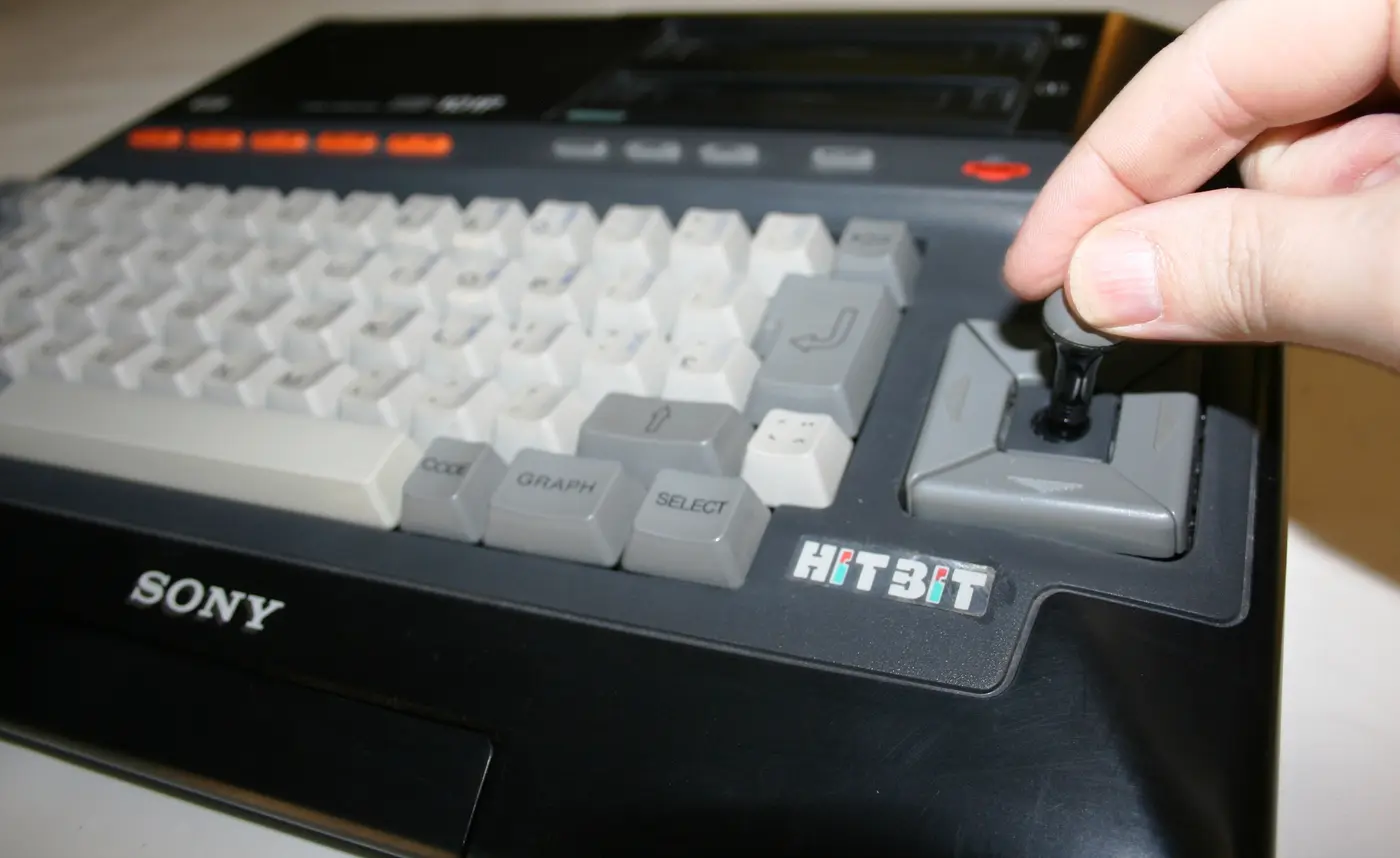
A small stick turned the cursor keys into a compact joystick; the conspicuous orange pause button sat nearby.
07 / From Mezzo to MSX2
HitBit became a complete product family
Sony used the HitBit name for a range of MSX computers and accessories. Within it, the HB-101 was primarily the compact, portable design model.
The related HB-201 offered 64 KB of RAM. Other machines received built-in data cassette drives, more extensive personal software, floppy drives or later the improved graphical abilities of MSX2. Sony repeatedly gave the standard platform a character of its own.
The HB-101 was not the most powerful HitBit and its modest memory restricted larger BASIC programs. Its legacy therefore lies less in performance than in product design. It demonstrates that compatibility need not produce uniformity: beneath the same MSX bonnet, radically different personalities could emerge.
08 / A red thread
From new standard to design classic
The HitBit arrived when Japanese electronics brands were attempting to make computers as approachable and desirable as their audio and video products.
MSX is announced
Microsoft Japan and ASCII unite multiple manufacturers around one technical standard.
The red HB-101
Sony launches the HitBit Mezzo in Japan in red, black and ivory white.
The HB-101P
Europe receives a PAL model with 32 KB of RAM and usually a black case.
MSX2
A new generation brings higher resolutions, more colours and generally more memory.
A collector’s piece
The red Japanese model in particular is admired as one of the most distinctive 8-bit designs.
09 / Sources & further reading
Explore further
- Sony Design Gallery — HB-101 HitBit Mezzo
- Generation MSX — Japanese Sony HB-101
- Sony — HB-101P/201P Service Manual
- Generation MSX — Sony HB-101P
- Francisco Charte — Microordenadores MSX
- Francisco Charte — Historia de la microinformática
Image credits
- Red Sony HitBit HB-101 — original editorial AI illustration for Silicon & Joysticks; not a product photograph
- HB-101P Curstick — Francisco Charte, CC BY 2.5; resized and converted to WebP