Classic 06 / 1979
Atari 800:
arcade hardware with a keyboard
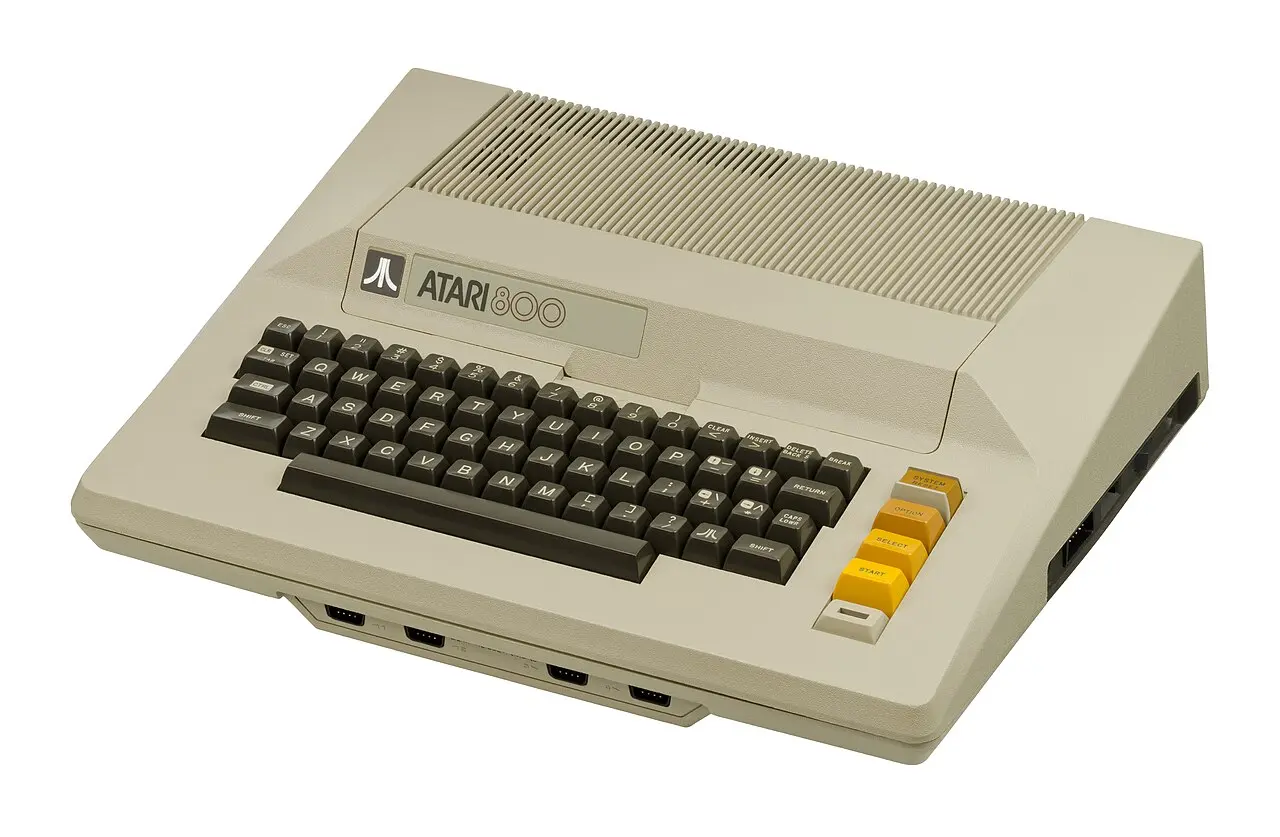
Atari did not build an ordinary 8-bit computer. The 800 had custom chips for graphics and sound, four joystick ports, intelligent peripherals and an almost excessively sturdy case—as if an arcade machine had learned to type.
01 / After the game console
The VCS successor acquired a keyboard
Soon after introducing the Atari VCS, Atari began work on more powerful hardware. It had to handle the next generation of games, but the fast-growing personal-computer market changed the plan.
At the end of 1978, Atari showed two new machines in New York. The Atari 400 became the affordable family model with a wipe-clean membrane keyboard; the Atari 800 was the full version, with real keys, expandable memory and room for two cartridges.
The numbers originally referred to intended price classes, not technical specifications. The 800 was clearly the luxury model. With a monitor output, a sturdy typewriter-style keyboard and a whole family of peripherals, it aimed to be both game machine and serious home computer.
That dual identity shaped everything. Atari understood moving images and immediate controls better than almost anyone, but also had to provide BASIC, word processing, storage and expansion. The 800 was therefore not a console with a keyboard added later, but a computer designed around audiovisual tasks from the outset.
02 / Built like a tank
Modular, heavy and almost overprotected
Pick up an Atari 800 and it is immediately clear how different it is from the lightweight keyboard computers that followed. Beneath the cream plastic sits an imposing metal shield.
American radio-interference rules were strict, especially for equipment connected to an ordinary television. Atari therefore shielded the electronics thoroughly. The result was heavy and expensive, but remarkably solid. The wide case, brown keys and ribbed cartridge door make the machine look like professional laboratory equipment.
Beneath the large door above the keyboard were separate memory cards and two cartridge slots. The left slot held ordinary software; the right was intended for the much rarer supplementary cartridges. By putting RAM on plug-in cards, an early 8 KB machine could grow to 48 KB without replacing the whole computer.
03 / The secret team
Three chips gave Atari its character
- 01
ANTIC
This display processor read a “display list” and could change graphics mode from one group of scanlines to the next. Text, colours and bitmaps could therefore share one screen.
- 02
CTIA and GTIA
The colour and graphics chip turned ANTIC's data into a television image and added Player/Missile Graphics: independently moving objects we would now call sprites.
- 03
POKEY
Four sound channels, but also timers, keyboard scanning, serial communication and analogue paddles. POKEY was both instrument and traffic controller.
04 / The screen as playing field
Display lists made the picture programmable
Many contemporaries treated a screen as one fixed grid. The Atari could alter its construction as it went. ANTIC executed a small program describing how each group of scanlines should appear.
A developer could place text at the top, a colourful playing field below it and a status bar in another resolution at the bottom. Screen memory could scroll without redrawing every pixel. Display-list interrupts could even change colours or positions at precise moments while a frame was being built.
Player/Missile Graphics placed moving objects over that background. Four “players” and four narrower “missiles” had their own horizontal positions. Collision registers told software when objects touched. It was not free magic—programmers had to understand the hardware—but it enabled fluid action that would otherwise have demanded much more from a roughly 1.8 MHz 6502.
The machine was socially unusual too. Four joystick ports sat right on the front. Games such as M.U.L.E. could gather several players around one television without a splitter or extra interface.
05 / The system seller
Star Raiders explained why the 800 existed
Specifications struggled to show what Atari's chips did together. Doug Neubauer's Star Raiders could: the cartridge transformed the computer into a spacecraft cockpit.
Players switched between a galactic map and a fast-moving three-dimensional view, managed energy and damage, and jumped to new sectors. The keyboard became part of the fiction; the joystick flew the ship. The game consequently felt like arcade action and computer simulation at once.
A library followed in which the hardware was used in continually different ways. Eastern Front (1941) made strategy visually legible, Archon turned a chess-like board into an action game, and Ballblazer and Rescue on Fractalus! showed how long the architecture could keep surprising players.
The same computer ran Atari BASIC, word processors, drawing packages and educational software. BASIC came on cartridge with the 800. Many users began with programs from books and magazines, changed a colour or sound value, and discovered that the game machine was also a machine for making things.
06 / One cable, a whole chain
SIO made peripherals surprisingly simple
The back of the Atari 800 did not present users with a collection of awkward card connectors, but one Serial Input/Output socket. Devices could be daisy-chained.
The Atari 410 Program Recorder stored programs affordably on cassette. The 810 Disk Drive gave much faster access and about 88 KB per disk side. Printers, modems and the 850 Interface Module could join the same chain. Each device contained electronics to recognise and pass on commands.
That made expansion straightforward for home users: switch off the computer, connect the cable, choose a device number and continue. The connector was entirely proprietary to Atari, but the idea of automatically recognised, “intelligent” peripherals anticipated the ease of use later generations would take for granted.
07 / An architecture with a long life
The 800 disappeared; its ideas remained
The complex case made the original 800 expensive to build. In 1983 Atari moved the same fundamental architecture into the slimmer and cheaper 800XL.
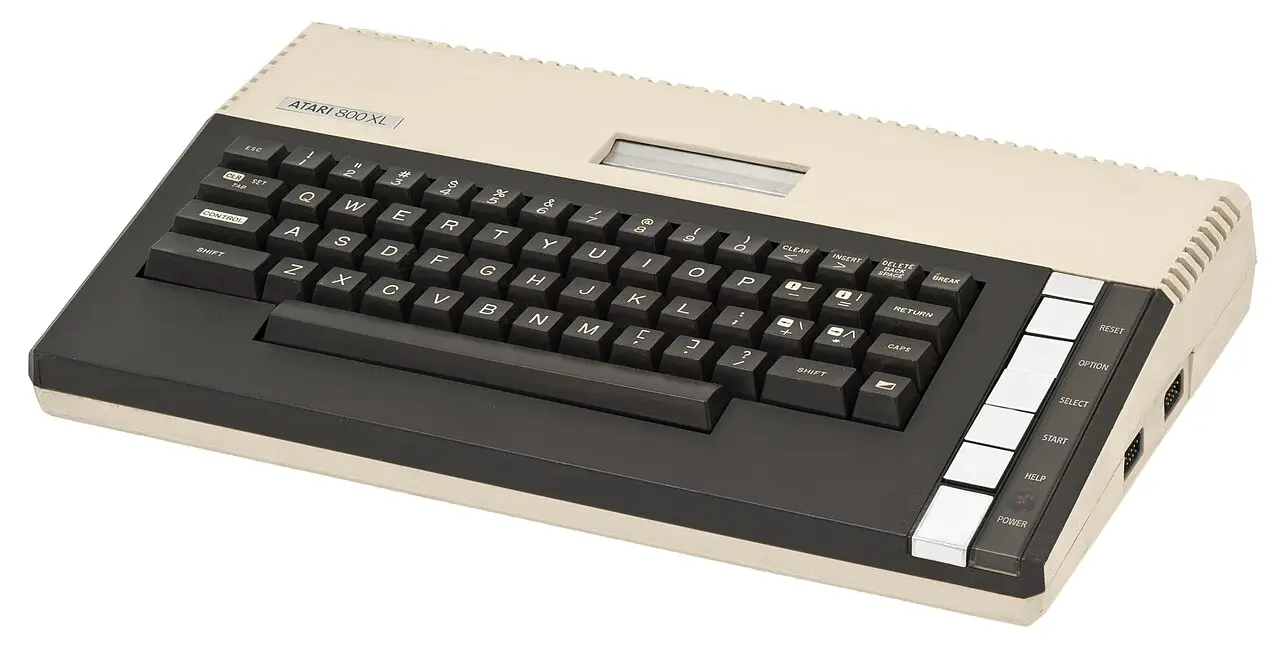
64 KB of RAM, built-in BASIC and a much more compact case made this the best-known successor to the 800.
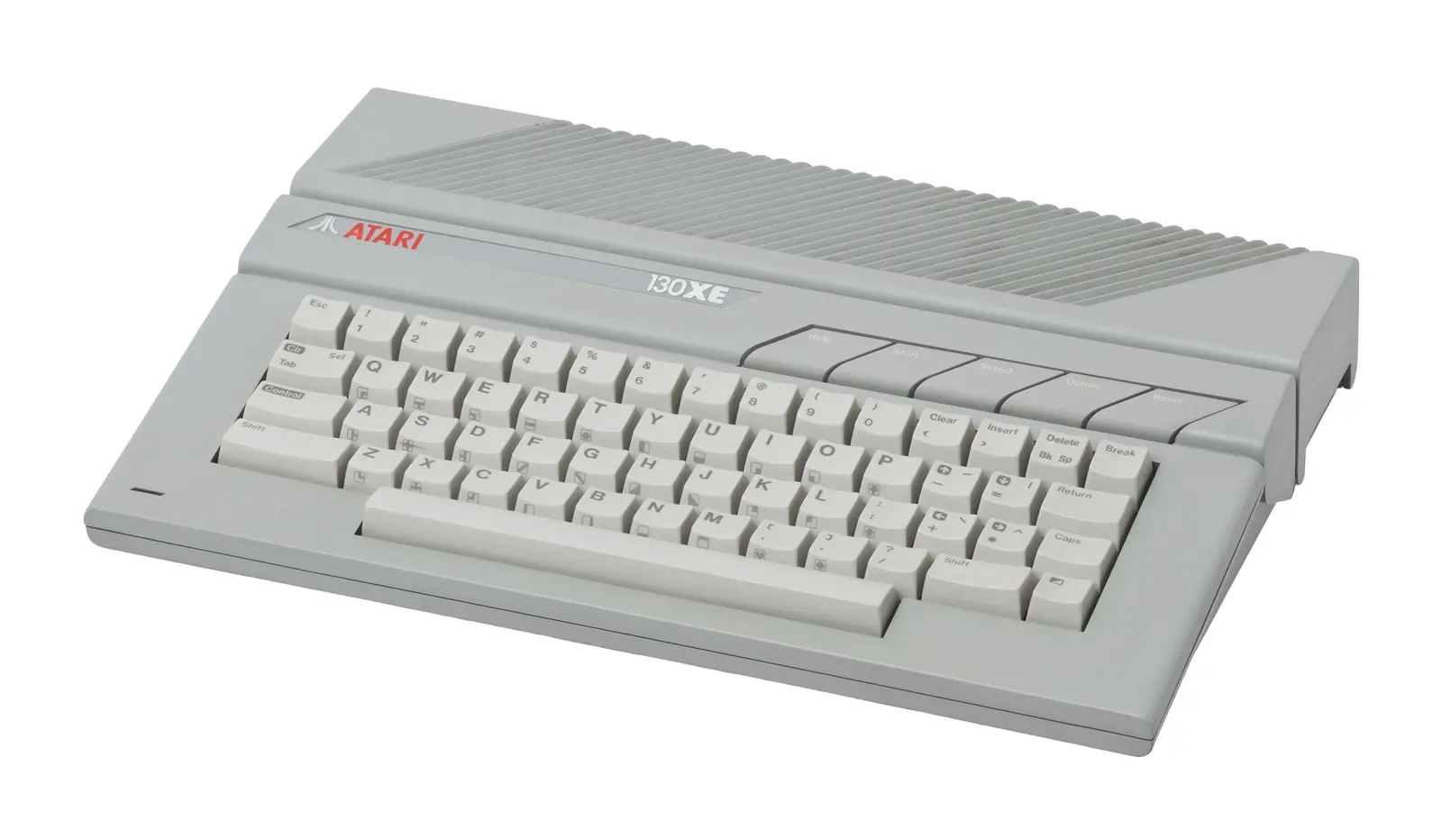
The XE range gave the familiar 8-bit architecture an ST-like appearance; the 130XE doubled memory to 128 KB.
The XL and XE models retained ANTIC, GTIA, POKEY, SIO and a large degree of software compatibility. The case and connections changed, and some older programs needed adjustments, but the 1979 machine remained recognisable beneath the plastic.
Even the 1987 Atari XEGS was essentially a member of the same family. That longevity is the 800's strongest legacy. Its specialist chips were not merely a trick for one generation of games; they formed a programmable platform for almost a decade.
08 / The 8-bit line
From luxury computer to game console
The original 800 established the technical grammar Atari would continue to use well into the 1980s.
Atari shows the 400 and 800
The two computers are presented to the press in December.
The Atari 800 arrives
The luxury model comes with a real keyboard, modular memory and two cartridge slots.
Star Raiders
The space simulation becomes the most convincing demonstration of Atari's custom chips.
Atari 800XL
A more compact successor combines 64 KB of RAM with built-in BASIC.
Atari 130XE
The 8-bit family gains 128 KB of RAM and styling that echoes the Atari ST.
Atari XEGS
The same architecture returns as a console with a detachable keyboard.
09 / Sources & further reading
Explore further
- Atari — 800 Operator's Manual, first version (1979)
- Atari — 800 Owner's Guide
- Computer History Museum — Atari manuals and documentation
- Michael Current — Atari introduces the 400 and 800
- Ctrl-Alt-Rees — Exploring the Atari 800
- Game Developer — The history of Star Raiders
Image credits
- Atari 800 — Evan-Amos, public domain; cropped and converted to WebP
- Atari 800XL — Evan-Amos, CC BY-SA 3.0; resized and converted to WebP
- Atari 130XE — Evan-Amos, CC BY-SA 3.0; resized and converted to WebP


