Classic 07 / 1977
Commodore PET 2001:
a computer in one piece
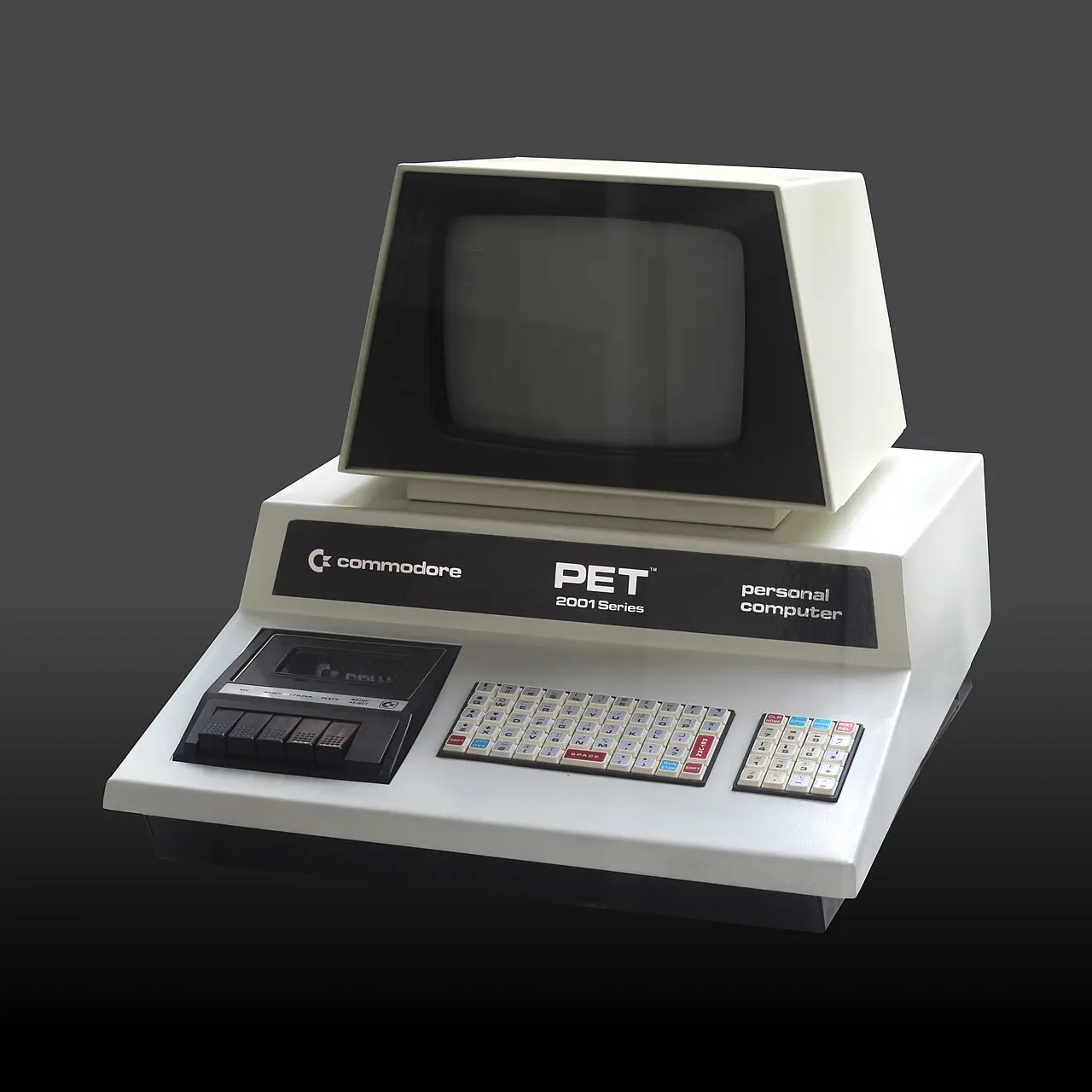
No kit, separate terminal or television for a display. The PET brought computer, monitor, keyboard and cassette together in one metal case—a complete machine ready to be programmed.
01 / From calculator to computer
Commodore had to start again
In the mid-1970s, Commodore earned much of its money from typewriters and calculators. When chip makers began selling complete calculators themselves, that market suddenly became dangerous. An acquisition offered Commodore an unexpected way out.
Commodore bought MOS Technology in 1976. It gained not only a semiconductor plant, but also the low-cost 6502 processor and engineer Chuck Peddle. He saw that a microprocessor would acquire real meaning inside an affordable, usable computer.
Jack Tramiel gave the team little time. A working system had to be ready for the Consumer Electronics Show in January 1977. Peddle and his colleagues therefore designed not a collection of loose components, but a machine people could understand at a glance.
The PET 2001 appeared in the same year as the Apple II and TRS-80. The three are often grouped together as the turning point at which personal computers left the hobby workshop. Of that trio, the PET made the strongest case for integration: plug in, switch on and begin.
02 / A machine from the future
The steel case told the story
The first PET resembles a cross between a terminal, laboratory instrument and futuristic typewriter. Its appearance made clear that this was no longer an experimental circuit board.
The electronics sat beneath a heavy, wedge-shaped sheet-steel work surface. Above it stood the nine-inch monochrome monitor in a matching housing. A small keyboard and built-in Datasette shared the front control panel. There was no need for a separate television, cassette recorder or power supply.
The case opened like the bonnet of a car. This kept the single large circuit board accessible for servicing while leaving the computer enclosed and orderly in daily use. It was a clever mixture of office equipment and microcomputer: robust enough for a classroom, yet approachable enough for the home.
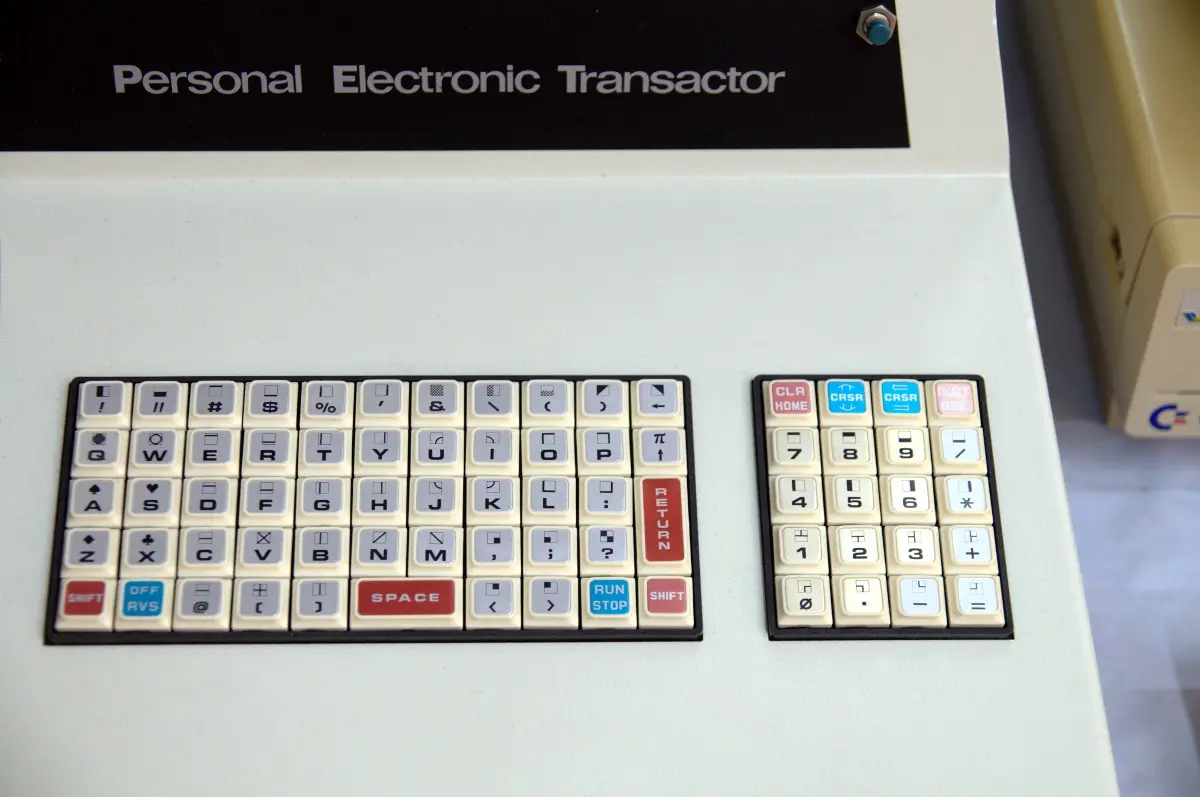
The Datasette occupied much of the work surface. Very little room remained for the keyboard.
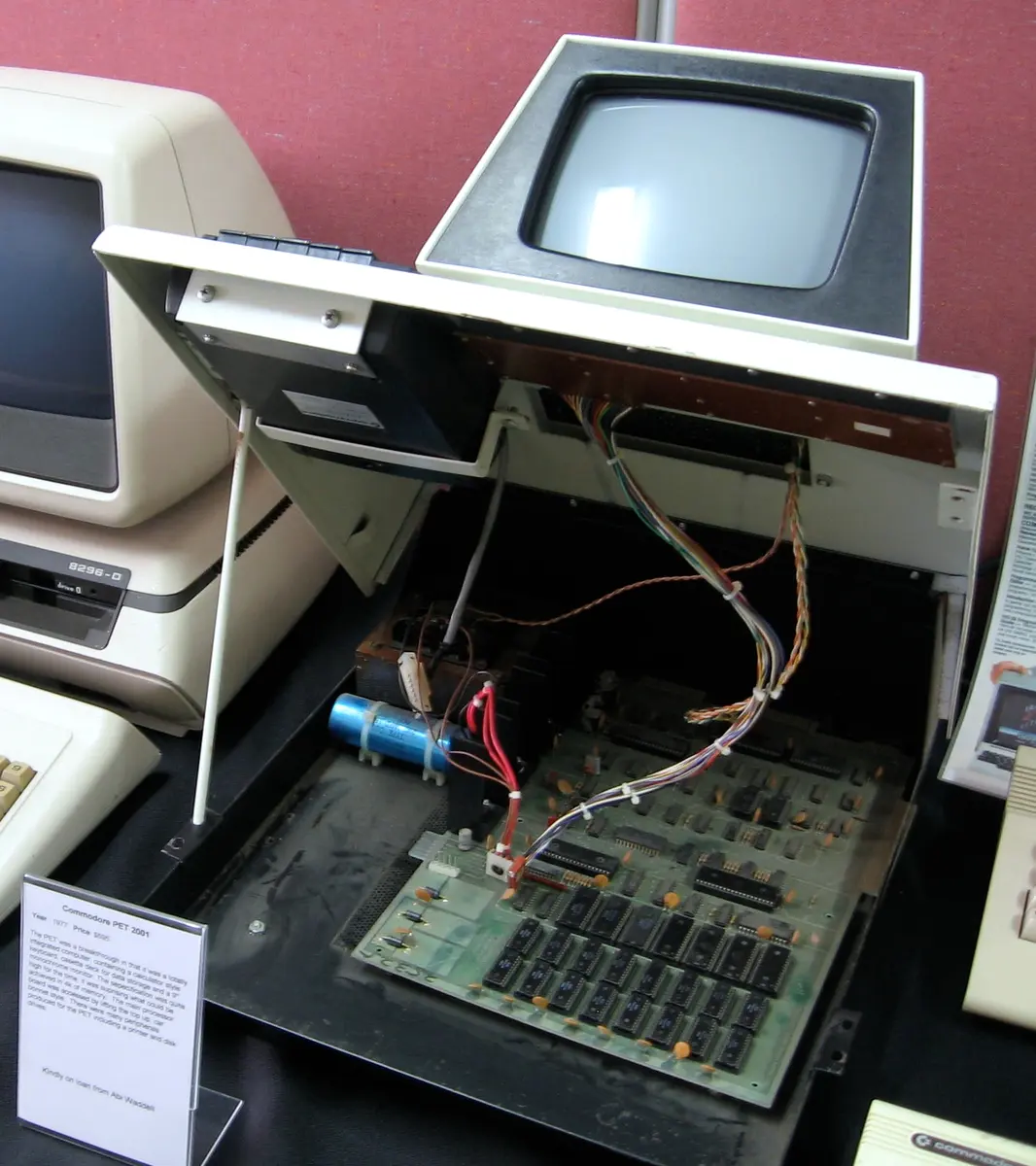
The upper section could be raised to reach the circuit board. A metal stay held the heavy case open.
03 / The keyboard compromise
Small keys, enormous personality
The chiclet keyboard is the first PET's most recognisable—and least practical—feature. Its small, flat keys seemed more at home on a calculator than a typewriter.
The built-in cassette recorder forced the designers to shrink the main keyboard dramatically. A prominent numeric pad received generous space instead, reflecting Commodore's calculator background and its hope that the PET would be used for administration.
The layout was adequate for short BASIC statements, but tiring for long documents. Commodore solved this on the PET 2001-N with a full-sized keyboard. The cassette recorder left the case and became an external device. The PET lost some visual charm, but became a much better work computer.
04 / Ready at power-on
Three permanent layers made the PET immediately useful
- 01
Commodore BASIC
The programming language lived in ROM. A prompt appeared as soon as the computer was switched on; there was no separate operating system to load.
- 02
Screen editor
The cursor could move across existing lines. Users corrected a command directly on screen and submitted the edited line again.
- 03
PETSCII
Graphic characters, lines, playing-card symbols and blocks allowed simple pictures and game scenes without true bitmap graphics.
05 / Forty by twenty-five
A text screen that still produced worlds
The PET had no colour, sprites or freely addressable display like the Apple II. It showed forty characters on twenty-five lines. Even so, the screen was far more than a digital typewriter.
The special characters could occupy ordinary text cells and appear mirrored or reversed. Programmers built mazes, playing cards, spacecraft and diagrams from them. The visual language later became known as PETSCII and travelled onwards to the VIC-20 and Commodore 64.
Screen memory was directly accessible. A short BASIC line could place a character at a particular position. This encouraged experiment: users immediately saw the effect of a number, loop or POKE command.
06 / Programs stored as sound
The Datasette made storage affordable
An ordinary compact cassette was cheap and familiar. The Datasette converted digital data into audio signals and wrote them to tape.
Loading and saving took time, but the integrated recorder made the process clear. The PET told users when to press PLAY. A mechanical counter helped them find a program on a tape holding several files.
Disk storage soon became more attractive to schools and businesses. Through its professional IEEE-488 interface, the PET could control Commodore disk drives and printers and connect several devices in a chain. This cost much more than cassettes, but turned the compact computer into the centre of a serious workstation.
07 / From living room to classroom and office
The PET found its strongest home beyond the home
The first PET welcomed hobbyists, but its successors proved especially well suited to schools, universities, laboratories and small businesses.
A teacher did not have to assemble separate monitors and recorders. The steel case tolerated intensive use, and BASIC made programming visible and immediate. In Canada and parts of Europe, the PET therefore became the first computer many pupils were actually allowed to touch.
The same strengths helped in offices. With a better keyboard, more memory, disk drives and printers, later models could handle accounts, stock control and word processing. In Europe they often appeared under the CBM name because the PET name was not available everywhere.
Games were never the only purpose, but they were present. Text adventures, strategy titles and brisk arcade clones used PETSCII characters as building blocks. The limitations made the software distinctive: worlds consisted of letters, blocks and symbols cleverly set in motion.
08 / The PET family
From striking object to business range
The original 2001 established the form. Later models made the concept more practical, larger and more professional.
Commodore buys MOS Technology
The 6502 processor and Chuck Peddle's team come under the same roof as Commodore.
The PET 2001 arrives
A complete computer with 4 or 8 KB of RAM, built-in display, chiclet keyboard and Datasette.
PET 2001-N
A full-sized keyboard replaces the small keys; storage moves to an external recorder or disk drive.
4000 and 8000 series
Larger displays, more memory and business-oriented 40- or 80-column machines broaden the family.
SuperPET
An educational model with an extra Motorola 6809 and several programming languages targets universities.
The living room chooses the C64
Commodore's new mass-market computer emphasises colour, sound and low price, while building on the 6502 foundation.
09 / Sources & further reading
Explore further
- Smithsonian National Museum of American History — Commodore PET 2001
- Computer History Museum — 1977 timeline
- Computer History Museum — oral history of Chuck Peddle
- Commodore — PET 2001-8 Personal Computer User Manual (1978)
- Computer History Museum — Commodore PET Datasette
Image credits
- Commodore PET 2001 — Rama & Musée Bolo, CC BY-SA 2.0 FR; cropped and converted to WebP
- PET keyboard — Soupmeister, CC BY-SA 2.0; resized and converted to WebP
- PET with lifted case — Marcin Wichary, CC BY 2.0; resized and converted to WebP
- PETSCII screen visual — original editorial design


