Classic 09 / 1981
Sinclair ZX81:
how far can a computer go with 1 KB?
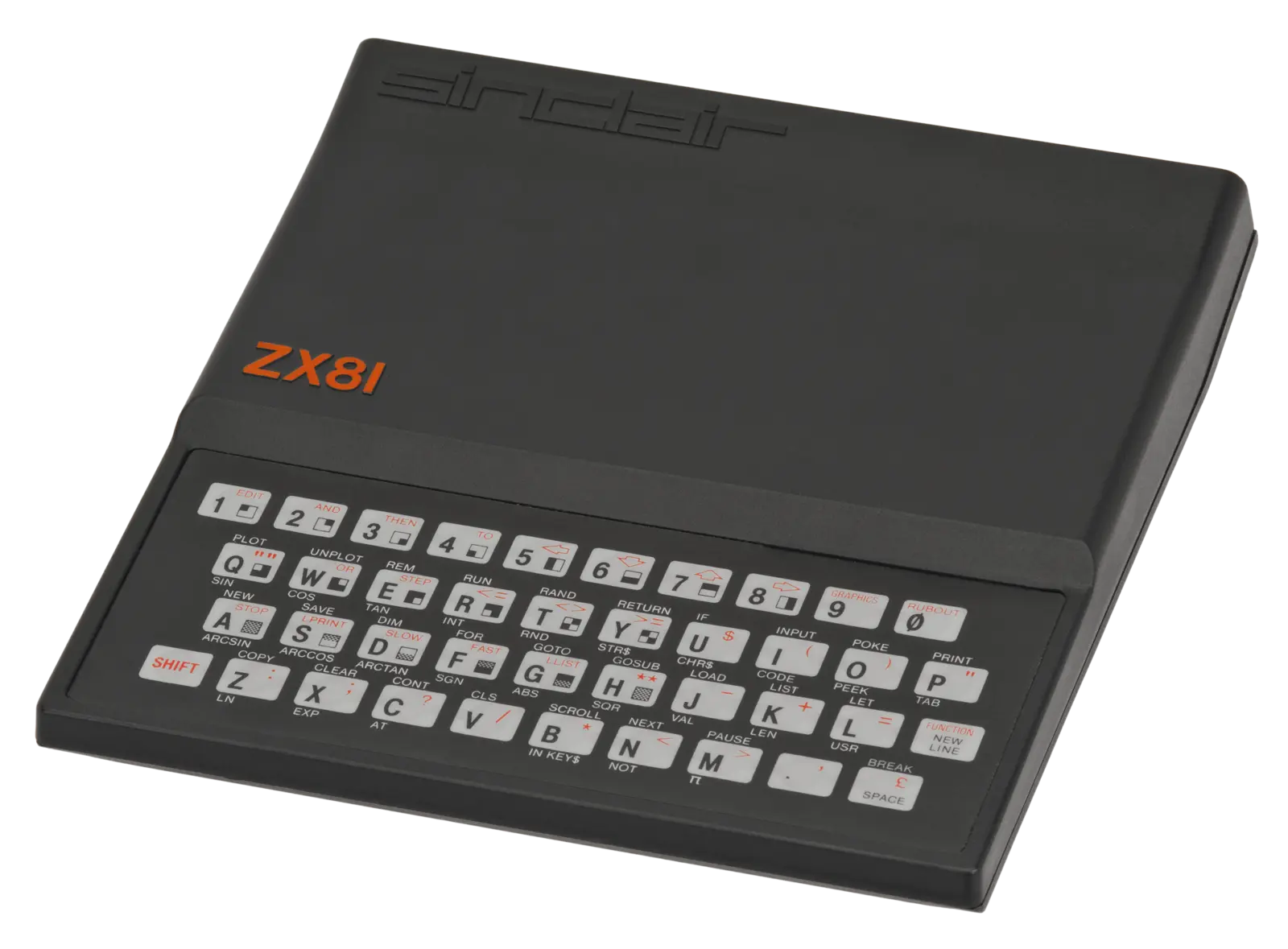
It had no colour, no sound chip, no moving keys and almost no memory. Yet this tiny black wedge put programming within reach of an unprecedented audience.
01 / A computer for the price-conscious home
Clive Sinclair wanted to break the price barrier
Most computers in 1981 were still serious purchases. Sinclair Research approached the problem from the opposite direction: what could be removed, combined or delegated to software until an ordinary household could afford one?
The ZX81 followed the white ZX80 of 1980, but was cheaper and more polished. At launch it cost £49.95 as a kit or £69.95 assembled. A television became the monitor and a domestic cassette recorder provided storage, so the box itself could remain remarkably small.
Sinclair sold directly through mail-order advertising. The message was carefully chosen: this was not merely a calculator for hobbyists, but a complete personal computer with BASIC. Buyers could assemble it themselves or take the ready-made route.
By December 1981, more than 250,000 had been sold. In the United States Timex later marketed a version as the Timex Sinclair 1000. The ZX81 helped turn a specialist pastime into a genuine mass market.
02 / Economy as engineering
Four chip roles did almost everything
- 01
Z80A processor
The familiar 8-bit CPU ran BASIC and also did part of the work needed to build the television picture.
- 02
8 KB ROM
Sinclair BASIC, floating-point arithmetic and the display routines were ready as soon as the machine was switched on.
- 03
1 KB RAM
Program, variables, stacks and the expanding screen file all had to share the same exceptionally small workspace.
- 04
Ferranti ULA
One custom logic chip replaced much of the separate circuitry in the ZX80 and made the new machine cheaper and simpler.
03 / Forty flat keys, hundreds of meanings
The keyboard was a map of BASIC
Rick Dickinson's slim black case looked coherent and futuristic, but the keyboard had no moving keycaps. Pressing it meant pushing two membrane layers together through a printed plastic sheet.
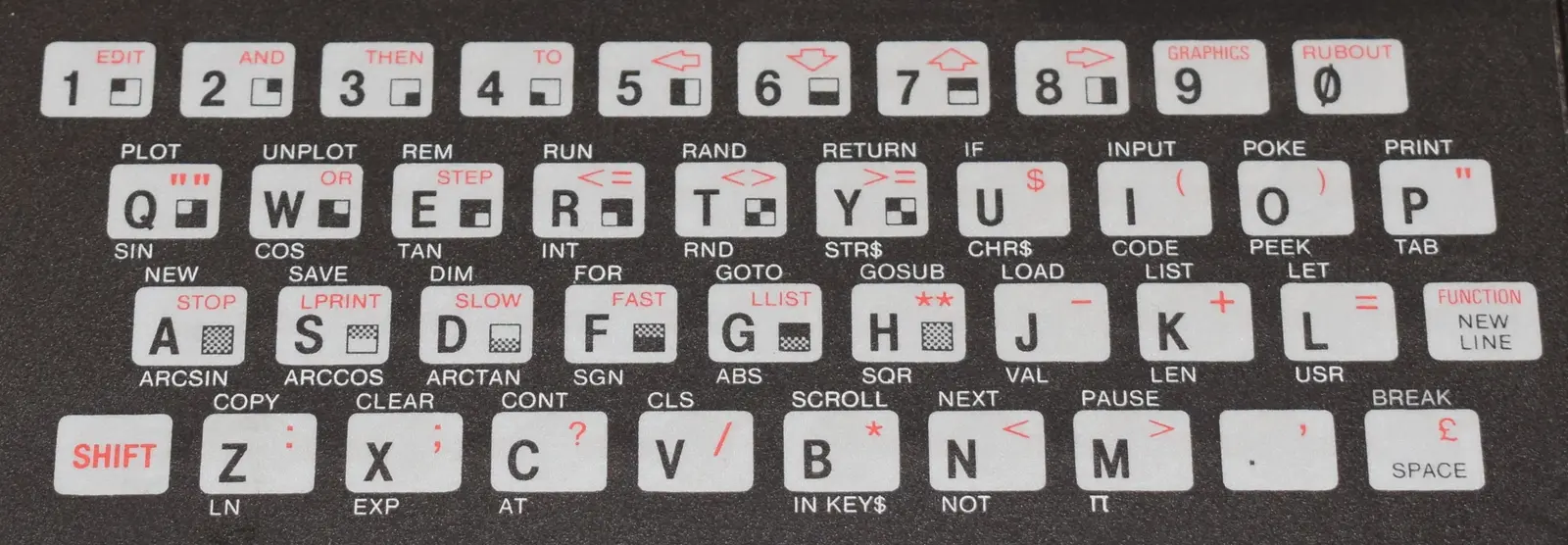
Letters, commands, functions, punctuation and block-graphics symbols shared the same forty pressure points.
At the beginning of a program line, pressing P did not enter a P—it produced the complete keyword PRINT. Other modes unlocked functions and graphics. This token system saved memory because a BASIC instruction occupied a single byte, and it prevented misspelled commands.
The price was a steep physical and mental learning curve. Typing prose felt awkward, and each key could have several meanings. Yet the legends also made the computer self-documenting: much of the language was always visible under the user's hands.
04 / Life inside 1,024 bytes
The screen itself competed with your program
One kilobyte was not merely storage for a program. System variables, user input, calculation stacks and the display file all occupied that same RAM.
The ZX81 conserved memory through a display file that grew with its contents rather than always reserving a complete screen. A full 32-by-24-character picture could consume most of the unexpanded machine's RAM, so blank lines and concise code were practical design decisions.
Block-graphics characters offered an effective 64 × 48 plotting grid. Clever machine-code programmers later forced much higher-resolution pictures from the hardware, but the standard experience was resolutely monochrome and character-based. 1K ZX Chess made the constraint legendary: David Horne fitted a playable opponent and most chess rules into just 672 bytes.
05 / FAST, SLOW and a disappearing picture
The processor had two jobs and not enough time
The ZX81 lacked dedicated video memory and a conventional graphics chip. Instead, the Z80 and ULA cooperated to turn bytes from memory into a television signal.
In SLOW mode the machine maintained the image while executing the user's program in the time left over. FAST reclaimed that time for computation, leaving the television grey or blank until the machine had an opportunity to show the picture again.
The result made an internal compromise visible in the living room. A numerical loop could finish much sooner in FAST, but the user literally lost sight of the computer's work. Few machines explained resource sharing so dramatically.
06 / Programs as sound
Loading began with a cable, a tape and patience
The ZX81 saved programs as audio pulses on an ordinary compact cassette. The arrangement was inexpensive, but success depended on volume, tone, recorder quality and a clean cable connection.
LOAD ""
Owners learned a ritual: rewind, set the counter, adjust the level, type LOAD "" and press play. Moving bands filled the screen as data arrived. A failure after several minutes meant trying again, perhaps a little louder or softer.
This fragility was part of early home computing, but cassette distribution also made software accessible. Programs could be bought cheaply, exchanged, or typed from books and magazines and then saved on any spare tape.
07 / Sixteen times the space—and one famous wobble
The 16K RAM pack transformed the machine
A module on the rear expansion connector raised the available memory from 1 KB to 16 KB. Suddenly there was room for larger games, useful programs and a far less anxious relationship with the display file.
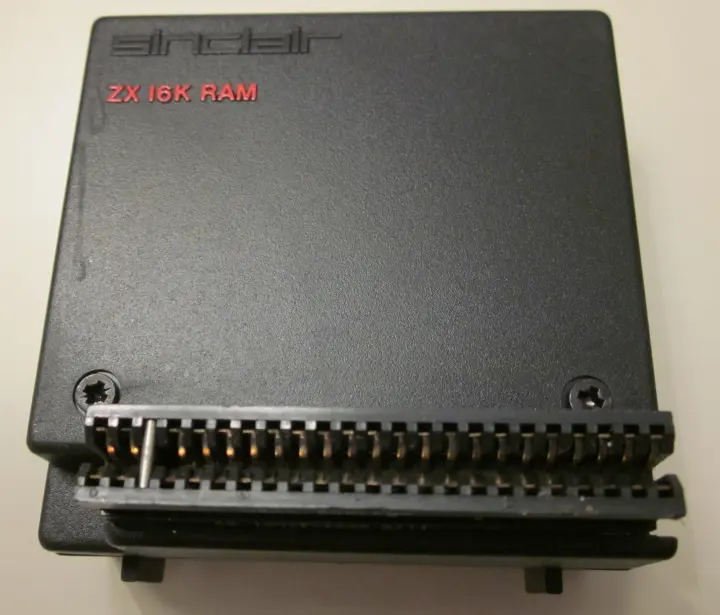
The pack plugged directly into the exposed connector at the rear of the ZX81, without a cable or locking mechanism.
The connection was mechanically vulnerable. A nudge could interrupt contact, crash the computer and erase an unsaved program—the notorious “RAM-pack wobble”. Owners improvised with adhesive tape, reusable putty or supports under the cartridge.
That same edge connector also encouraged printers, sound devices, alternative keyboards and storage interfaces. Around the inexpensive computer grew a cottage industry of small software and hardware businesses. The bare machine was minimal; the community made it extensible.
08 / A small machine with a long shadow
The ZX81 made the next step inevitable
Its commercial success proved that a very large audience wanted to learn, play and experiment at home.
Sinclair ZX80
The white predecessor establishes the idea of an unusually inexpensive British home computer.
ZX81 arrives
A custom ULA, improved 8K BASIC and SLOW mode make the concept cheaper and more usable.
250,000 sold by December
Sinclair gains the world's largest microcomputer user base at that moment.
Timex Sinclair 1000
A US version with 2 KB RAM carries the little wedge to American retailers.
ZX Spectrum
Colour, sound, more memory and rubber keys turn Sinclair's low-cost idea into a games phenomenon.
A lesson in purposeful limits
Emulators, replicas and new software keep the challenge of creating with almost nothing alive.
09 / Sources & further reading
Explore further
- Science Museum Group — Sinclair ZX81 microcomputer
- World of Spectrum — ZX81 BASIC Programming manual
- Sinclair Research — ZX81 BASIC Programming, HTML edition
- Smithsonian National Museum of American History — Sinclair ZX81
- FOSDEM — getting David Horne's 672-byte 1K ZX Chess online
Image credits
- Sinclair ZX81 — Evan-Amos, CC BY-SA 3.0; resized and converted to WebP
- ZX81 keyboard — Piergiovanna Grossi, CC BY-SA 4.0; resized and converted to WebP
- ZX 16K RAM pack — Truthanado, CC BY-SA 3.0; converted to WebP
- ZX81 screen and cassette visuals — original editorial design


