Console 04 / 1978
Philips Videopac G7000:
Europe's Odyssey
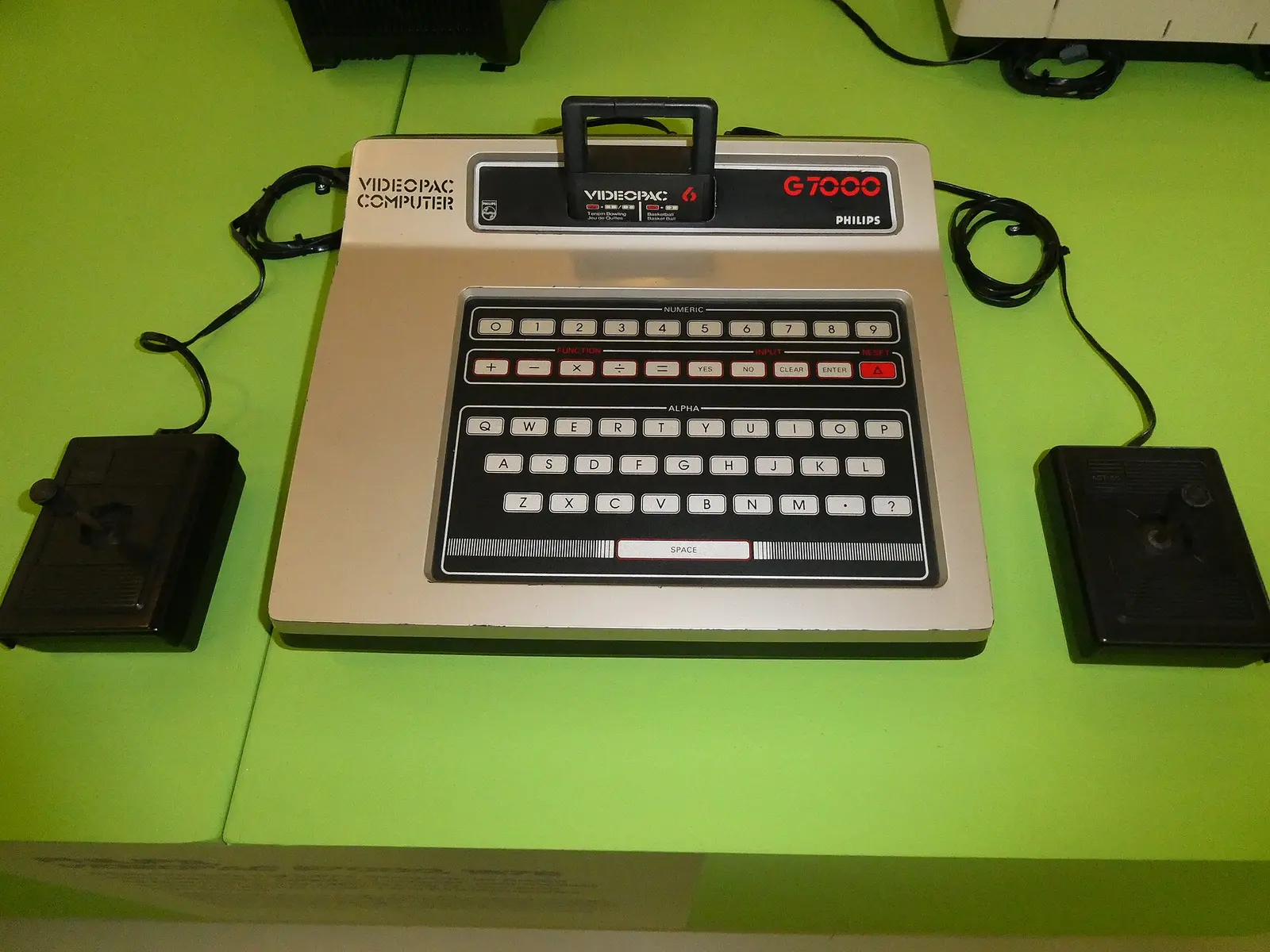
An American console family acquired a pronounced European identity at Philips. With its keyboard, the silver G7000 almost looked like a computer, yet it remained above all an idiosyncratic living-room games machine.
01 / A familiar name, a new generation
The Odyssey returned with a processor, colour and true software cartridges
Six years after the first Magnavox Odyssey, a successor arrived that had little in common with it technically. Screen overlays and interchangeable switching cards gave way to a microprocessor, colour graphics and cartridges containing program code.
In North America the system was called the Magnavox Odyssey². Magnavox had become part of the Philips group. In Europe, Philips placed its own name first and chose Videopac Computer G7000. Related versions appeared under other brands in France and Belgium.
The G7000 was therefore not a wholly Dutch invention that happened to be exported. Its technical core came from the American Magnavox organisation; industrial design, positioning and distribution gave the machine a distinct Philips character in Europe.
That distinction matters. Where Atari chiefly promised arcade action in the living room, Philips presented Videopac as something between a game, an electronic learning aid and a ‘computer’. The keyboard made that promise visible before the television was even switched on.
02 / Computer on the box
The flat keyboard was useful, ambitious and slightly theatrical
The black membrane keyboard was not a separate accessory but the centre of the silver fascia. It offered letters, digits, arithmetic functions and input keys such as YES, NO, CLEAR and ENTER.
Enter game variants, quantities and difficulty choices.
Control arithmetic, quiz and educational cartridges.
Use letters in word games and with dedicated software.
The keyboard did not automatically turn the G7000 into a home computer. Without the right cartridge, users could not type a BASIC program or save files. A title such as Computer Intro! demonstrated simple programming ideas, while other games used the keyboard mainly for names, answers and settings.
Its power was therefore also symbolic. Parents saw something educational and forward-looking; players saw a machine with more apparent possibilities than a joystick and a fire button alone.
03 / A microcontroller at the centre
The Intel 8048 did a great deal of work with remarkably little memory
The architecture differed from the Atari VCS. The G7000 used an Intel 8048 microcontroller with 64 bytes of internal RAM and 1 KB of built-in ROM, supplemented by 128 bytes of external working memory.
The 8-bit microcontroller runs cartridge code and reads the keyboard and joysticks.
The European PAL model uses a dedicated video chip for characters, sprites, a grid and audio.
Cartridges generally contain a few kilobytes of ROM and give the fixed machine new behaviour.
The video chip could show four freely defined sprites alongside built-in characters and a grid-like background. It produced bright, stable objects but also a recognisably angular style. Backgrounds remained simple and many figures seemed to come from the same box of digital building blocks.
This was not merely an inferior Atari but a different set of components. G7000 games consequently feel like Videopac games at once: colourful, immediate and often almost diagrammatic.
04 / Cartridges with a handle
A Videopac was a game, a product number and a distinctive shop object at once
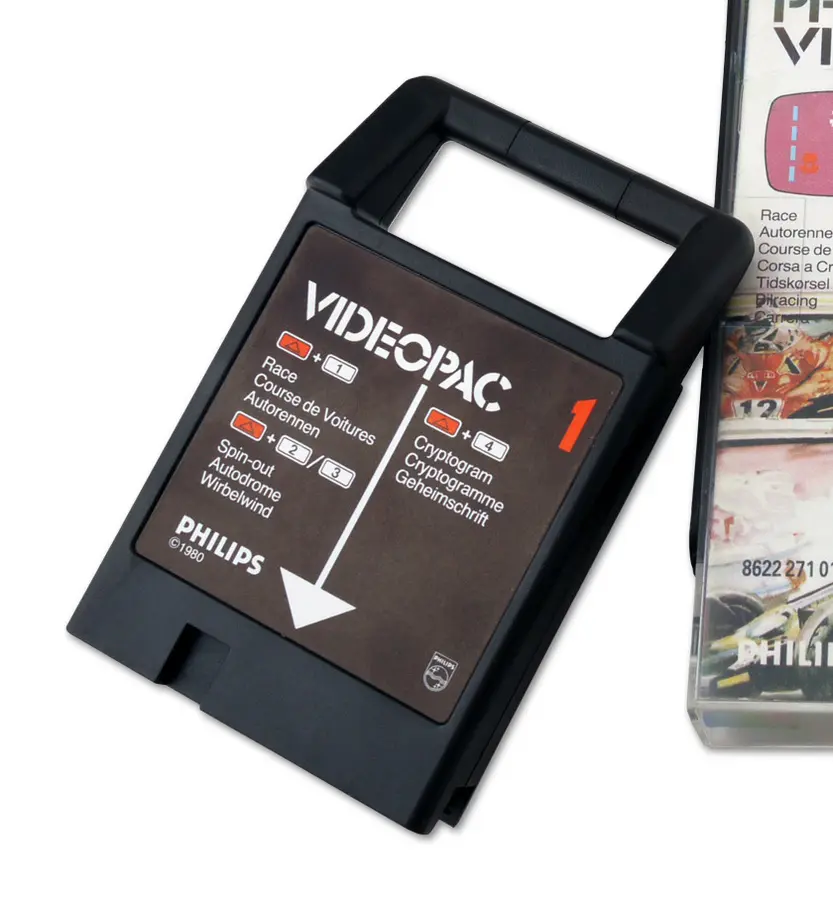
Philips numbered many European releases simply: Videopac 1, 2, 3 and onward. Boxes often carried several languages and sometimes combined multiple games on one cartridge.
Designed to be grasped
The large open handle made a Videopac instantly recognisable and helped users insert and remove it. Its shape was almost more conspicuous than the small amount of electronics inside.
Multilingual titles such as Race / Autorennen / Course de Voitures showed that Philips wanted to sell one catalogue across national borders. Numbering provided a universal point of reference.
05 / Games with their own accent
From Munchkin to Pickaxe Pete: simple images, immediate character
The library included sports, shooting, racing, arithmetic and puzzle games. Some clearly echoed arcade hits; others did not quite belong anywhere else.
Munchkin
A maze game with changing corridors and monsters. Its resemblance to Pac-Man made it famous — and legally contentious.
Pickaxe Pete
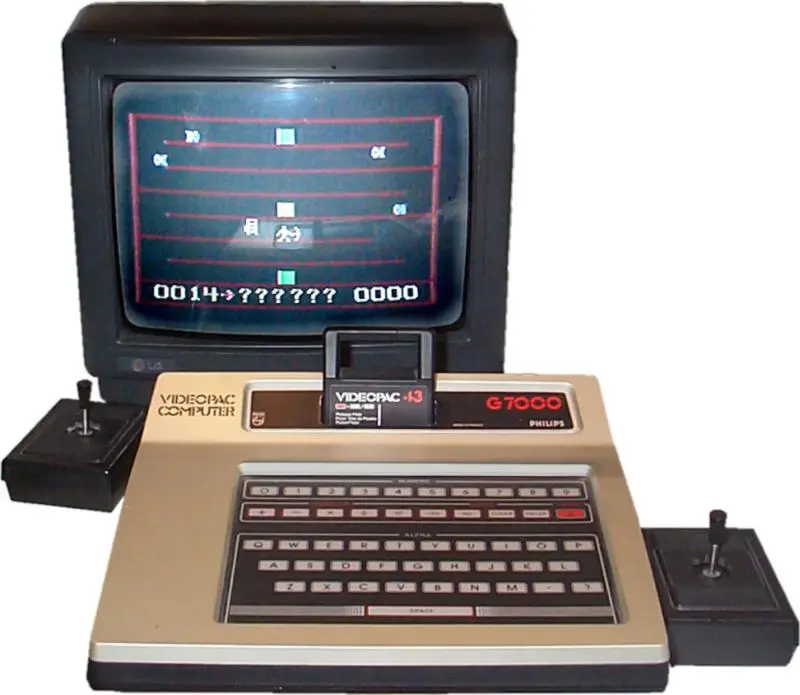
A miner, falling rocks and ladders formed a compact action game that became closely identified with the system.
Freedom Fighters
A space shooter in which the player rescues prisoners and repels enemy attacks.
Labyrinth / Supermind
Two thinking games representing the quieter, puzzle-like side of the catalogue.
06 / Table and screen
The Master Strategy games made the console one component of a board game
The Quest for the Rings and Conquest of the World came in large boxes containing a board, pieces, instructions and a cartridge. The television handled battles and events; players tracked the wider campaign at the table.
No choice between board game and video game
The computer did not replace the board. Each component had its own job. In this respect the series unexpectedly echoed the original Odyssey, which had also combined electronic play with physical materials.
The difference was substantial: the G7000 now calculated enemies, movement and outcomes itself. The screen was no longer merely a source of light, but an active playing partner.
07 / A European network of names
Philips turned one hardware family into several local products
Philips Videopac was the central identity in the Netherlands, Germany, Britain and other European markets. Related machines and games also appeared under names including Radiola, Schneider and Siera in France and Belgium.
The mostly multilingual packaging fits this European story. A cartridge did not have to be reinvented for every country; titles, manuals and distribution brands could be adapted around the same software.
To Dutch players, meanwhile, the machine naturally felt like a Philips product. Its logo, model number and businesslike typography matched radios, televisions and other electronics already found in many homes.
08 / The move to Videopac+
The G7400 added more detailed backgrounds but arrived at a difficult moment
The Videopac+ G7400 followed in Europe in 1983. It could play existing G7000 cartridges and added finer background images to dedicated ‘plus’ games.
Older objects continued to move in the foreground while a second video layer supplied more scenery. Some existing games gained a richer presentation on the G7400, and a handful of titles used the new capabilities more explicitly.
Timing worked against Philips. Affordable home computers offered programmability, keyboards and games in one device, while the international console business changed rapidly. The G7400 therefore remained a mainly European and relatively short-lived successor. The G7000 is the model that most clearly embodies the Videopac idea.
09 / The European line
From Odyssey² to Videopac+
A shared technical foundation acquired its own name, catalogue and memories in each region.
Magnavox joins Philips
The American electronics company becomes part of the Philips group.
Odyssey²
Magnavox introduces the programmable successor to Odyssey in North America.
Videopac G7000
Philips launches the European version under its memorable model name.
Quest for the Rings
The Master Strategy series combines board, playing pieces and television.
Munchkin
The maze game becomes one of the system's best-known titles.
Videopac+ G7400
The European successor adds more detailed backgrounds.
Collectors and homebrew
Fans document regional variants and continue to release new cartridges.
10 / Sources & further reading
Explore further
- Computer Historisch Museum — Philips Videopac G7000
- Centre for Computing History — Philips Videopac G7000
- Philips — Videopac Computer G7000 Instructions for Use (1978)
- Philips — G7000 Service Manual
- Magnavox — The Quest for the Rings manual (1981)
- Centre for Computing History — Philips Videopac+ G7400
Image credits
Philips Videopac G7000 — Jzh2074, CC BY-SA 4.0; resized and converted to WebP
Philips Videopac 1 cartridge — Studio Alijn, CC0 1.0; resized and converted to WebP
Videopac G7000 with Pickaxe Pete — boffy_b, CC BY-SA 3.0; resized and converted to WebP


