Console 05 / 1979–1980
Mattel Intellivision:
intelligent television
Mattel did not merely want to compete with Atari; it wanted to prove that video games could be smarter, better-looking and more mature. The result offered detailed sports games, a sixteen-direction controller and ambitions that reached far beyond the cartridge slot.
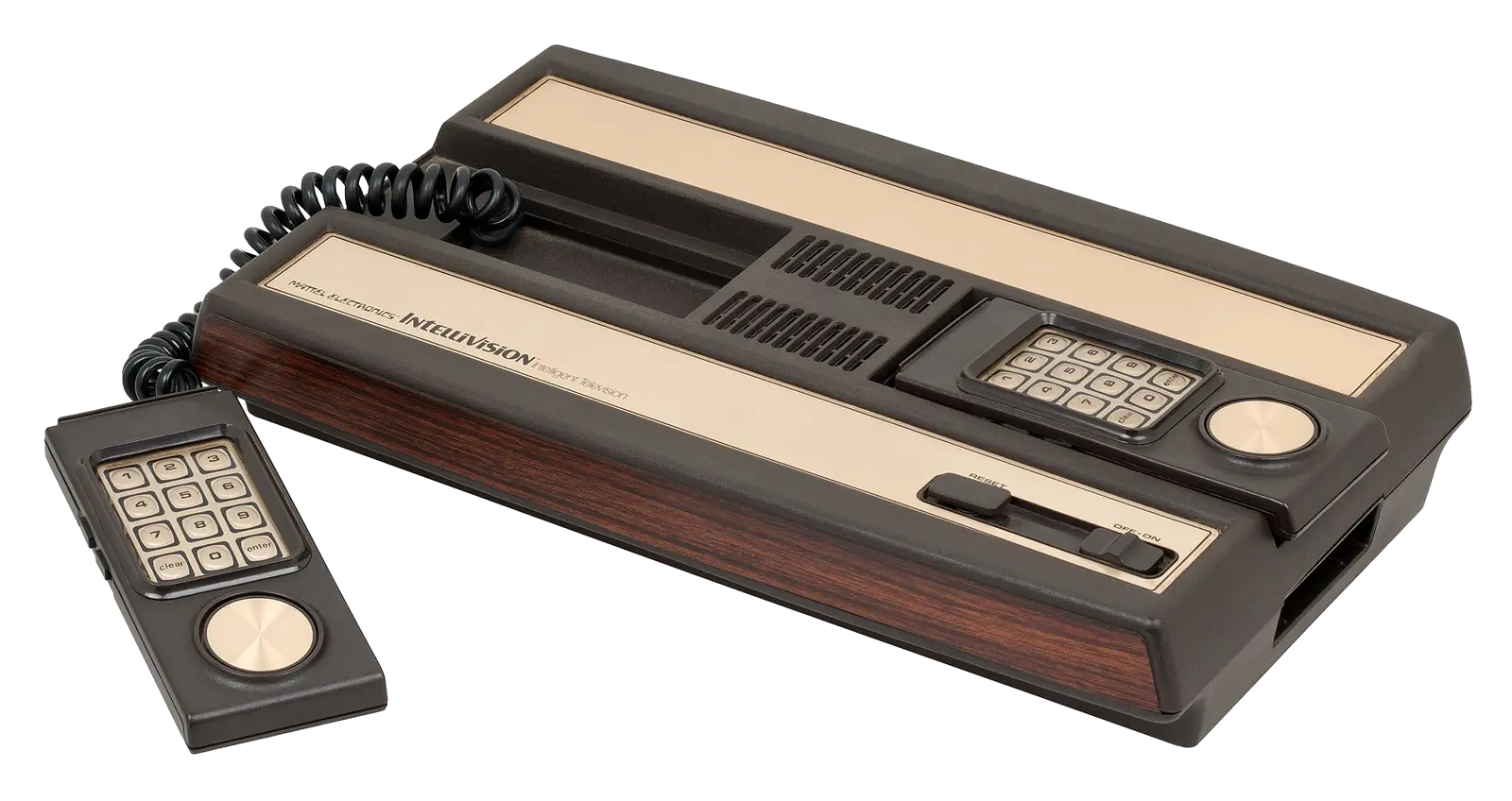
01 / Intelligent television
The name was a promise: this would be more than an electronic toy
Intellivision contracted the words intelligent television. For Mattel, best known for Barbie and Hot Wheels, the console opened a new market in which toys, consumer electronics and the emerging computer world overlapped.
Development began around a General Instrument chip set. A successful 1979 test market in Fresno, California, was followed by a nationwide American launch in 1980. The original system cost $299 and included Las Vegas Poker & Blackjack.
The broad, low case combined dark woodgrain with gold-coloured metal. Both controllers fitted into wells on top. Its design still belonged among the living-room furniture of the 1970s, while its name looked emphatically ahead.
Mattel sold about 175,000 systems in 1980, followed by roughly half a million in both 1981 and 1982. Intellivision did not become market leader, but it was the first rival to force Atari into a genuinely direct comparison.
02 / Comparative advertising
George Plimpton placed Intellivision and Atari conspicuously side by side
Television commercials showed writer and actor George Plimpton calmly pointing out differences between the same sport on both systems. Blocky Atari baseball was contrasted with an Intellivision field containing recognisable players and more actions.
A simple joystick, immediate action and a growing collection of arcade names.
More buttons, recognisable fields and room for rules, formations and choices.
The comparison was effective but hardly neutral. Either machine could excel or disappoint depending on the game. Still, the campaign gave Intellivision a distinct identity: this was the system for players who valued graphics, sport and more complex control.
Mattel later reversed the rivalry in software. Its M Network label released adapted Intellivision games for Atari 2600. The competitor was therefore both a target and a market Mattel was happy to reach.
03 / Disc, keypad and overlays
The controller offered many possibilities, but demanded practice
Instead of a stick and one button, it provided a flat directional disc, numeric keypad and action buttons along the sides. The disc could register sixteen positions, allowing finer directions than an ordinary four- or eight-way joystick.
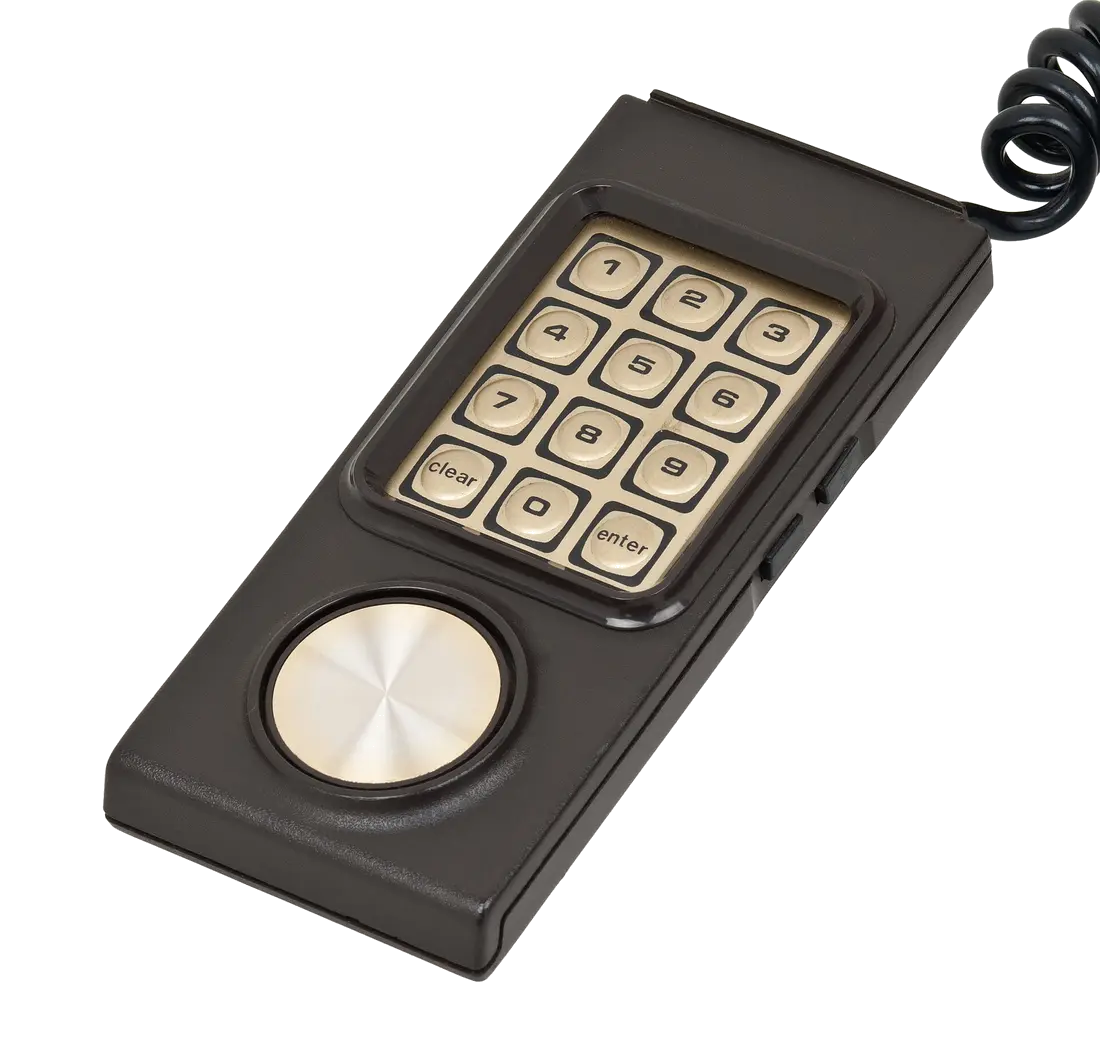
One device, three kinds of input
- Disc
Sixteen directions for walking, steering and aiming.
- Keypad
Twelve keys for formations, choices and game commands.
- Action buttons
Four physical side buttons, although the upper pair sends the same signal.
Almost every game supplied a printed plastic overlay that slid over the keys. A baseball overlay turned numbers into batting, pitching and running commands; a space game received an entirely different set of symbols. The controller was relabelled for every cartridge.
It was inventive and cumbersome at once. Functions were difficult to remember without the overlay, while the hard disc could produce a sore thumb during long sessions. This combination of versatility and eccentricity makes the Intellivision controller unforgettable.
04 / Sixteen bits, used differently
CP1610, STIC and EXEC formed an architecture unlike its competitors
At its heart was General Instrument's CP1610, a 16-bit processor running at about 0.895 MHz. That sounded impressive beside competitors' 8-bit chips, but bit count alone did not determine the speed or beauty of a game.
Runs game code and processes input using an unusual 16-bit instruction set.
Builds a display from 20 by 12 background cards and up to eight moving objects.
Provides three tone channels and a noise generator for music and effects.
An internal control program helps cartridges with graphics, sound and collisions.
Despite the 16-bit processor, freely available memory remained tight. EXEC left 147 of the 256 scratchpad bytes to a game; the architecture also used 352 16-bit system locations and 512 bytes of graphics RAM. Actual display resolution was 159 by 96 pixels, but background characters could be reused and redefined. Many games therefore look crisp and colourful, with small recognisable figures instead of broad colour blocks.
The built-in EXEC saved cartridge space while also imposing a house style on early games. Developers who later addressed the hardware more directly achieved smoother motion and unexpectedly rich effects.
05 / The sports machine
Baseball, football and basketball sold the system
Sport was where Mattel's combination of graphics and many buttons immediately made sense. Players could do more than run or shoot: they could pass, choose bases and direct team members.
Clever switching between fixed background figures and moving objects created the impression of full teams.
Copies shipped through June 1983, making it the best-selling Intellivision cartridge.
Many early sports titles were at their best with a human opponent beside you.
These games were not perfect simulations. They were, however, early attempts to capture not just one movement but the logic of a sport in software. The television became scoreboard, field and referee at once.
06 / Beyond the stadium
The best games used the console for worlds Atari did not naturally offer
Mattel initially grouped its catalogue into ‘networks’ for sport, action, space, strategy, education and children. Their coloured boxes told shoppers what kind of experience they were buying.
Astrosmash
Falling rocks, increasing speed and adaptive difficulty made this an approachable high-score chase.
Night Stalker
An atmospheric maze containing robots, bats and a weapon that had to be collected repeatedly.
Utopia
Two islands, economics and disasters: an early forerunner of strategy and god games.
AD&D: Cloudy Mountain
Exploration, listening and limited vision turned simple dungeons into a tense adventure.
Third parties including Activision, Imagic, Coleco and Parker Brothers also published games. Arcade conversions consequently appeared alongside distinctive titles such as Microsurgeon, Beauty & the Beast and Happy Trails.
07 / The console found its voice
Intellivoice made speech part of play
The 1982 Intellivoice module sat between console and cartridge. Speech could now be more than an opening phrase: directions and warnings became part of the controls themselves.
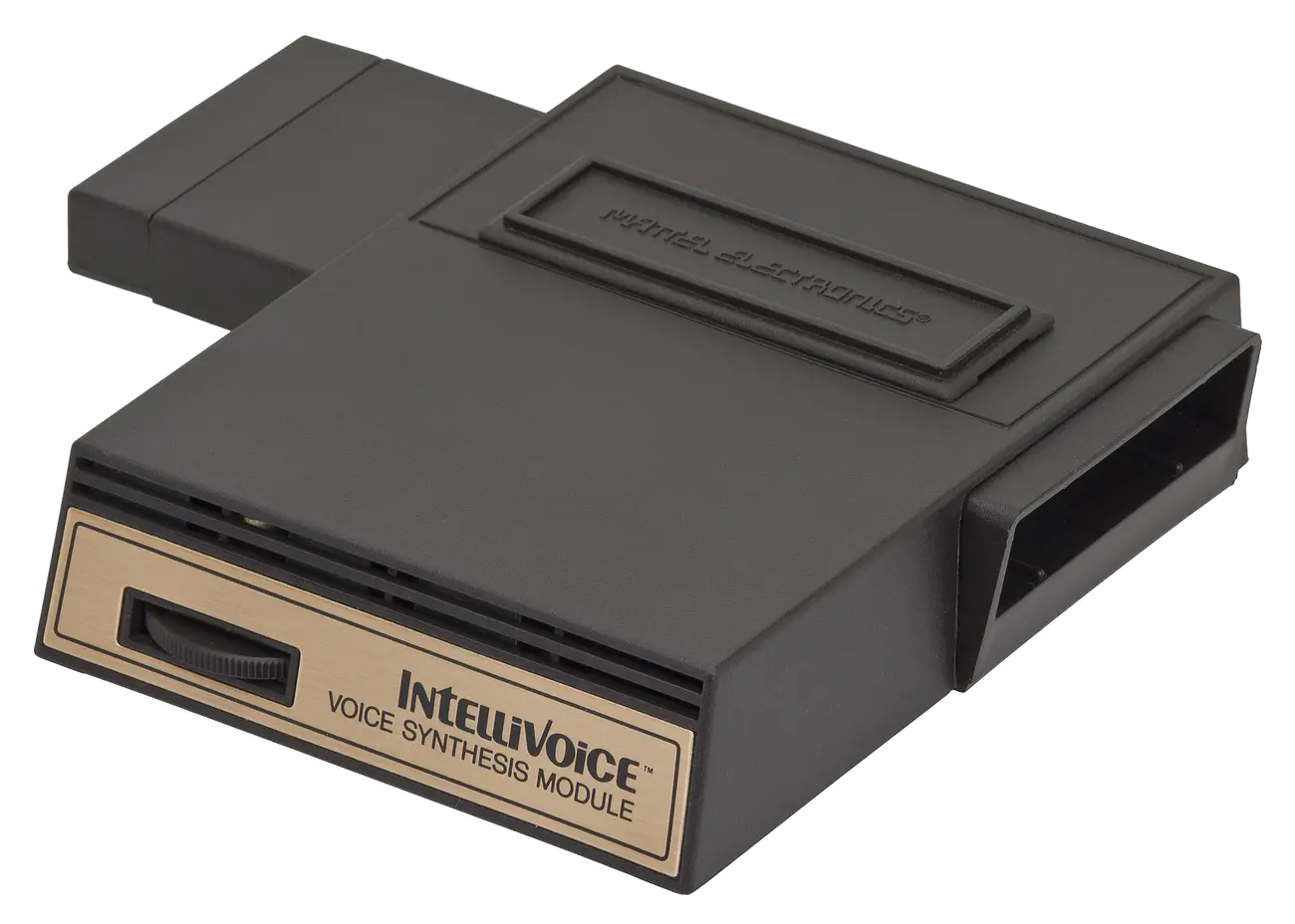
“Bandits at three o’clock!”
In B-17 Bomber, crew members reported attacks and damage. Space Spartans used a ship's computer as a constant companion, while Bomb Squad made spoken instructions into a game mechanic.
The technology impressed, but only five released games supported the module. The extra purchase and expensive speech ROMs prevented a wider breakthrough.
08 / The computer that would not arrive
The Keyboard Component turned a sales promise into a lasting headache
From its first advertising, Mattel promised an elaborate keyboard that would turn Intellivision into a true home computer. The Keyboard Component gained a 6502 for input and output, 16 KB of shared RAM, a cassette drive and dedicated software.
A games machine and expandable computer.
Expensive Keyboard Component in tiny numbers.
Cheaper module with BASIC and separate keyboard.
The original device worked but proved too costly and complex for mass production. Complaints about years of advertising attracted the attention of the US Federal Trade Commission. Mattel still had to deliver the promised capability.
The cheaper Entertainment Computer System provided simplified BASIC, cassette storage, a printer connection and optional music keyboard. It largely met the letter of the promise, but not the dream of a powerful family computer. In practice, Intellivision remained a game console.
09 / Smaller, cheaper, more expandable
Intellivision II made the hardware simpler while the market became more complicated
A smaller white and grey model arrived in 1983 with detachable controllers and an external power supply. Its redesign lowered component costs and made repairs easier.
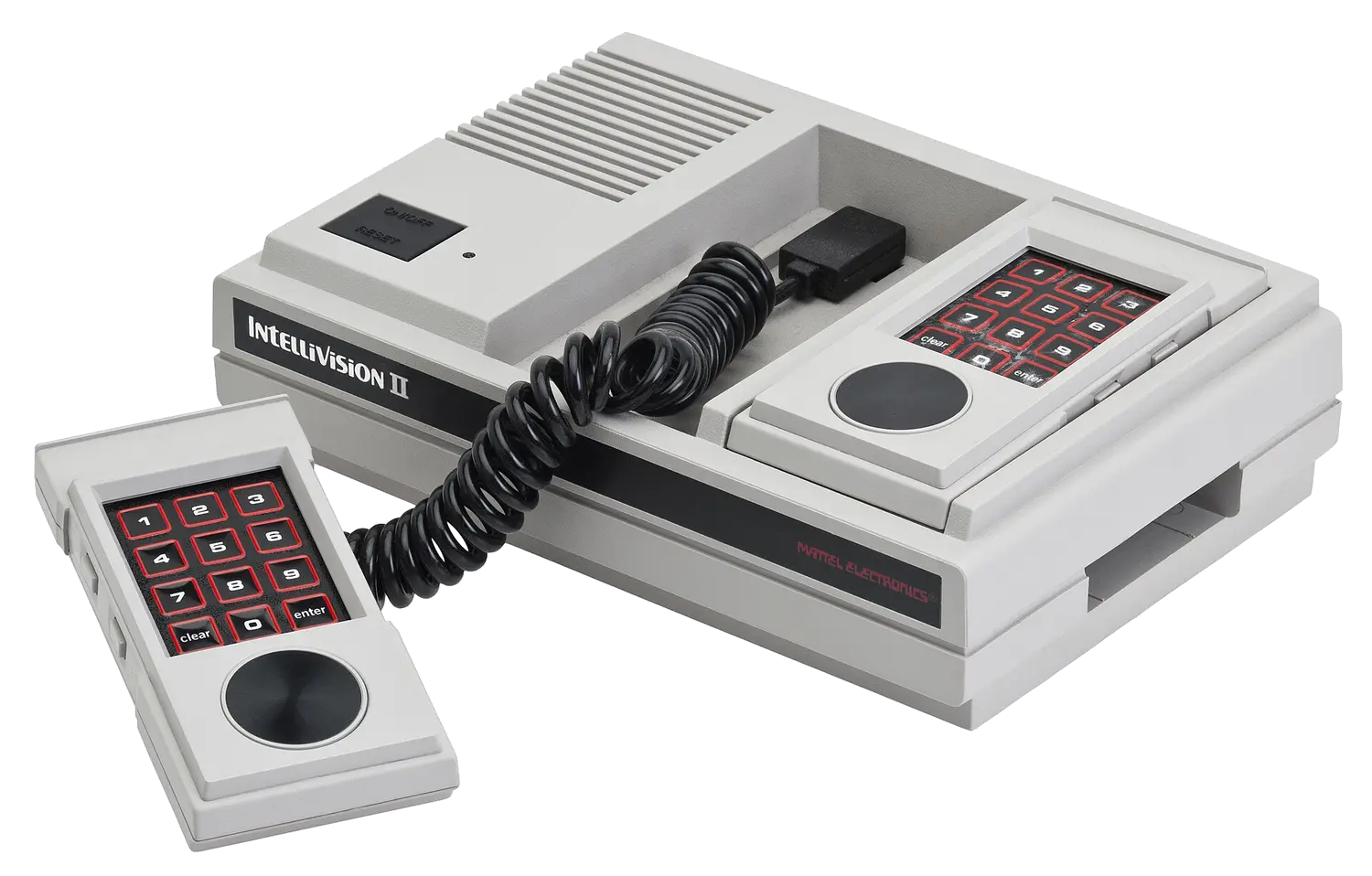
The System Changer also allowed the second model to run Atari 2600 cartridges. This was not Intellivision emulating Atari: the expansion effectively contained a complete Atari-compatible chipset of its own and mainly used the console for power and television output.
Meanwhile Intellivoice, ECS, PlayCable and plans for Intellivision III and IV all demanded attention. These projects demonstrated technical ambition, but also split money and effort at exactly the moment the American console market collapsed.
10 / From Mattel to INTV
The console outlived its maker
Spectacular growth ended in enormous losses, but a smaller company kept the catalogue alive for years.
Fresno test
Mattel tests the console with four cartridges and gains confidence for a wider launch.
National release
Intellivision becomes the most important challenger to Atari VCS.
PlayCable
The cable service sends a changing selection of games through the TV network to a special adapter.
Intellivoice
Speech synthesis makes audible information part of several ambitious games.
Intellivision II and ECS
A cheaper model and computer expansion arrive in an overcrowded market.
Mattel Electronics closes
After hundreds of millions of dollars in losses, Mattel shuts the division.
INTV Corporation
A successor sells old inventory, a new master system and new cartridges by mail order.
11 / Sources & further reading
Explore further
- Computer History Museum — Intellivision video game system
- Blue Sky Rangers — Mattel Electronics history
- Blue Sky Rangers — Master Component 2609 technical overview
- Blue Sky Rangers — Sports Network games
- Blue Sky Rangers — Intellivoice
- Blue Sky Rangers — Keyboard Component
- Blue Sky Rangers — Entertainment Computer System
- Mattel — Intellivision II Master Component Owner’s Manual (1982)
Image credits
Intellivision console — Evan-Amos, CC BY-SA 3.0; background removed, resized and converted to WebP
Intellivision controller — Evan-Amos, CC BY-SA 3.0; background removed, resized and converted to WebP
Intellivoice — Evan-Amos, CC BY-SA 3.0; background removed, resized and converted to WebP
Intellivision II — Evan-Amos, CC BY-SA 3.0; background removed, resized and converted to WebP


