Console 06 / 1982
ColecoVision:
the arcade comes home
Coleco promised not merely new games, but the sensation of the arcade at home. With Donkey Kong in the box, powerful standard chips and a row of expansions, ColecoVision became the brief star of 1982.
01 / One more attempt
A toy manufacturer decided the next home console had to resemble the arcade
Coleco had already built millions of simple Telstar systems during the 1970s. It withdrew when the Pong market collapsed. In 1981, the company tried again — now with interchangeable cartridges, colour and a much sharper idea of what players wanted to see.
Atari offered the largest library; Mattel emphasised sport and strategy. Coleco chose a third position: translate recognisable coin-operated machines to television as convincingly as possible. The phrase the arcade quality video game system made technical resemblance the sales pitch.
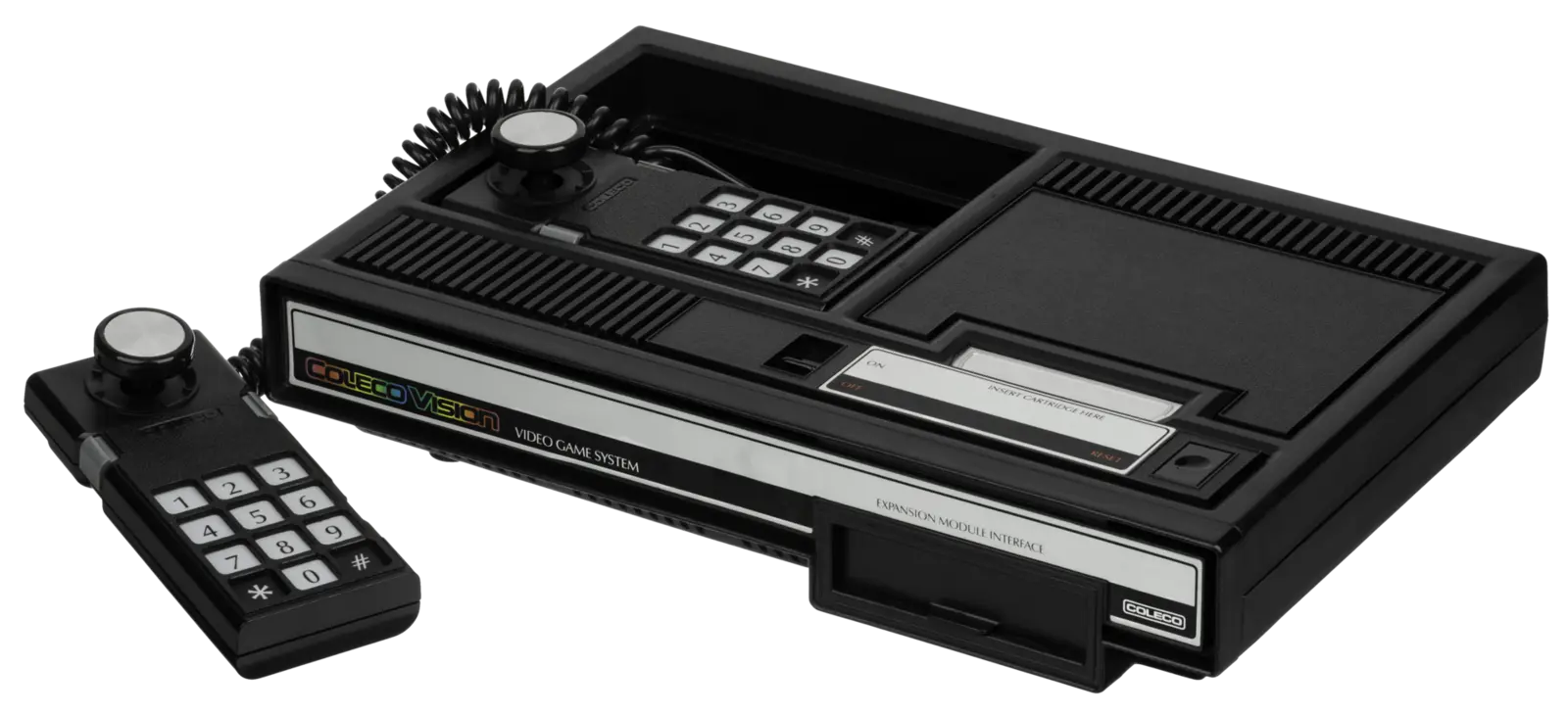
The black case was broad and busy. Two controllers rested in recessed bays on top, beside the cartridge slot. Behind a front flap waited the Expansion Module Interface — an opening that promised the system might become something else later.
The North American launch followed in August 1982 at about $175. CBS Electronics distributed the machine outside North America as CBS ColecoVision from 1983.
02 / The ape in the box
Donkey Kong turned the pack-in cartridge into a demonstration
Nintendo's 1981 coin-op hit was perfect for Coleco: instantly recognisable, colourful and technically difficult enough to expose the difference from older consoles. Coleco president Arnold Greenberg decided not to sell it separately as an expensive hit, but to include a cartridge with every machine.
The original alternated between four distinct challenges.
Incomplete, yet more recognisable and richer than earlier home conversions.
Systems sold by Christmas 1982; sales passed one million early in 1983.
The missing cement factory and other simplifications did little to weaken the effect. Mario, barrels, ladders and girders visibly belonged to the same world as the arcade machine. Donkey Kong gave the new console something a specification list could not: a comparison anyone understood in seconds.
03 / Standard chips, cleverly combined
The Z80A and Texas Instruments chips made colourful, active screens affordable
Coleco assembled its machine largely from available components. The same technical family soon reappeared in Sega's SG-1000 and, with a different sound chip, in MSX computers. These systems are not compatible, but their relationship explains why some conversions could be comparatively direct.
A familiar 8-bit processor for game code and control.
Sixteen colours, tile graphics and up to 32 sprites.
Three tone channels and a noise generator for music and effects.
Very little working RAM, but a generous dedicated video buffer.
The video chip could not show unlimited sprites at once — four were available per scanline — but gave developers a far more convenient base than the extremely timing-sensitive Atari 2600. Characters, mazes and fixed backgrounds did not need to be constructed line by line by the CPU.
Its strength therefore lay less in one spectacular figure than in balance. Processor, video and sound were predictable enough to rebuild arcade designs inside compact cartridges of 8 to 32 KB.
04 / Stick, keys and overlays
The controller combined arcade movement with the keypad fashion of its time
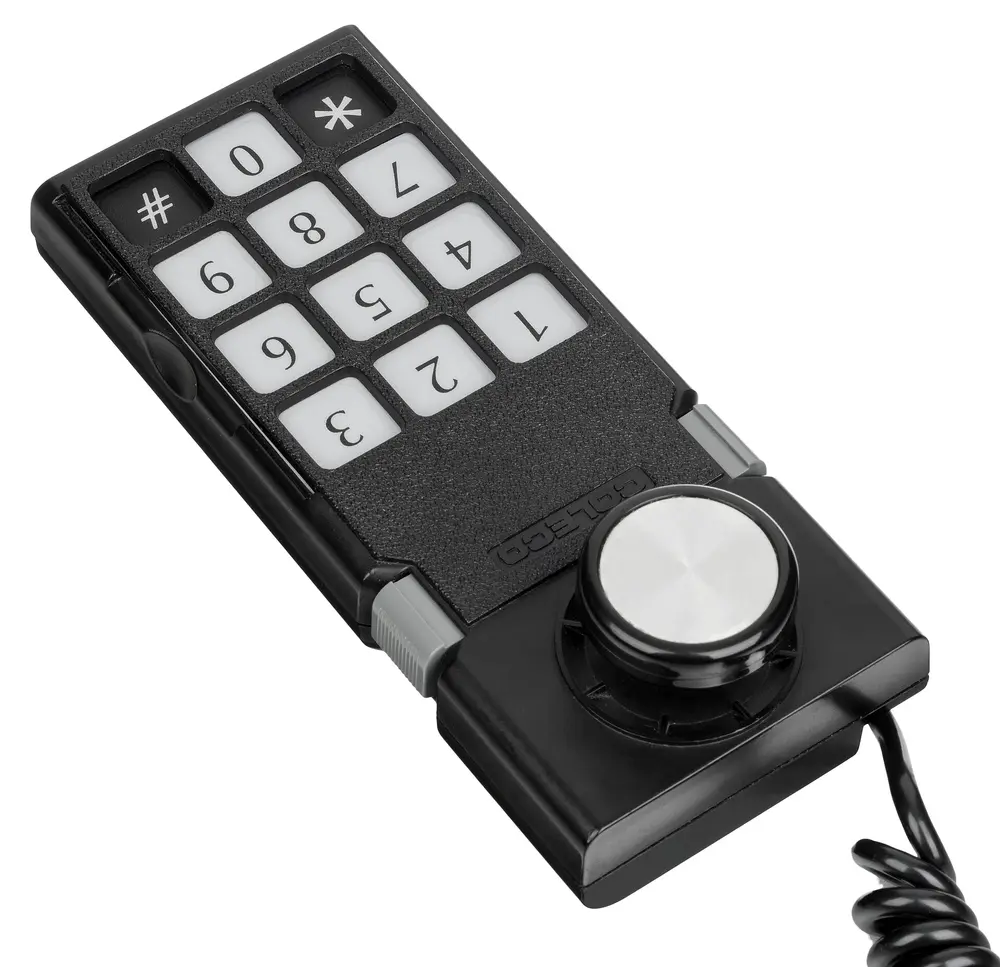
A short joystick sat above a numeric keypad; two action buttons lay along the sides. Printed overlays could turn numbers into game commands. It looked modern and versatile, but ergonomically it was a compromise.
Everything under one hand
- Short stick
Eight directions, but little leverage and therefore tiring during fast arcade action.
- Twelve keys
Numbers, star and hash for choices and additional functions.
- Two side buttons
Separate actions for firing, jumping or accelerating.
The resemblance to Intellivision is obvious: printed overlays also covered that system's keypad. Coleco joined the idea to an ordinary digital stick. The keypad worked in complex games; during long sessions, the stiff joystick and side buttons remained the weakest part of an otherwise convincing system.
05 / An arcade catalogue
Zaxxon, Lady Bug and Venture gave the console its own recognisable repertoire
Atari controlled the rights to many of the largest arcade names. Coleco therefore looked deliberately elsewhere, licensing machines from Sega, Universal, Exidy and Stern. The result was not a collection of second choices, but a distinctive cross-section of the early 1980s.
Zaxxon
Isometric flight with height, shadows and walls that created convincing space.
Lady Bug
A maze whose revolving gates continually alter routes and pursuits.
Venture
Small rooms full of monsters, treasure and nervous retreats to the exit.
Turbo
A fast racing game sold with a steering wheel and accelerator pedal.
Mouse Trap
Maze action with doors, dogs and a rhythm distinct from Pac-Man.
Donkey Kong Jr.
Vine climbing showed the Nintendo agreement could yield more than one hit.
Not every game needed an arcade parent. Smurf: Rescue in Gargamel's Castle used large cartoon characters and scrolling screens; WarGames avoided a literal film adaptation and became a remarkable strategy game about a network of threatened cities.
06 / Expansion Module #1
The expansion ran Atari cartridges because it effectively contained an Atari-like console
Coleco presented compatibility as an expansion of the ColecoVision library. Technically the main console did not execute those cartridges. The module housed the necessary 2600-like electronics, switches and controller ports and used ColecoVision for power and output.
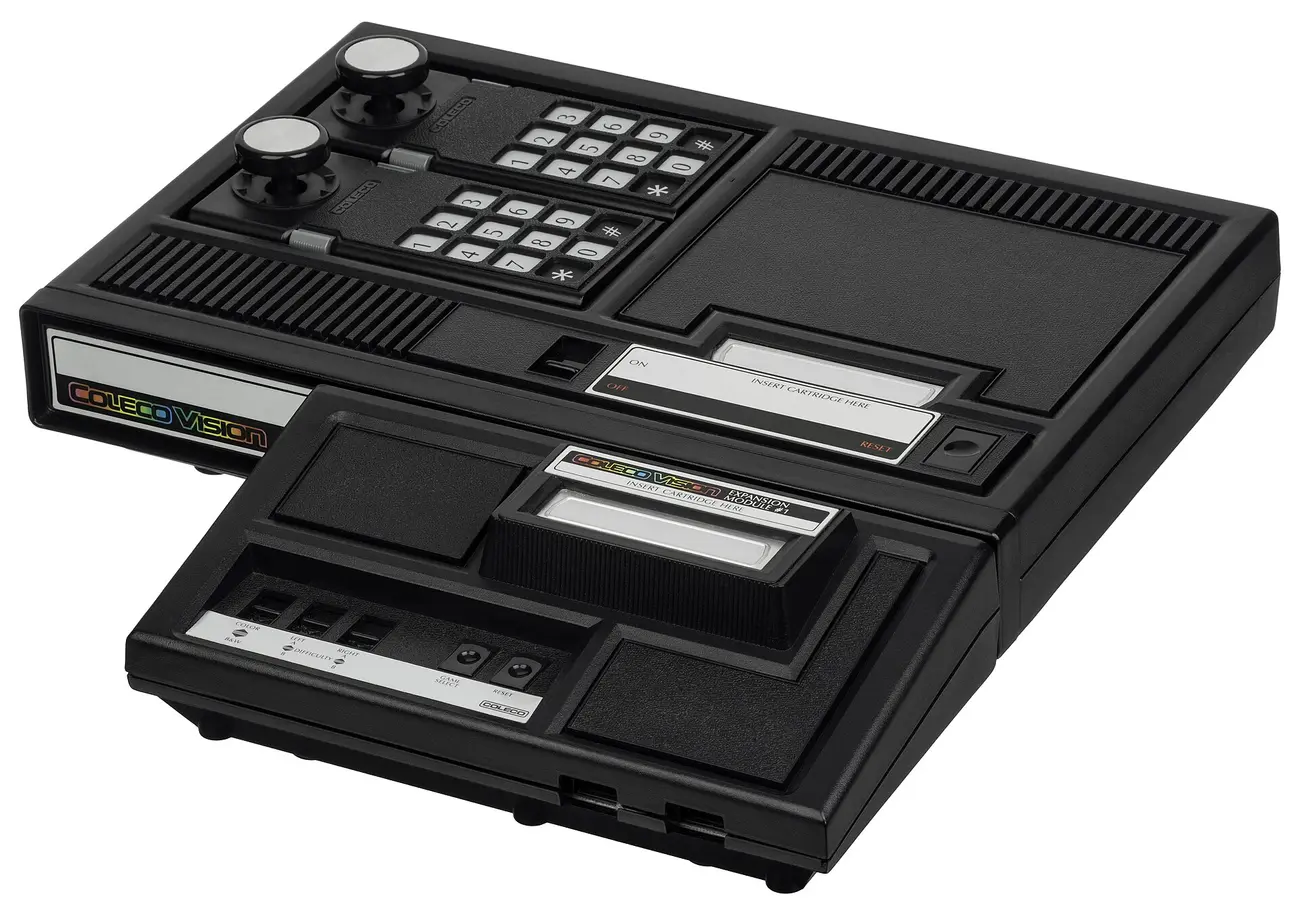
Atari sued Coleco for patent infringement late in 1982. In March 1983 the companies settled: Coleco became a licensee under Atari's patents and paid royalties. The module remained on sale and also formed the basis of Coleco's stand-alone Gemini system.
It was an aggressive move. Buyers did not need to discard an existing pile of Atari cartridges and, alongside Coleco's new software, immediately gained access to the largest home library of the moment.
07 / Steering, rolling and super action
Coleco designed a different control device for each game genre
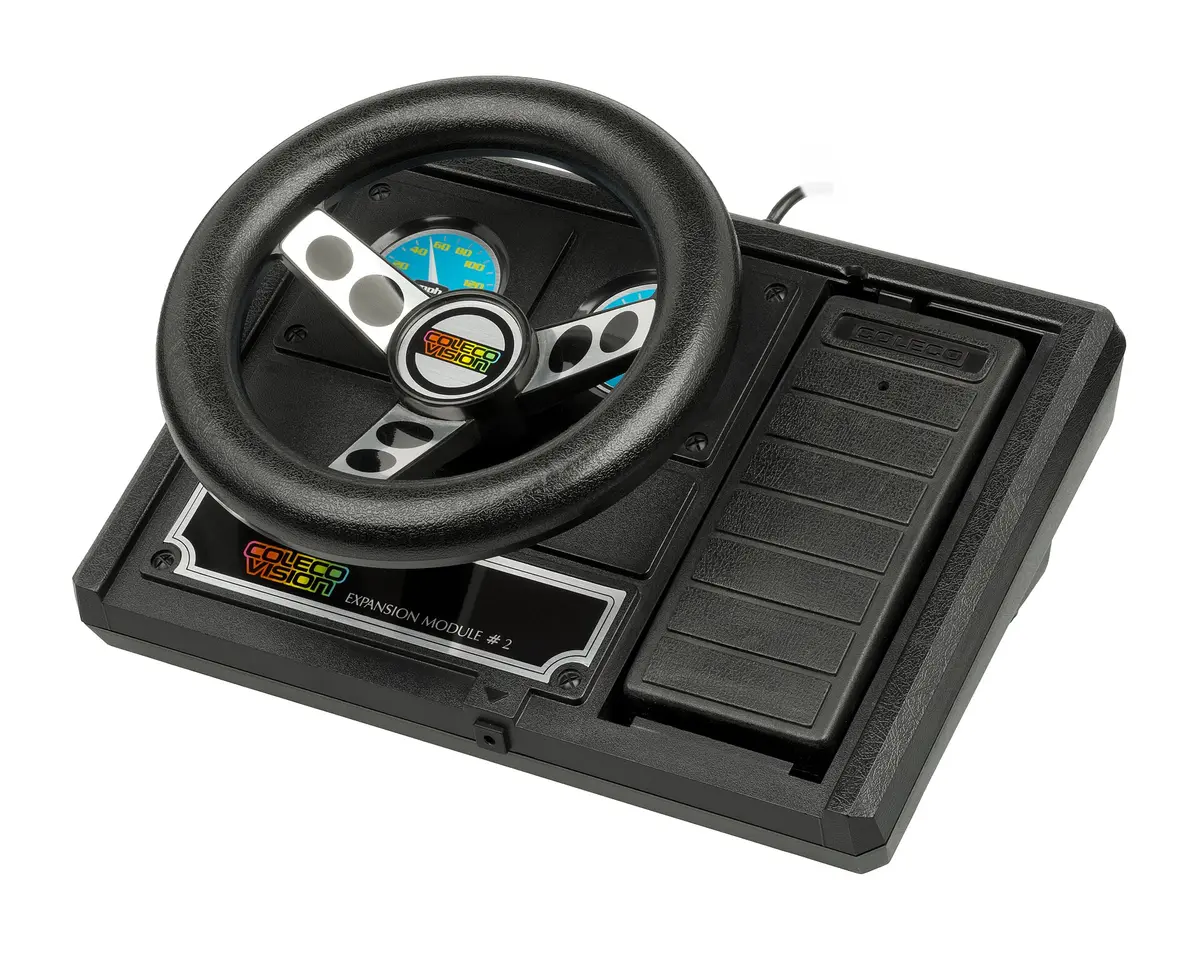
Expansion Module #2 combined a steering wheel and separate accelerator pedal and came with Turbo. A standard controller in a cradle provided the action buttons. The pedal was digital — throttle or no throttle — but the setup visibly turned the living room into a tiny cockpit.
Beyond two standard controllers
The Roller Controller was a large trackball for games including Slither and Victory. The Super Action Controllers combined a joystick, four coloured finger switches, numeric keypad and speed roller.
The selection looked spectacular in catalogues, but fragmented the platform in practice: accessories cost extra, occupied space and worked with only a limited number of cartridges.
08 / Expansion Module #3
The ADAM computer turned the expansion promise into a risky detour
Coleco announced ADAM in 1983 both as a complete computer and an expansion for existing ColecoVision owners. With 64 KB RAM, keyboard, fast cassettes and a daisy-wheel printer, the package looked unusually complete.
ColecoVision games, word processing, BASIC, storage and printing in one system.
The computer depended on its bundled printer to work at all.
Faulty units, unreliable Digital Data Packs and returns damaged confidence.
The problems arrived at the worst possible moment. Cheaper home computers were already fighting a price war while the American console market contracted. Coleco had concentrated vast stocks, development costs and marketing in one complicated product.
ADAM was not the sole cause of Coleco's retreat, but accelerated it. The computer was cancelled in January 1985; later that year Coleco left the video game market.
09 / A bright, brief arc
From breakthrough to farewell in three years
ColecoVision arrived at the height of the second generation and was almost immediately struck by the American market crisis.
Coleco Telstar
Coleco enters the market with a series of Pong-like home systems.
ColecoVision
The console launches with Donkey Kong and a catalogue full of arcade conversions.
More than 500,000
Sales exceed expectations during the first Christmas season.
One million and ADAM
Success peaks, but Coleco shifts money and attention to a home computer.
The decline
Quarterly sales fall sharply after the market crash and retailers hold excess stock.
Production ends
Coleco cancels ADAM and leaves video games later that year.
10 / Sources & further reading
Explore further
- 8bitworkshop — ColecoVision hardware documentation
- ColecoVision — console and ADAM history
- ColecoVision Zone — console overview and launch catalogue
- The New York Times — Atari–Coleco settlement (12 March 1983)
- Coleco — ColecoVision Owner's Manual (1982)
- Coleco — ColecoVision Game Catalog (1982)
Image credits
ColecoVision with controllers — Evan-Amos / OliverGalvin, public domain; resized and converted to WebP
ColecoVision controller — Evan-Amos, public domain; resized and converted to WebP
Expansion Module #1 — Evan-Amos, public domain; resized and converted to WebP
Expansion Module #2 — Evan-Amos, public domain; resized and converted to WebP


