Console 07 / 1982
Vectrex:
an arcade drawn in light
No television connection, no coloured pixels and no ordinary joystick. Vectrex was a complete miniature arcade with its own vector display — a brilliant anomaly that arrived at exactly the wrong moment.
01 / A screen in search of a game
A stock of small picture tubes led to a console unlike anything else
At California-based Smith Engineering, John Ross and colleagues looked for a use for cheap, unused CRTs in 1981. The first idea was a portable game built from vector lines. Under project names including Mini Arcade, that experiment grew into a complete console.
Vector graphics were familiar from arcade machines such as Asteroids and Battlezone. An electron beam travelled directly between coordinates, producing exceptionally crisp lines. Home consoles, meanwhile, had to build their pictures one television scanline at a time.
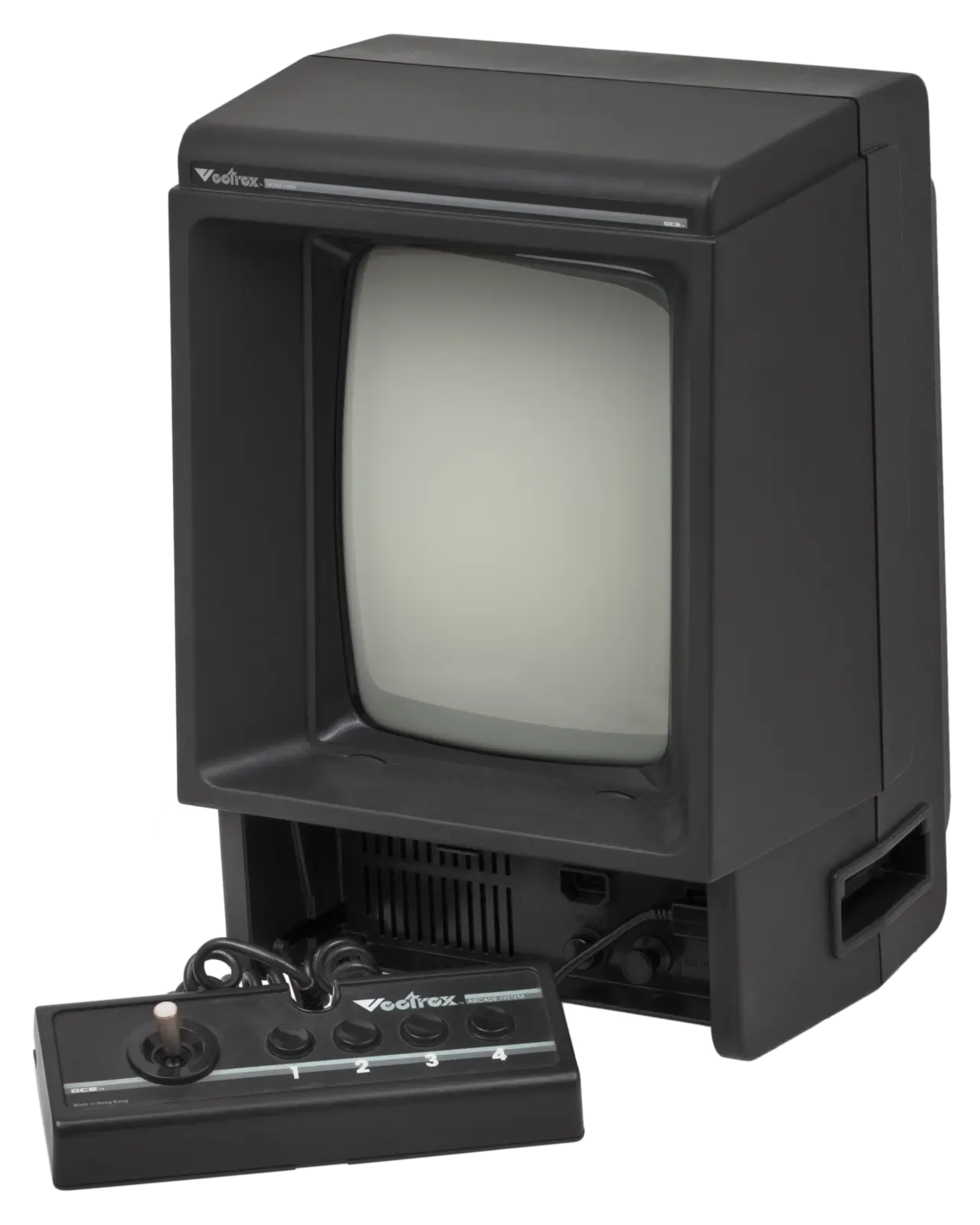
General Consumer Electronics recognised the prototype’s potential, named it Vectrex and turned it into a self-contained product. Everything needed to play sat inside one black cabinet: display, speaker, cartridge slot, processing hardware and a controller stored beneath the screen.
That decision made Vectrex heavier and more expensive than its rivals, but also instantly recognisable. It was not a box placed beneath the television; it was the playing field itself.
02 / Switch on and play
Vectrex needed no RF box, aerial switch or television tuning
The US launch followed in November 1982 at $199. Put the cabinet on a table, plug it in and the built-in Mine Storm appeared on the screen — even without a cartridge.
Its own picture
A vertical 9-inch monochrome CRT, designed for vector lines rather than television images.
Its own controls
A removable analogue controller fitted precisely into the recess below the screen.
Its own game
Mine Storm lived in internal ROM, making every bare console immediately playable.
A volume knob on the front doubled as the power switch. The cartridge slot sat on the right side; two controller ports supported games for two players. The vertical display suited space, shooting and maze games and gave the machine the posture of a miniature arcade cabinet.
03 / Lines instead of pixels
The electron beam travelled from point to point, leaving glowing phosphor trails
An ordinary television constantly scans horizontal lines. Vectrex directed its beam along the contours a game actually needed. The screen therefore has no meaningful fixed pixel resolution: a ship is a sequence of coordinates and line segments, not a grid of picture elements.
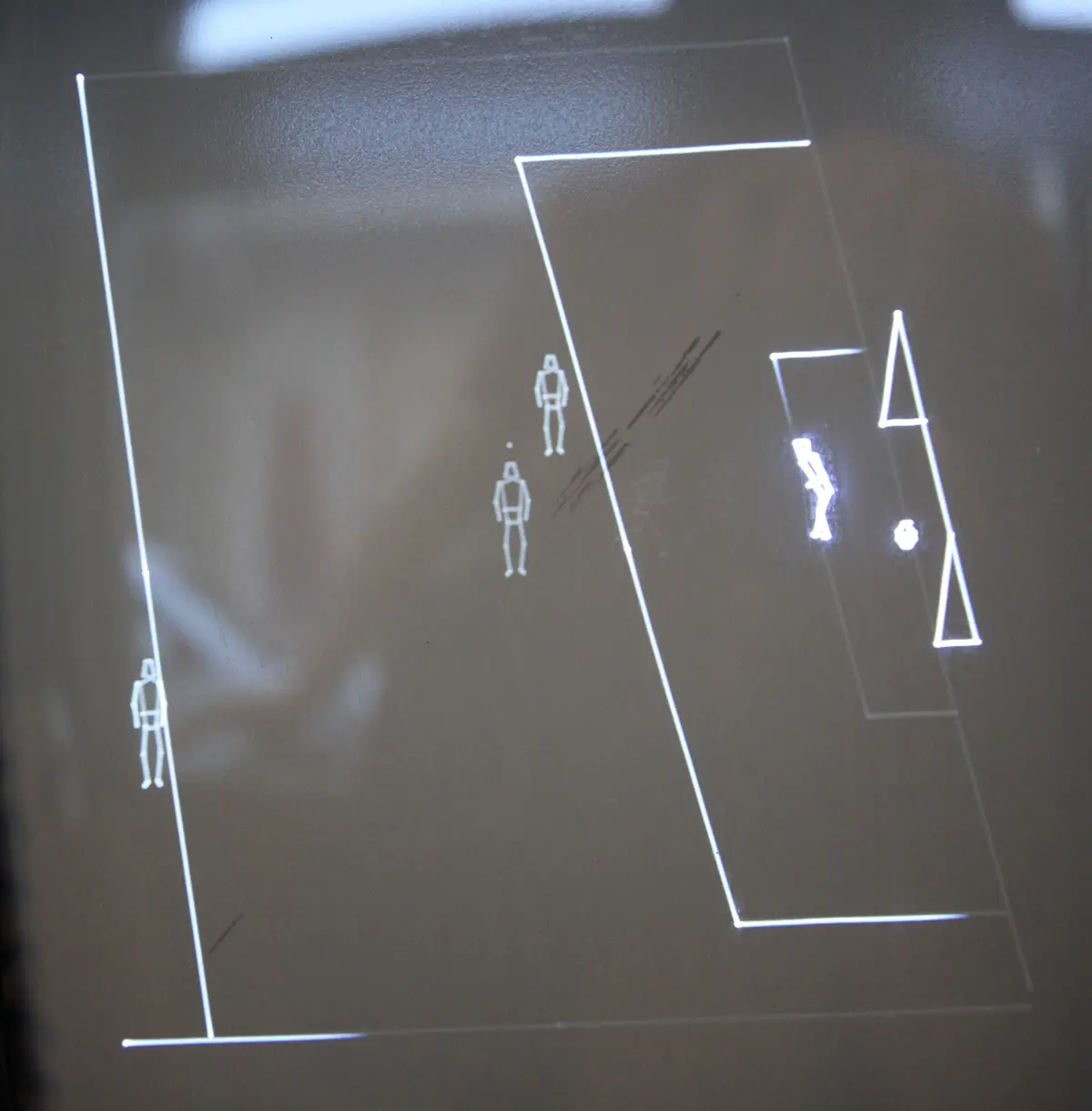
Crisp, bright and constantly moving
Straight lines remained smooth at every angle. Bright points and intersections acquired an almost neon glow. At the same time, the display had to redraw the picture before the phosphor faded.
With many objects, the result could flicker. Solid areas, photographic detail and natural colour images were difficult. The limitation became the style: wireframes, starfields, lettering and geometric figures.
04 / The machine behind the beam
Digital game code and analogue deflection met in one unusual system
The Motorola 68A09 processor ran at 1.5 MHz. Through a 6522 interface chip, it fed a digital-to-analogue converter and integrators that determined the electron beam’s X and Y position. Brightness was switched separately.
8-bit processor for game rules, object lists and control.
Two 2114 chips; cartridges supplied the additional game code.
A DAC and integrators turned values into physical beam deflection.
Sound and controller input combined in one versatile chip.
The 8 KB internal ROM contained not only Mine Storm, but routines cartridges could call to draw lines and text or make sounds. This saved valuable cartridge space and gave games a recognisable technical foundation.
05 / Mine Storm is always ready
The built-in game became a welcome, a demonstration and an unlikely collectible
Mine Storm placed a small spacecraft among drifting mines. Rotation, thrust, firing and hyperspace made the relationship with Asteroids clear, while different mine types gave it a rhythm of its own.
The game started automatically after switch-on whenever the cartridge slot was empty.
The original version could crash on reaching level 13. Owners who complained received a corrected cartridge.
Because few players got that far and requested a replacement, the corrective cartridge became scarce.
The story is typical of Vectrex: even without separate software, the machine had a convincing calling card, and a technical error later produced one of the catalogue’s strangest variants.
06 / Colour in front of the screen
Transparent overlays turned white lines into complete game worlds
The picture tube remained monochrome. Every commercial cartridge therefore came with a printed plastic overlay that clipped in front of the screen. Coloured fields, frames, logos and instructions stayed still as the vector figures moved behind them.
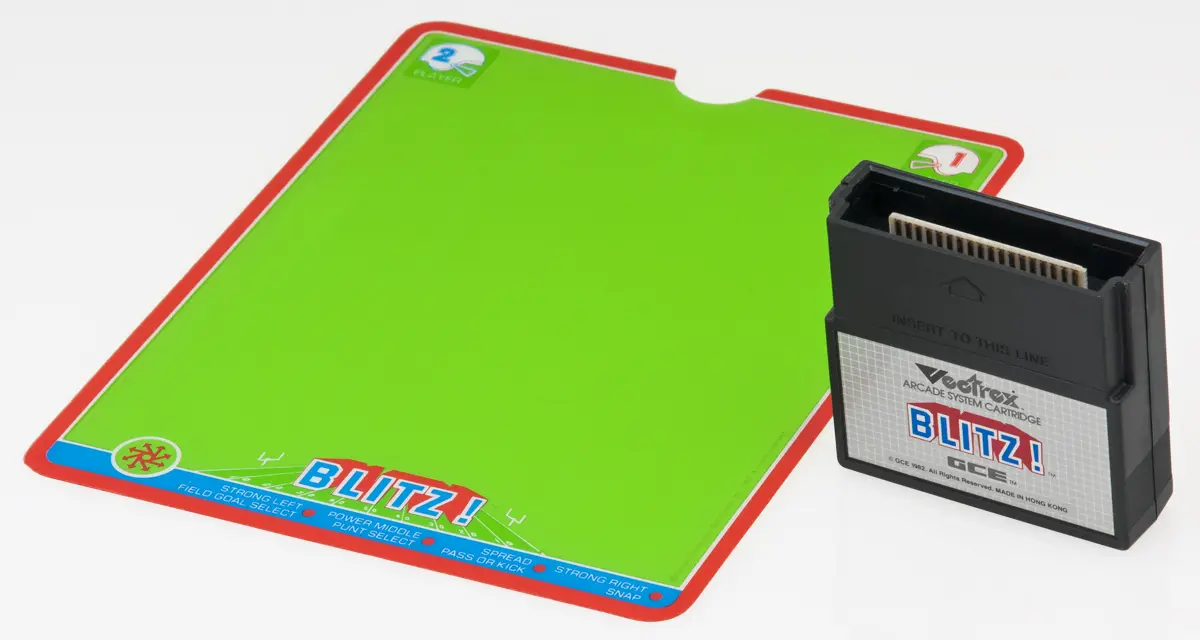
A physical graphics layer
A blue region could suggest space, a red field danger and printed text a scoring area. Some overlays also showed which controller buttons belonged to the game.
The trick recalled Magnavox Odyssey’s television overlays, but worked more convincingly here: the sharp moving light lines genuinely seemed to float within the coloured artwork.
07 / Analogue control
The self-centring joystick knew not only direction, but distance
Many contemporaries used digital switches: left was on or off. The Vectrex controller measured horizontal and vertical position continuously. Games could therefore distinguish a slight movement from full deflection.
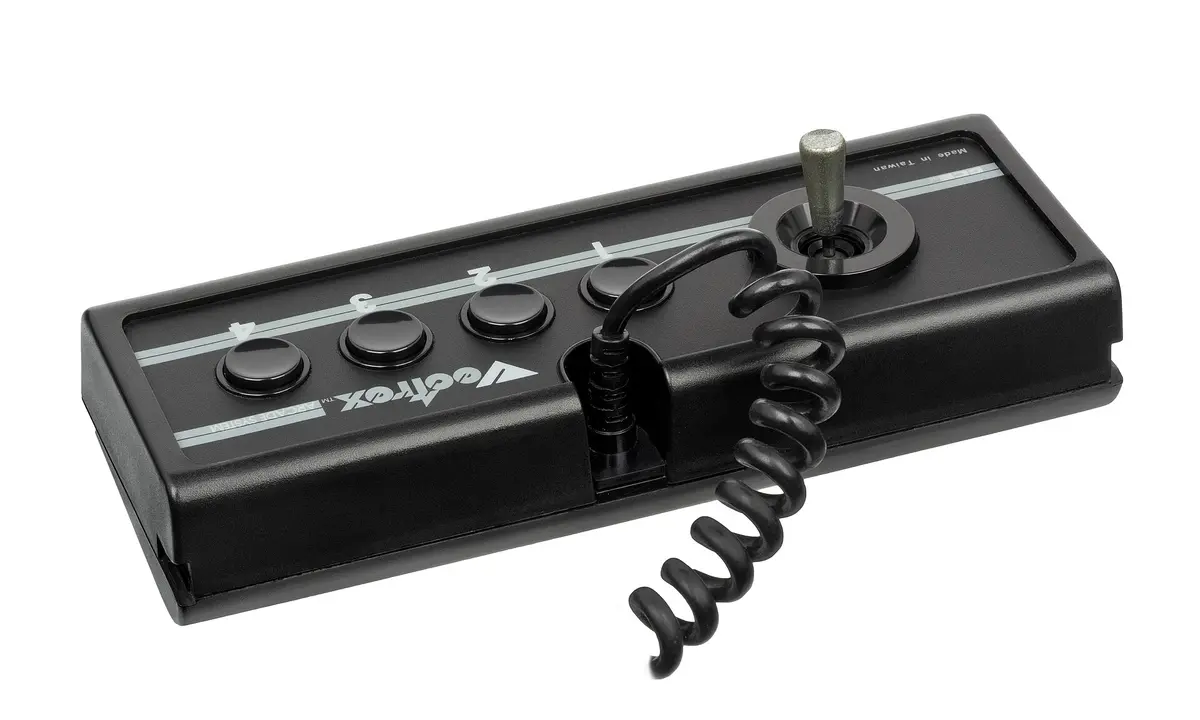
Simple on the outside
- Analogue stick
Two axes and a spring that returned the stick to centre.
- Four buttons
Neatly numbered; overlays and manuals translated them into game actions.
- Stowable
Cable and controller disappeared below the screen, turning the cabinet into one unit.
Not every game used the full analogue precision. Even so, the stick suited the machine perfectly: a proprietary control method for proprietary display technology, independent of the standard Atari had established.
08 / A library of geometry
Arcade conversions and new designs had to speak the same language of lines
Games that already used vector displays in the arcade felt natural. Raster hits had to be reinvented: no coloured sprites or tiled backgrounds, but contours, symbols and clever movement.
Armor Attack
Tanks and helicopters move through a city printed partly on the overlay.
Star Castle
Rotating rings protect a cannon in an elegant battle of lines.
Rip Off
Co-operative defence of fuel cells against groups of intruders.
Scramble
A raster classic remade as glowing mountains, missiles and fuel tanks.
Hyperchase
Road markings and obstacles rushing towards the player create speed.
Spike
Platform action with simple speech — unusually expressive for a vector game.
Berzerk, Cosmic Chasm, Solar Quest and Web Wars also showed how much variety the same visual limitation could hold. The official library remained small, but almost every game is immediately recognisable as Vectrex.
09 / The display becomes an input
The 3-D Imager and Light Pen made the built-in screen stranger still
Because GCE controlled both the picture tube and its timing, it could design accessories that were far more difficult to use with an ordinary television. Two ambitious expansions actually reached shops.
A spinning colour wheel for each eye
A motorised disc with coloured segments rotated in front of one eye at a time. Synchronised pictures gave each eye a different perspective, creating limited colour and stereoscopic depth.
Supported by titles including 3D Crazy Coaster and 3D Mine Storm.Drawing directly on the picture tube
The light pen registered the instant the moving vector beam passed its tip. Software could calculate a screen position and turn touch into lines, notes or animation.
Used by Art Master, Melody Master and AnimAction.Both accessories were expensive and received little software. That is precisely why they capture Vectrex so well: designed not for compatibility or mass appeal, but for experiments that made sense only on this one machine.
10 / A brief flash of light
From prototype to cult machine in barely three years
Vectrex entered the market as the second console generation peaked and disappeared when North American retailers lost faith in video games.
Mini Arcade
Smith Engineering builds the first vector-game prototype around a small CRT.
Vectrex arrives
GCE launches the self-contained system in the United States for $199.
Milton Bradley
The toy company acquires GCE and carries the console into more markets.
Europe and Japan
The European rollout follows in May; Bandai introduces a Japanese edition in June.
Production ends
Price cuts cannot offset the effects of the North American market crash.
New cartridges
A royalty-free invitation to hobbyists helps establish an active homebrew tradition.
11 / Sources & further reading
Explore further
- Vectrex Museum — the history of Smith Engineering, GCE and Milton Bradley
- General Consumer Electronics — Vectrex Service Manual
- Vectrex — collection of original game and accessory manuals
- Game Developer — A History of Gaming Platforms: The Vectrex
- Vectrex Museum — Mine Storm and its level-13 fault
- Vectrex.be — Jay Smith and the development of Vectrex
Image credits
Vectrex console — Evan-Amos, CC BY-SA 3.0; resized and converted to WebP
Vectrex controller — Evan-Amos, public domain; resized and converted to WebP
Vectrex cartridge and overlay — Evan-Amos, CC BY-SA 3.0; resized and converted to WebP
Vectrex display — Florian Schäffer, CC BY-SA 4.0; resized and converted to WebP


