Console 08 / 1983–1986
Famicom and NES:
one console, two identities
In Japan it was a red-and-white Family Computer that openly looked like a toy. In the West, nearly the same technology became a grey Entertainment System that distanced itself from earlier consoles. Nintendo invented not one machine, but two ways of understanding it.
01 / Donkey Kong as the yardstick
Nintendo did not ask for a collection of chips, but for the arcade at home
When Nintendo president Hiroshi Yamauchi commissioned a new console in 1981, he set a hard commercial requirement: competitors should not be able to catch it easily for about three years. Hardware leader Masayuki Uemura translated that into a concrete technical goal — could one affordable chipset run a convincing Donkey Kong?
The Donkey Kong arcade board used many separate components. Nintendo and Ricoh had to reduce its processing, picture functions and sound to a cheap system that could be manufactured by the million. Ricoh proposed a modified MOS 6502 processor, less familiar in Japan than the Z80.
This was more than a choice of speed. Nintendo owned the game, employed its designers and understood the arcade hardware. It could develop product and console together instead of building a general machine and hoping that a convincing application would follow.
The Family Computer appeared on 15 July 1983 for ¥14,800. Its three launch games were Donkey Kong, Donkey Kong Jr. and Popeye: not abstract demonstrations, but recognisable Nintendo arcades on cartridges.
02 / The Family Computer
The Japanese machine was not ashamed to be a toy
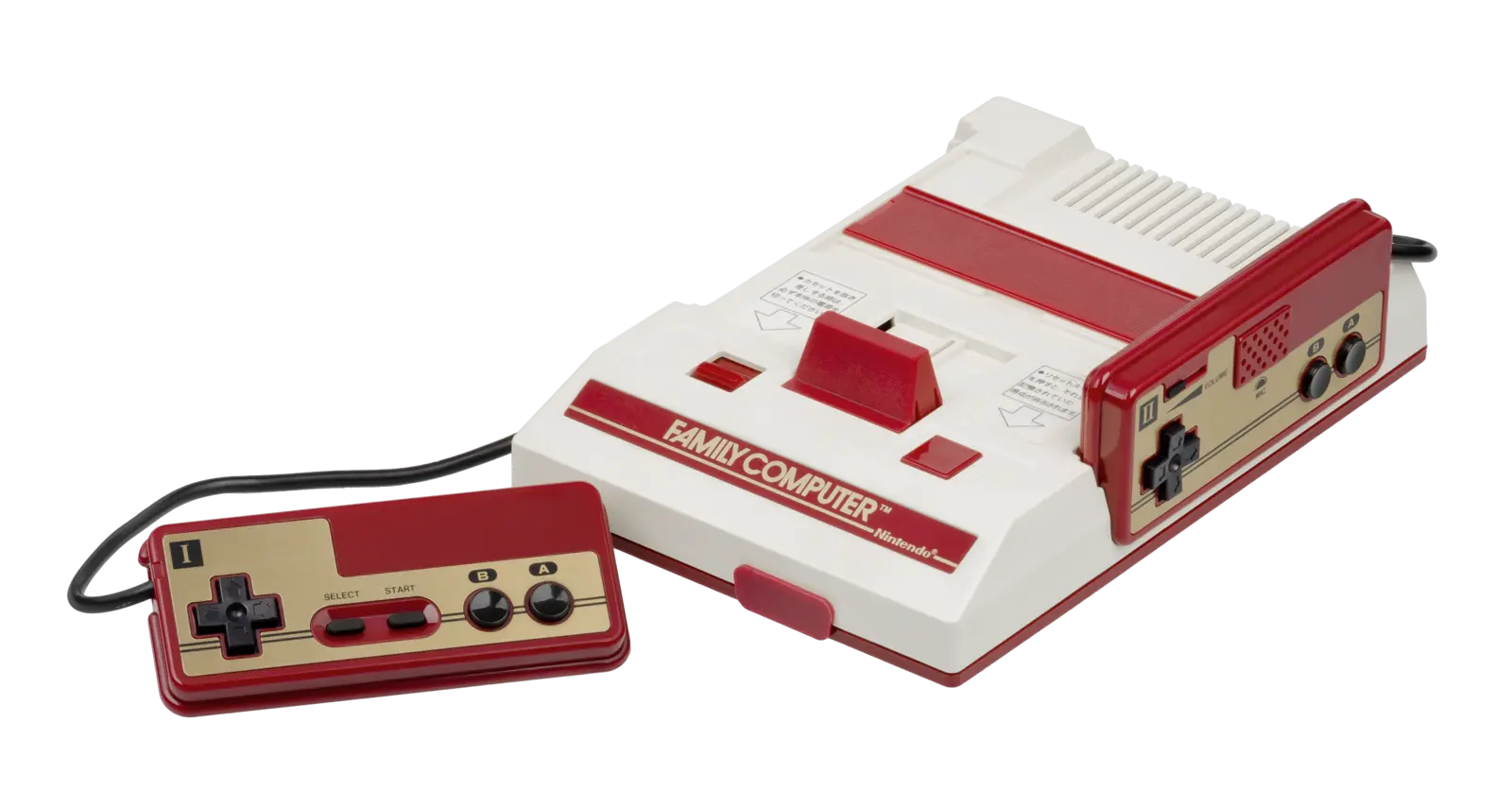
Cream, dark red and gold made Famicom cheerful and domestic. Its two controllers were hard-wired with short cables and slotted into recesses on either side. Controller II lacked Start and Select, but gained something far stranger: a microphone.
Hard-wired controls
Always complete and hard to lose, but cables could not be replaced easily when damaged.
Microphone
Uemura had karaoke in mind. Only a few games ever used the microphone as a real input.
Expansion port
Light gun, keyboard, mahjong controls and other Japanese accessories gained a direct connection.
The name was equally deliberate. As ‘personal computer’ and ‘home computer’ sounded modern, Nintendo chose ‘Family Computer’: not a tool for one technically minded owner, but a machine for the living room. The public naturally shortened the name to Famicom.
03 / The Entertainment System
In America, the same console was not supposed to look like a console
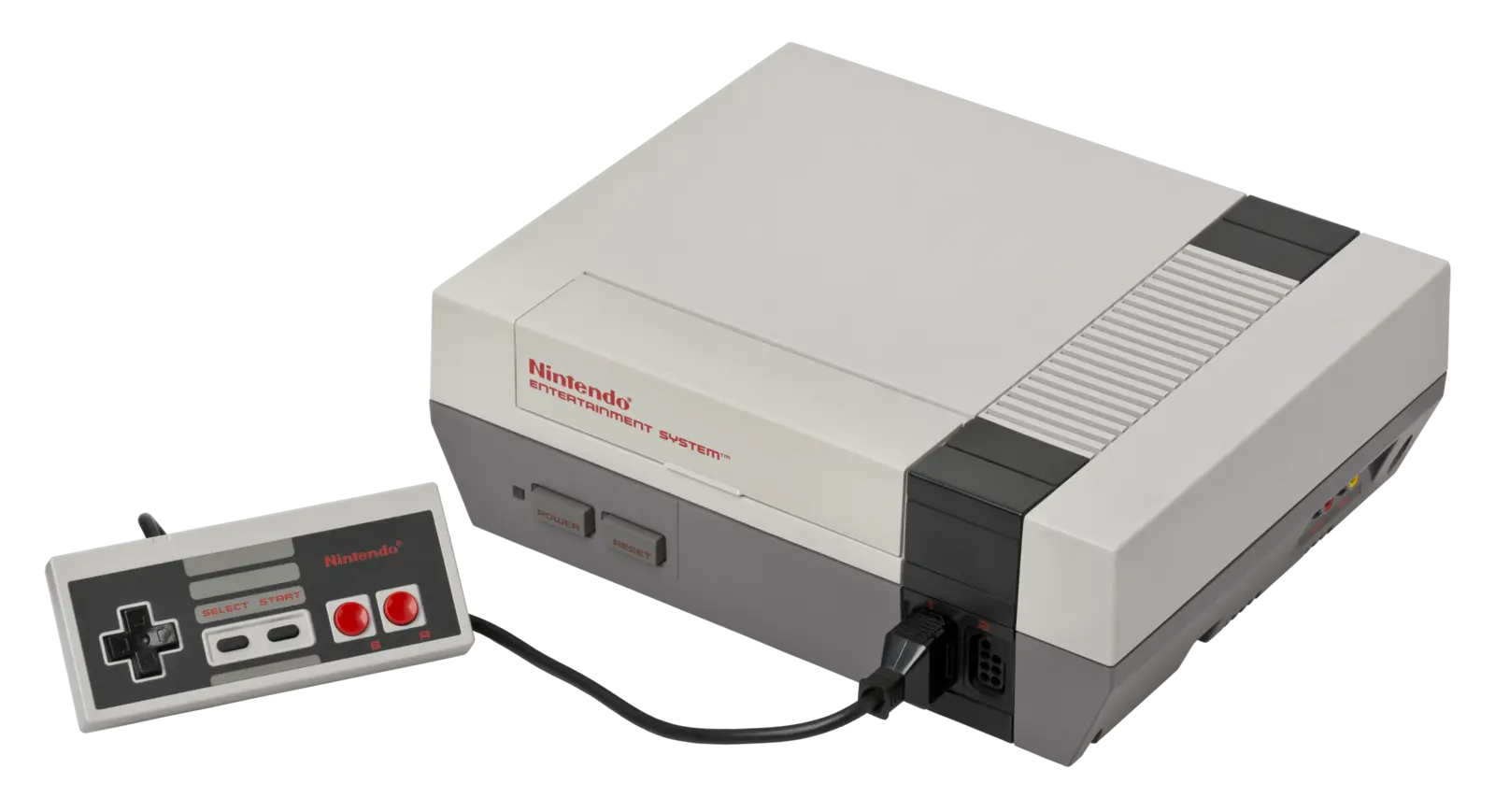
After the collapse of the American home videogame market, many retailers wanted nothing more to do with ‘video games’. Nintendo of America therefore changed not only the casing, but the language. This was no Video Game System, but a Nintendo Entertainment System.
The small Japanese cassette became a large grey Game Pak with a security chip.
Two identical controllers received their own sockets and longer cables.
The cartridge disappeared behind a flap and pressed down like a videotape.
Grey, black and red replaced the emphatic Japanese colour scheme.
The front loader shielded the contacts and suited dry American homes, where static electricity posed a greater risk. It also gave the machine the posture of a VCR. Beneath the new case, the family resemblance was clear: the same processor architecture, picture logic and game designs.
04 / The robot at the door
R.O.B. did not need to succeed to complete his most important job
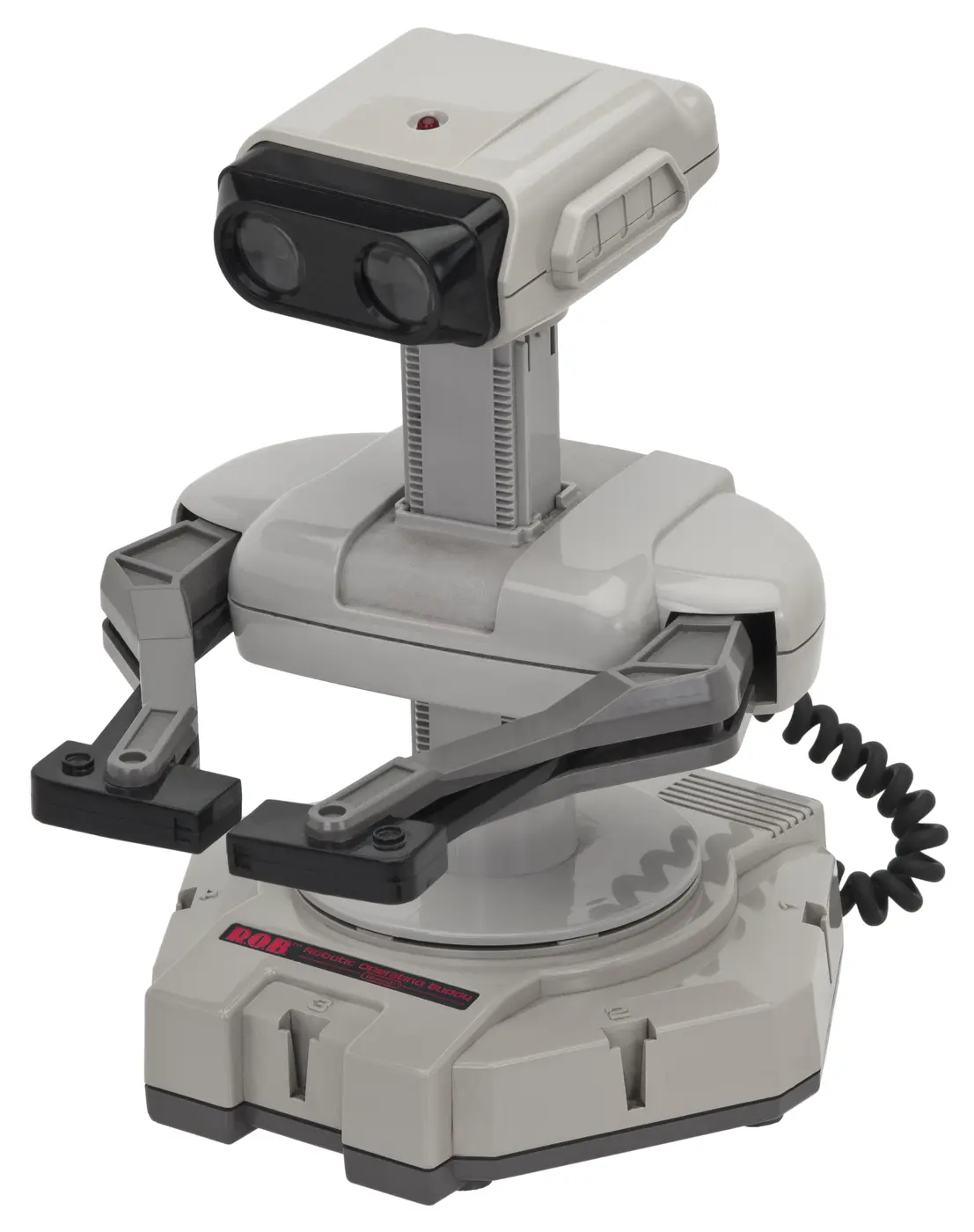
For the limited New York test launch in October 1985, Nintendo offered to take unsold stock back from retailers and set up displays itself. The Deluxe Set placed not the ordinary controller, but the Zapper and R.O.B. — the Robotic Operating Buddy — at centre stage.
An optical co-player and a marketing instrument
R.O.B. watched flashing commands on a CRT with light sensors and slowly moved discs or spinning tops. Only Gyromite and Stack-Up supported him. As a control method, it was cumbersome.
In a shop he did something more important: he made the package look like interactive play from the future. R.O.B. helped Nintendo distinguish its product from the previous generation’s discounted consoles. Once the NES could sell on the strength of its games, his role was largely over.
05 / One technical heart
Processor, picture chip and cartridge divided the work between them
The Ricoh 2A03 combined a modified 6502 core with five sound channels. The separate PPU built the television image from small tiles and up to 64 sprites. With only 2 KB of working memory, every moving object had to be managed carefully.
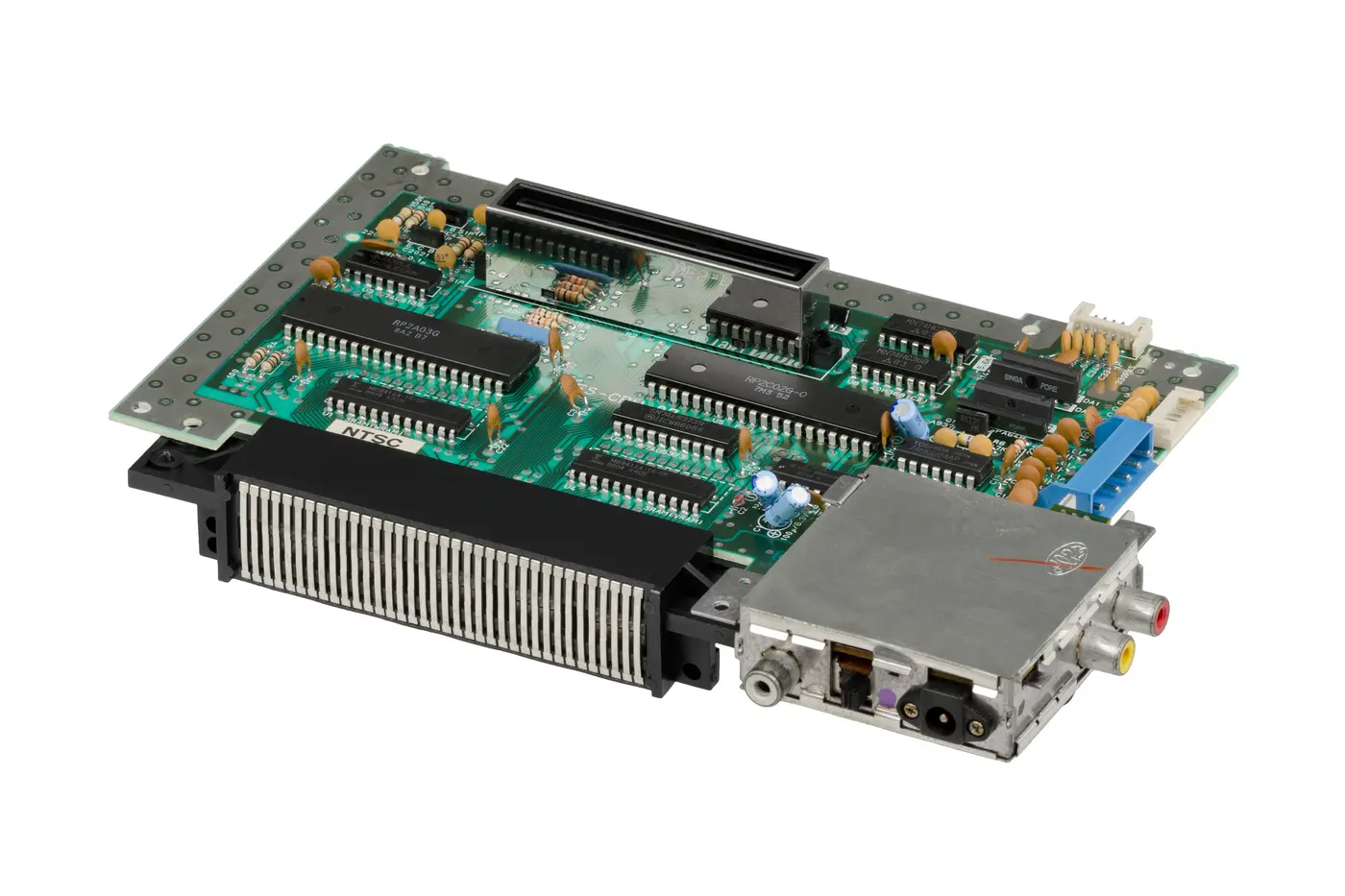
6502 family at 1.79 MHz in NTSC systems, with pulse, triangle, noise and sample audio.
256 × 240 pixels, tile backgrounds and 64 hardware sprites.
Working memory for game state and separate video memory for screen layout.
Program and graphic tile data, later joined by memory and control chips.
The European PAL NES used adapted 2A07 and 2C07 chips and ran at 50 Hz. Many early conversions were not fully adjusted to this different timing, making European games run slower and display black borders. The same console did not feel precisely the same everywhere.
06 / Eight directions, four choices
The gamepad made sophisticated control smaller rather than larger
Nintendo carried the directional cross over from its handheld Game & Watch line. Four digital directions sat beneath one thumb; the other hand received A and B. Start and Select replaced functions for which other consoles used keypads or switches.
The rectangular NES controller could dig into the hands during a long session, but its visual grammar was immediately legible. No overlays, numeric keys or removable joystick: the game had to communicate its possibilities with few buttons. That restriction became a design standard inherited by almost every later gamepad.
07 / A language without a manual
Super Mario Bros. taught movement through the world itself
When Super Mario Bros. appeared in 1985, it impressed with more than smooth horizontal scrolling. World 1-1 rationed information. Mario began on the left, faced right and gave the player time to try the directional pad before the first Goomba approached.
An empty stretch of ground explained direction and speed without text.
The first enemy forced discovery of A; a question block rewarded the same movement.
Coins, pipes and hidden blocks taught that the world contained more than its direct route.
The game made controller, scrolling and level layout one language. That mattered more than a list of technical achievements: children who never read a manual could learn by watching, trying and starting again.
08 / The console grew inside its cartridge
Mapper chips gave 1983 hardware years of new possibilities
The earliest cartridges connected ROM almost directly to the processor and PPU. Larger games quickly exceeded the addressable space. A mapper chip could expose different memory banks during play and later manage scrolling, interrupts, extra RAM and storage.
CPU, PPU, RAM and input remained unchanged.
Switched code and graphic data into the available windows.
More levels, better scrolling, saving and new effects.
09 / Quality as lock and key
Nintendo restored confidence by becoming referee and gatekeeper at once
Famicom began as a system for which Nintendo expected to make the software itself. When Hudson, Namco and other publishers asked to join, a licensing model emerged. On NES, that control was enforced technically by the 10NES chip.
A publisher needed permission
Nintendo reviewed titles, controlled manufacturing and tied its seal to officially approved Game Paks.
Two chips checked one another
A master chip in the console expected the correct data stream from a chip in the cartridge. Without it, the system kept resetting.
Tengen sought its own key
Atari Games developed the Rabbit chip to publish cartridges without a Nintendo licence. The struggle ended up in court.
Nintendo presented this as protection against the overproduction and uneven quality of the earlier American market. It made shelves more orderly, but also concentrated unprecedented power in the console maker. NES did not merely restore the old market; it replaced it with a more tightly managed platform.
10 / A different Europe
In the Netherlands, Nintendo did not arrive as the inevitable sole ruler
NES reached Europe from 1986 through several distributors. The market here was less empty than the familiar American rebirth narrative implies: inexpensive home computers were deeply established and Sega’s Master System offered a visible console rival.
Bandai managed Nintendo products in the Dutch market. Only in 1993 did Nintendo establish a Netherlands subsidiary and take distribution over.
Regional security and television standards divided European cartridges into incompatible groups, commonly identified as PAL-A and PAL-B.
NES competed with machines on which families not only played, but programmed, drew and completed homework.
That makes Europe’s history less tidy and more interesting. Nintendo became important, but NES meant something different in each country. To many Dutch players it was one desirable system alongside Commodore, MSX, Atari and Sega — not the only machine that defined the decade.
11 / One generation, two stories
From Japanese family machine to global platform
The system changed its appearance, distribution and storage format while its technical foundation remained recognisable for nearly a decade.
The brief
Yamauchi asks Uemura to build a cartridge console that can stay ahead for years.
Famicom
Nintendo launches the Family Computer in Japan with three arcade conversions.
Third parties
Hudson and Namco are among the first outside companies to publish Famicom cartridges.
New York
NES starts cautiously in an American test market, with R.O.B. and Zapper as attractions.
Europe and disk
NES reaches Europe; Japan receives the Famicom Disk System with rewritable media.
New shape, long tail
Compact top-loaders appear and Nintendo Netherlands takes distribution over from Bandai.
12 / Sources & further reading
Explore further
- Nintendo — Iwata Asks: NES & Mario, with Masayuki Uemura
- Nintendo — official Famicom timeline and hardware history
- Nintendo Europe — company history, European launch and the Netherlands
- NESdev Wiki — processor, memory and cartridge architecture
- NESdev Wiki — technical documentation of the picture processor
- U.S. Court of Appeals — Atari Games Corp. v. Nintendo on 10NES
- Wired — the New York NES test launch
Image credits
Nintendo Famicom — Evan-Amos, public domain; resized and converted to WebP
Nintendo Entertainment System — Evan-Amos, public domain; resized and converted to WebP
R.O.B. — Evan-Amos, public domain; resized and converted to WebP
NES motherboard — Evan-Amos, public domain; resized and converted to WebP


