Console 09 / 1985–present
Sega Master System:
one console, three lives
In Japan it remained in the Famicom’s shadow. In America it lost the fight for store shelves. Yet in Europe and Brazil the same 8-bit machine lived a different history. Master System proves that a console’s success depends on where you stand.
01 / Before the name
Master System began not as a reply to NES, but as a third attempt
The familiar story places two boxes opposite one another: Nintendo’s NES and Sega’s Master System. That pairing barely existed in Japan. The technology appeared there in October 1985 as Sega Mark III — the third step in a line that began with SG-1000 and SG-1000 II.
Sega wanted to move forward without immediately abandoning loyal owners. Mark III accepted older Japanese SG-1000 cartridges and added a slot for flat My Cards. At the same time its video hardware was thoroughly renewed. Backward compatibility and a leap ahead occupied the same white case.
The machine was designed with Sega’s System 2 arcade hardware in mind. That explains its first identity: not a neutral living-room computer, but a device intended to shrink the colour, motion and pace of Sega’s arcades to television scale.
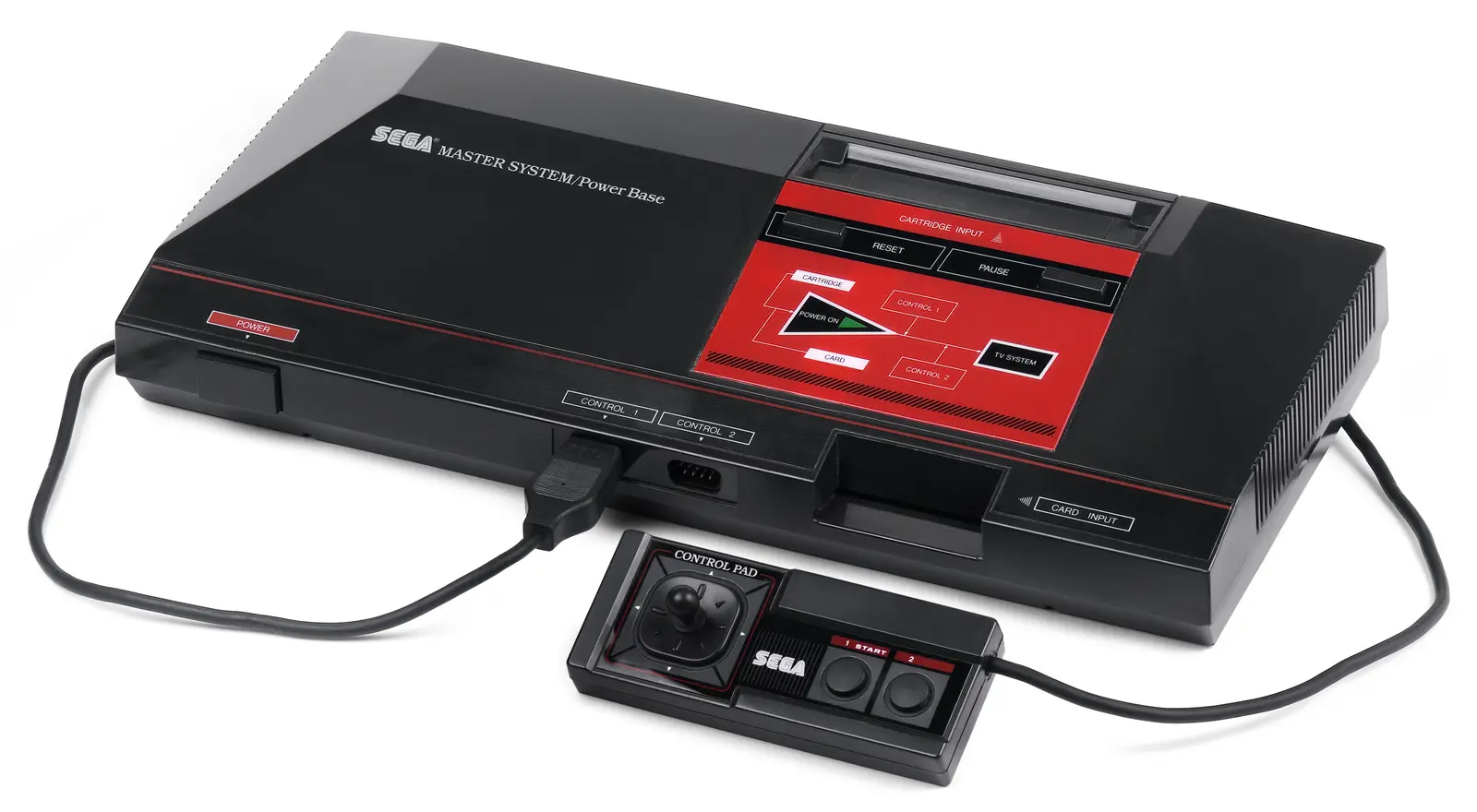
Only for export did Mark III receive a larger black-and-red shell and a far more ambitious name. ‘Master System’ sounded not like version three of an unfamiliar Japanese family, but like a complete, self-assured platform.
02 / A Western uniform
The case sold technology; the grid sold order
The Western Master System looked like a device in control of something serious. Its asymmetric black case, red triangle and long technical labels suggested an instrument panel. Its boxes did the opposite: white space, a black grid and austere line drawings.
Black and red
Not friendly toy colours, but the appearance of fast consumer electronics.
The white grid
Games from unrelated genres became one recognisable family on the shelf.
Power Base
Even ‘console’ gave way to words that promised power and control.
The packaging was later mocked for looking bare, but it solved a real problem: Sega had no Mario to unite every box. The grid therefore allowed the system itself to act as the brand. Each game looked like an entry in the same technical catalogue.
03 / The arcade as an impossible measure
Sega sold not perfect conversions, but recognisable echoes
Sega possessed something Nintendo displayed less insistently: a range of spectacular arcade machines. Hang-On, Space Harrier, Out Run and After Burner delivered speed, scale and movement that an affordable 8-bit console could never reproduce in full.
16-bit processors, specialised chips, a large display and loud sound.
The same colours, enemies and music rebuilt within fixed limits.
Not a miniature arcade board, but a home game that felt close enough.
The gap itself made those conversions interesting. In Space Harrier, developers constantly rewrote background tiles to suggest large figures. The screen became not a photographic copy of the arcade, but a sequence of clever counterfeits. Sega’s arcade heritage was both its strongest sales pitch and its most impossible promise.
04 / Colour with memory of its own
The video chip gave developers room, but no automatic beauty
The Z80A processor was familiar from home computers and earlier consoles. Sega’s Video Display Processor stood out: 256 × 192 pixels, up to 32 simultaneous colours from a palette of 64, horizontal and vertical scrolling, and 16 KB of dedicated video memory.
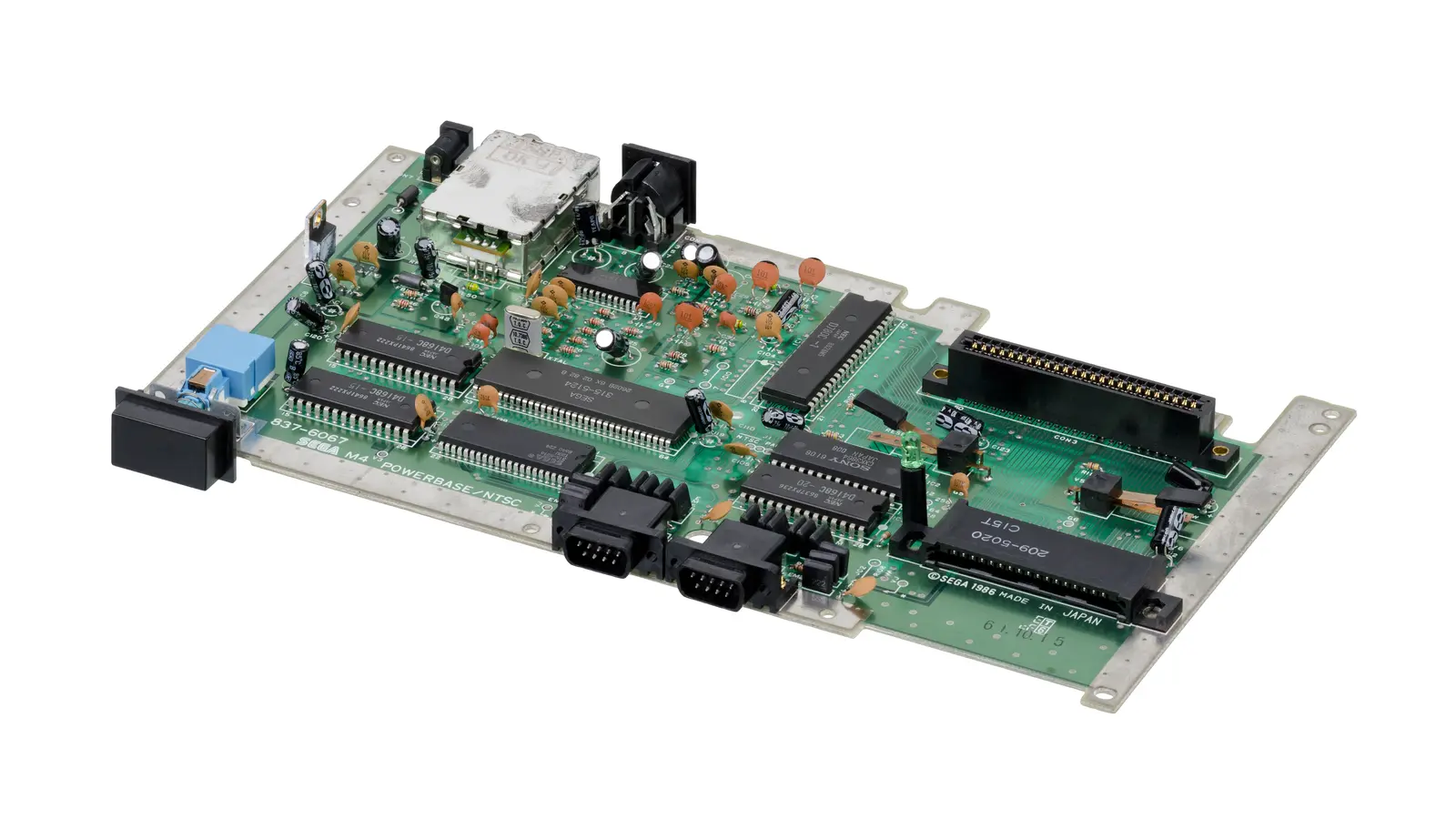
About 3.58 MHz in Western systems; familiar, affordable and well documented.
More simultaneous colour choice than bare comparisons with rivals often suggest.
Working RAM for game state and a notably generous separate store for video data.
Three tone channels and one noise channel; Japan’s Master System added FM sound.
Comparing NES and Master System through one specification is tempting and usually simplistic. Master System could look crisp and colourful; NES had different strengths and far more developers. Hardware defined the space in which a game could emerge, not how much imagination would automatically fill it.
05 / Two buttons and a walk to the box
The controller was simple; Pause lived awkwardly on the console
The Control Pad followed the new 8-bit grammar: a directional pad and two action buttons. Button 1 also served as Start in many games. Pausing, however, meant walking to the television and pressing the button on the Power Base.
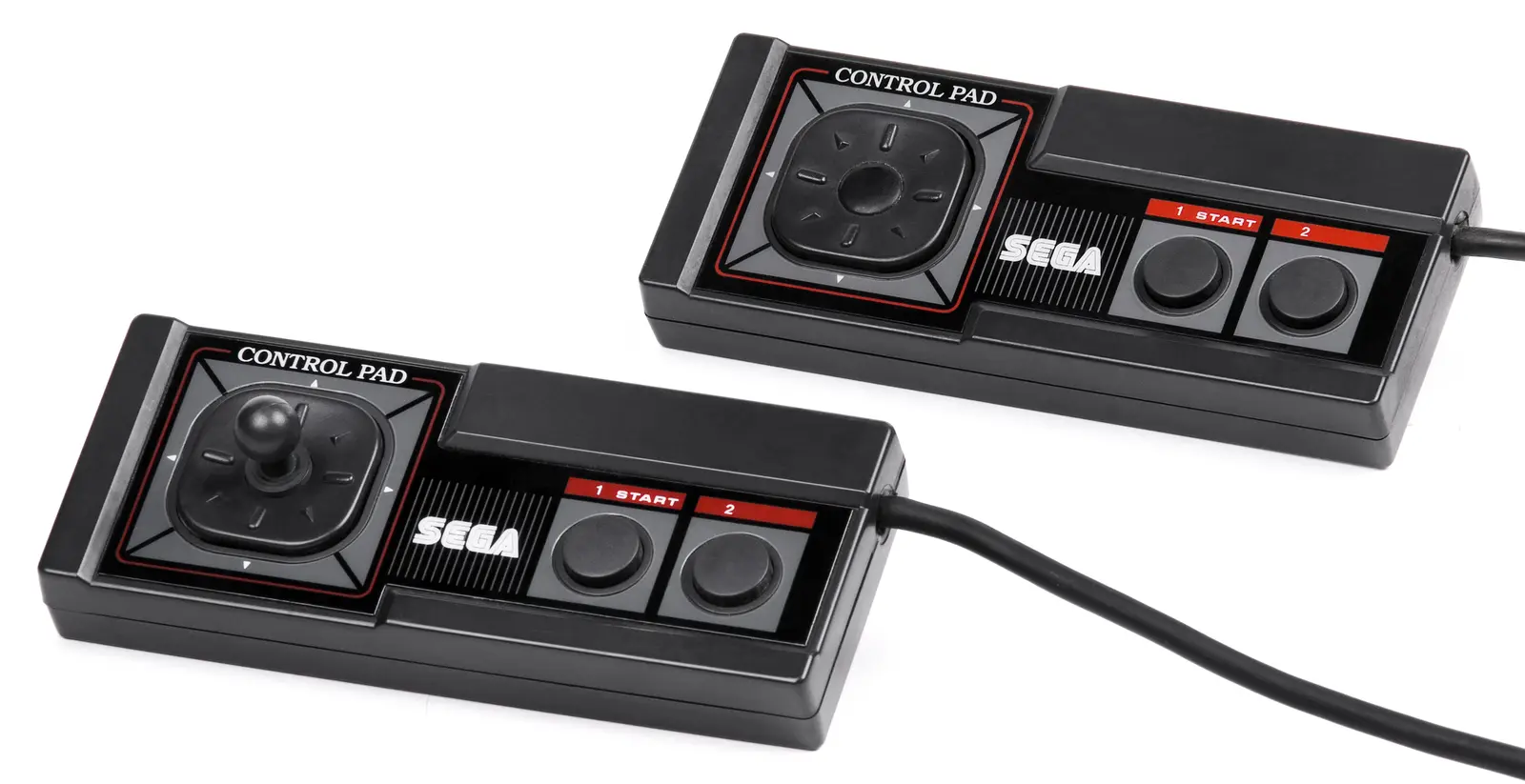
Almost a joystick, almost a gamepad
An early version had a threaded hole in the centre of its directional pad. A small screw-in stalk changed the flat pad into a miniature joystick. Later models abandoned that compromise.
The nine-pin connector resembled those used by Atari and Commodore, so simple joysticks often worked across systems. An identical plug did not mean every peripheral was electrically or functionally interchangeable.
06 / The format that vanished
Sega Card made software physically small
Alongside cartridges, the first model accepted cards roughly the size of a credit card and two millimetres thick. They were cheaper to manufacture and perfectly suited the idea of a modern system. Their 32 KB capacity soon became a constraint.
Thin, inexpensive and elegant — useful for compact early games such as Spy vs. Spy and Super Tennis.
Larger games and more elaborate worlds eventually made the cartridge the obvious medium.
The card slot found one unexpected second job. SegaScope 3-D Glasses used an adapter inserted there to darken their two lenses in turn, precisely synchronised with alternating images on a CRT television.
07 / A future that worked only on a tube
The 3-D glasses were more convincing than their small library
This was not red-and-blue cardboard but an active shutter system. Each eye saw a slightly different image in alternation. At the speed of a CRT display, real depth seemed to appear between them.
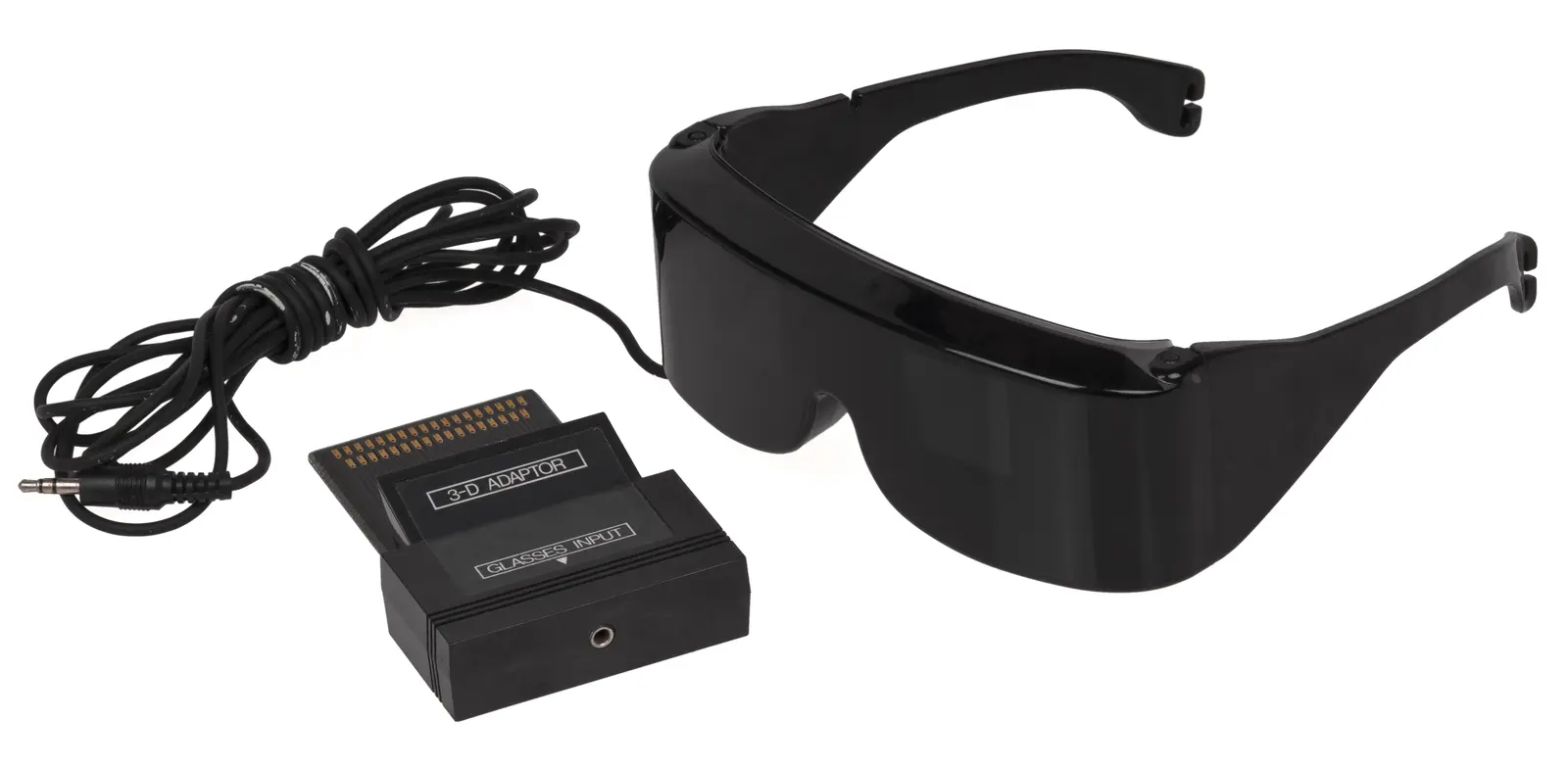
A peripheral that belonged to its moment
Space Harrier 3-D, Zaxxon 3-D and Maze Hunter 3-D used the technology. The effect could be strong, but flicker, eye strain, price and a small catalogue left the glasses at the margins.
Modern flat displays do not reproduce the original timing without workarounds. The glasses are therefore more than a curiosity: they preserve a play experience dependent on how an old television drew light.
08 / Three markets, three outcomes
‘Failed’ and ‘successful’ can both be true
In Japan, Sega faced a Famicom with an enormous software ecosystem. In the United States, Master System met Nintendo’s retail power, licensing terms and head start. Tonka took over distribution there but could not cure the shortage of a steady software flow.
Mark III and the enhanced Japanese Master System found a committed but limited audience. Mega Drive followed in 1988.
Strong hardware and Light Phaser bundles could not break Nintendo’s lead in retail, marketing and publishers.
Fragmented distribution became a strength: local companies, low prices and new PAL games kept the system visible.
Many English-language histories use the American sales battle as a world map. Master System then becomes a footnote before Mega Drive. From Europe it looks more like the foundation on which Sega’s later brand was built.
09 / The European main life
In the Netherlands Sega reached shops before Nintendo
According to surviving distribution records, Homesoft brought Master System to the Netherlands in October 1986, roughly a year before NES arrived there. Sega therefore did not fight Nintendo alone. Its everyday competition also included Commodore 64, MSX, Amstrad and Spectrum.
An early opening
The console could present itself as a direct arcade machine in a market where home computers were already ordinary.
New games after America
European developers and Sega kept releasing titles after the American catalogue had nearly stopped.
The game was already inside
Alex Kidd in Miracle World, then Sonic the Hedgehog, removed the need for a separate first-day cartridge.
Not everything needed to be global
Asterix, The Lucky Dime Caper and 8-bit versions of Mega Drive games gave Europe a late library of its own.
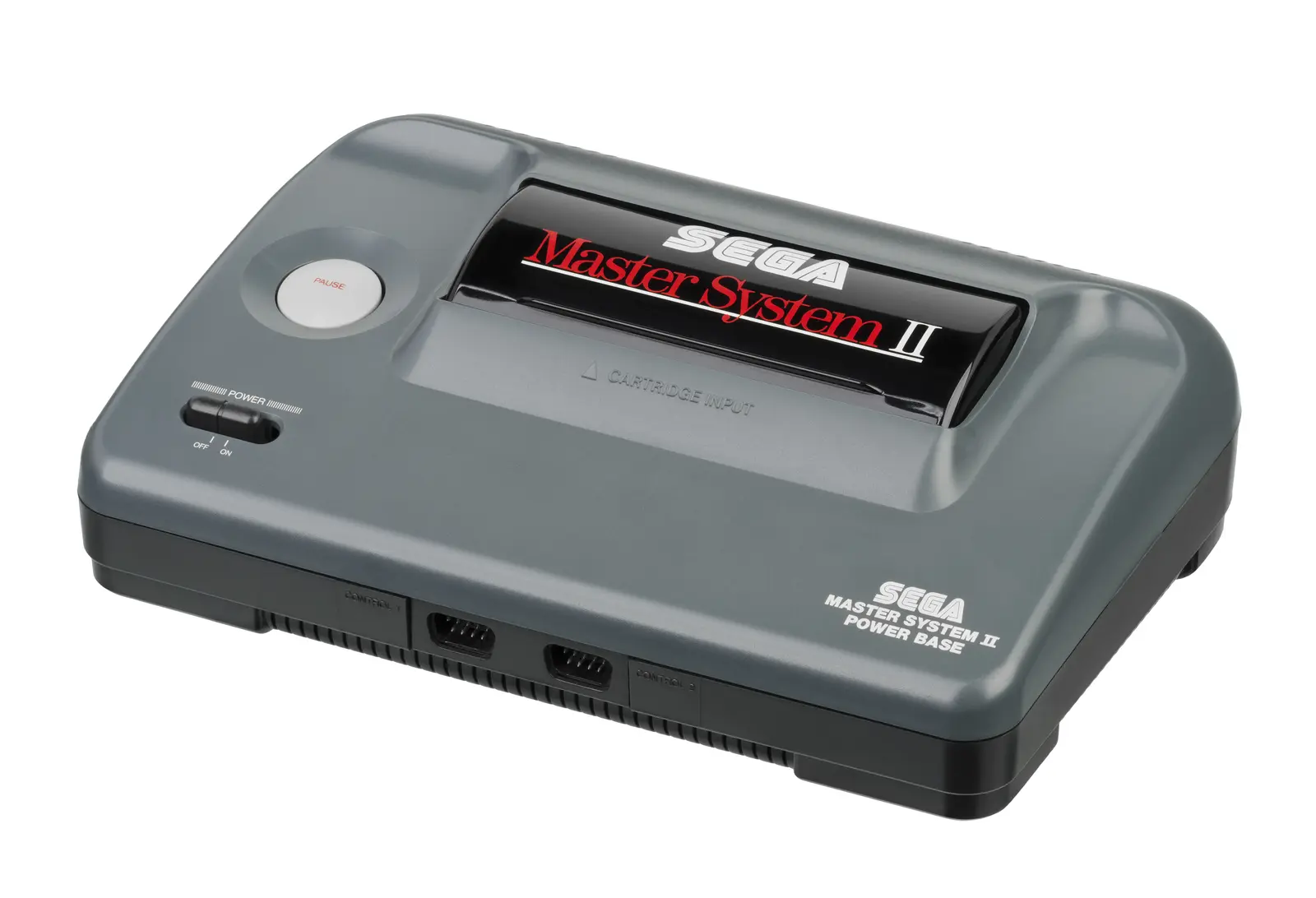
The austere Master System II extended the European life by removing features. As 16-bit Mega Drive drew attention, the 8-bit machine remained beside it as an inexpensive entry point. Sega was now competing not only with Nintendo, but with its own future.
10 / Brazil rewrites the console
Tectoy treated Master System not as an import, but as raw material
Tectoy introduced the console in September 1989 and received unusual freedom from Sega. The Brazilian company assembled hardware, translated games, offered telephone hints and connected familiar national characters to existing game worlds.
Mônica instead of Wonder Boy
Mônica no Castelo do Dragão turned Wonder Boy in Monster Land into an adventure starring Brazil’s famous comic character.
From Compact to Girl
Tectoy made its own models, including a wireless Super Compact and the bright-pink Master System Girl.
Cartridges became built-in collections
Later machines lost the slot and offered dozens or more than one hundred games directly from memory.
The Brazilian story reverses the usual product cycle. Normally, the manufacturer decides when a console is obsolete. Here, a local partner kept changing its meaning, shape and audience. Tectoy’s sale of Master System variants well into the twenty-first century makes this 8-bit machine less a closed product than a lasting format.
11 / One motherboard, many calendars
Master System did not run on the same clock everywhere
A timeline that nearly ends in Japan just as it properly begins in Brazil.
SG-1000
Sega places its first cartridge console beside Nintendo’s Famicom in Japan.
Mark III
New video hardware, two software formats and compatibility with Japanese predecessors.
Master System
The black-and-red export version reaches the US and, in October, the Netherlands through Homesoft.
Europe and Japan
European rollout expands; Japan gets a Master System with FM sound and built-in accessories.
Tectoy
The Brazilian partner begins the machine’s longest and most localised life.
Master System II
A lower-cost model with a built-in game keeps the European market accessible.
A format remains
Tectoy builds new plug-and-play variants with increasingly large game collections in memory.
12 / Sources & further reading
Explore further
- Sega — Hardware Story, part 2: from Mark III to Master System
- Sega — official Master System hardware description and specifications
- Sega — Mark III My Cards, expansions and accessories
- Sega of America — Master System Game Catalog (1986)
- Sega Retro — international distribution history, including the Netherlands
- ROMchip — Ricardo Martins, Sega and its Mônica’s Gang
- Tectoy — Master System Evolution with a built-in game collection
Image credits
Sega Master System set — Evan-Amos, public domain; resized and converted to WebP
Master System controllers — Evan-Amos, public domain; resized and converted to WebP
SegaScope 3-D Glasses — Evan-Amos, public domain; resized and converted to WebP
Master System circuit board — Evan-Amos, public domain; resized and converted to WebP
Master System II — Evan-Amos, public domain; resized and converted to WebP


