Console 10 / 1987–1994
PC Engine / TurboGrafx-16:
small machine, big story
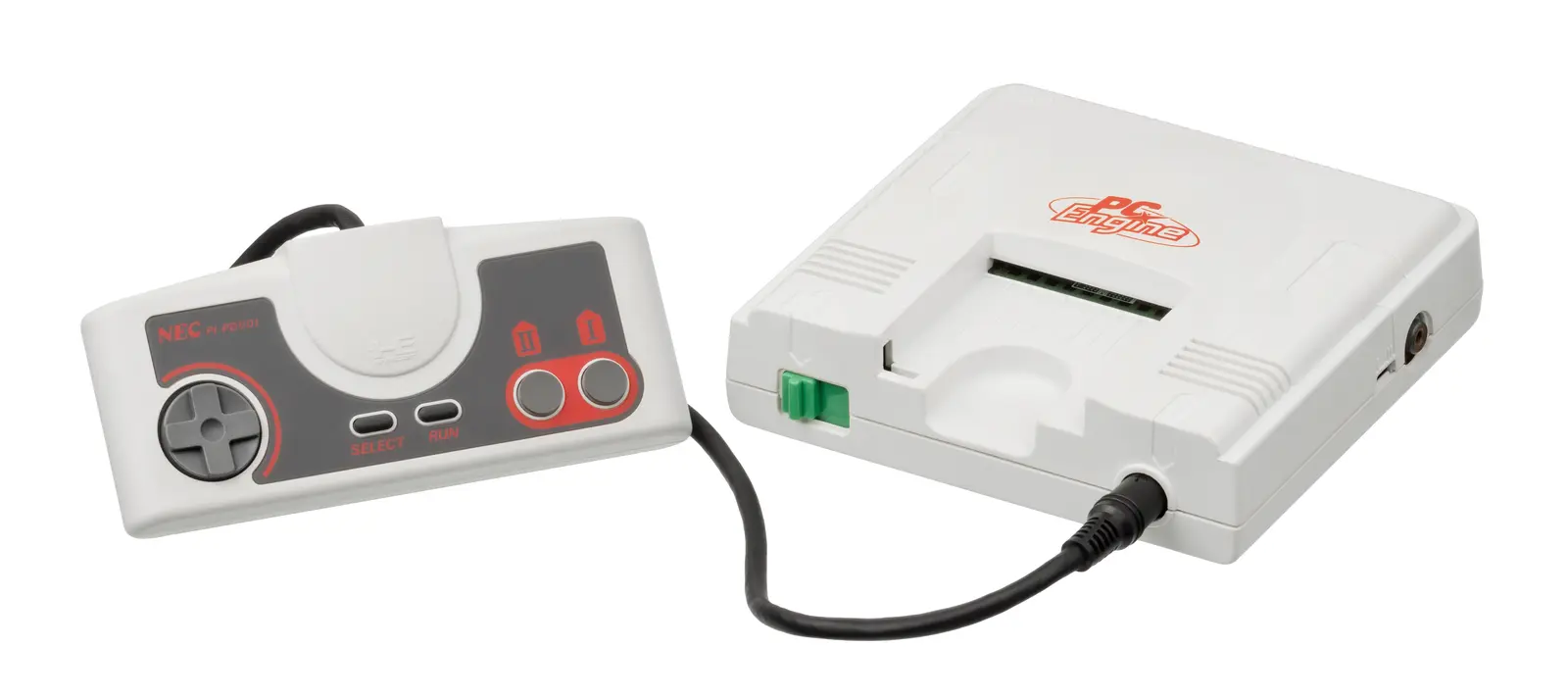
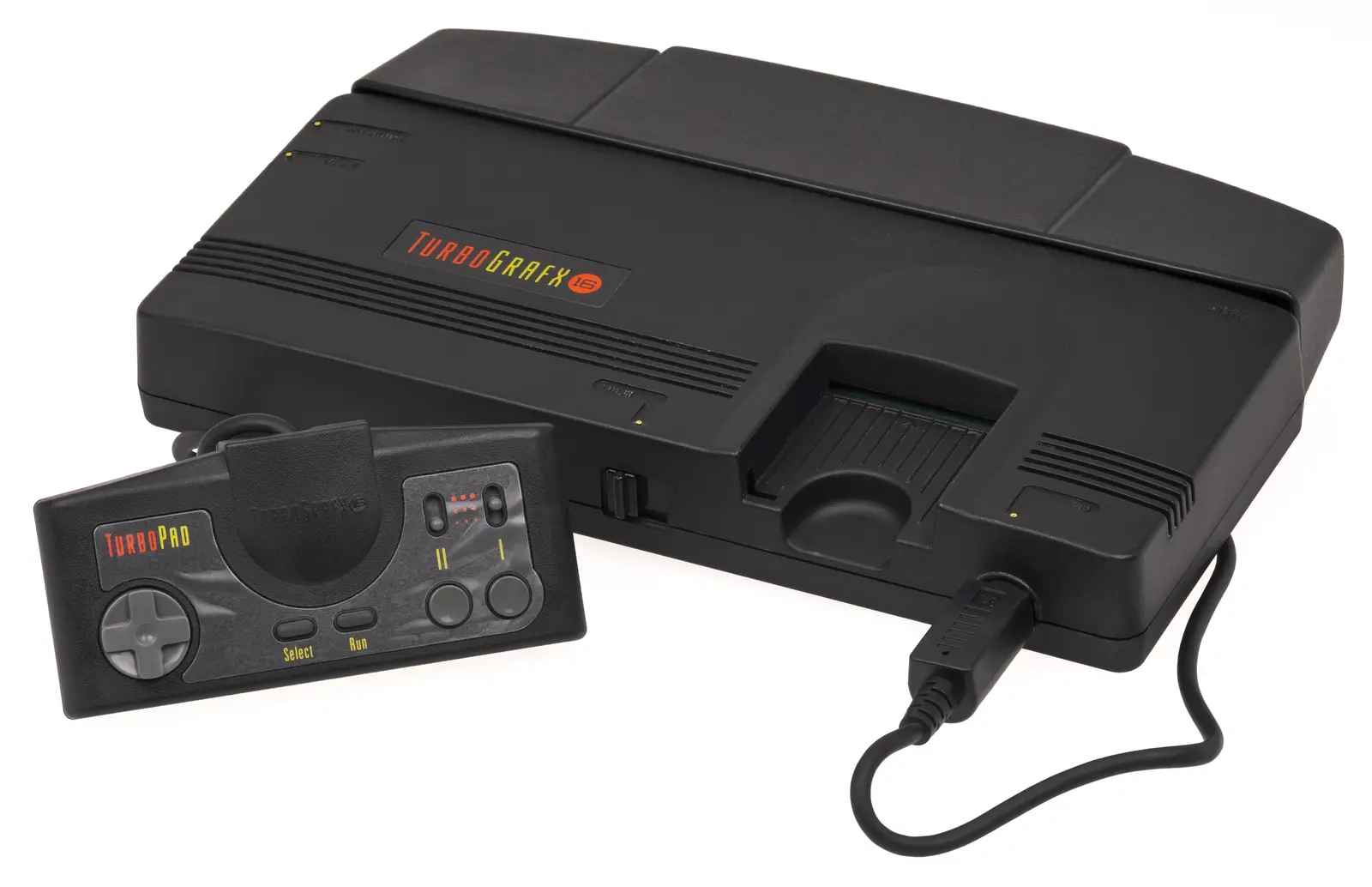
In Japan it almost fitted beneath a sheet of paper. In America, the same technology was placed inside a much larger black case and given a ‘16’ in its name. NEC and Hudson sold not one console, but two ideas of what power ought to look like.
01 / An unusual alliance
The chip came from a games company; the factory from a computer giant
Hudson Soft knew the Famicom from the inside. It made games, designed chips and had already experimented with flat Bee Cards on MSX computers. NEC knew semiconductors, displays and the successful PC-88 and PC-98 computers — but not the home console.
A developer that knew which limits troubled programmers and could offer its graphics designs to a hardware partner.
An electronics group with money, component expertise and a name that made ‘PC Engine’ sound credible.
That difference in background became the machine’s strength. The PC Engine was not a console to which games were added later; it began as a negotiation between people who made software and people who could manufacture hardware at scale.
02 / One board, two bodies
America did not trust a small console
The original PC Engine was remarkably confident: white, square and smaller than many game boxes. It did not imitate a computer or VCR. American market testing read that compactness differently. Small could mean cheap, light or insignificant.
NEC therefore placed the electronics inside an elongated black shell and changed the name. ‘Turbo’ promised speed, ‘Grafx’ turned display technology into a brand and ‘16’ positioned the machine beside a new generation. The work delayed launch until 1989 — just as Sega’s genuinely 16-bit Genesis defined the American comparison.
03 / Eight plus sixteen is not a generation
The number on the box was marketing, but not wholly invented
The HuC6280 is a fast 8-bit processor from the 65C02 family. For display work it partnered with two chips using 16-bit data paths: the HuC6270 Video Display Controller and HuC6260 Video Color Encoder. That did not make a tidy sum, but it did create an unusual balance.
8-bit · up to 7.16 MHz · six sound channels
Sprites, tiles, scrolling and access to 64 KB of video memory
Colour encoding from a palette of 512 possibilities
The machine could place many colourful sprites on screen, yet had only 8 KB of general working memory. That contrast makes its design more interesting than an ‘8-bit’ or ‘16-bit’ label. The PC Engine was purpose-built: frugal where game state lived, generous where the moving picture was assembled.
04 / The game as a card
The HuCard made the cartridge almost disappear
There was no thick cassette wrapped in an empty plastic shell, but a rigid card roughly the size of a bank card. Its contacts remained exposed and its print carried the game. Sliding the power switch right engaged a mechanism that kept the card from being removed under power.
A medium made to match the console
The white card and white PC Engine formed one compact object. In North America the same medium became the TurboChip, with eight connections rearranged so Japanese and American cards could not be used directly across regions.
The format was not merely elegant. Small cards were light to ship, quick to exchange and gave retailers a very different shelf from the NES’s large boxes.
05 / One port, five players
The sparsest connection led to the busiest sofa
The front offered only one controller port. Two or more players needed a TurboTap or MultiTap. What looked like a cost saving became part of Hudson’s social identity: as many as five gamepads on one console.
Bomberman offered the clearest demonstration. Four or five figures, one maze and bombs that made alliances useless within seconds. The technology was not only inside the console, but in the human commotion in front of it.
Dungeon Explorer used the same expansion differently: not a short arena, but a shared adventure. An apparently missing second port thus became the prompt for something many rivals did not offer.
06 / The arcade test
R-Type made the small box believable
Early buyers did not need to understand a specifications table. They only had to see Irem’s vast spaceship, waves of enemies and Force pod on a living-room television. Japan’s PC Engine version of R-Type was divided across two HuCards, but retained enough of the arcade game to function as a demonstration.
R-Type
Not a perfect copy, but the moment when physical size and visible power dramatically parted company.
Gunhed / Blazing Lazers
Projectiles, fast scrolling and power-ups turned the vertical shooter into a home language.
Soldier series
Hudson’s Caravan contests made short score attacks both a public event and a design standard.
The console became strongly associated with shoot ’em ups. Not because its hardware could manage only one genre, but because shooters made its strengths instantly visible: colour, sprites, speed and clearly readable patterns.
07 / A future beside the console
In 1988, CD-ROM became part of a game system
Japan’s CD-ROM² System arrived on 4 December 1988. The drive did not sit inside the console, but in its own Interface Unit onto which the small PC Engine clipped. A System Card in the HuCard slot contained the software that let disc and machine communicate.
Early games were still searching for a language. More storage did not automatically mean better design; sometimes it meant long intros and waiting. Yet Ys Book I & II made the change audible: spoken scenes, arranged music and a longer adventure no longer bound to the economics of a small ROM.
08 / The console becomes a family
‘PC Engine’ became less a box than a compatibility promise
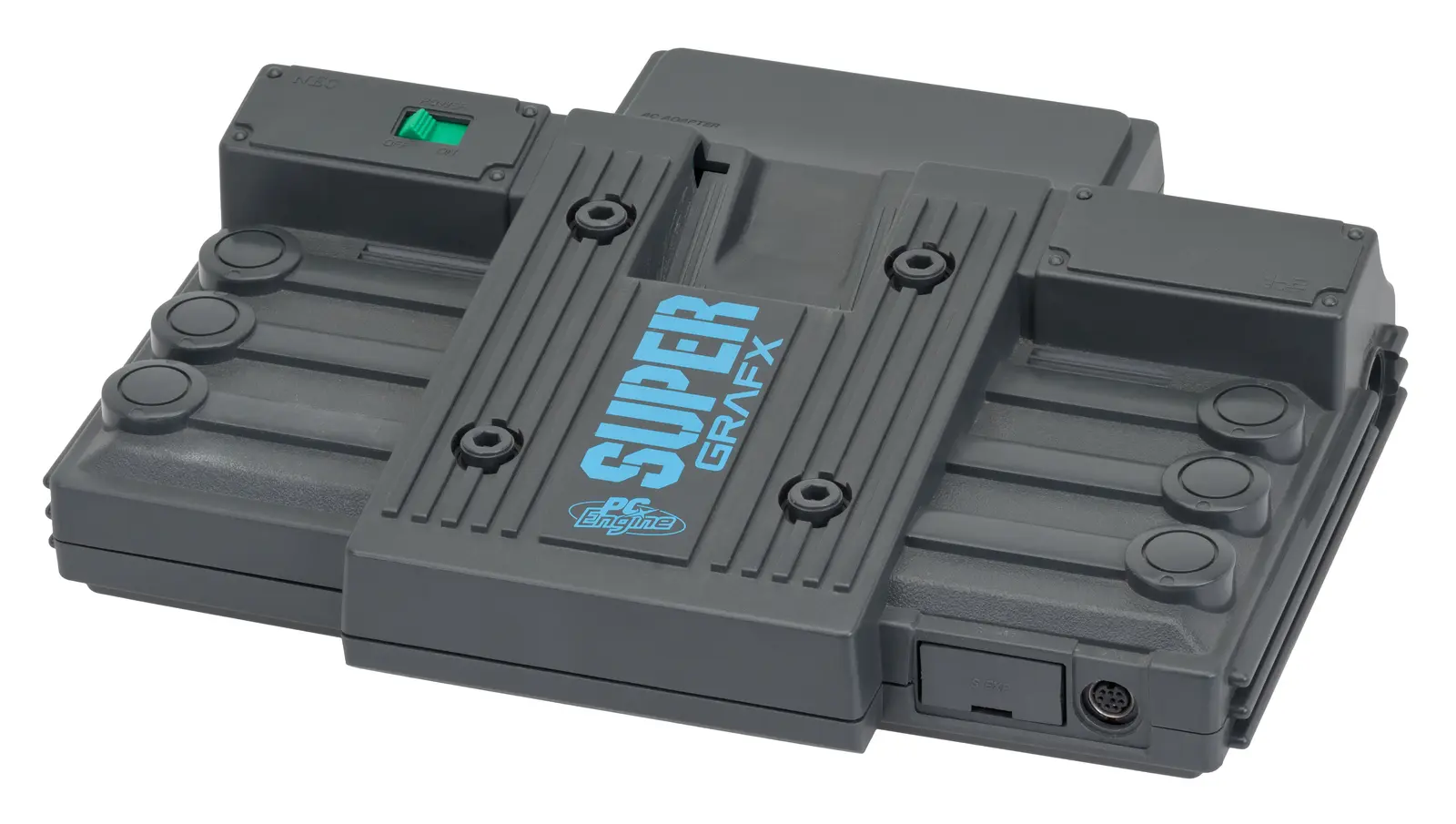
NEC and Hudson kept repackaging the foundation: CoreGrafx with composite video, the portable GT, the amplified SuperGrafx and finally Duo models with an integrated CD drive. For enthusiasts it was a rich ecosystem; to a buyer it could become a dictionary of expansions.
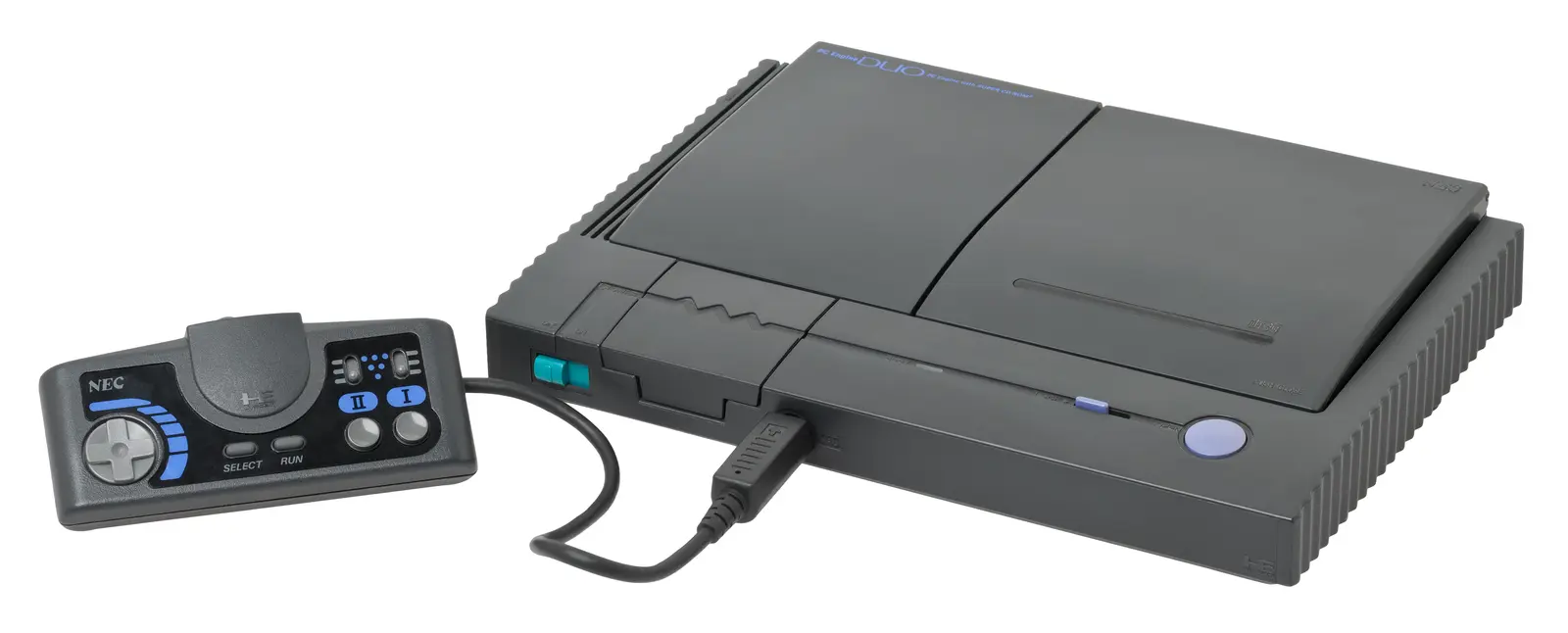
The Duo was the most elegant answer to a problem NEC itself had built: separate drive, interface, system card and versions of that system card. The console moved technology forward, but also showed early how an expandable platform could become fragmented.
09 / Five games, five functions
The library says more when it is not a ranking
Shows how much moving image came from the compact machine.
The same bald hero received a new name and branding job abroad.
Made the MultiTap not an accessory, but a reason to own the console.
Joined two role-playing games with voices, music and storage space.
Demonstrated in 1993 how mature Super CD-ROM² had become.
10 / Three maps, three realities
Japan got a leading role, America a difficult reintroduction and the Netherlands an import machine
In Japan, the PC Engine arrived early enough to challenge the Famicom and built strong third-party support. In the United States, TurboGrafx-16 started late, with an unfamiliar pack-in game and a name that placed it directly beside the Genesis.
A living platform
Many models, strong arcade conversions, CD games and a market that knew PC Engine as a family in its own right.
Big body, small reach
A delayed roll-out, limited localisation and formidable competition kept ‘Turbo’ from becoming the natural third name.
Between official and import
From late 1989, Sodipeng distributed adapted Japanese machines with French documentation. In the Netherlands it remained largely a system for specialist shops and informed players.
There is therefore no single European story either. The planned broad PAL introduction of the American TurboGrafx stalled, while Japanese PC Engines did reach buyers through France and Benelux. The console was present, but seldom ordinary.
11 / A platform in motion
Seven years of cards, discs and new cases
The same core remained while nearly everything around it changed shape.
Hudson × NEC
Graphics-chip knowledge, game experience and manufacturing capacity become one console project.
PC Engine
The white mini-console appears in Japan with HuCards and one controller port.
CD-ROM²
Optical storage reaches the games console as an expensive modular expansion.
TurboGrafx-16
The larger American reworking launches shortly after Sega’s Genesis.
CoreGrafx & SuperGrafx
One refines the base machine; the other attempts to raise its graphics ceiling.
PC Engine GT
The HuCard library becomes portable on an expensive colour display.
PC Engine Duo
Console and Super CD-ROM² drive meet inside one case.
The final hardware phase
Arcade Card and Duo-RX stretch the platform as NEC prepares PC-FX.
12 / Sources & further reading
Explore further
- Shmuplations — The History of the PC Engine, translated interviews from 1987 and 2003
- Game Developer — interview with Hudson’s Takahashi Meijin
- Time Extension — memories from Japanese PC Engine developers
- Konami — official PC Engine mini game catalogue
- HomeComputerMuseum — NEC PC Engine in the Dutch collection
- TurboGrafx-16 — technical data, regional launches and hardware variants
Image credits
PC Engine set — Evan-Amos, public domain; resized and converted to WebP
TurboGrafx-16 set — Evan-Amos, public domain; resized and converted to WebP
PC Engine Duo — Evan-Amos, CC BY-SA 3.0; resized and converted to WebP
PC Engine SuperGrafx — Evan-Amos, CC BY-SA 3.0; resized and converted to WebP


