Console 11 / 1988–1997
Sega Mega Drive:
how the arcade acquired an attitude
Not a shrunken arcade cabinet and not merely the SNES rival. Sega brought its arcades’ knowledge, pace and sound home — then gave the same machine a different accent in Japan, America and Europe.
01 / The arcade as blueprint
Sega did not design a console company — it brought an existing company to the television
When project ‘Mark V’ began in 1986, Sega had already spent years building arcade machines. The question was therefore not what a living-room computer should be, but how much arcade thinking could fit inside an affordable console.
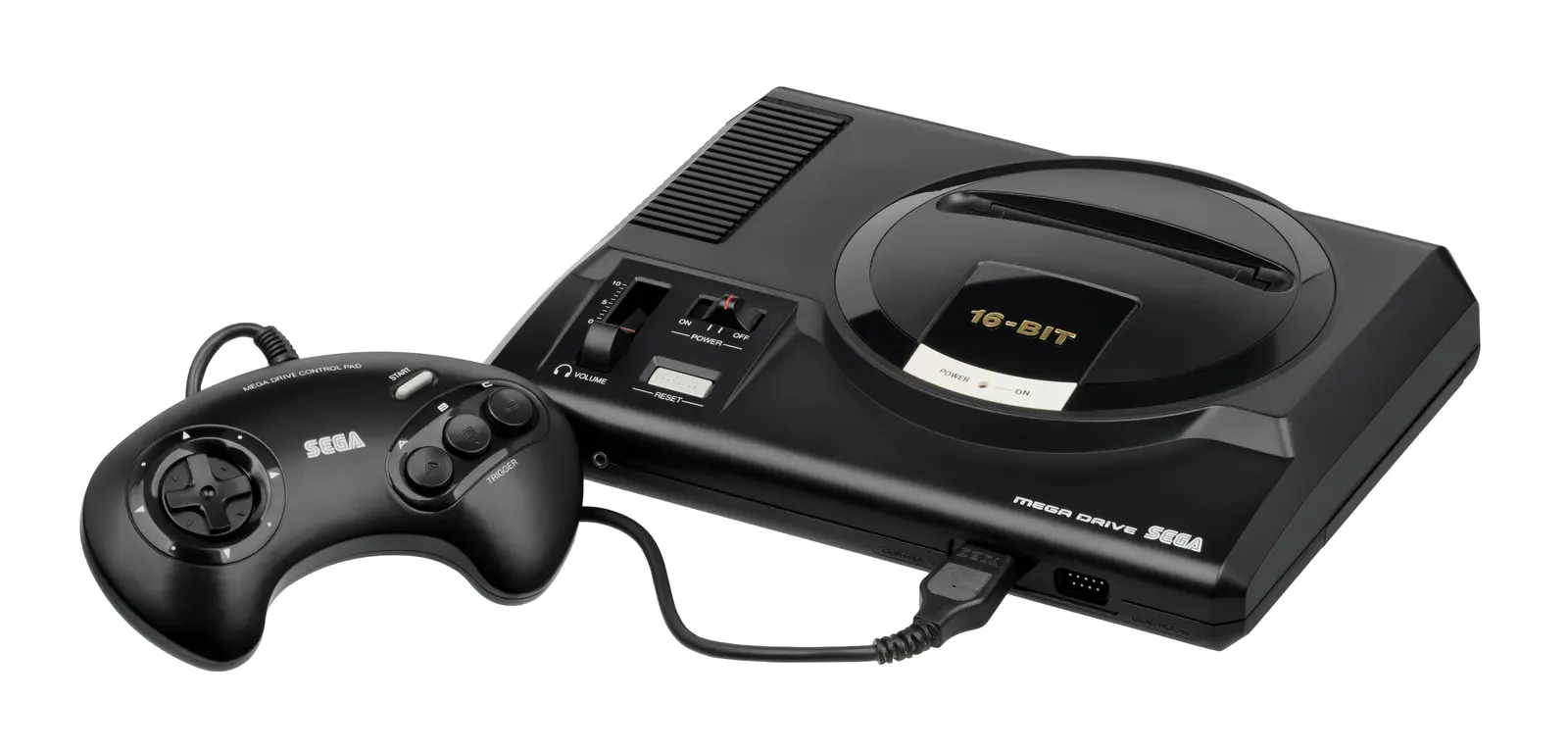
Mega Drive was not a System 16 board in a plastic box. Both systems did, however, share a Motorola 68000 and a design world of sprites, layers and immediate action. That shortened the mental distance between Sega’s coin-ops and its cartridges. Altered Beast, Golden Axe and Super Hang-On were more than games: they demonstrated where the machine came from.
02 / A serious object
The case looked towards a hi-fi stack rather than a toy box
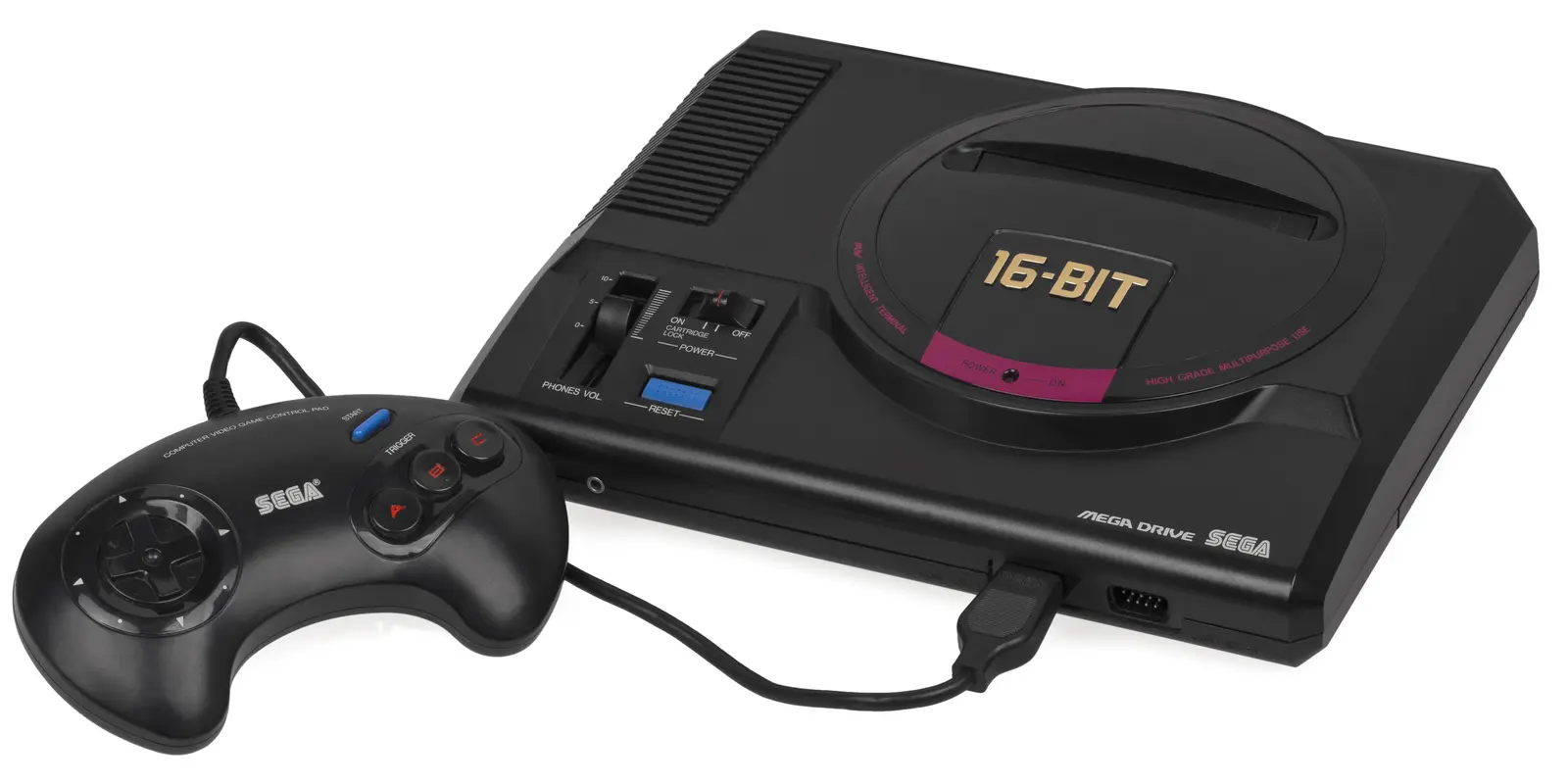
Black plastic, circles around the cartridge, a gold ‘16-BIT’ inscription, a volume slider and a headphone socket: the first Mega Drive wanted to look like grown-up technology.
VOLUME
CARTRIDGE
That styling promised more than additional colours or larger games. It positioned the console among devices that older children and adults already took seriously. Even the circular machine lines served the story: this was no neutral games console, but a machine with speed in its silhouette.
03 / Two processors, two histories
The new 68000 worked beside a familiar old chip
The 16-bit Motorola 68000 did the main work. Beside it sat a Z80A, known from Sega’s 8-bit systems. It mainly helped with sound and, through the Power Base Converter, made many Master System games usable.
Game code, movement and main logic.
Sound and a bridge to the 8-bit past.
Compatibility was not merely an adapter trick; it was baked into the architecture. Mega Drive literally carried Sega’s previous generation with it while the 68000 created room for faster and more complex games.
04 / The sound of silicon
FM sound was not a flaw to hide, but an instrument of its own
The Yamaha YM2612 produced six FM channels; a PSG added three tones and noise. Composers could build metallic basses, sharp percussion, glassy chords and samples from them. The limitations were audible — and therefore distinctive.
From Yuzo Koshiro’s club rhythms in Streets of Rage to the chopping engine power of racing games, developers learned to make the chip sound not naturalistic but full of character. The first model’s headphone socket made that character private and unexpectedly close.
05 / Genre changes the controller
Three buttons were generous — until fighting games demanded six
The original controller was large, rounded and comfortable, with A, B and C. That made sense for late-1980s arcade games. The rise of Street Fighter II suddenly made a second row of buttons necessary.
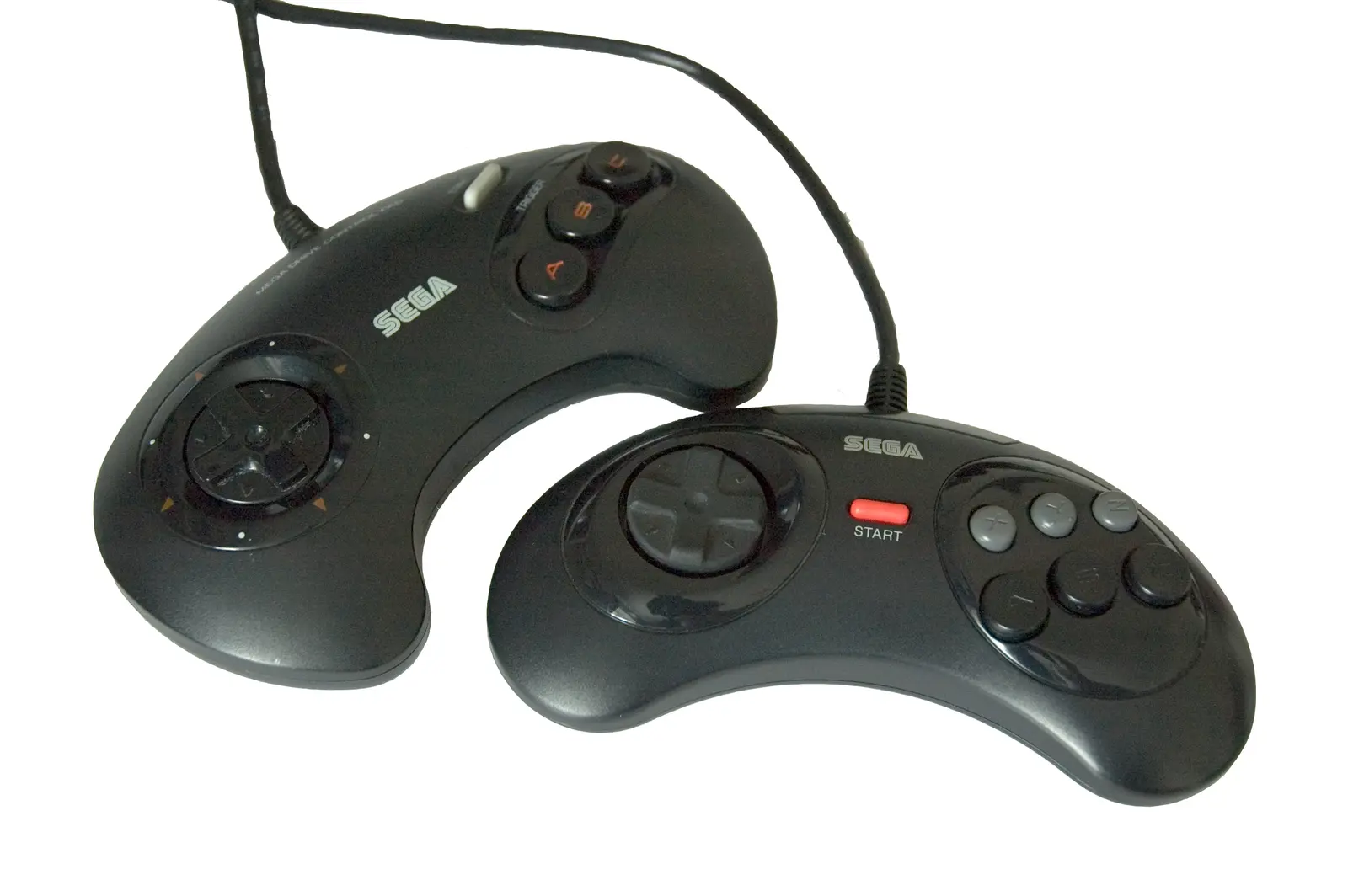
The more compact six-button controller shows that a console does not only shape games. New genres press back on hardware too. Its extra MODE button also helped with older games that failed to recognise the new pad correctly.
06 / One machine, three voices
Mega Drive went global by refusing to remain locally identical
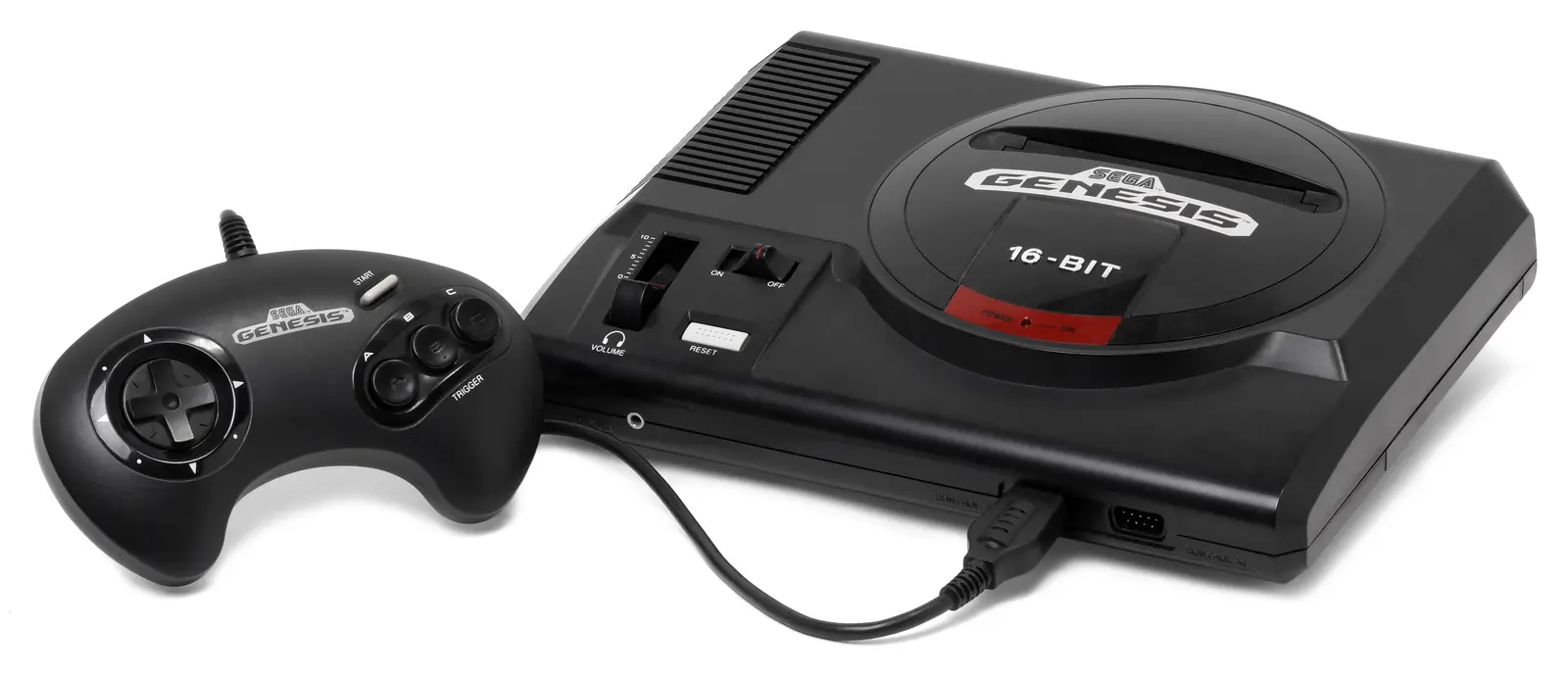
In Japan it was a stylish successor in a market where PC Engine and later Super Famicom were strong. In North America it became Genesis: a new beginning with noisy advertising. Europe kept the Mega Drive name and built upon Master System’s firm position.
The 16-bit machine
Early, technical and mature in appearance, but never the dominant console in its home market.
Genesis
Sport, celebrities and ‘Genesis does what Nintendon’t’ turned hardware into youth culture.
Mega Drive
A successor with a familiar name, strong arcade conversions and a place beside Amiga, Atari ST and other home computers.
07 / Speed becomes a worldview
Sonic sold more than speed — he changed Sega’s rhythm
The familiar story turns Sonic into one inspired invention. In fact, Naoto Ohshima’s character, Yuji Naka’s movement prototype and Hirokazu Yasuhara’s levels came together. The hardware could scroll quickly; the design had to teach players when to accelerate and when not to.
Sonic the Hedgehog became a powerful pack-in during 1991, but its most important effect ran deeper. Sega’s loose collection of arcade hits suddenly acquired a face and a pace. Marketing and game design spoke the same language: fast, slightly provocative and visibly unlike Nintendo.
08 / A platform has co-authors
Electronic Arts helped decide who sat in front of Mega Drive
EA investigated Genesis independently and negotiated a more favourable licence in 1990. John Madden Football, NHL Hockey and later FIFA then gave the console an audience that did not come only for Japanese action.
EA developed its own knowledge of the hardware.
A stronger negotiating position enabled a larger programme.
Annual series made the console part of a season.
EA’s distinctive cartridges with their yellow tabs were almost a brand within the brand. They remind us that the character of a platform is not written by its manufacturer alone. A publisher can change the audience, rhythm and even the appearance of a games shelf.
09 / The cartridge refuses to stand still
Sometimes the game itself became a hardware expansion
The slot carried more than ROM data. Virtua Racing brought Sega’s SVP chip for polygons; Sonic & Knuckles placed a second slot on top of the cartridge and created ‘lock-on’ combinations.
Virtua Racing
Extra computation in the cartridge enabled a remarkable 3D conversion.
Sonic & Knuckles
One cartridge became a connection for another cartridge.
Mega-CD + 32X
Larger expansions stretched the platform but also made its promise expensive and confusing.
Here lies the paradox of Sega’s urge to expand. The base was flexible enough to grow for years, but each attachment made ‘a Mega Drive’ harder to define. The strength to keep trying something new also became a source of fragmentation.
10 / The Netherlands between console and computer
Here Sega fought more than Nintendo
In Europe, Mega Drive also stood beside Amiga and Atari ST. Those computers offered games, a culture of copying and many broader applications. Sega’s answer was simplicity: insert cartridge, switch on and play immediately — with the arcade as a mark of quality.
Sega Netherlands reported that two hundred thousand Mega Drives had been sold in the country. The figure came from Sega itself, but makes clear that the console was no longer an exotic import here.
The success carried a technical footnote. European PAL televisions ran at 50 hertz. Games imported without adaptation from Japan or America could therefore run more slowly and show black borders. Europe’s Mega Drive was culturally complete, yet did not always receive the version best suited to its display standard.
11 / A machine accelerating
Nine years from black circles to a stack of expansions
The identity changed faster than the base hardware.
Project Mark V
Sega starts the Master System successor and ultimately selects the Motorola 68000.
Mega Drive
The black 16-bit console appears in Japan for ¥21,000.
Genesis
The American machine gains a new name and an increasingly sharp market position.
Europe
The Mega Drive name remains; arcade conversions and the Master System base help Sega advance.
Sonic
A new character and a new pace become the face of the platform.
Mega-CD and Model 2
CD-ROM is added and a smaller, cheaper enclosure follows.
SVP and 32X
Sega searches twice for greater 3D power, in a cartridge and above the console.
The European end
The official lifespan closes, though new games and hardware variants continue elsewhere.
12 / Sources & further reading
Explore further
- Sega — official Mega Drive hardware history and specifications
- Sega Hardware Story — designing project Mark V and Mega Drive
- Sega — adapters, modem, SVP, lock-on and other expansions
- Shmuplations — translated interviews with the makers of Sonic
- Sega-16 — interview with EA founder Trip Hawkins
- Sega Retro — history of Sega in the Netherlands
- Gamegeschiedenis — Dutch Sega sales charts from 1995
Image credits
European Mega Drive — Evan-Amos, public domain; resized and converted to WebP
Japanese Mega Drive — Evan-Amos, public domain; resized and converted to WebP
Mega Drive controllers — X201, public domain; resized and converted to WebP
Sega Genesis Model 1 — Evan-Amos, public domain; resized and converted to WebP


