Console 12 / 1989–2003
Nintendo Game Boy:
the console for in-between time
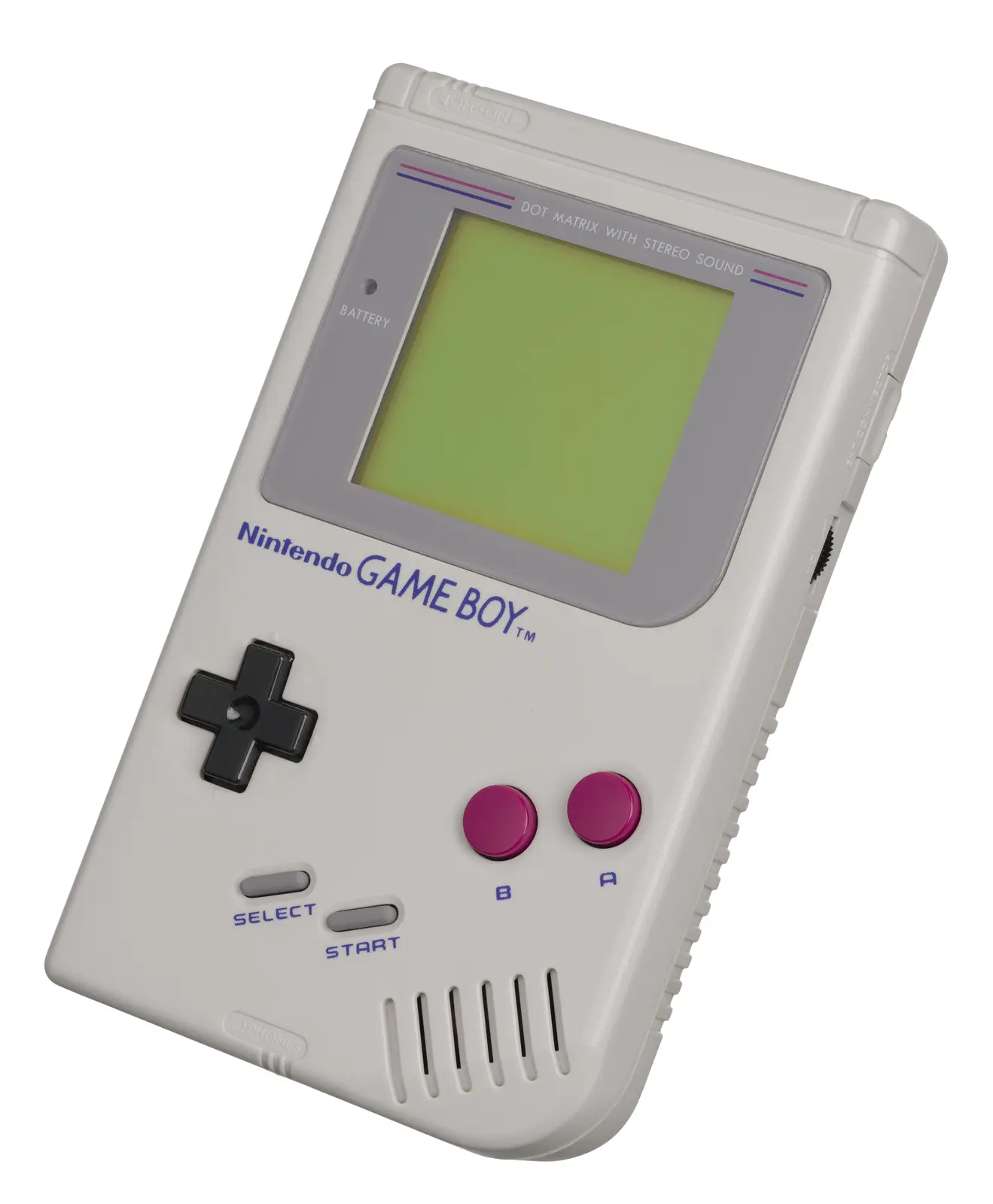
Four shades of green, four AA batteries and two red buttons did not change how beautiful games could be, but where they could exist: in the back of a car, under the covers, on a platform and beside someone holding a Link Cable.
01 / Time as a platform
The Game Boy’s real rival was not another console, but having nothing to do
Home consoles occupy a television and demand a place. Game Boy occupied minutes: a car journey, a break, waiting for an appointment. Nintendo did not build a small living room, but a device for time that had no destination yet.
That is why ‘portable’ is really too weak a word. A device can be movable yet remain too heavy, fragile or power-hungry to be truly available. Game Boy succeeded because display, enclosure, software and batteries made one promise together: you can play now.
02 / The battery budget
Mobility was designed from the back
Lynx and Game Gear could show colour and illumination. Game Boy first asked how many playing hours four ordinary batteries could provide. That energy ceiling determined the processor, reflective screen and ultimately the whole experience.
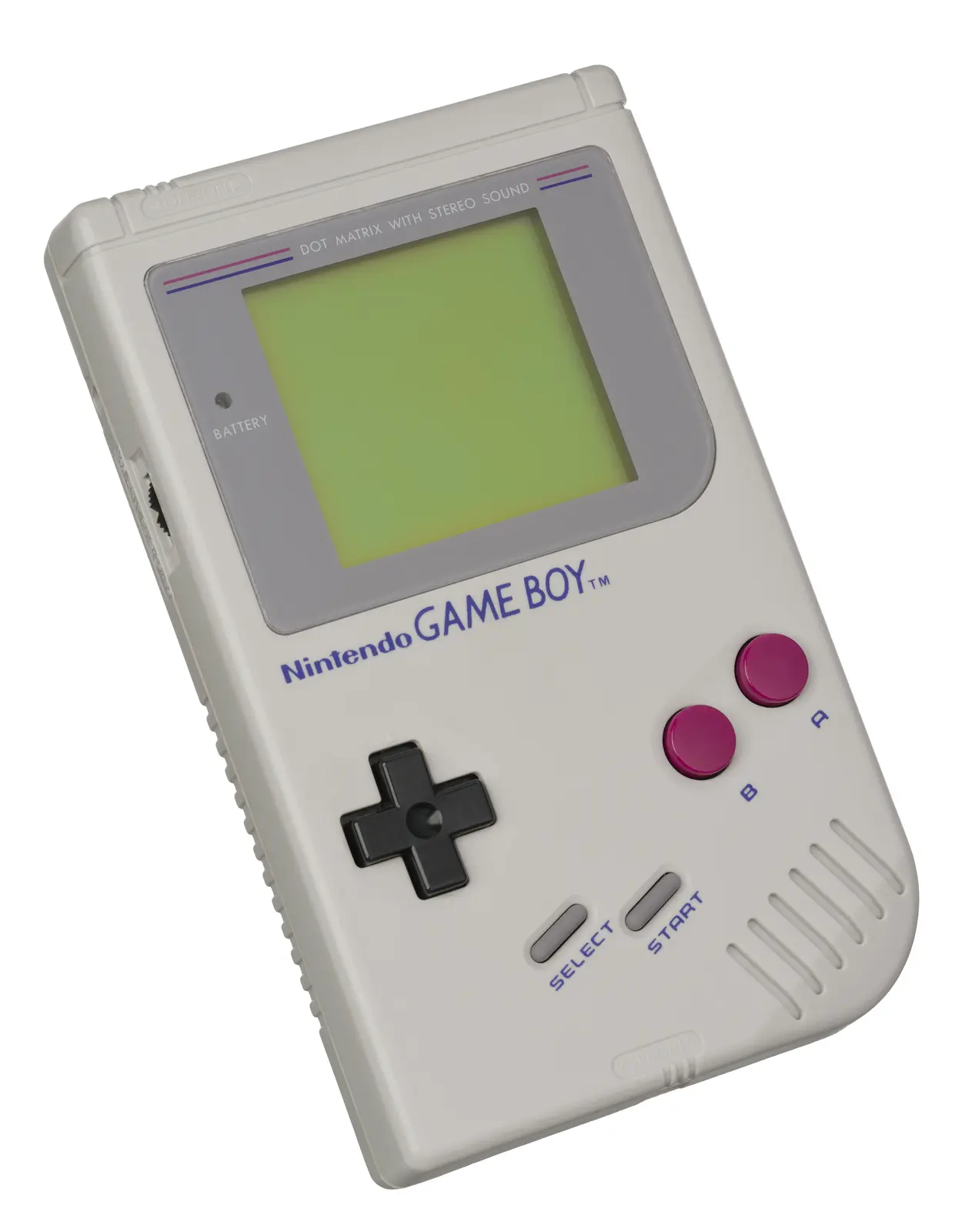
Not the highest number on the box, but fewer spare batteries in the bag.
This was not simply a choice of cheap components. It was system design: a more powerful part would demand a larger battery bay, more weight or shorter play. Nintendo optimised not one specification, but the distance to the next wall socket.
03 / A screen that asked for the world
No backlight meant the surroundings became part of the image
The reflective LCD used ambient light. In the sun it could be surprisingly clear; in a dark room the game disappeared. The player kept searching for the right picture with the contrast wheel.
Four shades, no colour and trailing pixels visible during movement.
Developers answered with clear silhouettes, large faces and patterns that retained meaning without colour. The slow LCD could make motion smear; some games even used that effect to suggest intermediate frames and transparency. The green haze was limitation, material and visual language at once.
04 / Components choose the posture
The vertical shape emerged from the inside out
Designer Satoru Okada initially considered a horizontal device. Once the team arranged the components as compactly as possible, the upright form proved more practical. The hands had to adapt to circuit board, screen and batteries.
Yet the result felt immediately legible. The cross came from Nintendo’s Game & Watch line, Start and Select from NES, while the angled A and B buttons followed the right thumb’s natural position. A new category could therefore begin with a familiar vocabulary.
05 / Tetris fills exactly what is available
Not a world to disappear into, but a system that accepted any wait
Tetris needed no large screen, colour or long introduction. A round could last three minutes or an hour. Its rules lived in the mind; progress was skill rather than a story that first had to be resumed.
Instantly legible
Seven shapes, one well and no language barrier.
Elastic duration
A session grows with the minutes available.
Repetition without reset
Every failure becomes knowledge for the next attempt.
The famous bundle was therefore more than clever salesmanship. Tetris explained what this new device could do with time. Mario demonstrated a Nintendo world; falling blocks demonstrated portability.
06 / The Netherlands accepts the small screen
Game Boy did not create a second Walkman panic
Dutch newspapers had often described the Walkman as a headphone wall between user and surroundings. Research into Game Boy coverage from 1990 to 2000 shows something different: this portable machine was generally received without major cultural anxiety.
The explanation may lie in how it was used. Headphones keep sound out; a Game Boy could be watched, passed around and connected by cable. Parents also saw a practical benefit during long car trips. The handheld did not become invisible, but a recognisable part of a schoolchild’s equipment.
07 / A network without a network service
Link Cable turned two private screens into one playing space
Satoru Okada held on to the serial connector, although colleagues thought linked play difficult and of little use. At launch, even he could not know how important the port would become.
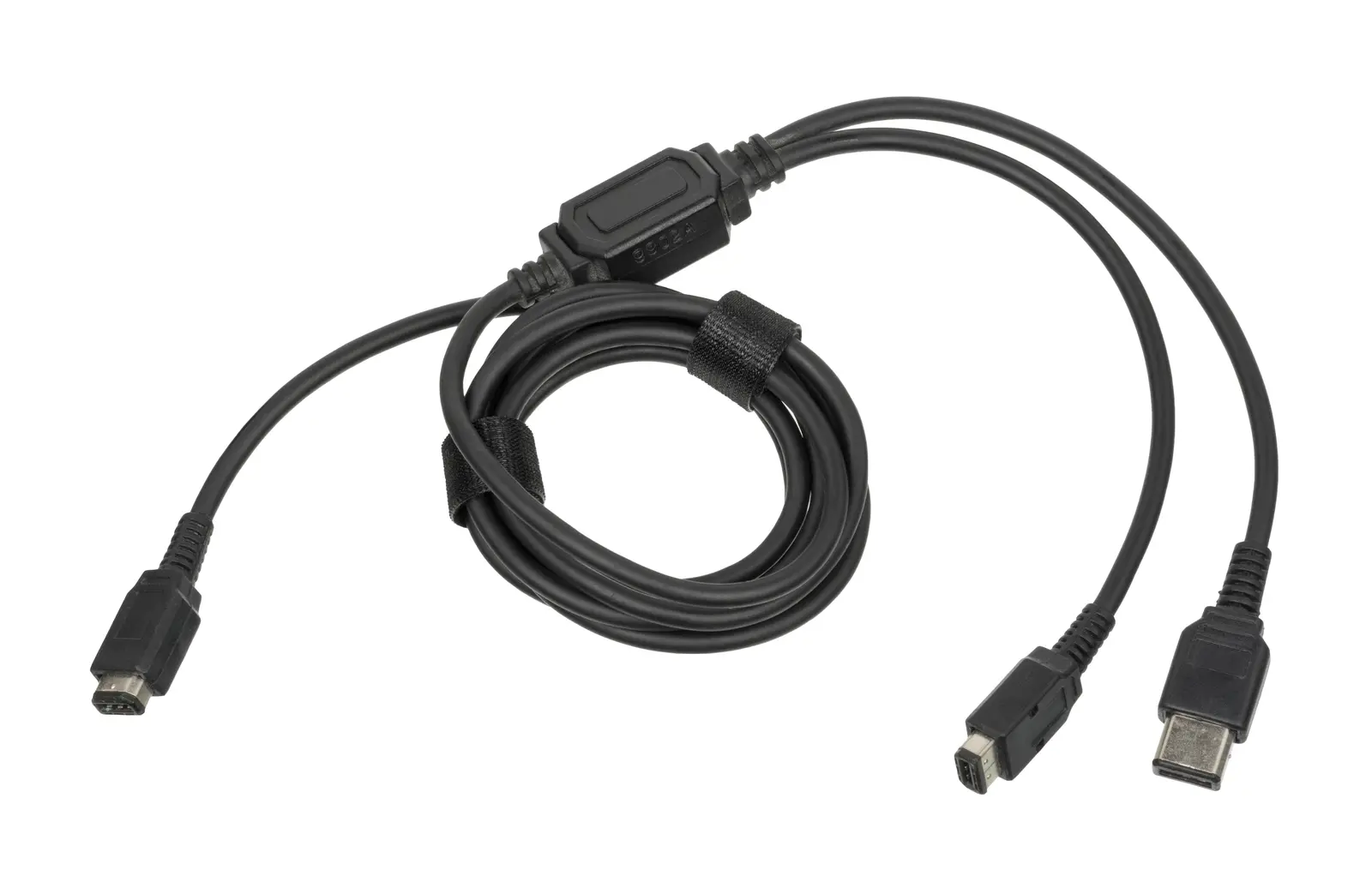
With Tetris, connection mostly meant competition: completed lines sent penalty rows to the other player. More important was the habit this created. Players learned that a portable screen could be personal without being solitary.
08 / Pokémon changes the cable’s grammar
From beating the other person to giving them something
Satoshi Tajiri saw not a score connection in the cable, but a route through which something could travel. Pokémon Red and Green made trading necessary to complete the collection.
A personal collection emerges.
Different versions make meeting valuable.
Rumours and strategy continue beyond the screen.
That was a fundamental reversal. The software used scarcity not only to sell more cartridges, but to make ownership social. Seven years after the Japanese launch, the old hardware found a second youth — not through better pixels, but through a new kind of relationship.
09 / Games learn to think portably
The best Game Boy games were not made smaller; they were reformulated
A weak copy of a console game emphasised everything that was absent. Strong designs asked what one small screen, limited buttons and interruptible time made possible instead.
Familiar, but not shrunken
Short worlds, large forms and unexpected shooting stages.
Legibility as style
A round character with an immediately recognisable silhouette.
A world in rooms
A large adventure divided into clear screens and saveable progress.
An identity of its own
Not portable Mario, but a heavier, greedier rhythm.
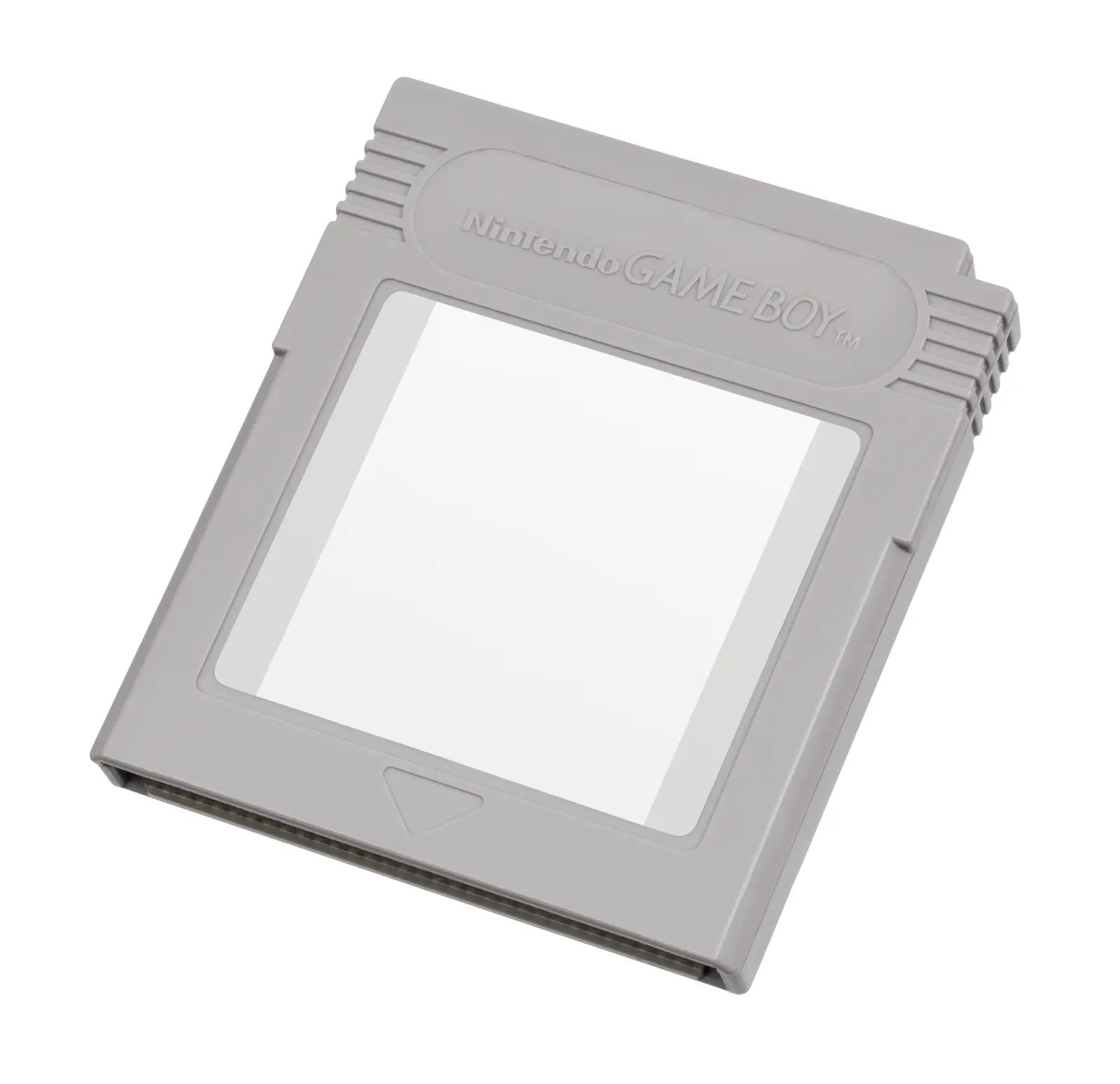
The cartridge remained a small physical memory. Some games brought battery-backed saves; others could be exchanged or lent in seconds. The machine was personal, but its library circulated.
10 / The library outlives its enclosure
Nintendo changed the body without rejecting the memory
The coloured Play It Loud! models first changed only the outside in 1995. Game Boy Pocket became smaller and more efficient in 1996. Japan’s Game Boy Light added illumination in 1998; Game Boy Color finally brought colour that same year.
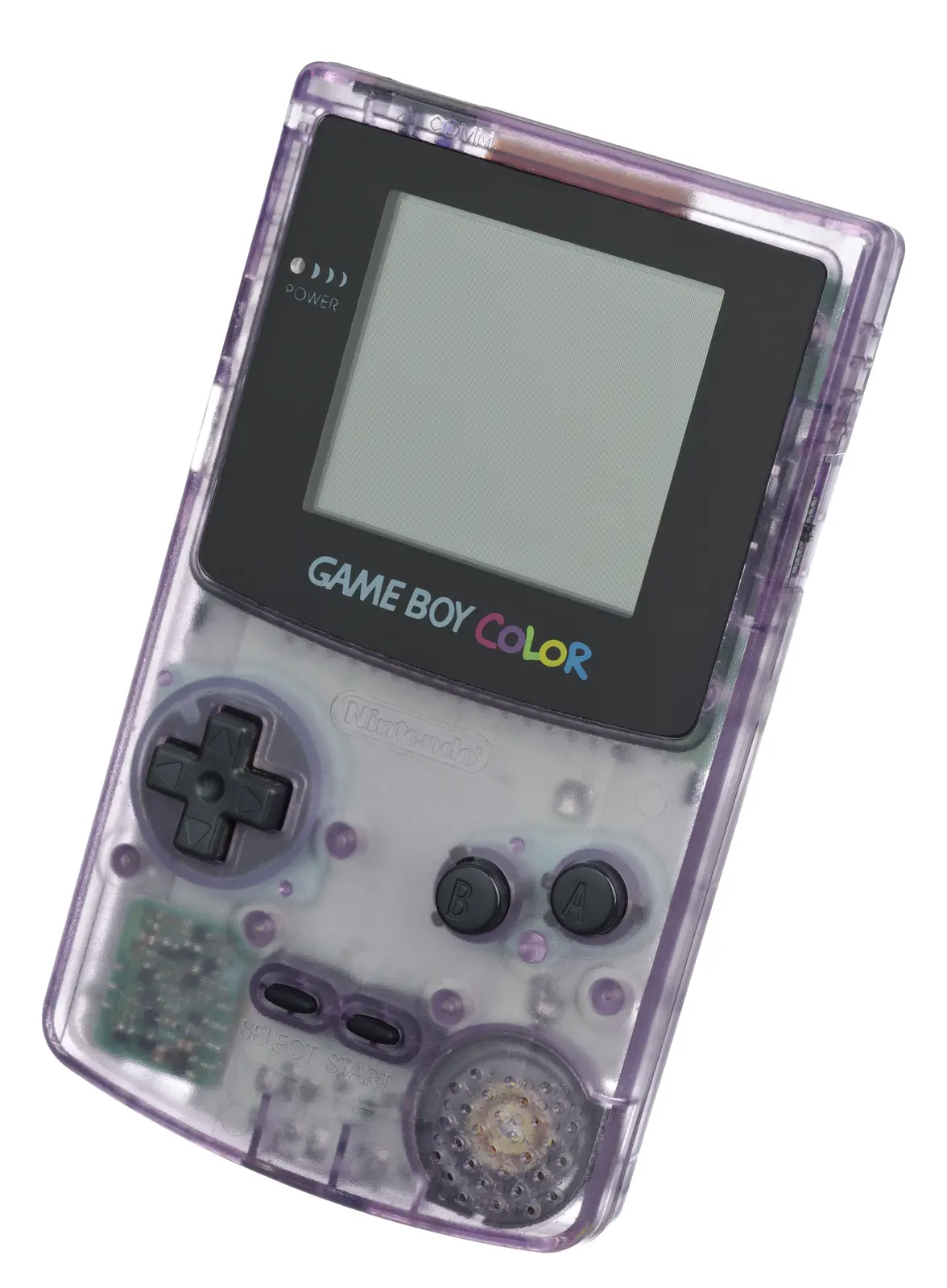
The most important feature remained compatibility. An old grey cartridge worked in the newer Color; through Super Game Boy it could even return to the television. ‘Game Boy’ was therefore less one device than an agreement: your collection was allowed to move house.
11 / A long portable decade
Fourteen years in which the same language found new bodies
Not one grand generational leap, but a platform that slowly changed shape.
Game Boy
DMG-01 appears in Japan with four launch games and a Link connector.
Tetris travels
The puzzle becomes a telling bundle outside Japan; Europe follows in 1990.
Dutch recognition
Game Boy wins the Toy of the Year election for schoolchildren.
Super Game Boy
The portable cartridges regain a television screen through Super NES.
Play It Loud!
The standard grey case gains colour without changing the technology.
Pocket and Pokémon
A smaller model appears; in Japan, trading changes the cable’s purpose.
Light, Color, Camera
Illumination, colour and personal images stretch the family’s meaning further.
End of the line
Production stops while Advance is already carrying the portable library onwards.
12 / Sources & further reading
Explore further
- Nintendo — official company history from Game Boy to Color
- Shmuplations — retrospective interview with hardware designer Satoru Okada
- Nintendo — technical service manual for Game Boy and accessories
- Nintendo of America — Game Boy Programming Manual
- Famimaga 64 — translated interview with Pokémon creator Satoshi Tajiri
- Game Studies — Dutch press, popularity and social reception
Image credits
Game Boy front — Evan-Amos, public domain; resized and converted to WebP
Game Boy back — Evan-Amos, public domain; resized and converted to WebP
Game Boy Link Cable — Evan-Amos, public domain; resized and converted to WebP
Game Boy cartridge — Evan-Amos, public domain; resized and converted to WebP
Game Boy Color — Evan-Amos, public domain; resized and converted to WebP


