Console 03 / 1977
Atari VCS / 2600:
racing the beam
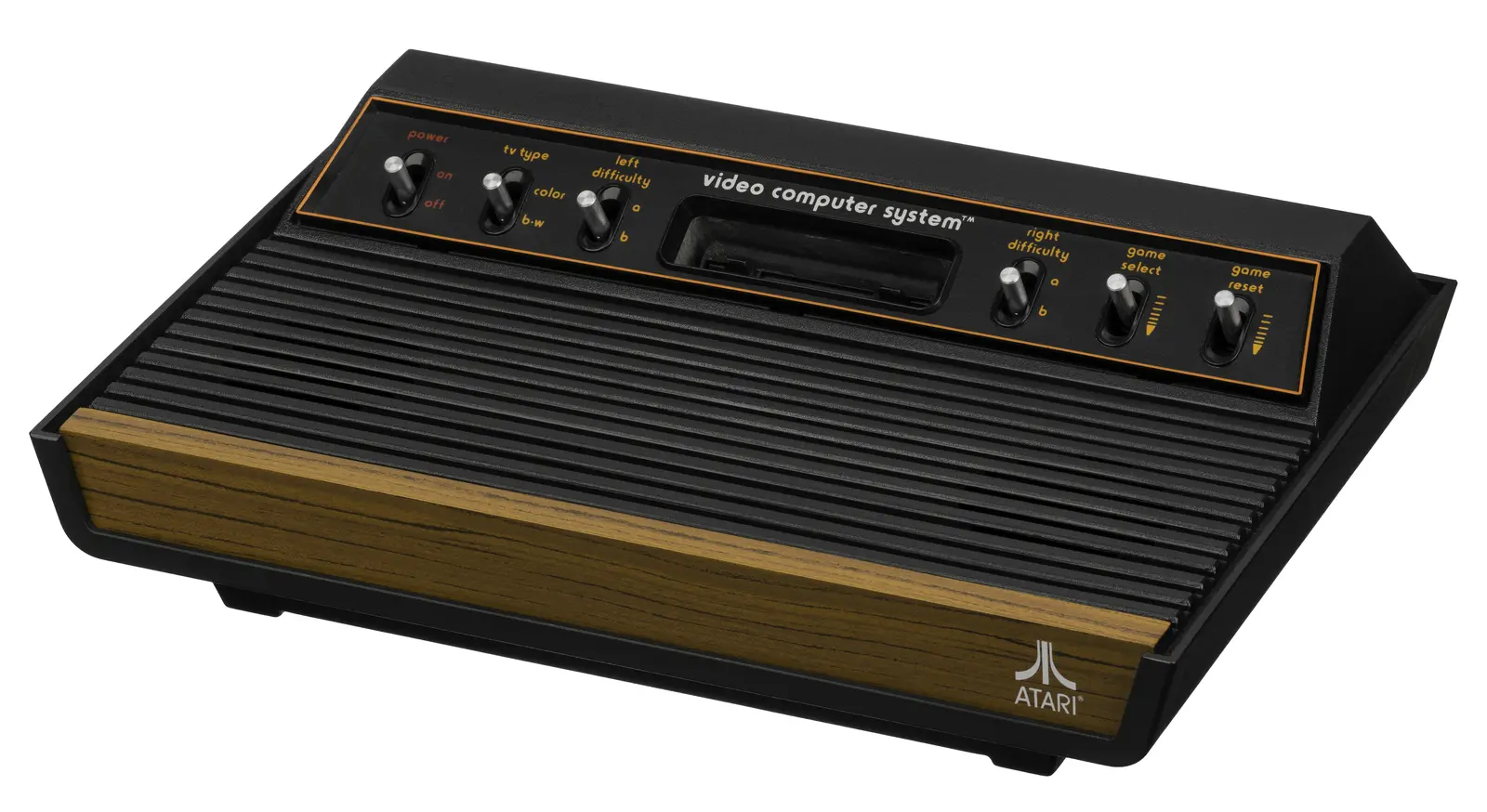
Not the first cartridge console, but the machine that turned the model into mass culture. With 128 bytes of RAM and almost no room for an image, the VCS forced programmers to think in step with the television.
01 / From invention to habit
Fairchild invented the ROM cartridge; Atari gave it a mass market
When the Video Computer System appeared in 1977, the idea of interchangeable program cartridges already existed. The Fairchild Channel F had arrived a year earlier. Atari turned that idea into a complete popular culture.
The VCS joined an affordable machine to a growing software library, a simple joystick and the promise that arcade games could live on at home. The console did not have to contain every game in advance; each new cartridge gave the same hardware a different personality.
Sales grew slowly at first. When Space Invaders reached the VCS in 1980, the pairing of a famous arcade hit and a home console became irresistible. A technical gamble turned into a living-room standard.
This portrait therefore does not retell Atari’s founding, Pong or its later home computers. That wider company story is told in Atari — from arcade to home office. Here, the VCS’s own logic takes centre stage.
02 / Three chips, as cheaply as possible
Stella was designed for a future that still had to fit inside a cartridge
The development project was called Stella. Atari wanted a programmable machine that could handle several kinds of games while remaining cheap enough for the consumer market.
The MOS 6507 was a simplified version of the 6502. The RIOT chip combined input, a timer and just 128 bytes of RAM. Jay Miner’s Television Interface Adapter — the TIA — handled video, sound and controller signals. Together they made a system with no operating system and no true frame buffer.
An inexpensive 8-bit processor with a limited address range.
Workspace for game state, stacks and temporary values.
Video, two audio channels and controller input in one custom chip.
03 / Racing the beam
The picture came into existence as the television drew it
A modern game machine stores a complete image and sends it to the screen. The VCS could not. As the electron beam travelled across the tube line by line, software had to give the TIA new values at precisely the right moment.
The television starts a picture line.
The processor changes players, ball and playfield.
The TIA turns those values directly into video.
A program loop therefore had to decide not only what happened, but exactly when. One instruction too early or late could shift an object or disrupt the picture. The technique became known as racing the beam.
The TIA knew five moving objects: two players, two missiles and a ball, plus a repeatable playfield. Programmers reused and changed those elements in the middle of a frame. Castles, jungles, spaceships and complete mazes emerged from hardware that was never literally designed for them.
04 / One stick, one red button
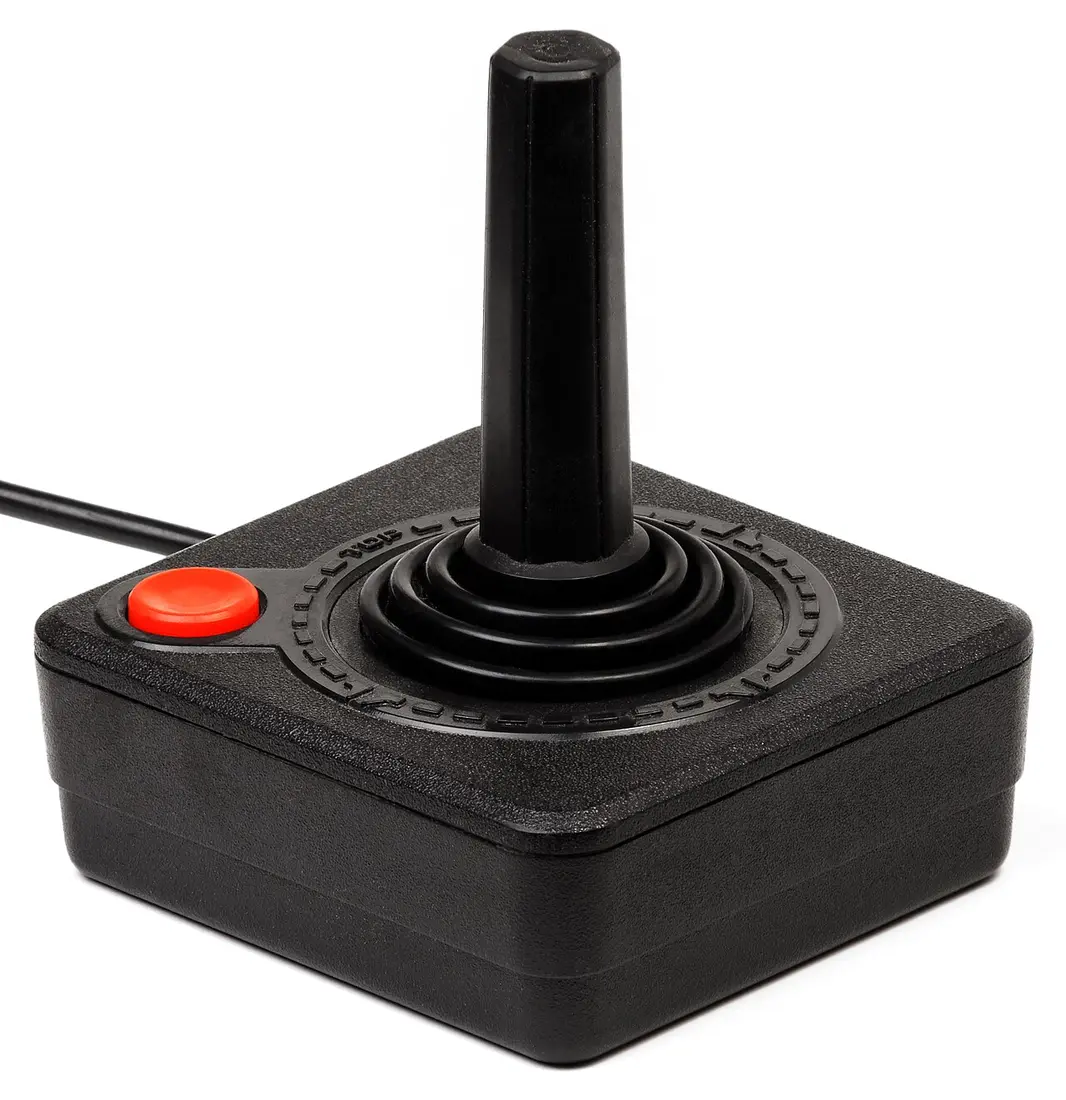
The CX40 made control legible before the game began
The black joystick with its square base, ridged shaft and red fire button became the face of the VCS. Where the Channel F controller could push, pull and twist, Atari chose direct simplicity.
A grammar of five signals
Up, down, left, right and fire were enough for shooting, steering, jumping and dodging. Players could try a new game without learning a new device first.
Paddles remained available for Breakout, Video Olympics and other precise rotary movement. The controller port later accommodated driving, keypad and other controllers too.
05 / Combat as instruction manual
The pack-in showed how many variations the same chips could handle
Combat came with the early VCS. Its cartridge combined tank, biplane and jet battles in 27 game variations. A few switches and rules created different arenas, speeds and projectiles.
Space Invaders
The official home version of the arcade hit gave many families a clear reason to choose this console.
Adventure
Rooms, keys and a wandering dragon formed a miniature world. A hidden name became a famous early game easter egg.
Yars’ Revenge
An original Atari game built around colour fields, sound and an unusual rhythm rather than an arcade conversion.
Pitfall!
David Crane created a flowing adventure world by combining parts of the screen procedurally.
Recognisable rules and immediate action mattered more than realistic graphics. River Raid, Kaboom!, Warlords and Missile Command each proved that fixed hardware did not have to produce a fixed form.
06 / The programmer steps out of the shadows
Activision turned one closed catalogue into a market of publishers
Atari did not put programmers’ names on its boxes or reward major sales in the way the creators wanted. Four experienced VCS developers — David Crane, Larry Kaplan, Alan Miller and Bob Whitehead — left and founded Activision with Jim Levy in 1979.
Activision designed colourful, recognisable packaging, credited designers visibly and used manuals to explain how players could achieve higher scores. Atari tried to stop the independent cartridges in court. A settlement allowed publication to continue and confirmed in practice that other companies could make games for a console.
That was both breakthrough and risk. Strong publishers expanded the library, but a wave of hurried cartridges made shops confusing. The newly opened platform had no mature quality control.
07 / Growth without brakes
The market did not collapse because of one bad game
At the start of the 1980s, manufacturers expected rapid growth to continue automatically. More consoles, publishers and cartridges arrived than shops and players could absorb.
High production forecasts, discounting, returns and uneven quality eroded confidence. The disappointing VCS versions of Pac-Man and E.T. became symbols of the crisis, but they were not its sole cause. Affordable home computers also offered both games and programming in one machine.
The North American console market contracted sharply in 1983 and 1984. For the wider consequences at the company, see the Atari portrait; what matters here is that the VCS outlived its own crisis.
08 / A name that lasted longer than planned
The VCS became the 2600 and returned as a budget machine
When Atari introduced the 5200 in 1982, the older Video Computer System became the Atari 2600, after product number CX2600. The woodgrain later gave way to an all-black model.
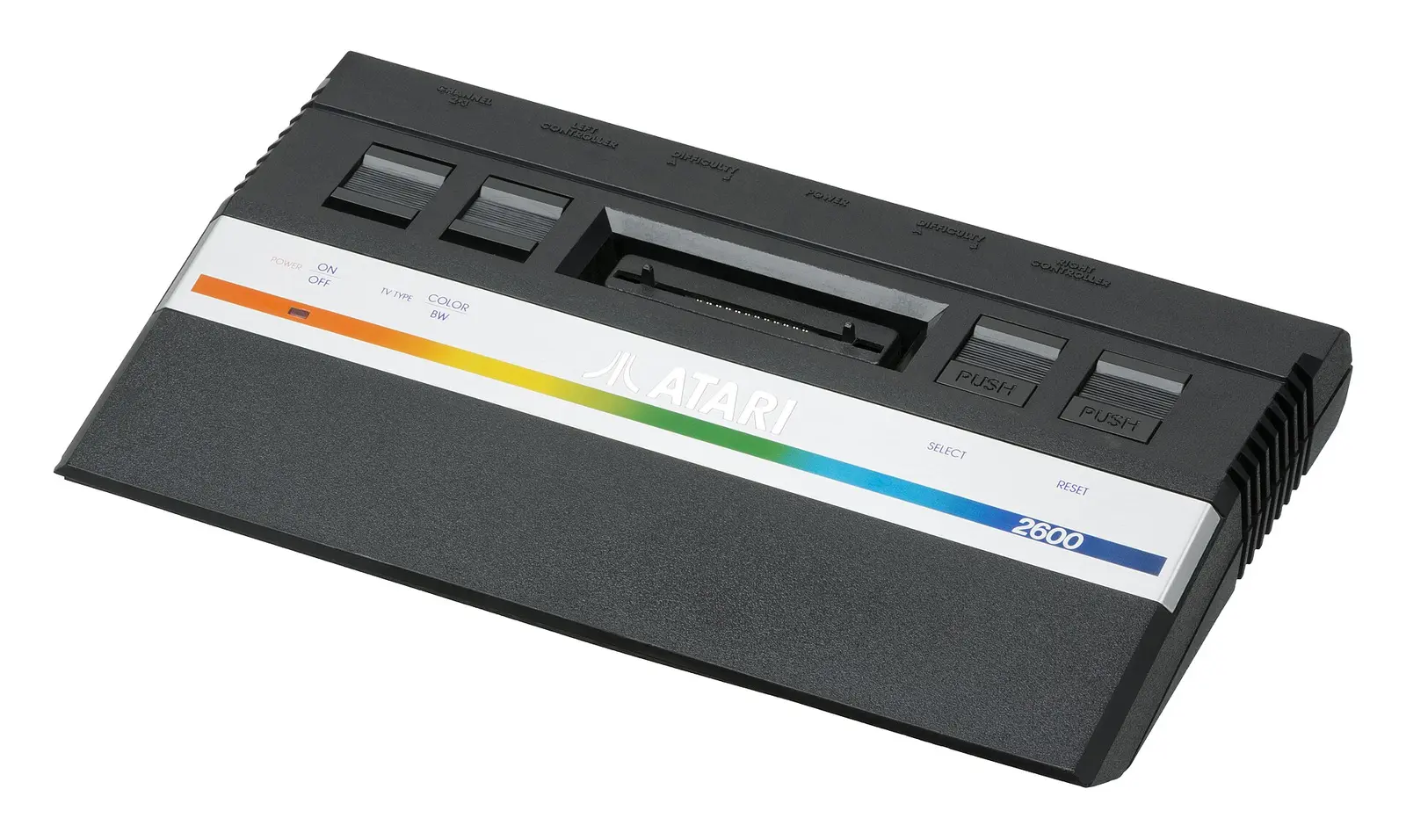
The smaller 2600 Jr appeared in 1986 beside the newer 7800. It was a remarkable second life for hardware from 1977. New commercial games continued to arrive and production lasted into the early 1990s.
The software did not stop there. Homebrew developers still build cartridges and discover new TIA tricks. The VCS lives on not merely as a collectible, but as a minimal computer architecture that can still be explored.
09 / The long line
From Stella to an enduring programming platform
The technology stayed almost the same; the world around it changed radically.
Project Stella
Atari builds an affordable system around the 6507, RIOT and TIA.
Video Computer System
The VCS arrives with joysticks, paddles and Combat.
Activision
Four former Atari programmers start an independent publisher.
Space Invaders
The arcade hit becomes a decisive system seller.
Atari 2600
The new name distinguishes the machine from the 5200.
The market crash
Overproduction and quality problems break confidence.
2600 Jr
The classic library returns in a smaller budget console.
New cartridges
An active homebrew scene keeps investigating the old hardware.
10 / Sources & further reading
Keep exploring
- Computer History Museum — Atari 2600 with “Combat”
- Computer History Museum — Atari 2600 prototype
- Computer History Museum — Game On
- Smithsonian — Pong, Atari and the origins of the home video game
- The Strong — From Space Invaders to Fortnite
- Atari — Combat manual (1977)
Image credits
Atari VCS / 2600 — Evan-Amos, public domain; resized and converted to WebP
Atari CX40 joystick — Evan-Amos, public domain; resized and converted to WebP
Atari 2600 Jr — Evan-Amos, public domain; resized and converted to WebP


