Console 02 / 1976
Fairchild Channel F:
a new game in one click
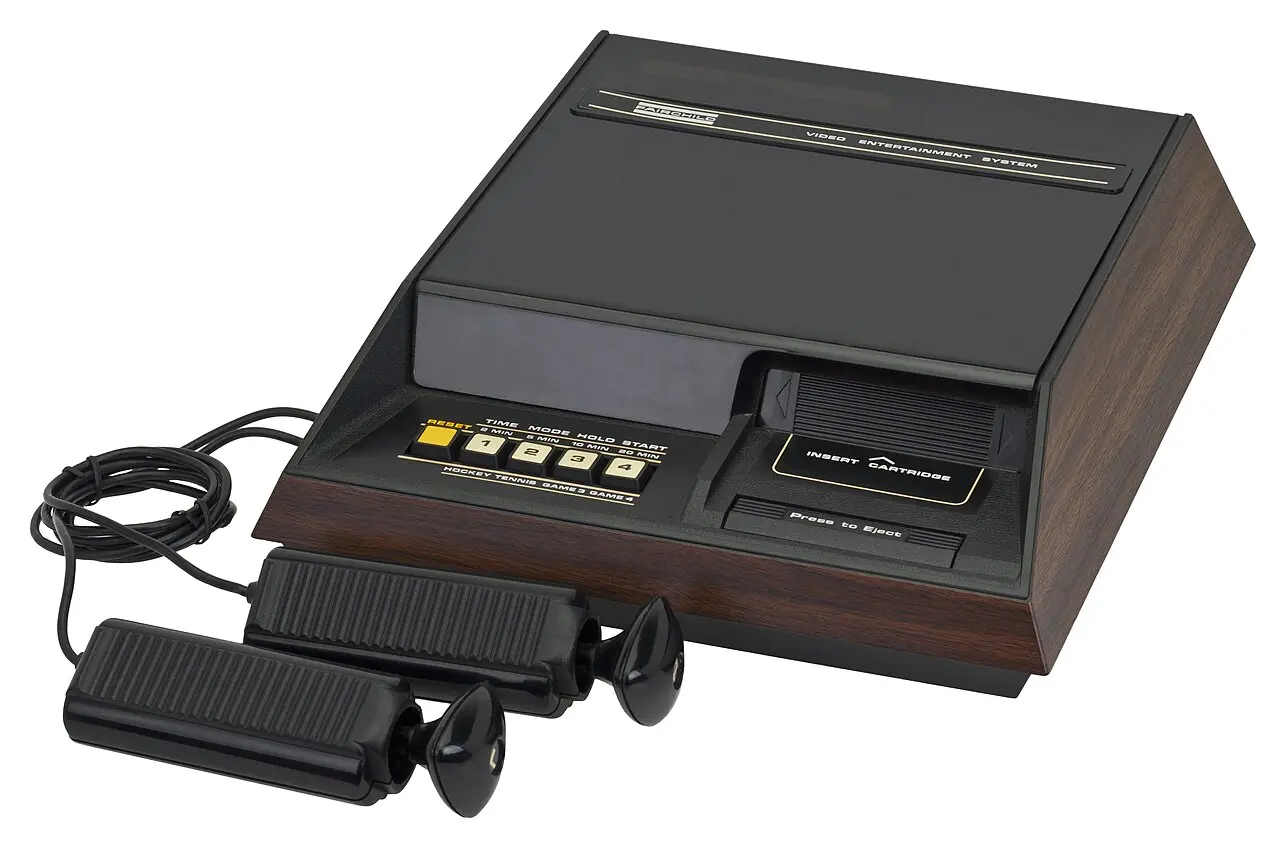
Before the Channel F, a game belonged to its machine. Fairchild made software interchangeable: buy one console, then add cartridges. That simple idea shaped the console market for decades.
01 / The console becomes a platform
After one game was exhausted, the machine remained useful
The first generation of consoles consisted largely of closed machines. If you wanted a different selection of games, you usually needed different hardware. In November 1976, the Fairchild Video Entertainment System changed that logic.
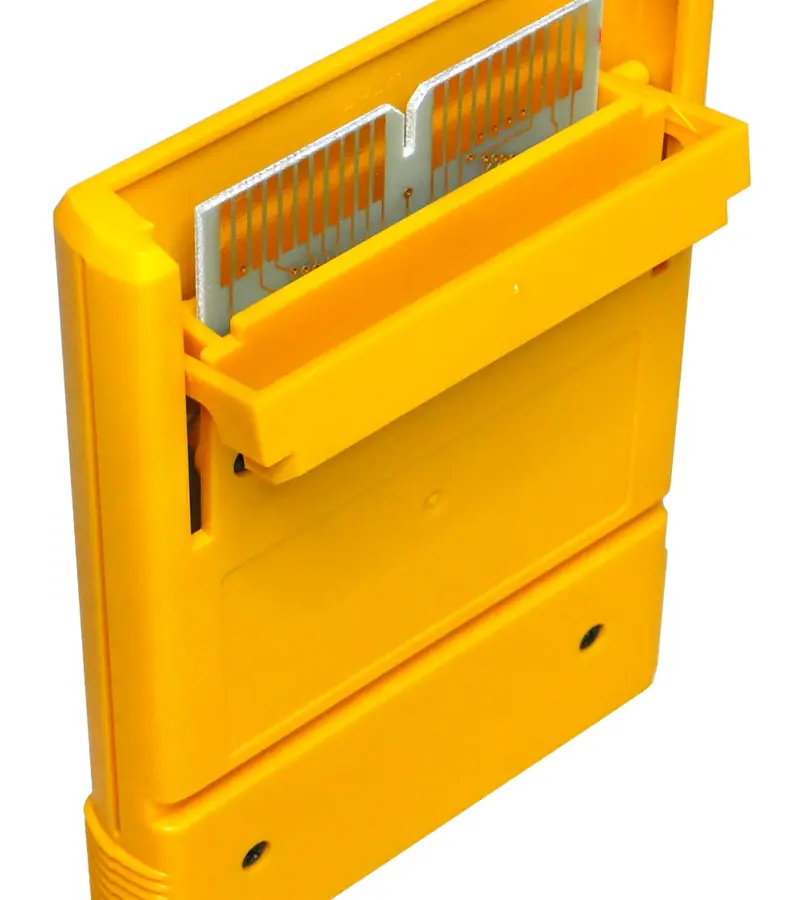
A yellow cassette held actual program code in a ROM chip. Insert another Videocart and the same machine became a shooter, card game, racer or drawing program. This was not a switching card like the Magnavox Odyssey used: the program itself travelled with the cartridge.
Fairchild renamed the machine Channel F in 1977, with the F standing for Fun. Behind that friendly name was a new business model: the console was only the starting point and separate software kept it interesting.
That model later became normal for Atari, Nintendo, Sega and nearly every other console maker. The Channel F was the first to bring it to the living room as a consumer product.
02 / Project RAVEN
The idea began at Alpex and had to survive the living room at Fairchild
Wallace Kirschner and Lawrence Haskel of Alpex Computer Corporation built a prototype with interchangeable software. Project RAVEN was innovative, but still too fragile and complicated for everyday use.
Fairchild recognised its potential in 1975. Jerry Lawson, head of engineering and hardware for its new video game division, led the team tasked with turning RAVEN into a marketable product. Ron Smith and industrial designer Nick Talesfore were important members of that team.
The challenge went far beyond a working circuit. The board had to become cheaper, the controls simpler and the cartridge safe enough to be swapped repeatedly by adults and children. Lawson and his colleagues replaced the original processor with Fairchild’s own F8 and designed an entire product family around the console.
Kirschner and Haskel build the RAVEN prototype around removable ROM boards.
Lawson’s team makes the electronics, connector and controls ready for the home.
The console and the game become two separate purchases.
03 / A program inside yellow plastic
The cartridge had to look simple and work reliably
For the player, the action was small: press eject, remove one Videocart and insert the next. Careful product design sat behind that movement.
Software became a physical object
Nick Talesfore drew inspiration from the 8-track tape. A spring-loaded door protected the electronics while a cartridge sat outside the console.
The bright yellow shell and colourful boxes made every game recognisable in a shop and on a shelf at home.
The ROM chip retained its program code without power. The console therefore did not need to know every possible game in advance. New cartridges could appear later — the hardware effectively gained new abilities after purchase.
04 / A microprocessor in the living room
The F8 turned games into software instead of fixed wiring
The Channel F was not only the first console with programmable cartridges; it was also the first commercial home video game console built around a microprocessor.
The Fairchild F8 ran at approximately 1.79 MHz. The machine used 64 scratchpad registers and separate video memory for a 128 by 64 pixel field, not all of which was visible. That sounds exceptionally modest, but programs could now make decisions, enforce rules and control a computer opponent.
05 / A controller with eight movements
The hand grip was joystick, rotary control and action button in one
The slim controller looked like a handle topped by a triangular knob. It could do far more than move left and right.
The knob moved up and down through the housing.
Four directions moved characters across the screen.
Rotation could change the angle of a paddle.
The entire knob also worked as an action button.
The result was remarkably versatile, but required practice. In Hockey, a player could move and change the angle of a striking surface at the same time. The controller therefore felt unlike both the simple paddles of Pong machines and the joysticks Atari later popularised.
06 / Hockey, Tennis and a yellow game library
Two games were built in; the rest came through the slot
Hockey and Tennis lived inside the console. Videocarts added titles including Video Blackjack, Spitfire, Space War, Drag Race and educational games.
The graphics were spare and sound emerged from a speaker inside the console. Yet the Channel F could do something many earlier home games could not: let a person play against the machine. Not every game required a second human player.
The library remained small. Fairchild and later Zircon released only a few dozen Videocarts, some containing several games. The variety proved the concept, but was not broad enough to hold off later competition.
07 / A one-year head start
Atari adopted the cartridge idea and built the larger world
When Atari launched the Video Computer System in 1977, Fairchild was the technical pioneer. Pioneering, however, is not the same as winning the market.
The Atari VCS offered livelier graphics, a more familiar joystick and a rapidly expanding library. Atari also had a stronger connection to the arcade: versions of recognisable coin-op hits gave families a clear reason to want the machine.
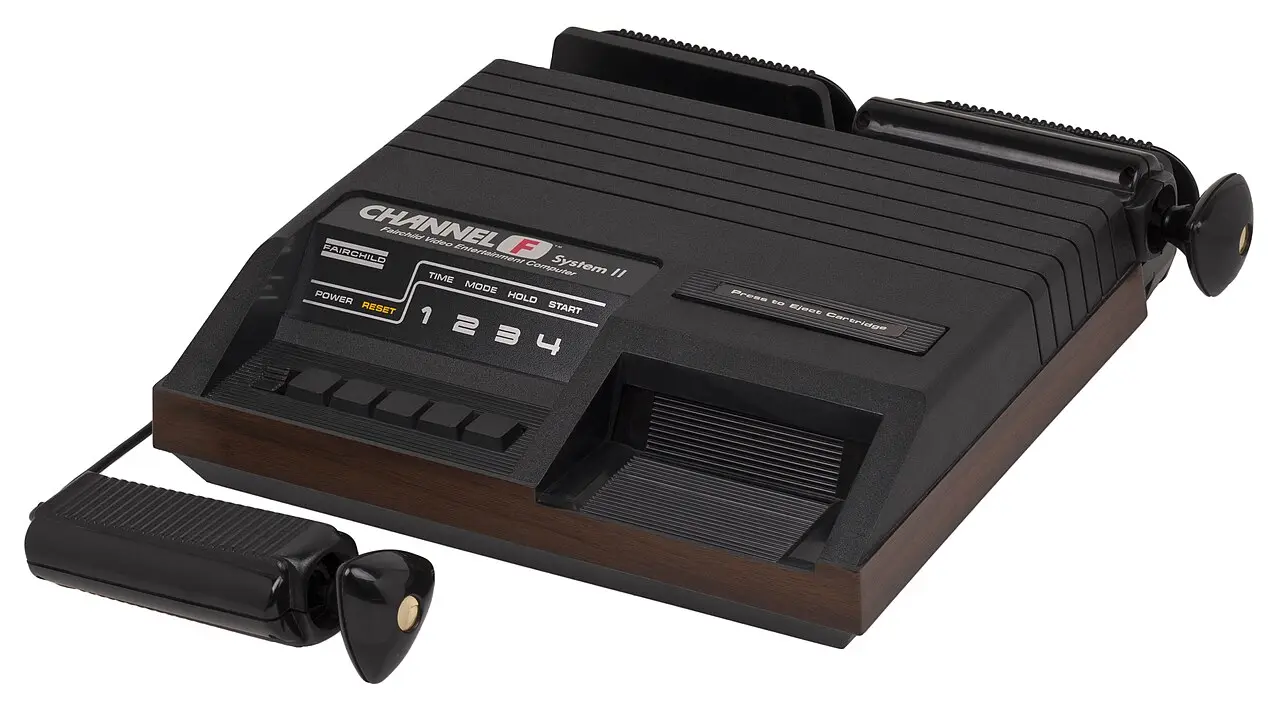
According to The Henry Ford, Fairchild sold about 300,000 units during the early period, but the Channel F faded as Atari grew explosively. Rights passed to Zircon in 1979, and the company released the more compact Channel F System II.
08 / The yellow line
From fragile circuit board to the model for the console market
The Channel F spent only a short time in the spotlight, but its most important idea lasted far longer.
Project RAVEN
Wallace Kirschner and Lawrence Haskel develop an interchangeable-ROM prototype at Alpex.
Fairchild joins in
Jerry Lawson and his team begin turning the concept into a mass-produced device.
Public debut
Fairchild presents the Video Entertainment System at the Consumer Electronics Show.
On sale
The first console with interchangeable ROM cartridges reaches North America.
Channel F
The new name stresses fun; meanwhile, Atari launches the VCS.
System II
Zircon acquires the rights and modernises the machine.
09 / Sources & further reading
Continue exploring
- The Henry Ford — Jerry Lawson & the Fairchild Channel F
- The Henry Ford — Fairchild Channel F Video Game System, 1976
- The Strong — Collection Documents the Career of Jerry Lawson
- The Strong — Jerry Lawson, Video Soft and the Channel F
- Computer History Museum — Let the Games Begin!
Image credits
Fairchild Channel F — Evan-Amos, CC BY-SA 3.0; resized and converted to WebP
Channel F cartridge — Schnurrikowski, CC BY-SA 4.0; cropped, resized and converted to WebP
Channel F System II — Evan-Amos, public domain; resized and converted to WebP


