Console 01 / 1972
Magnavox Odyssey:
the television became a playing field
The first home video game console could not count, made no sound and drew only a few white shapes. Yet something new began here: for the first time, a family controlled what happened on the television.
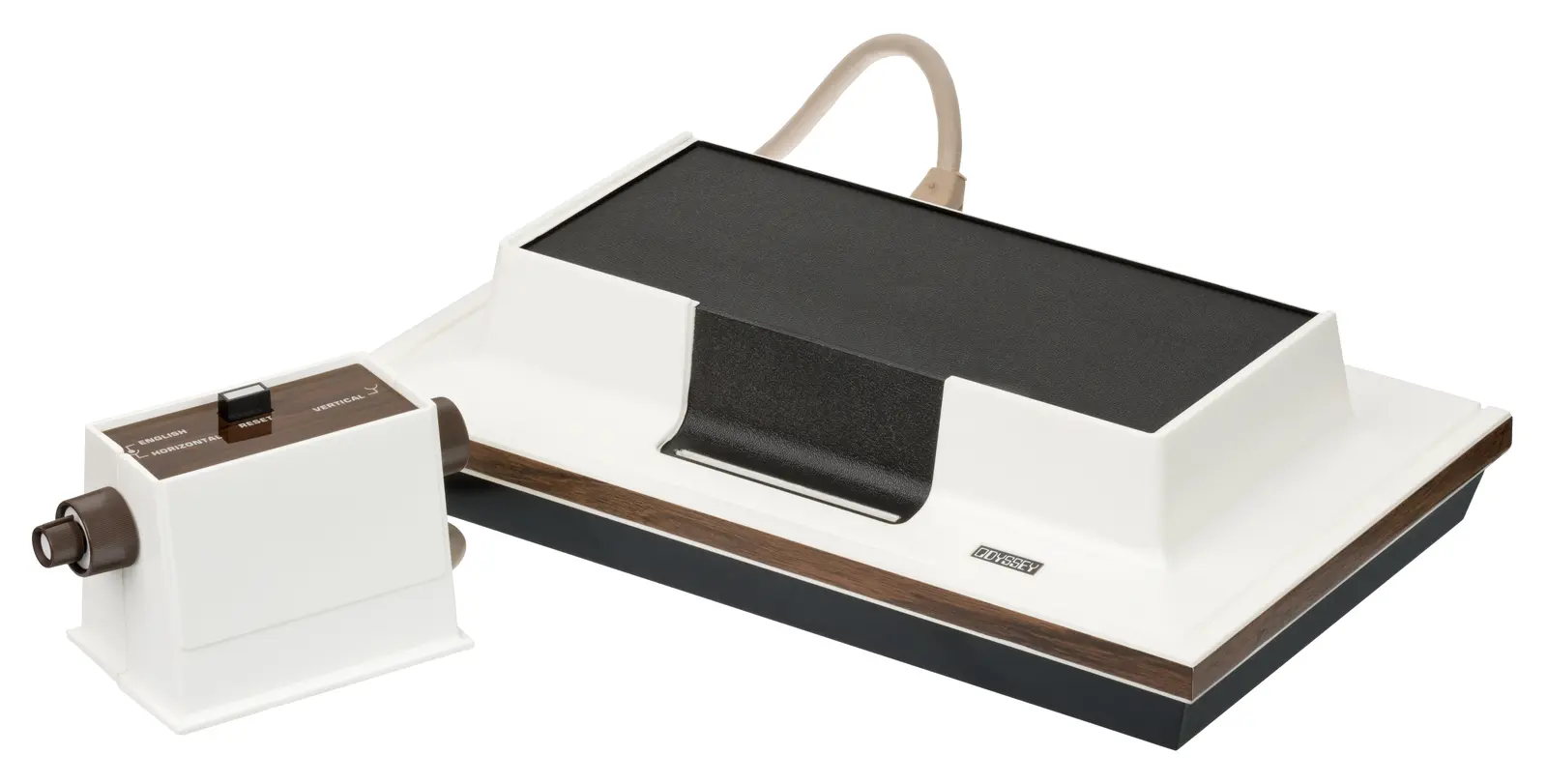
01 / An active television
Until 1972, you watched television. With Odyssey, you took part
Television was a one-way medium: broadcasters decided what appeared and the viewer merely selected a channel. The Magnavox Odyssey reversed that relationship in the living room.
Two players each held a white control box with rotary knobs. They moved glowing rectangles horizontally and vertically across the screen. A third shape could become a ball. The picture was simple, but it responded immediately to human hands.
That seems ordinary now. In 1972 it looked like a magic trick. There was no game programme inside the television and no broadcast signal arriving. A separate device created its own television signal and turned the familiar picture tube into a playing field.
Odyssey was therefore more than the ancestor of one particular console. It introduced a new idea: the screen as a place in which the viewer could act.
02 / From Brown Box to shop product
Ralph Baer wanted television to be more than a receiver
Engineer Ralph Baer worked at defence contractor Sanders Associates when he began developing his idea for games on an ordinary television in 1966.
With Bill Harrison and Bill Rusch, he built a series of prototypes. The best known later acquired the nickname Brown Box: a woodgrain cabinet with switches and two controllers. It could display a chase game and a table-tennis-like game; the team even developed a light gun for shooting games.
Sanders looked for a manufacturer that could turn the design into a consumer product. Magnavox licensed it, simplified the technology and gave it a futuristic name and a striking white, black and brown case. In September 1972, Odyssey reached American Magnavox dealers.
An ordinary television should become an active game machine.
The prototype supports controllable shapes and several types of game.
The experiment becomes the first commercial home video game console.
03 / Almost nothing, cleverly used
No processor, no memory and no software
Later consoles execute millions of instructions per second. Odyssey did not even have a microprocessor. Transistors, diodes and other discrete components generated the video signals directly.
The machine could produce a few white blocks and a line. It knew no colours, played no music and kept no score. Players counted their own points. Each controller had knobs for horizontal and vertical movement and a reset control that returned a game element to play.
Those limitations made the design interesting. Odyssey did only what was electronically essential; rules, scenery, story and scoring were divided between people and physical game components.
04 / A console as a board game
The box was filled with cards, money, tokens and dice
Unpacking Odyssey revealed more than electronics. It looked as though a game console and a board-game cupboard had landed in the same box.
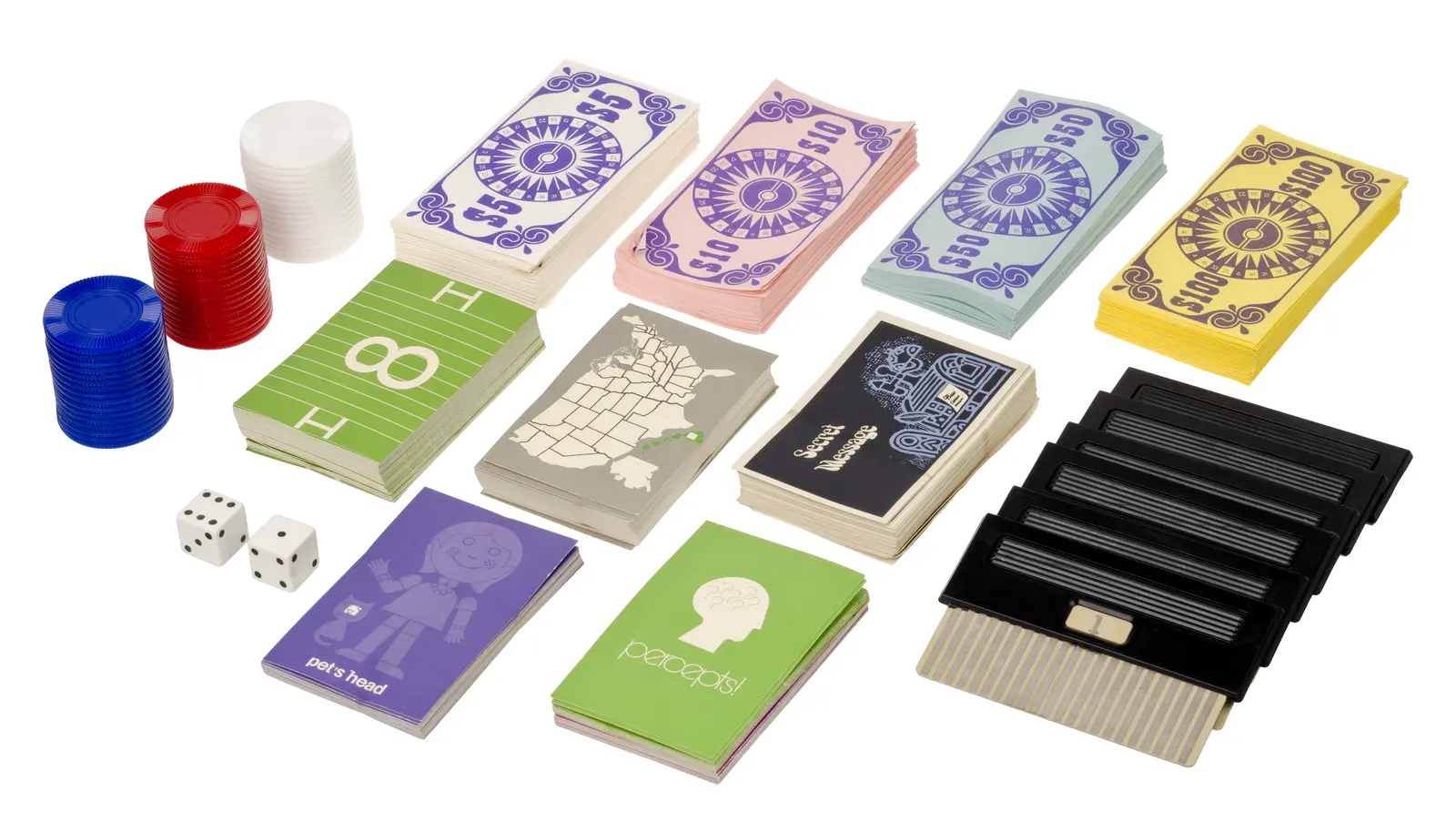
The numbered “game cards” resemble cartridges, but they contain no program. Contact points on a card connected existing circuits in a different arrangement. This changed the placement and behaviour of the light shapes; the actual rules remained in the manual.
In games such as Football and Roulette, much of the action happened away from the screen. Players moved tokens, drew cards or used a separate board. Odyssey was not yet a sealed digital world. It was the electronic centre of a hybrid parlour game.
05 / Colour without a colour chip
Transparent overlays turned the same blocks into different games
Odyssey could only generate a monochrome picture. Magnavox therefore supplied thin, coloured overlays in two television sizes.
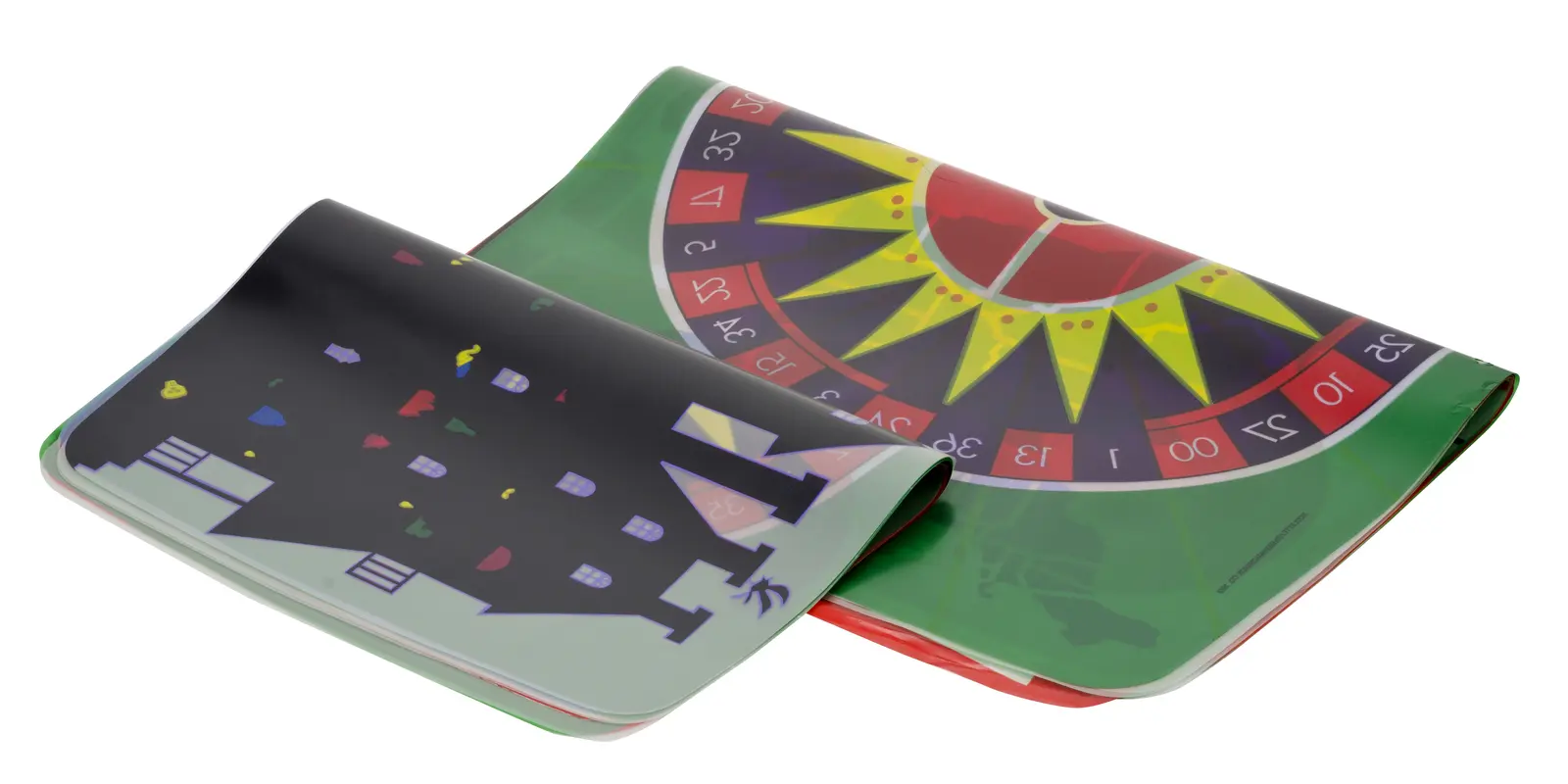
Static electricity held them against the picture tube. The white blocks shone through transparent areas and could become tennis players, skiers, ghosts or roulette markers. The scenery changed; most of the electronics remained the same.
The overlays were more than an unimaginative workaround. They exposed how game design works: meaning comes not only from what a computer calculates, but also from rules, visual design and what players are willing to see in simple symbols.
06 / Table Tennis and Pong
A simple ball game had major legal consequences
Table Tennis was Odyssey's clearest demonstration: two players returned a block of light with movable rectangles.
Nolan Bushnell saw the system at a Magnavox demonstration in 1972. Later that year, his young company Atari released the arcade game Pong. Pong was faster, had sound, kept score and became a far better-known cultural phenomenon.
Yet Baer's earlier work provided the legal foundation beneath the market. Magnavox defended the patents granted to Sanders against Atari and other game companies. Atari settled and took a licence. The lawsuits confirmed that Odyssey was not merely a curiosity, but the commercial starting point for play through a television screen.
07 / A difficult market debut
Many customers thought Odyssey worked only with a Magnavox television
The technology worked with ordinary television sets, but sales through Magnavox dealers and unclear demonstrations created a persistent misconception.
Odyssey cost about one hundred dollars and had to be explained at a time when nobody knew what a home video game console was. Salespeople sometimes presented it mainly as an addition to a Magnavox television. Owners of other brands could therefore assume that it would not work for them.
Sales began slowly, but recovered after clearer advertising. According to the Computer History Museum, more than 350,000 units were eventually sold. That was modest beside later mass-market consoles, but enough to prove that interactive television play could be a consumer product.
08 / The first journey
From notebook to a new industry
Odyssey grew from years of experimentation and became the legal and technical departure point for the young console market.
The idea
At Sanders Associates, Ralph Baer begins designing a game device for ordinary televisions.
The Brown Box
A working prototype combines several games, controllers and a light gun.
Public demonstrations
Magnavox shows Odyssey and its table tennis game to dealers and visitors.
Odyssey arrives
The first commercial home video game console reaches American shops.
Pong
Atari makes the electronic ball game famous in the arcade.
The core patent
Baer's US patent for game control through a television is granted.
09 / Sources & further reading
Explore further
- National Museum of American History — The Magnavox Odyssey predicted the future of video games
- National Museum of American History — Magnavox Odyssey Video Game Unit, 1972
- Computer History Museum — Games On Your TV?
- Computer History Museum — Odyssey video game system
- Ralph H. Baer — Television gaming and training apparatus, US 3,728,480
Image credits
Magnavox Odyssey — Evan-Amos, public domain; resized and converted to WebP
Odyssey accessories — Evan-Amos, public domain; resized and converted to WebP
Odyssey screen overlays — Evan-Amos, public domain; resized and converted to WebP


