Console Outlier B07 / 1991–1998
Philips CD-i:
the game console that refused to be one
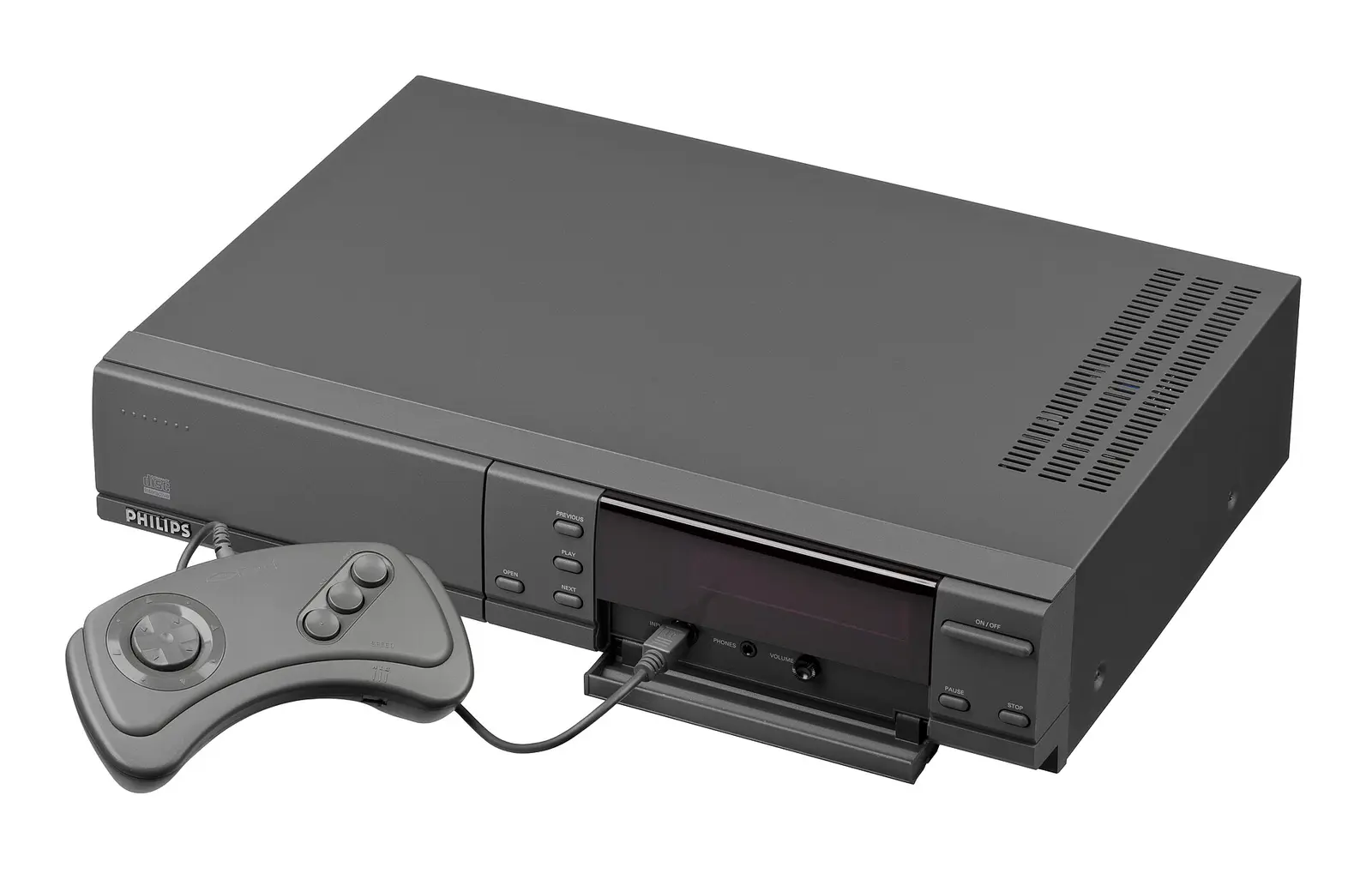
It played games, but Philips called it a player. It came with a pointing device, not necessarily a gamepad. CD-i was meant to be the compact disc’s final form: music, images, films, knowledge and interaction in one living-room box.
01 / The decisive noun
Philips did not place a console beneath the television, but a “player”
Words shaped the object. Consoles belonged near toys; players belonged beside the hi-fi and video recorder. The broad, flat CD-i 200 series adopted the dimensions, display window and sober black finish of serious audiovisual equipment.
CONSOLE≠CD-i
PLAYER
That vocabulary was not empty marketing. A disc could contain a game, an encyclopaedia, a museum tour, children’s lessons or an interactive music album. The difficulty began when a shop assistant or buyer had to explain what all those categories had in common.
02 / A book before a box
CD-i began as a standard that imagined many manufacturers and many kinds of player
Philips and Sony described Compact Disc Interactive in the Green Book specification. It fixed the disc format, a Motorola 68000-family architecture and CD-RTOS so that one title could run on compatible machines from different manufacturers.
many possible appliances
This explains the unusual hardware family: consumer decks, portable presentation players, professional authoring systems, a mini-stereo and even televisions with CD-i built in. It was conceived less like one console and more like a new species of compact disc.
03 / The controller reveals the audience
A remote that moved a pointer made perfect sense—until the disc demanded reflexes
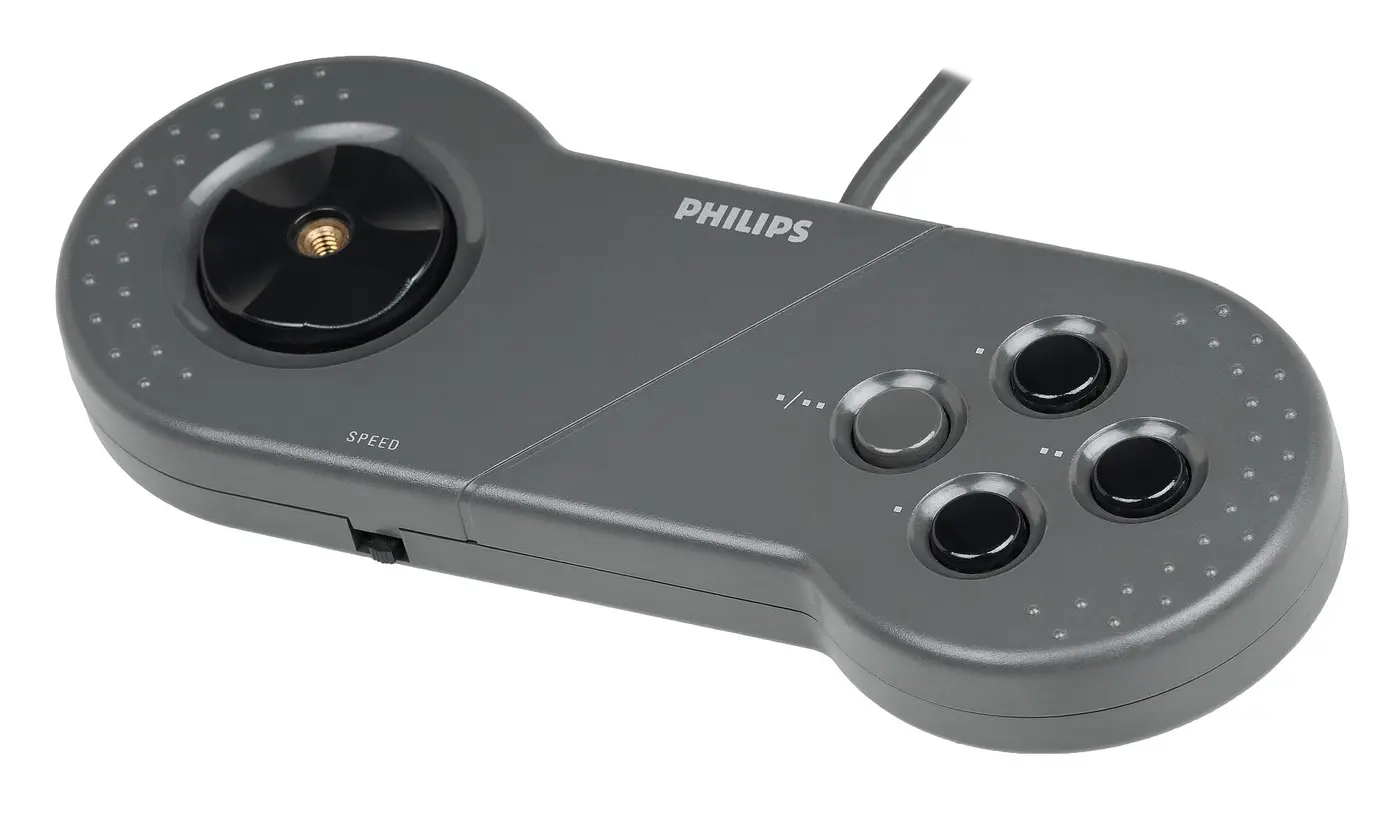
Early players were commonly operated with an infrared Commander or thumbstick-style pointing device. Moving a cursor through menus from the sofa suited an encyclopaedia or Photo CD. Fast platform games exposed every compromise.
MENUMOVE
CURSORREACT
GAME
CD-i therefore had no single iconic hand gesture. Remote, mouse, trackball, roller controller and gamepad each implied a different product. Where Nintendo’s pad told the owner exactly how to begin, Philips offered a choice before the disc had even loaded.
04 / Built for streams, not for sprites
The machine was designed to keep sound, images and data arriving together
The SCC68070 processor ran CD-RTOS, based on Microware’s OS-9. Dedicated video hardware could combine image planes, transparency and natural-picture backgrounds while the disc supplied compressed audio and data in a timed stream.
and control
and audio
and effects
coordination
This architecture excelled at presentation rather than the sprite-heavy action by which consoles were judged. CD-i could show digitised photographs and play clean stereo sound, yet ordinary scrolling and responsive animation often required careful compromises.
05 / The shelf with no single department
Its catalogue looked less like a game library than an optimistic map of the digital home
There were reference works, art collections, cookery guides, children’s stories, music experiments, board games, arcade conversions and interactive films. The common feature was not genre but the promise that pictures and sound could answer back.
The variety now feels prophetic: today one screen moves effortlessly between video, music, games and information. In the early 1990s, however, every category already had a familiar alternative—and CD-i was rarely the cheapest or strongest at any one of them.
06 / Plenty of space, little speed
The compact disc removed one limit and made another impossible to ignore
A CD could hold hundreds of times more data than a cartridge of the previous generation. Developers filled that space with speech, photographed scenes, long music tracks and filmed actors. But the single-speed drive had to seek and load them.
Loading was therefore not a minor inconvenience; it shaped the grammar of the software. Rooms, menus and short video clips suited the medium. Constantly changing action did not. Capacity encouraged spectacle, while access time kept interrupting it.
07 / The future in an expansion slot
Full-motion video became CD-i’s strongest demonstration, but first required another purchase
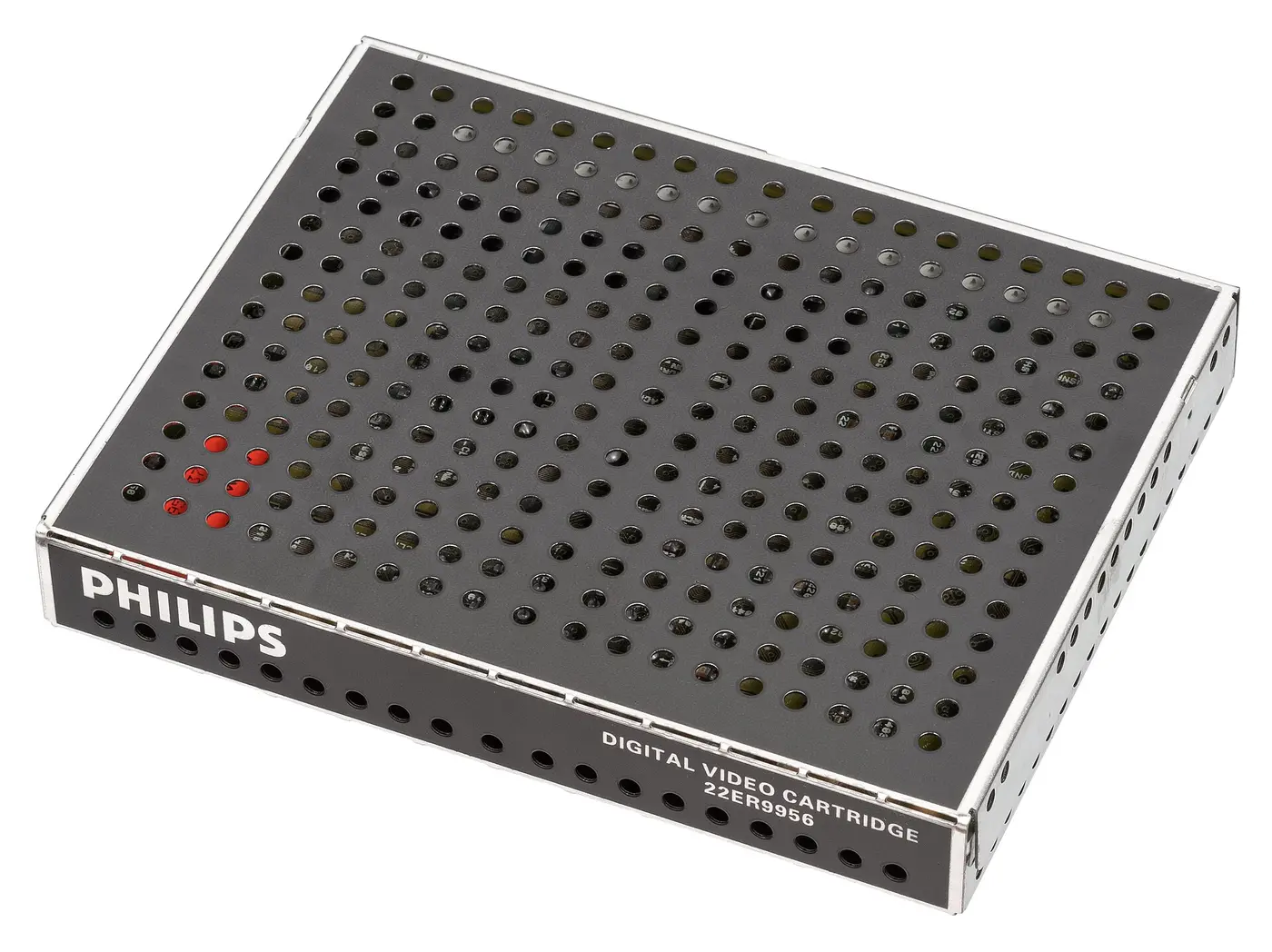
The Digital Video Cartridge added MPEG-1 decoding and extra memory. With it, later players could show Video CD films and software built around moving pictures. Philips had placed an upgrade path inside the machine, but also split its audience into two capabilities.
PICTURES
The add-on made Dragon’s Lair, Mad Dog McCree and video-heavy adventures persuasive showpieces. It also revealed how quickly the target moved: the multimedia future promised at launch became a cartridge option before it could become ordinary.
08 / When the player became a console
Games gradually moved from one category in the brochure to the centre of attention
As the general multimedia proposition struggled, Philips released smaller 400-series players, gamepads and software with a clearer games identity. Yet a platform designed for many purposes could not instantly acquire the reflexes, price or developer culture of a dedicated console.
The best CD-i games are interesting precisely because they chose a side. Burn:Cycle treated the disc as a cinematic space; the Dutch-made The Apprentice worked hard to behave like a conventional console platformer.
09 / Four famous distractions
Mario and Zelda explain why CD-i became an internet curiosity—but not what the machine was for
After a planned Philips–Nintendo CD project came to nothing, Philips could publish Hotel Mario and three games using Zelda characters. Their awkward animated sequences later became endlessly quoted online.
multimedia promise→INTERNET
MEMORY←NOW
four licensed games
They deserve a place in the story, not the whole story. Focusing only on them turns an ambitious Dutch media standard into a punchline about Nintendo. CD-i’s more revealing failure was conceptual: it asked households to buy a category that did not yet have a name.
10 / A Dutch vision of the living room
In the Netherlands, CD-i connected global multimedia ambition to recognisable local culture
Philips published a Dutch Lingo, the interactive music title 2 Unlimited: Beyond Limits and numerous educational and reference discs. TeleCD-i experiments later connected local information and shopping services to the television.
That local catalogue makes the machine more than a failed import console. It was a Philips attempt to decide how European households would enter the multimedia age—through the television and remote control, rather than through a beige personal computer.
11 / The ordinary function that endured
When the interactive future disappointed, the machine could still play an ordinary audio CD
That sounds trivial, but it reveals Philips’ product logic. The new medium was built on top of the familiar compact disc, not beside it. A failed software ecosystem did not leave a completely useless black box.
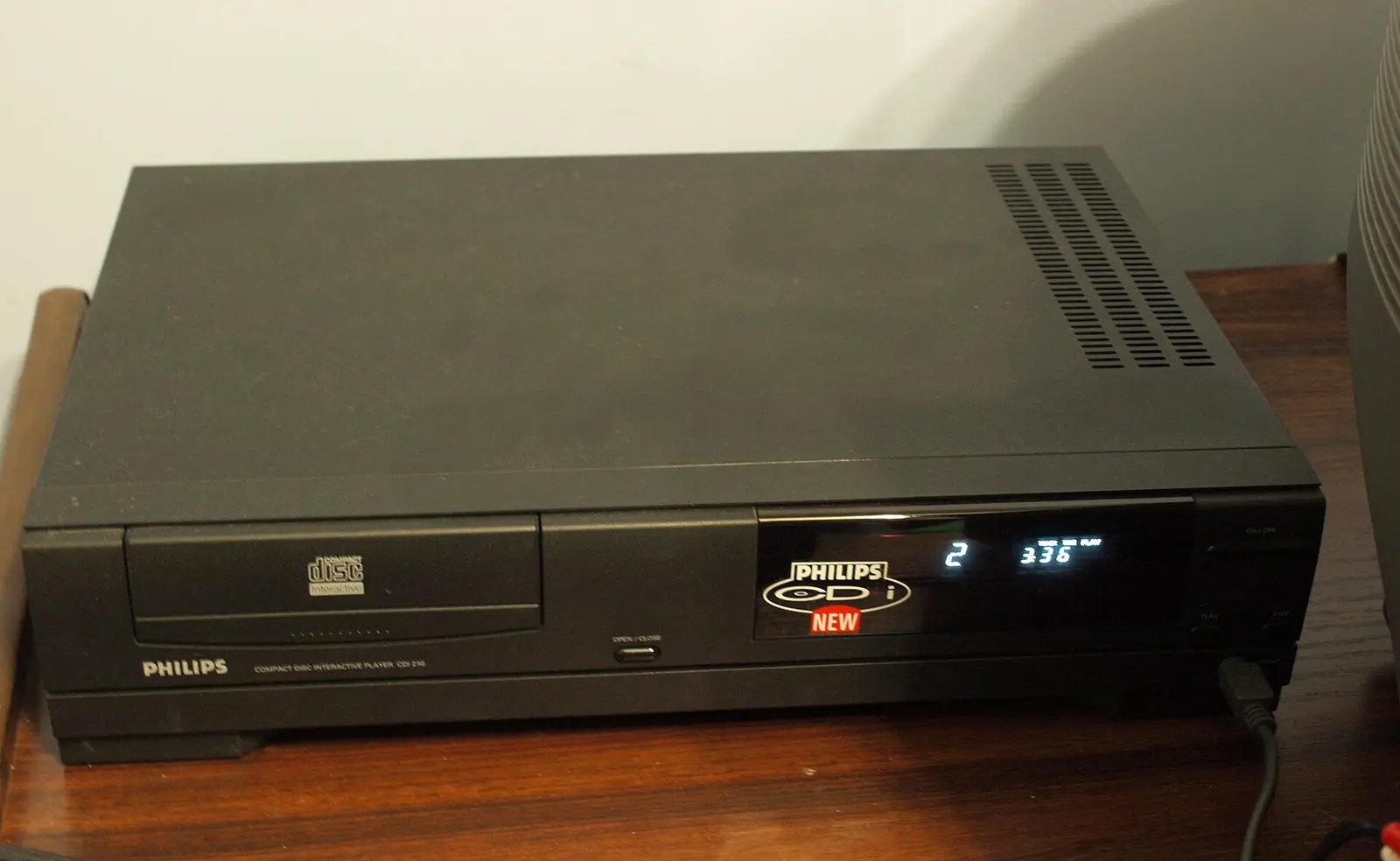
The photograph could almost show any Philips CD player of its time. That anonymity was deliberate—and fatal to its game identity. CD-i fitted beautifully into the equipment stack because it looked as if it had always been there.
12 / The wrong answer to the right question
CD-i predicted the converged living room, but tried to deliver it one expensive disc at a time
Today a television box can stream films, play music, show photographs, answer questions and run games. Philips recognised that convergence early. What it lacked was broadband, cheap storage, fluid interfaces and a clear reason to choose CD-i over specialised devices.
EVERY MEDIUM÷ONE DISC
AT A TIME
The CD-i was not ridiculous because it imagined too much. It was fascinating because the imagined future is now ordinary—only the route was wrong. Philips built the smart-TV question before networks, software economics and controllers were ready to answer it.
13 / From coloured book to black box
A standard became a player, a player became a console, and a console became an online memory
The identity changed faster than the underlying hardware.
Work begins
Philips and Sony start extending the compact disc into an interactive medium.
CD-i announced
The concept is presented as a general multimedia standard, years before consumer players arrive.
Professional system
The modular 180/181/182 equipment brings CD-i to authoring and institutional use.
Consumer launch
The 200 series and American CDI 910 place the player beneath household televisions.
Digital Video
The MPEG cartridge makes moving pictures and Video CD an important new promise.
Smaller, more game-like
The 400 series shifts the design and marketing closer to dedicated consoles.
CD-Online
Modem services try to connect the television and disc to a changing networked world.
The format fades
Hardware disappears, while the last software closes a remarkably broad catalogue.
14 / Sources & further reading
Explore further
- Philips Interactive Media Systems — CD-i 220 User Manual (1995)
- The New International CD-i Association — CD-i player manuals
- The New International CD-i Association — player and Digital Video FAQ
- The New International CD-i Association — technical documentation and Green Book archive
- C²DH, University of Luxembourg — “The Rise and Fall of CD-i”
- The Centre for Computing History — Philips CD-i 220/25
- Wikimedia Commons — CD-i image collection
Image credits
CD-i 220 with controller — Evan-Amos, public domain; resized and converted to WebP
CD-i gamepad — Evan-Amos, public domain; resized and converted to WebP
Digital Video Cartridge — Evan-Amos, public domain; resized and converted to WebP
CD-i 210 as audio player — Matthew Paul Argall, CC0; resized and converted to WebP


