Console Outlier B08 / 1993–1996
3DO:
the game console that did not want to be a brand
Panasonic put its name on the case, GoldStar chose another shape and Sanyo built a third machine. Inside, they had to speak the same language. 3DO sold not a console but the recipe for one—and discovered that nobody wanted to pick up the first bill.
01 / A logo seeks a case
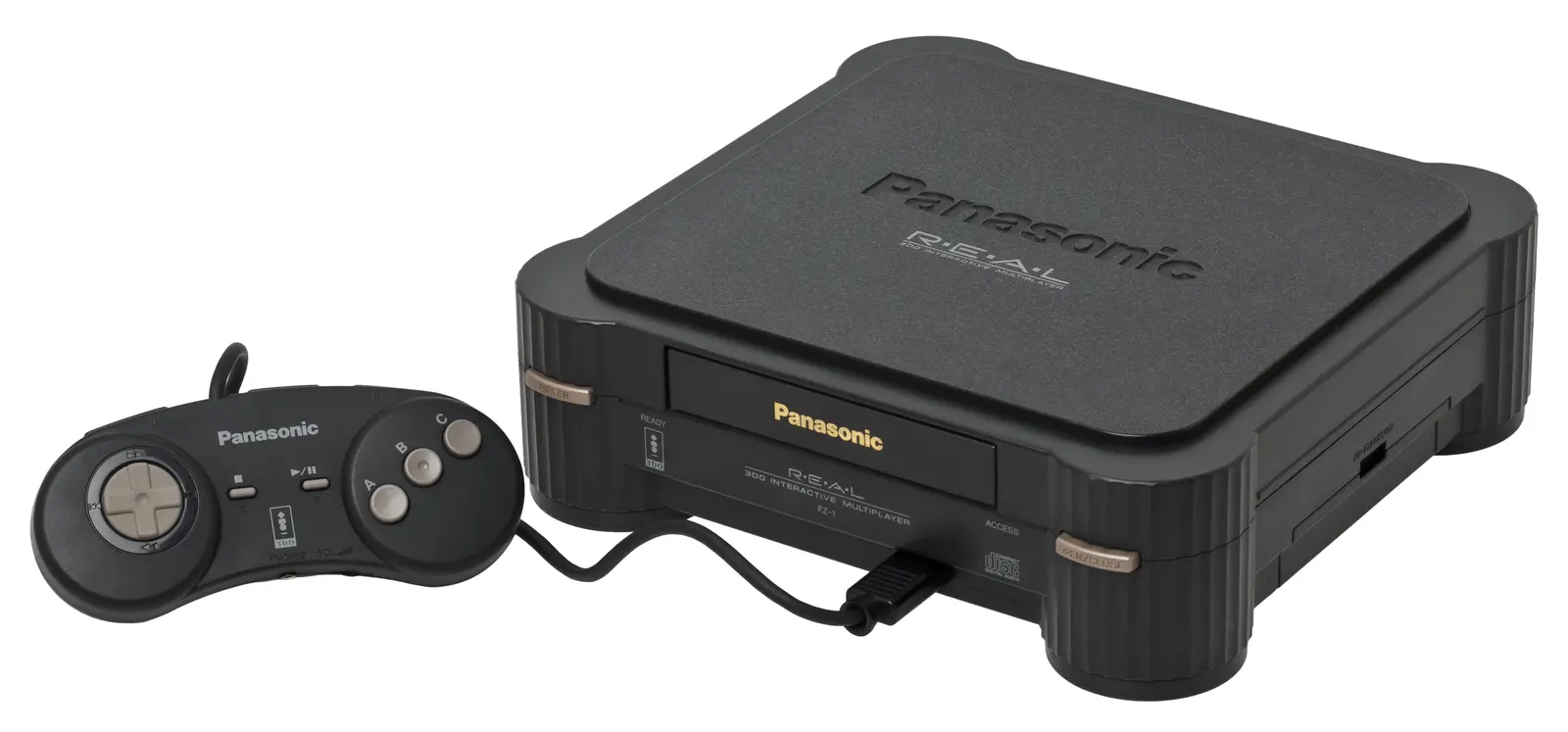
Panasonic appeared on the front; the actual game platform was called 3DO
The first buyer saw a weighty black player with a motorised tray, the letters REAL and the familiar Panasonic name. Yet Panasonic did not own the platform. It built one version of a design managed by The 3DO Company.
PANASONICbuildsSTANDARD
3DOrunsSOFTWARE
BY ANYONE
That made the machine harder to explain than a Nintendo or Sega. A 3DO was simultaneously a technology, a software platform, a certification mark and a collection of mutually compatible machines. The brand on the box could vary; the circular 3DO emblem promised that the same disc would still work.
02 / The video recorder as a model
Trip Hawkins wanted game machines to work like an open consumer-electronics standard
The founder of Electronic Arts saw something peculiar in the console market. Nintendo and Sega decided who could make hardware, which games appeared and how much every publisher paid. Hawkins imagined a shared specification, built by competing electronics brands and open to far more creators.
It resembled VHS, CD or the PC: the standard was meant to matter more than any individual device. But a game console is not a passive player. Good development tools, a consistent controller, marketing and a steady supply of exclusive software require somebody to steer the whole thing every day.
03 / Amiga lineage under the lid
Designers Dave Needle and RJ Mical once again built a machine around specialised chips working together
Needle and Mical had previously worked on the Amiga and Atari Lynx. 3DO likewise did not depend on one do-everything processor. A 32-bit ARM60 ran game code, two graphics processors handled images and a custom digital signal processor produced sound.
12.5 MHz
and objects
and input
audio synthesis
With 2 MB of main memory, 1 MB of video memory, millions of colours, CD-quality stereo sound and a double-speed CD-ROM drive, the system was unusually generous in 1993. Its architecture was made for large images, scaled objects, textures and digitised media—the exact ingredients from which the 1990s imagined their future.
04 / A future appliance in hi-fi clothing
The FZ-1 deliberately resembled an expensive CD player more than a toy
The motorised tray glided out electrically, the controller carried a headphone socket, and the machine also played ordinary audio CDs and Photo CDs. It wanted a place not beside a child’s console but among the amplifier, television and laserdisc player.
That presentation explains both its appeal and its distance. 3DO offered a glimpse of the multimedia room before the PC naturally belonged there. But the glossy front also announced that this was no impulse purchase. The machine was demonstrated as the future and priced as an exclusive piece of the interior.
05 / One interior, different faces
Panasonic, GoldStar and Sanyo proved that members of a console family did not need to look alike
Panasonic followed the FZ-1 with the lighter, top-loading FZ-10. GoldStar released the GDO-101 and Sanyo sold the TRY in Japan. Creative went further: the 3DO Blaster put the platform on an expansion card for a Windows PC with a compatible CD-ROM drive.
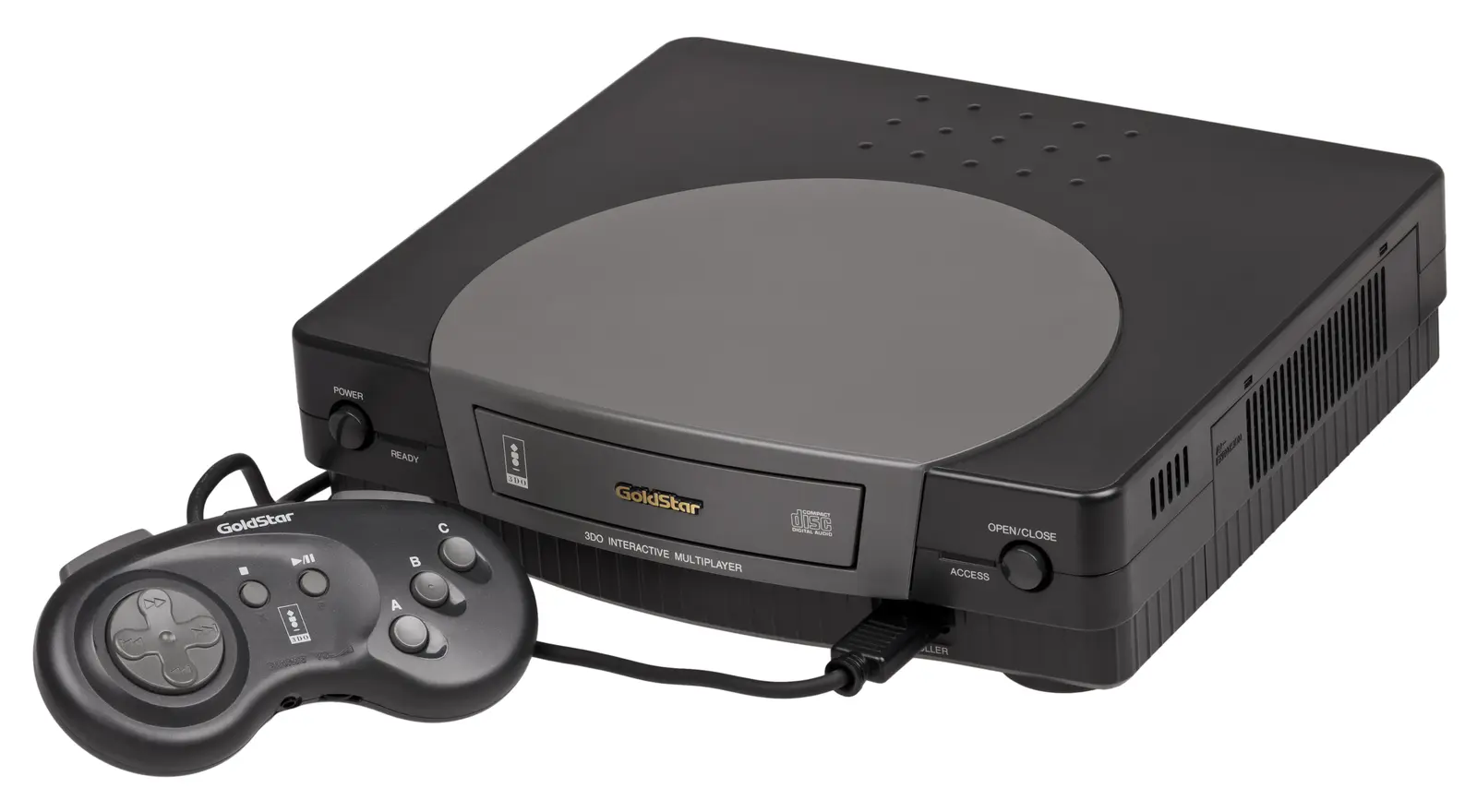
That variety is wonderful for collectors today. For the market, it meant no single appearance became the symbol of 3DO. The Panasonic FZ-1 came closest, yet even its distinctive shape was only one possible package for the platform.
06 / One port, a chain of players
Extra controllers plugged not into the console but into one another
The front offered a single controller socket. A second player’s cable went into a port on the first controller; a third could hang behind the second. Technically elegant, on the sofa sometimes a garland of cables and little boxes.
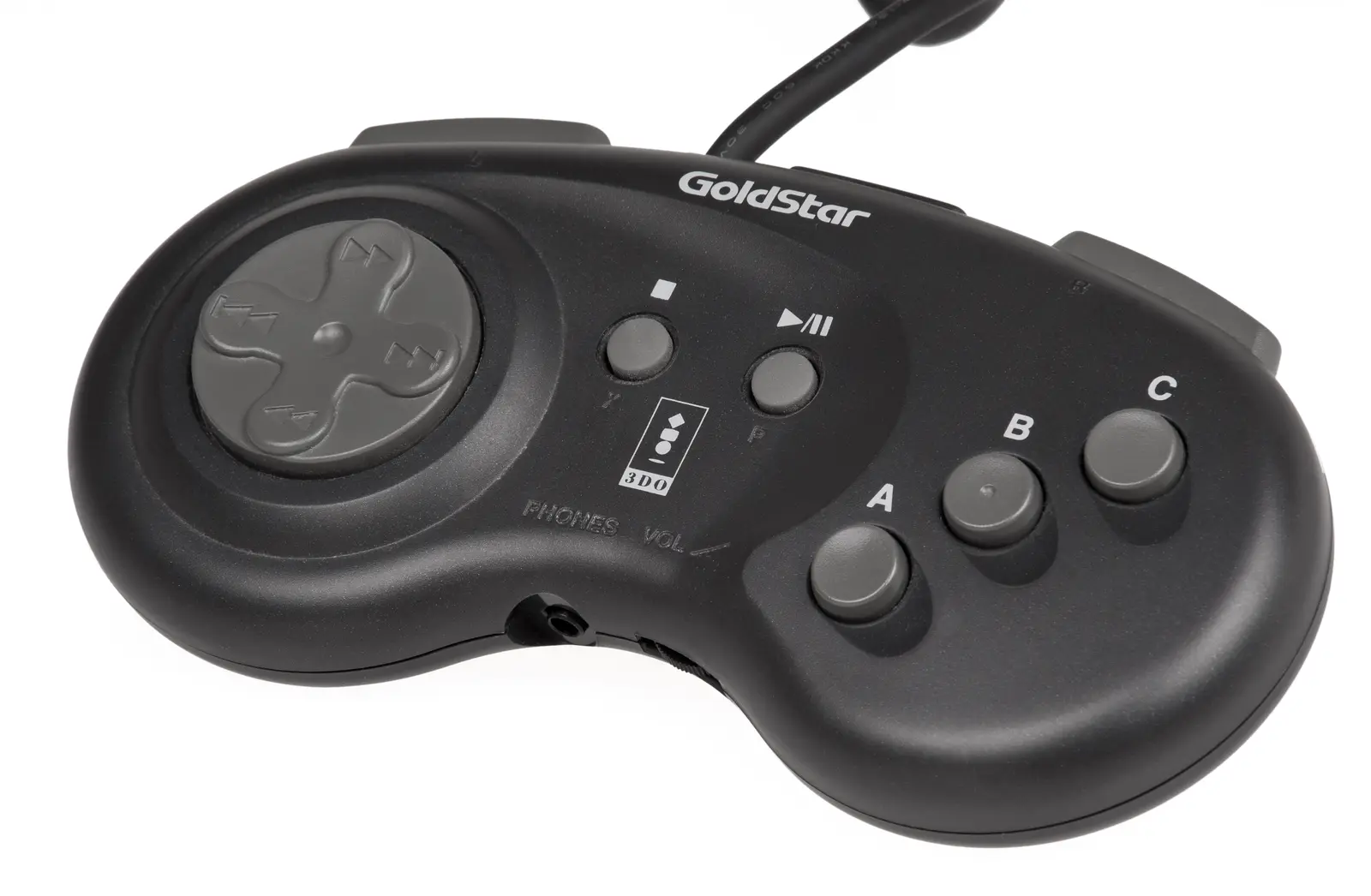
It suited the standards idea: manufacturers could make their own controllers provided they followed the same interface. Ordinary pads, a Capcom fighting controller, mice and other variations followed. The freedom did not merely surround the console; it literally ran through the cable.
07 / CD became a style, not just storage
Developers filled the space with filmed images, recorded voices and music that no longer needed to sound like a game console
The double-speed drive made video clips and generous amounts of digital audio natural choices. Titles including The Daedalus Encounter, Corpse Killer and Mad Dog McCree used actors and camera footage as their primary material.
fixed limitsCD-ROM
images · voices · music
Many of those interactive films have aged badly, but they capture a genuine transition. The industry knew that cartridge limits were disappearing; it did not yet know what visual language three-dimensional games would adopt. 3DO consequently staged both dead-end experiments and early forms of the later console game.
08 / The best games chose motion over film
Road Rash, The Need for Speed and Return Fire proved 3DO could do more than play video windows
Road Rash combined flowing roads, CD music and gloriously silly video scenes in a version that clearly surpassed its 16-bit predecessors. Road & Track Presents: The Need for Speed debuted on 3DO and laid the foundations for a series that would become far larger than the platform.
Gex, FIFA International Soccer, Wing Commander III and the expanded version of Star Control II gave the library character too. Many successes later moved to cheaper consoles. They proved the software’s quality while making the costly 3DO itself ever harder to defend.
09 / The bill without a subsidy
The notorious $699.95 was not merely high—the price exposed a flaw in the model
Traditional console companies could offer cheap hardware and earn money later from every game sold. Panasonic made 3DO hardware but did not own the software toll road. It therefore needed a healthy margin on the player itself.
the front door was not
For that sum, a household could buy several established game consoles. The price later fell steeply and cheaper models appeared, but the first impression remained: 3DO was for affluent early adopters. A standard that wanted to go everywhere began in the narrowest part of the market.
10 / The window closed quickly
A technical lead is most valuable before cheaper competition reaches the same future
In 1993, 3DO looked spectacular beside the Mega Drive and Super Nintendo. Two years later, the Sega Saturn and especially Sony PlayStation brought faster 3D hardware, strong brands, large developer networks and lower prices.
LEAD→1994
CHANCE→1995
OVERTAKEN
Sony also did what 3DO could not: price hardware aggressively and recover losses through software licences. PlayStation was not a more open standard, but it was a coherent platform. The simplicity of one accountable owner proved commercially stronger than a consortium of impressive names.
11 / The successor became an exit
M2 promised a far more powerful sequel, then changed from rescue plan into sold technology
The 3DO Company developed a 64-bit successor called M2. Panasonic parent Matsushita bought the technology in 1995. Prototypes and demonstrations raised expectations, but a full consumer console never reached the market.
3DO thus lost its hardware future before the first platform had entirely disappeared. The company continued as a game publisher, with series including Army Men, until bankruptcy in 2003. The name intended to become a universal standard ended as a name printed above software boxes.
12 / The right insight, wrongly divided
3DO understood that platforms can be larger than devices, but underestimated who pays for the ecosystem
The central idea sounds familiar now. Different manufacturers can build compatible devices; software makers work from one technical base; the platform brand sits beside the hardware brand. Android and the PC demonstrate how powerful that separation can be.
FOR MAKERS+AFFORDABLE
FOR BUYERS=ONLY TOGETHER
A STANDARD
At 3DO, each party pulled at a different section. The platform holder wanted low software fees, the manufacturer needed to profit from the box, and the buyer had to finance the shared ambition in advance. The machine failed not because the idea was absurd, but because its benefits arrived later than its bill.
13 / From standard to publisher
In twelve years, 3DO moved from universal hardware plan to a name on games
The technology disappeared faster than the thinking behind it.
The 3DO Company
Trip Hawkins establishes the company around a new interactive multimedia platform.
Architecture completed
Dave Needle and RJ Mical’s New Technology Group forms the technical foundation.
Panasonic FZ-1
The first US 3DO appears in October for $699.95.
More devices
GoldStar, Sanyo and Creative give the same standard different forms.
The library grows
Road Rash, Star Control II and The Need for Speed reveal different strengths.
M2 sold
Matsushita acquires the successor technology as PlayStation and Saturn advance.
Hardware era ends
New 3DO players disappear and the company concentrates on software.
Bankruptcy
The 3DO Company closes after years as a game publisher.
14 / Sources & further reading
Explore further
- Panasonic — 3DO FZ-1 User Manual
- 3DO Development Repository — technical manuals and schematics
- Wired (1993) — ‘3DO: Hip or Hype?’
- Wired (1994) — ‘Third Time’s a Charm (They Hope)’
- Wired (1997) — ‘3DO: Consoles ‘R’ Not Us’
- Centre for Computing History — Panasonic REAL 3DO
- REAL 3DO — archive of press releases from 1994–1997
Image credits
Panasonic FZ-1 with controller — Evan-Amos, CC BY-SA 3.0; resized and converted to WebP
GoldStar GDO-101M with controller — Evan-Amos, CC BY-SA 3.0; resized and converted to WebP
GoldStar 3DO controller — Evan-Amos, CC0; resized and converted to WebP


