Console Outlier B09 / 1993–1996
Atari Jaguar:
when one number had to explain everything
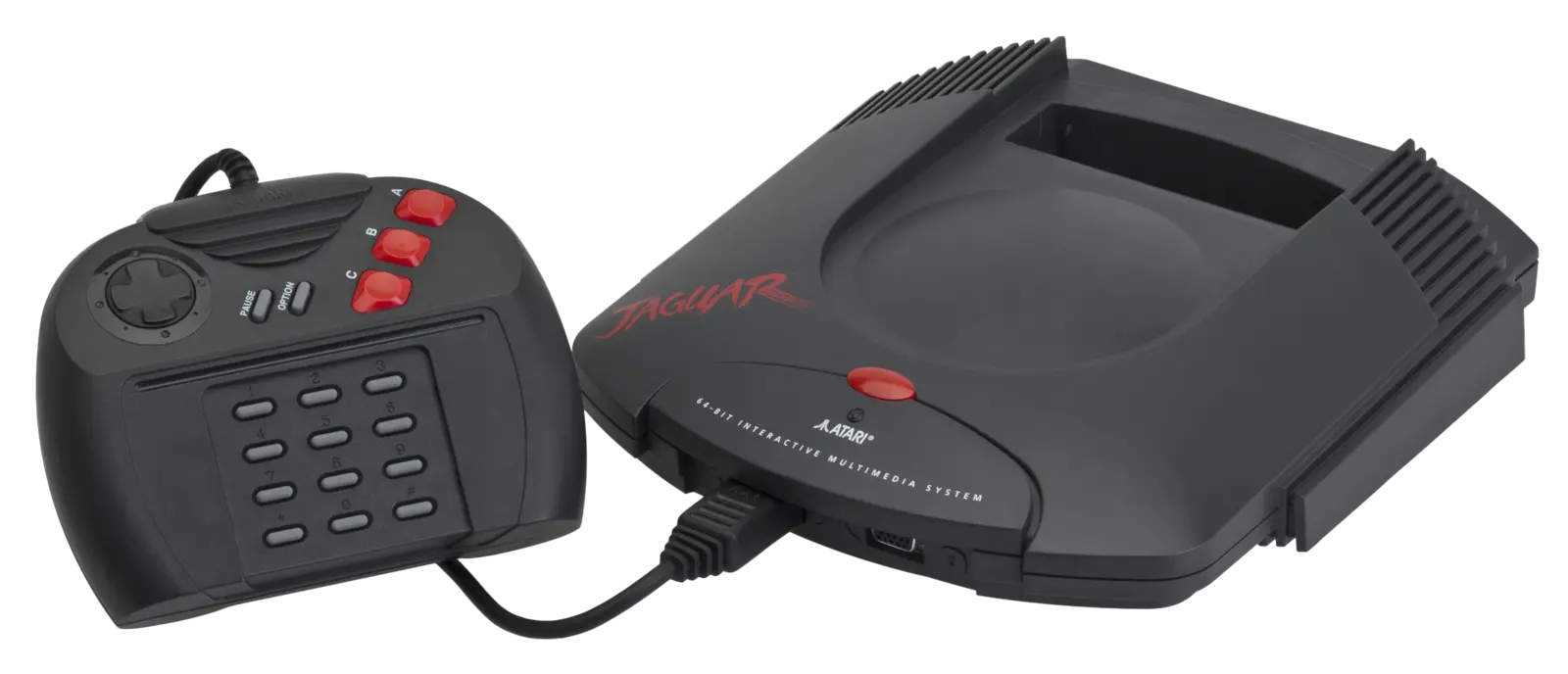
The box said 64-bit. Underneath it sat a 68000 manager, two RISC processors, an Object Processor and a Blitter, all negotiating one shared machine. Atari’s arithmetic was easy to advertise—and exceptionally difficult to turn into a game.
01 / The hot number
Before a buyer saw a game, the Jaguar asked them to compare three numbers
Mega Drive and Super Nintendo were 16-bit. New rivals called themselves 32-bit. Jaguar printed 64-BIT across the front and reduced an entire generation of hardware to a piece of mental arithmetic.
It was brilliant compression. Processor design, memory bandwidth, development tools and software support disappeared behind one figure. Yet the number also became a debt: every ordinary-looking game now had to explain why four times as many bits did not automatically produce four times as much spectacle.
02 / A British engine for an American return
The machine began with Flare Technology, not in Atari’s old Californian arcade laboratories
British designers Martin Brennan and John Mathieson developed the ideas behind Jaguar after work on Flare One and the unrealised Konix Multi-System. Atari funded their more ambitious design and abandoned its intermediate Panther project.
That lineage matters. Jaguar was not a cautious sequel to the 7800 or XEGS; it was Atari buying a route back to the front of the industry. For a company whose name still evoked the invention of home video games, the console carried more than a product launch. It had to make Atari feel inevitable again.
03 / Tom, Jerry and three more colleagues
Jaguar was less a single processor than a small studio in silicon
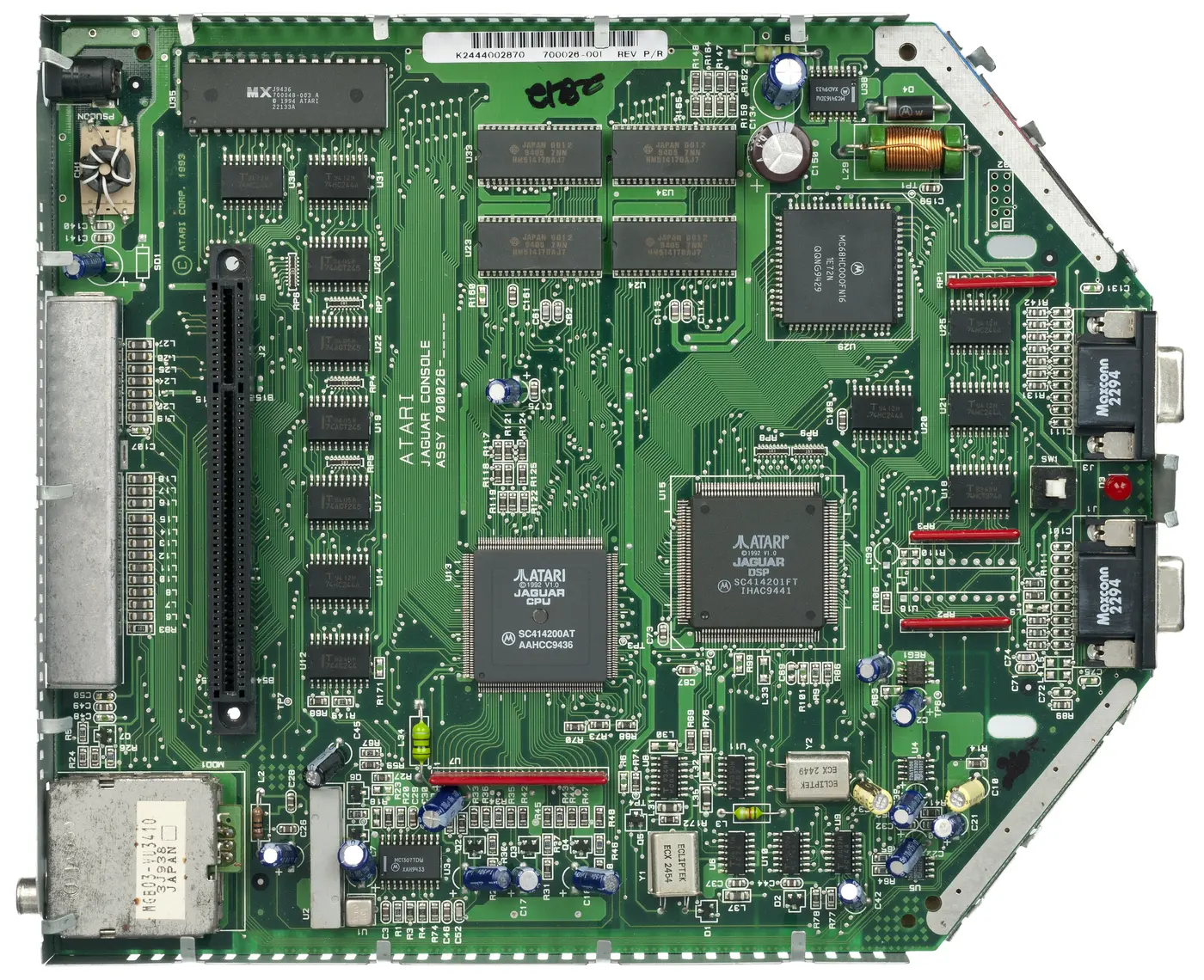
The custom Tom chip contained a 32-bit graphics processor, a 64-bit Blitter and an Object Processor that assembled the picture line by line. Jerry held a second 32-bit RISC processor for sound. A Motorola 68000 coordinated the work.
On paper, it was a clever division of labour. In practice, speed depended on giving each worker the right task, moving data at the right moment and preventing them from fighting over memory. Jaguar offered power as a coordination problem.
04 / The manager in the middle
Atari’s own manual called the familiar 68000 a manager, not the star
The same processor family already powered the Mega Drive, Amiga and Atari ST. Jaguar’s designers intended it to handle control and communication while the custom processors did the heavy visual and audio work.
assignsTOM + JERRY
perform
But familiar code was easier to write than finely tuned parallel code. When a production leaned too heavily on the 68000, the supposedly futuristic console could behave like an older machine with exotic helpers. Its performance was not a fixed property; it depended unusually strongly on how well a developer understood the whole orchestra.
05 / 64-bit was true—and incomplete
The number described the road between components better than the minds travelling on it
Jaguar had a 64-bit data path to memory, and the Blitter and Object Processor could move 64-bit “phrases”. Its programmable RISC cores nevertheless used 32-bit instructions; the 68000 communicated over a narrower path.
So “64-bit” was neither a pure fabrication nor a useful summary. It selected the widest part of a heterogeneous design and promoted it to the identity of the entire product. The argument over whether Jaguar counted as 64-bit obscures the more interesting point: bit width had stopped being a reliable shorthand for what a console could do.
06 / Power with footnotes
The technical manual ended with bugs, severity levels and workarounds
Some chip behaviour cost a little speed; other faults demanded that instructions be reordered, pixels paired or features used only in particular combinations. The machine could still perform—but its shortcuts required expert local knowledge.
Every platform has quirks. Jaguar’s problem was the combination: several processors, tiny pools of fast local memory, shared bandwidth, immature tools and documented silicon surprises. A small studio did not simply learn a new CPU. It learned a choreography, including the places where the floorboards moved.
07 / Tomorrow held like yesterday
The PowerPad put a futuristic console behind a telephone keypad
Its directional pad and three red action buttons looked conventional. Beneath them waited twelve numbered keys, with plastic overlays for weapons, commands or options—a design echo of Intellivision, ColecoVision and Atari 5200.
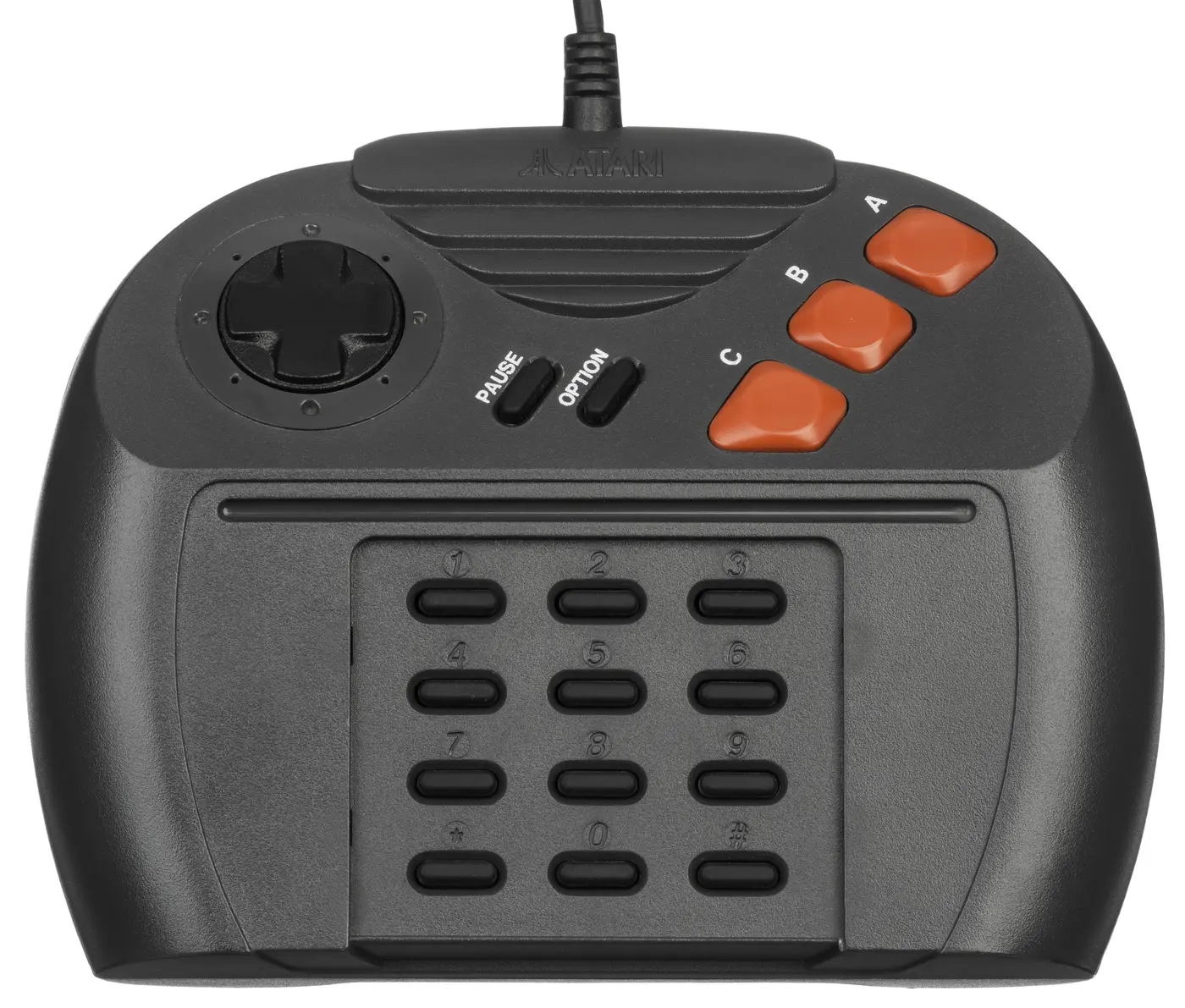
The keypad was genuinely useful in Doom, Alien vs. Predator and simulations with many commands. It was also a visible contradiction. As Sega and Nintendo refined the compact gamepad, Atari revived the controller language of its least successful early-1980s systems.
08 / Four games, four different Jaguars
The best software did not prove one specification; it found one part of the architecture to trust
Tempest 2000 turned simple geometry, colour and music into velocity. Rayman treated rich 2D art as a strength. Alien vs. Predator exchanged fluidity for oppressive space, while Iron Soldier built its appeal from large, clean polygons.
Together they reveal a machine with several distinct talents, not one automatic next-generation look. Jaguar was most convincing when a developer chose a narrow idea and shaped the hardware around it. Generic ports rarely received that luxury.
09 / Early enough to lead, too late to define
Jaguar arrived before PlayStation and Saturn, but could not turn its head start into a shared visual language
In late 1993, polygon graphics and 24-bit colour sounded like a leap beyond 16-bit consoles. By 1995, texture-mapped 3D, CD-ROM and large developer programmes were becoming ordinary expectations rather than exotic promises.
FIRST CLAIM→1994
SMALL LIBRARY→1995
NEW BASELINE
Atari had launched into a narrow window and then watched the frame move. Sony did not need shoppers to debate buses or processor roles; PlayStation games repeatedly demonstrated one recognisable kind of 3D future. Jaguar’s architecture remained a conversation its market no longer wished to have.
10 / The future clicked onto the cartridge slot
Jaguar CD made the promised multimedia machine literal—and physically taller
The 1995 double-speed CD add-on sat on top of the console and left a cartridge slot available for memory or ordinary games. It played audio CDs and included Jeff Minter’s Virtual Light Machine, which transformed music into moving colour.
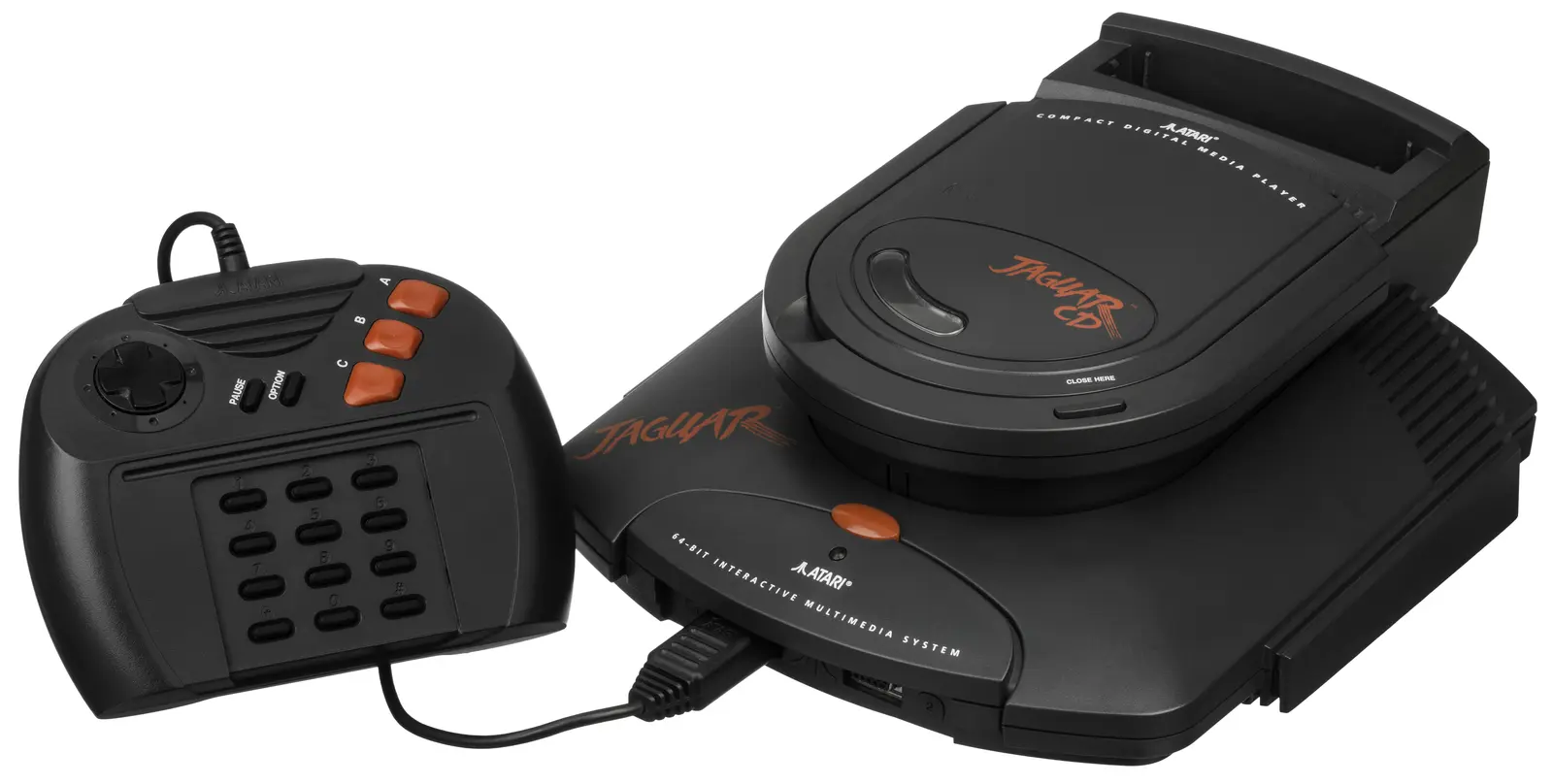
The add-on is remembered for its unusual silhouette, but the timing mattered more. It reached stores just as PlayStation and Saturn made CD an integrated starting point. Jaguar owners had to buy an extra layer to reach a future competitors already included in the base price.
11 / Ports to futures that never arrived
The back of the console and Atari’s announcements suggested a much larger system than buyers ever received
Atari discussed network connections, a voice modem, MPEG video, a combined Jaguar Duo and a Virtuality-based VR headset. Most remained prototypes, demonstrations or plans; the CD unit was the major expansion that actually shipped.
SHIPPEDMODEM
RAREVR
PROTOTYPEDUO
CANCELLED
Expansion ports are physical optimism. They reserve space for business relationships, accessories and audiences that do not yet exist. On Jaguar, those connectors survived as outlines of the ecosystem Atari needed but lacked the time and money to build.
12 / The warehouse did the final arithmetic
By the end of 1995, Atari had almost as many Jaguars in inventory as it had sold since launch
Atari’s 1996 filing reported approximately 125,000 consoles sold from launch through 1995 and roughly 100,000 still in inventory on 31 December. The company cut the suggested price, wrote down stock and withdrew from active Jaguar support.
No single flaw produces a warehouse like that. Sparse software, limited marketing resources, Atari’s weakened retail position and fast-moving competition all mattered. The bit-count debate became the memorable joke, but the commercial failure was an ecosystem running out of oxygen.
13 / A console becomes open after closing
Hasbro’s 1999 rights release gave Jaguar a second, smaller life
After acquiring Atari’s properties, Hasbro Interactive released the rights it held to the Jaguar hardware platform and declared it open. Independent programmers could publish without the original licensing gatekeeper.
COMMERCIAL END→1999
OPEN PLATFORM→TODAY
NEW SOFTWARE
The architecture that had discouraged hurried commercial ports became a long-form puzzle for enthusiasts. New cartridges, CD releases, tools and increasingly accurate emulation now approach Jaguar without a Christmas deadline. Its most durable community began only after market relevance was no longer the measure.
14 / The wrong unit of measurement
Jaguar’s tragedy was not that 64-bit meant nothing, but that it was asked to mean everything
A wide memory path was real. So were the capable Blitter, Object Processor, GPU and DSP. None of them could replace tools, documentation, patient optimisation, third-party confidence or a steady stream of finished games.
Atari sold the Jaguar as a generational answer before the industry had agreed on the question. The next era would not be won by the console with the largest number on its shell, but by the platform that made difficult hardware feel simple to developers and obvious to players. Jaguar did the opposite: it made a fascinating machine look like elementary maths.
15 / From comeback to open platform
Six years separated Atari’s great return from Hasbro’s release of the hardware rights
The commercial life was short; the technical afterlife is still unfolding.
Flare II
Work begins on the architecture that will become Jaguar.
Panther cancelled
Atari concentrates on the more ambitious Jaguar project.
Test launch
New York and San Francisco receive the first consoles in November.
The distinctive library
Tempest 2000, Alien vs. Predator and Iron Soldier find different strengths.
Jaguar CD
The optical add-on arrives as PlayStation and Saturn reset expectations.
Atari withdraws
Inventory is discounted and the company merges with JTS.
Open platform
Hasbro releases its Jaguar hardware rights for independent publishing.
Afterlife
Homebrew developers, publishers and emulator authors keep studying the orchestra.
16 / Sources & further reading
Explore further
- Atari / Martin Brennan — Jaguar Technical Reference Manual, revision 8
- Atari (1993) — original Jaguar launch press release, preserved by Vintage Computing
- Atari Corporation — Annual Report 1992
- AtariAge — Jaguar timeline with extracts from Atari’s 1996 SEC filing
- Atari — Jaguar CD User Manual
- John Mathieson — interview about Flare, Panther and Jaguar
- Hasbro Interactive (1999) — release of Jaguar publishing rights
Image credits
Atari Jaguar with controller — Evan-Amos, CC BY-SA 3.0; resized and converted to WebP
Atari Jaguar motherboard — Evan-Amos, public domain; resized and converted to WebP
Atari Jaguar controller — Evan-Amos, public domain; resized and converted to WebP
Atari Jaguar CD with controller — Evan-Amos, public domain; resized and converted to WebP


