Console Outlier B10 / 1995–1996
Nintendo Virtual Boy:
the screen built for one pair of eyes
Nintendo produced convincing stereoscopic depth by removing almost everything normally surrounding a console screen: colour, a television, freedom of movement and other people. The result was not quite VR, not truly portable and impossible to watch from the sofa.
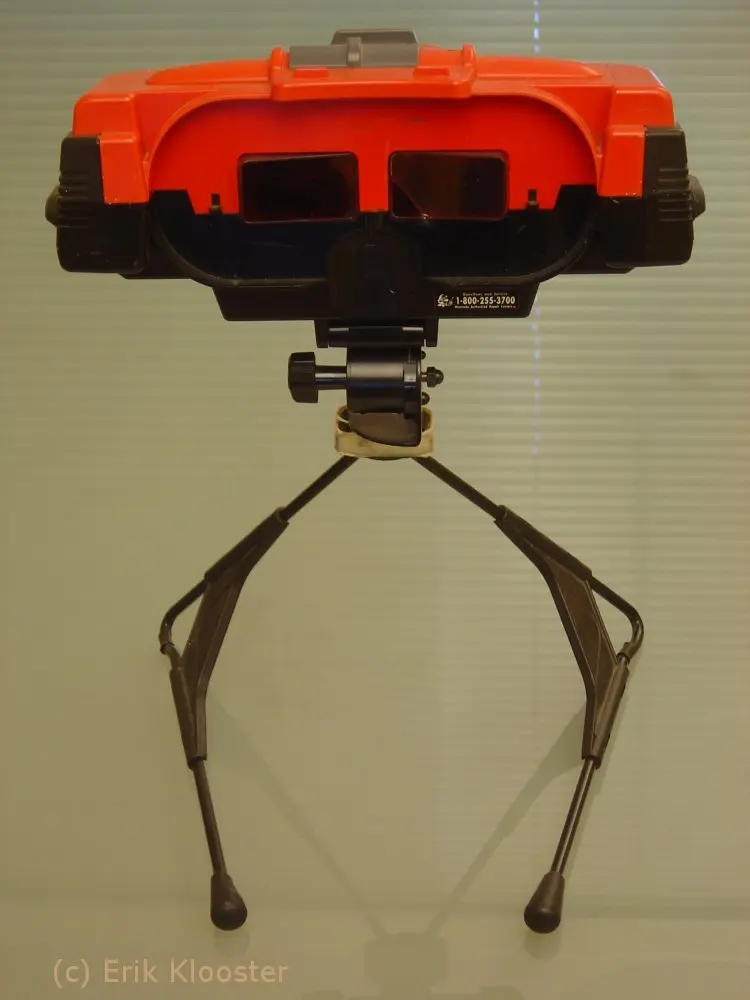
01 / The private theatre
Every other console placed a picture in the room; Virtual Boy removed the room
A television could be watched by players, siblings and passers-by. The Game Boy could be turned towards a friend. Virtual Boy asked one person to press their face against a black rubber shade while everyone else saw only the back of a red machine.
That isolation was not an accidental side effect. It was the condition that made the depth effect work: each eye had to receive a separate, precisely aligned picture. Nintendo therefore built a screen that was intensely personal but physically difficult to treat as a personal device.
02 / A display looking for a purpose
The technology began as a tiny computer monitor for people whose hands were busy
In the 1980s, Massachusetts company Reflection Technology developed the Private Eye: a miniature display intended for technicians, doctors and portable computers. Its trick was not a tiny rectangular panel, but a single vertical row of lights reflected by a rapidly moving mirror.
INFORMATION→VR32
EXPERIMENT→VIRTUAL BOY
TOY
After other toy companies passed, Reflection demonstrated the system to Nintendo in 1991. Gunpei Yokoi—designer of Game & Watch and central figure behind Game Boy—saw a mature, unusual technology that competitors could not easily copy. The console inherited the display’s compromises before it had found the games that might justify them.
03 / A line pretending to be a screen
Each eye looked at 224 red LEDs and a mirror moving fast enough to make them appear 384 lights wide
The LEDs changed while an oscillating mirror swept their reflection across the field of view. Persistence of vision joined those moments into a 384 × 224 image. The entire illusion happened twice, once for each eye.
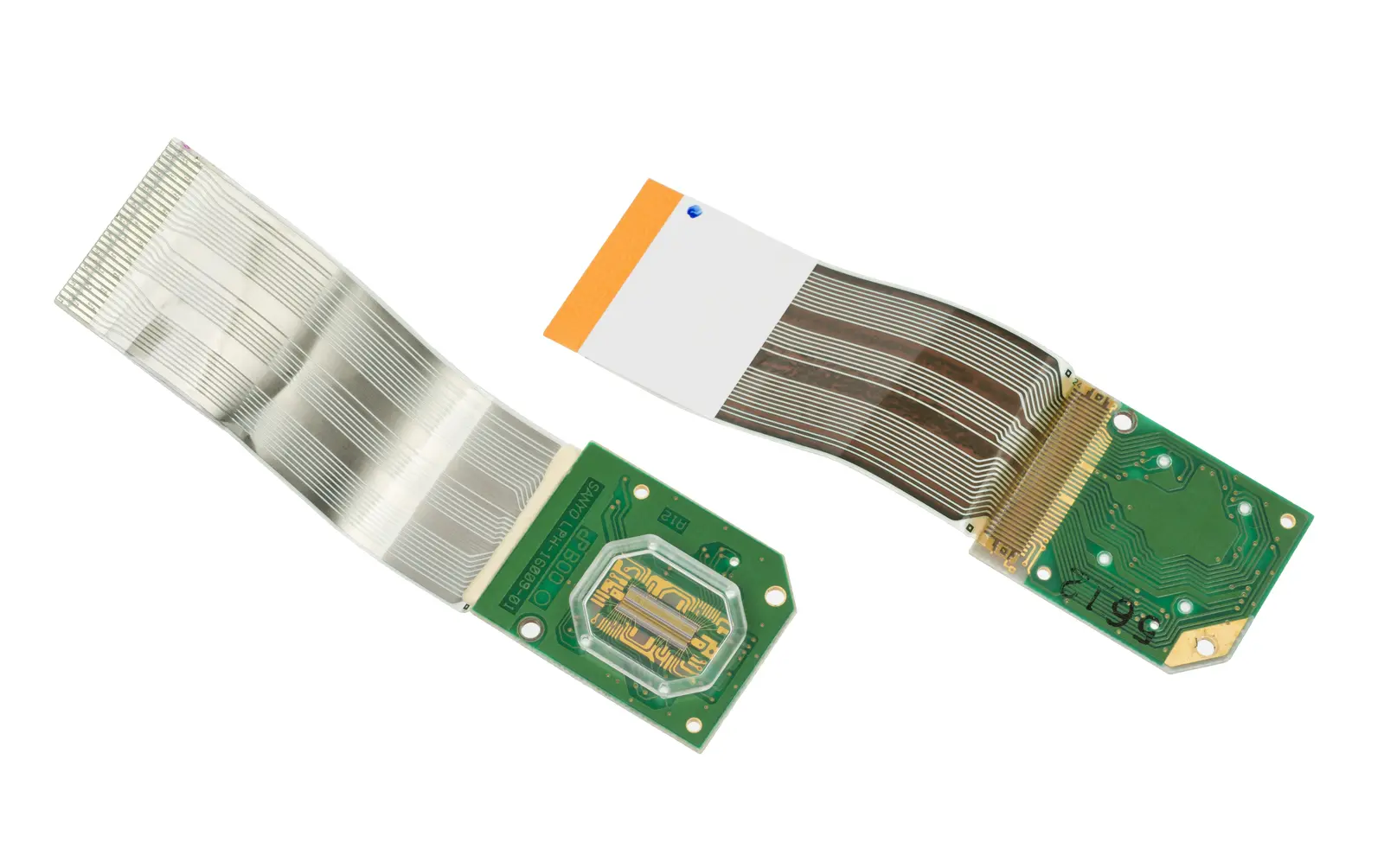
LEDS384 × 224
PER EYE
No liquid-crystal panel sat behind the eyepiece. The picture was a timed performance by light, optics and mechanics. That gave Virtual Boy sharp blacks and real binocular separation, but also made its display a moving part whose alignment mattered.
04 / Depth without a viewpoint
Virtual Boy showed two perspectives, but it never learned where the player was looking
Objects shifted slightly between the left and right pictures. The brain combined that parallax into layers of space: a tennis court receded, an enemy fist approached and Wario jumped between foreground and background.
But turn your head and the world did not turn with you. There was no head tracking, no panoramic environment and no sense of walking around an object. Virtual Boy was a stereoscopic console, closer to an electronic View-Master than to the responsive virtual-reality headsets its name suggested.
05 / Portable until the moment of use
The machine ran on batteries but demanded a table, a stand and a motionless head
Six AA cells lived in a pack on the controller, so no wall socket was required. Yet the viewing unit could not be held like a Game Boy. Its tripod had to support the optics at face height while the player bent towards it.
UNTETHERED+TABLE
ANCHORED+HEAD
STILL
This is the central physical contradiction. Virtual Boy carried its own screen and power, but not its own usable posture. It was portable between sessions rather than during them—a personal machine that needed furniture.
06 / The console in your hands
With the screen out of sight, the controller carried the power switch, batteries and spatial logic
Two directional pads mirrored one another across a wide double grip. Face buttons and rear triggers let games map movement across several planes without asking the player to look down.
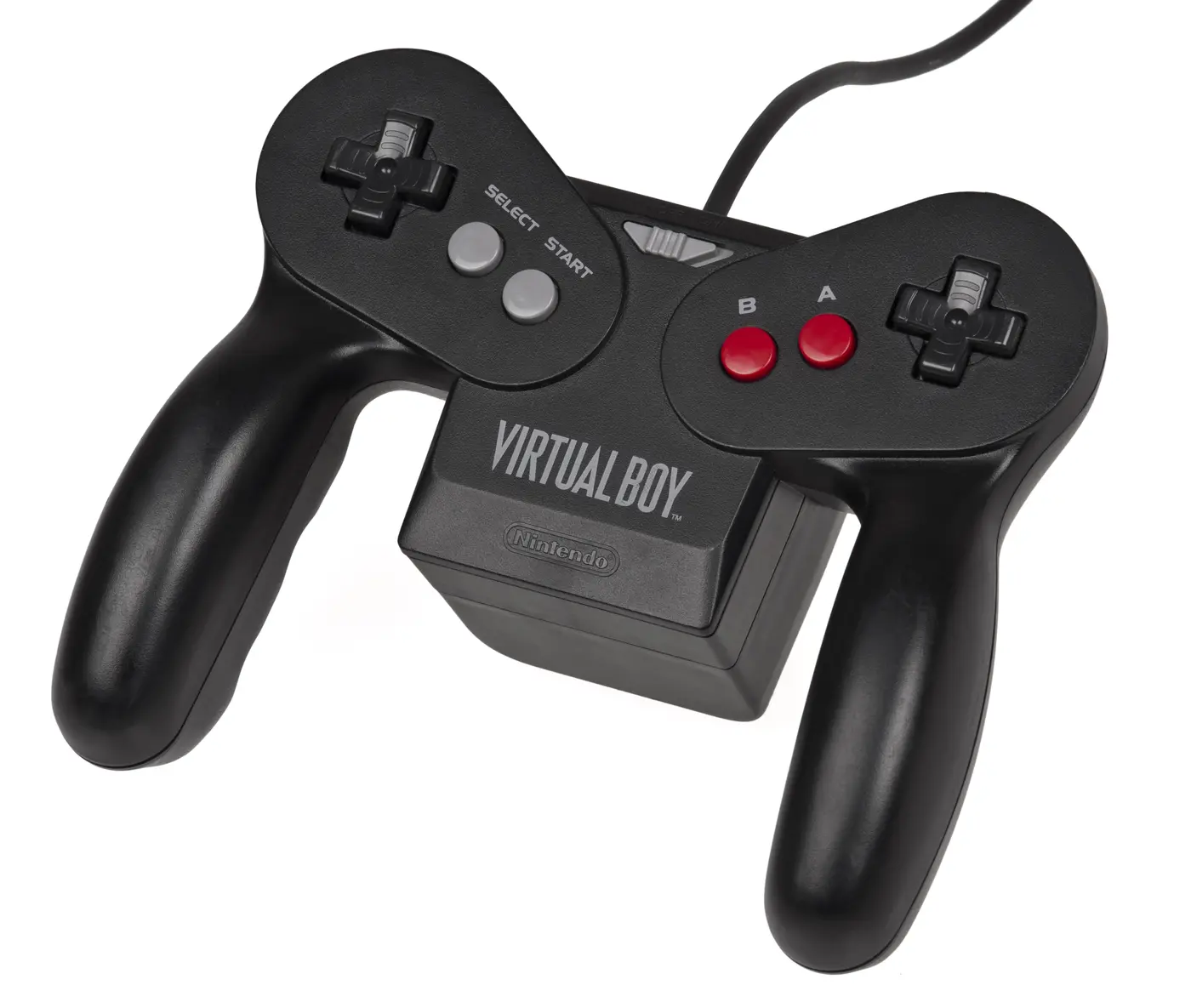
SELECT✚RIGHT PLANE
The second pad promised three-dimensional movement, though few games needed all of it. More revealing was the power switch in the centre: the object in the player’s hands started the distant viewing unit and supplied its electricity. The controller was effectively the accessible half of a hidden console.
07 / Calibrate before play
Virtual Boy did not merely ask to be switched on; it asked to be fitted to a body
An IPD dial adjusted the distance between the two displays. A focus slider sharpened the image. Game manuals opened with a four-corner test, and every cartridge included an automatic-pause option that Nintendo recommended leaving on.
EYE DISTANCEFOCUS
CLARITY20 MIN
REST
Those instructions are more interesting than the familiar jokes about headaches. They reveal a console whose image depended on the viewer’s anatomy and endurance. Setup no longer ended at tuning a television channel; the player became part of the optical system.
08 / Games as stagecraft
The best software treated depth as choreography, not decoration
Virtual Boy Wario Land let Wario leap between front and rear planes. Mario Clash turned an arcade platform into two stacked stages. Teleroboxer sent fists towards the viewer, while Red Alarm used wireframes to make open space legible.
Most titles still assembled flat sprites at different distances. That was not a failure of imagination so much as a practical language: clear layers survived the four red brightness levels and modest graphics hardware. Virtual Boy’s most successful 3D often resembled theatre scenery rather than a simulated world.
09 / The machine behind the darkness
Inside the red shell, optics occupied more space than computing
A 20 MHz NEC V810 processor and Nintendo’s graphics hardware drove two frame buffers, but the broad interior belonged to lenses, LED boards, oscillating mirrors and the mechanisms that held them in alignment.
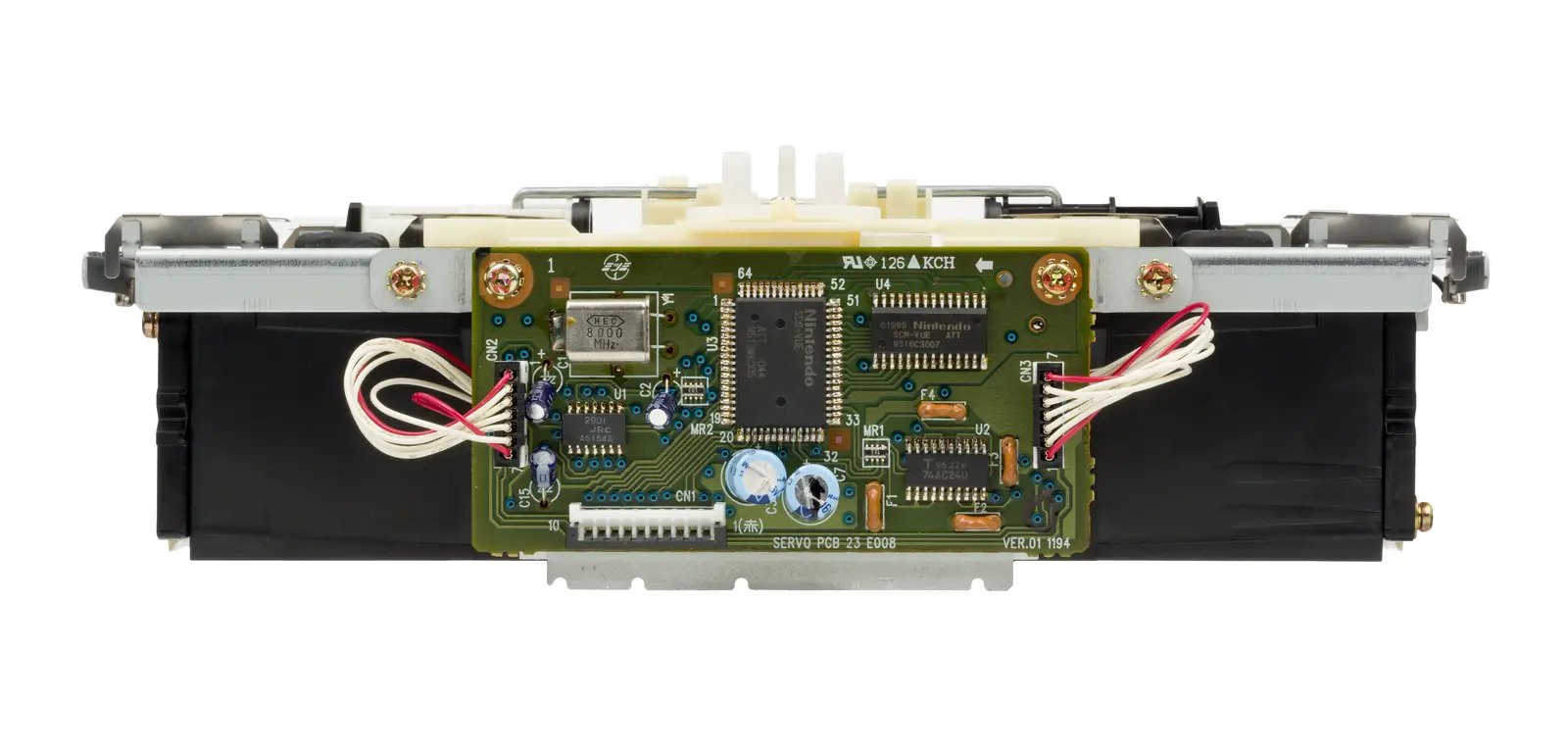
This explains both the size and the afterlife of the hardware. A normal console can be reduced to a small emulator box and an HDMI cable. Reproducing Virtual Boy means reproducing the separation between eyes—or inventing another way to deliver it.
10 / Red was both solution and prison
The colour everyone remembers began as an economical property of the display technology
Red LEDs were mature, bright and affordable when Reflection built its scanning display. On black they produced clean contrast and convincing empty depth. Nintendo turned that restriction into the machine’s entire identity.
Yet 1995 was a punishing moment for deliberate monochrome. PlayStation and Saturn demonstrated texture and colour on television, while the inexpensive Game Boy already owned the practical argument for a limited palette. Virtual Boy’s red image looked less like restraint than an expensive future arriving with one sense missing.
11 / The product advertising could not show
A two-dimensional advertisement could describe Virtual Boy, but it could not demonstrate the reason to buy one
Nintendo placed demonstration units and organised a large Blockbuster rental promotion in the United States. The 1995 press release openly identified the problem: print and television could not reproduce the private stereoscopic image.
FLAT≠TELEVISION
FLAT→PUT YOUR EYES HERE
Trying the machine was more persuasive than watching footage, but also exposed every practical question at once: Where does the stand go? How does another person watch? Is this a handheld, a home console or a headset? Virtual Boy’s retail demonstration was simultaneously its best advertisement and its most honest critique.
12 / Toy or platform?
Nintendo launched a fascinating toy under a name that made buyers expect the next Game Boy
Virtual Boy appeared while Nintendo 64 was still in development. It was not a replacement for Game Boy and could not perform the shared living-room role of Super Nintendo. Even inside Nintendo, however, it was sold through the expectations of a full console business.
PORTABLEVIRTUAL BOY
?NINTENDO 64
HOME
Miyamoto later argued that it made more sense as an unusual toy for curious buyers: five excellent games might have been enough. As a licensed platform, modest sales and a small library became catastrophic. The hardware had not only missed a category; Nintendo had measured it by the wrong category.
13 / The replica proves the point
In 2026 Nintendo brought the games back—and rebuilt the viewing shell around a Switch
Virtual Boy – Nintendo Classics emulates the software on Switch and Switch 2, but requires a separate binocular accessory. One version deliberately reproduces the shape of the original hardware; even the inexpensive alternative is a cardboard viewer.
LEDS + MIRRORS→2026
SWITCH + VIEWER
That is an unusually literal form of preservation. The code alone is not considered sufficient: without two separated images and the small ritual of leaning into a viewer, these games lose the property around which they were designed. Three decades later, the screen is still part of the software.
14 / What depth cost
Virtual Boy did not fail to create depth; it succeeded at a price no mass-market console could comfortably pay
The stereoscopic image was real, crisp and impossible to reproduce in an ordinary screenshot. To obtain it, Nintendo traded away colour, portability, bodily freedom, spectators and the effortless demonstration on which console culture depended.
That bargain makes the machine more than a famous flop. It is a controlled experiment in what a display changes around itself. Virtual Boy built the most private screen Nintendo had ever made—and discovered that video games rarely live inside a screen alone.
15 / From Private Eye to replica
The idea survived longer than the original console
A scanning display became a game platform, disappeared, and returned as a viewing ritual.
Scanned Linear Array
Allen Becker develops the display principle behind Reflection Technology’s Private Eye.
Nintendo sees depth
Reflection demonstrates its technology; Gunpei Yokoi champions the idea.
VR32 revealed
Nintendo presents the red stereoscopic machine at Shoshinkai.
Two launches
Virtual Boy reaches Japan in July and North America in August.
The platform ends
Production and commercial software cease; PAL territories never receive a launch.
Nintendo looks back
Miyamoto describes the mismatch between an appealing toy and a full platform.
The viewer returns
Nintendo Classics pairs emulation with a new physical stereoscopic accessory.
16 / Sources & further reading
Explore further
- Nintendo — Iwata Asks: Shigeru Miyamoto Talks Virtual Boy
- Nintendo — Virtual Boy Instruction Book (1995)
- Nintendo — Virtual Boy Wario Land Instruction Booklet
- Nintendo of America (1995) — “Blockbuster” launch press release, preserved by Planet Virtual Boy
- Benj Edwards — Unraveling the Enigma of Nintendo’s Virtual Boy
- Guy Perfect / Planet Virtual Boy — Virtual Boy: Sacred Tech Scroll
- Reflection Technology — US patent 5,334,991, Dual image head-mounted display
- Nintendo — Virtual Boy – Nintendo Classics (2026)
Image credits
Virtual Boy on stand — Erik Klooster, own photograph; used with permission and converted to WebP
Virtual Boy controller — Evan-Amos, public domain; resized and converted to WebP
Virtual Boy LED arrays — Evan-Amos, public domain; resized and converted to WebP
Virtual Boy optical mechanism — Evan-Amos, public domain; resized and converted to WebP


