Failed promises / Part 3
Videotex: the internet before the internet
Reading news, booking travel, sending messages and searching for information through a television — long before the web existed.
01 / The promise
The world behind a page number
The television shows no presenter, football match or American drama, but a menu.
Using a keypad, the viewer chooses a number. Moments later, the latest news appears. A few more keystrokes produce stock prices, a holiday offer or a train departure time.
No personal computer is required. The television is already in the home, a telephone line is already connected and somewhere in a data centre an enormous database is waiting. The user only needs to dial in.
This was the promise of videotex: electronic information for ordinary households and businesses. Newspapers, directories, catalogues and forms could become digital. Shopping, banking, reservations and messages would no longer require a counter, a letter or a telephone conversation with an employee.
It sounded like the internet before almost anyone could imagine an internet. Yet people did not speak of websites, browsers or hyperlinks. They called it viewdata, Prestel, Bildschirmtext, Minitel and, in the Netherlands, Viditel.
02 / Interactive television
Teletext with a telephone line
Videotex resembled teletext, with one crucial difference: the user could send something back.
Teletext travelled with the television broadcast. Viewers selected a page number, but everyone continuously received the same collection of pages. A videotex terminal or modified television called a central computer over the phone line. The user requested a page and the computer returned that particular page.
British Post Office engineer Sam Fedida began developing such a service in the early 1970s. His work became the basis of Britain’s Prestel, commercially launched in 1979.
The display consisted of large coloured characters and simple block graphics. Photographs were impossible and pages could appear visibly line by line. Even so, the result was remarkable: the television was no longer just a receiver, but a gateway to a living information source.
Operation had to be simple. Instead of computer commands, users chose numbered options. That orderliness would later prove a limitation as well.
03 / The Netherlands calls Viditel
The PTT builds an information medium
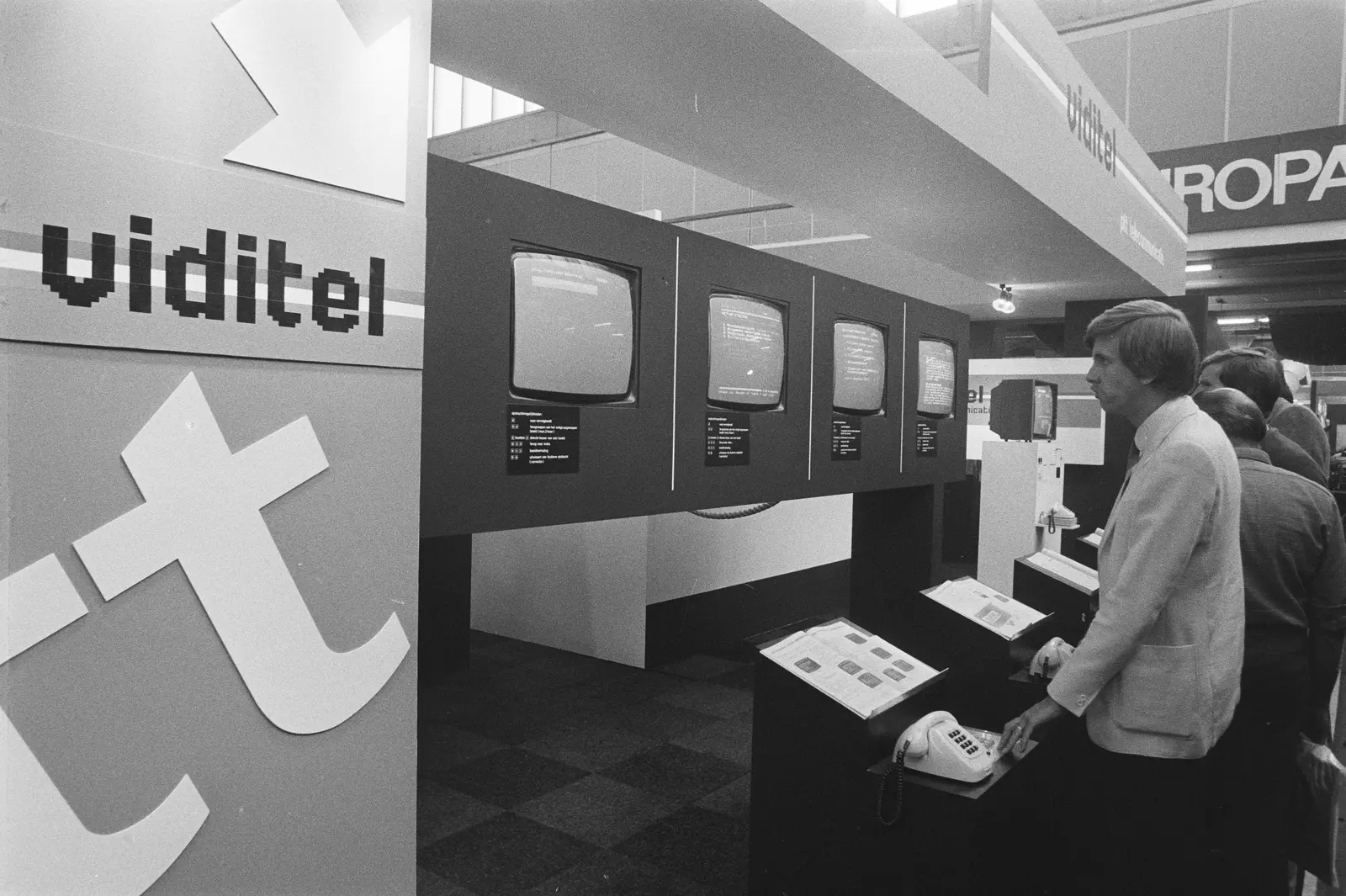
The Dutch PTT demonstrated viewdata at the Firato exhibition in 1978. The Viditel public trial began on 7 August 1980.
The name joined vidi — Latin for “I have seen” — to telephone: information seen through the phone. Companies and institutions supplied pages while the PTT managed the infrastructure and central computers. Users could retrieve news, weather, financial information, travel times and product details.
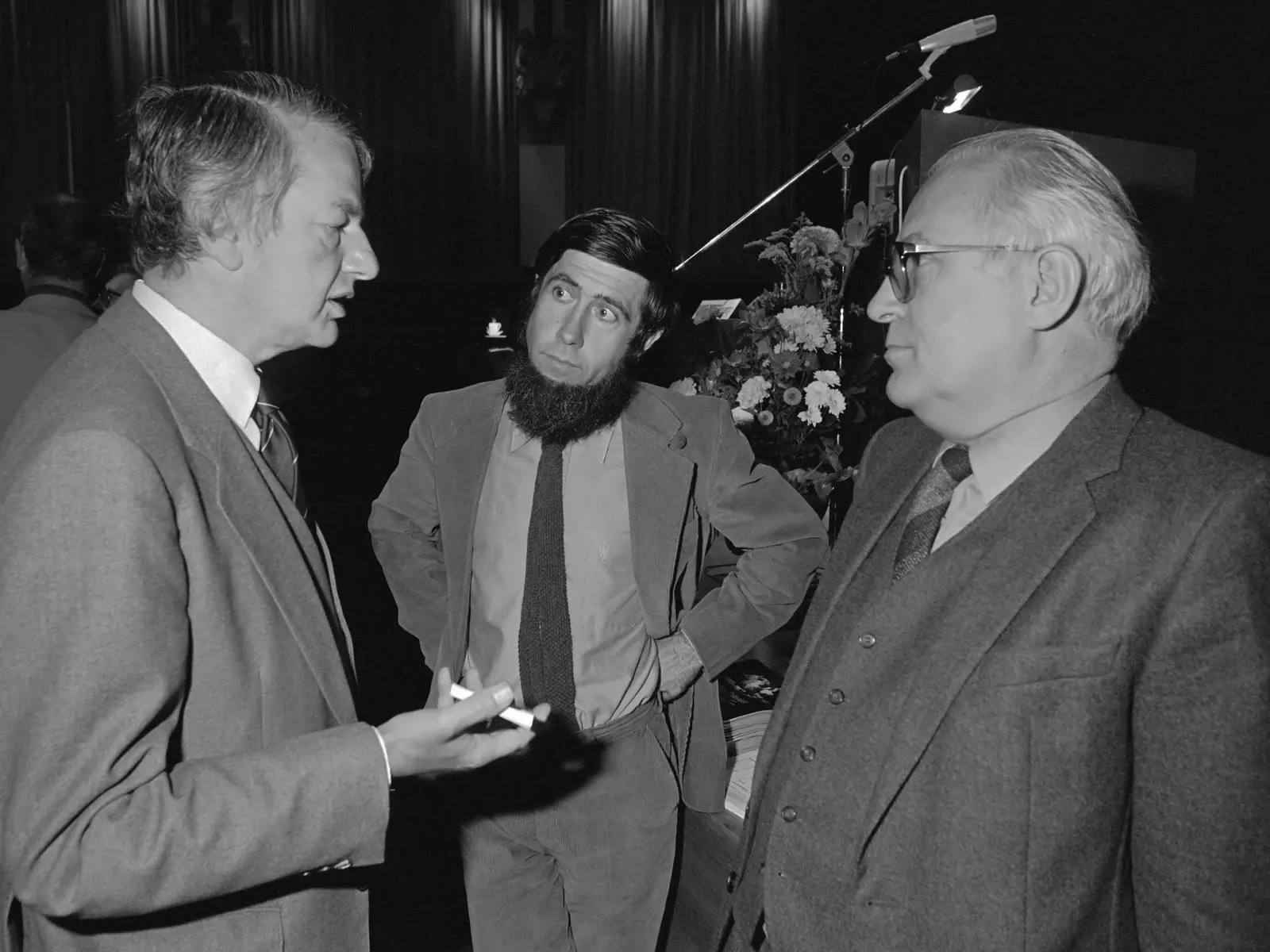
The Dutch government took the project seriously. A special committee considered technology, privacy, copyright, commercial information and social consequences. In 1984 the government decided to make Viditel permanent. The Netherlands, it argued, must not fall behind in the fast-growing field of information technology.
Videotex would make information accessible, modernise business and familiarise households with the information society. Officials expected business use to establish the service before consumers followed. Viditel did reach offices, but scarcely entered Dutch living rooms.
04 / Reality
An expensive glimpse of the future
A complete setup could cost thousands of guilders — and only then did the meter start running.
Viditel required a terminal, modified television or home computer with a modem. According to the HomeComputerMuseum, a dedicated terminal initially cost about five thousand guilders. Subscription charges, telephone costs and sometimes a fee for each requested page came on top.
The connection remained open while the user searched or read, so the bill kept rising. On the later web, people could wander freely; on Viditel, an imaginary taxi meter hung over every choice.
The telephone was occupied throughout the session. Text arrived faster than the post, yet painfully slowly by modern standards. The screen held little information and blocky graphics made long texts tiring.
Viditel had about five thousand users in 1982. That was respectable for an experiment and far too few for a new mass medium.
05 / Content
The chicken-and-egg problem
An information service becomes attractive when it contains many useful services. Suppliers build those services only when users are plentiful.
For newspapers, retailers and travel agencies, creating and updating videotex pages meant extra work. Text had to be shortened, information fitted to a rigid screen and navigation carefully numbered. With only a few thousand visitors, the investment was difficult to justify.
Users faced the opposite calculation. Why buy costly equipment and a subscription while content remained limited? A newspaper arrived each morning, the telephone directory sat on a shelf and holidays could be booked at a travel agency.
Videotex competed simultaneously with newspapers, telephones, post, catalogues, shops and service counters. Each alternative was familiar and often cheaper. By 1984, the Dutch government acknowledged that adoption was slower than expected and a rapid mass-market breakthrough had not occurred.
06 / The French exception
Minitel found the missing button
France made the terminal free and created the first mass online network for consumers.
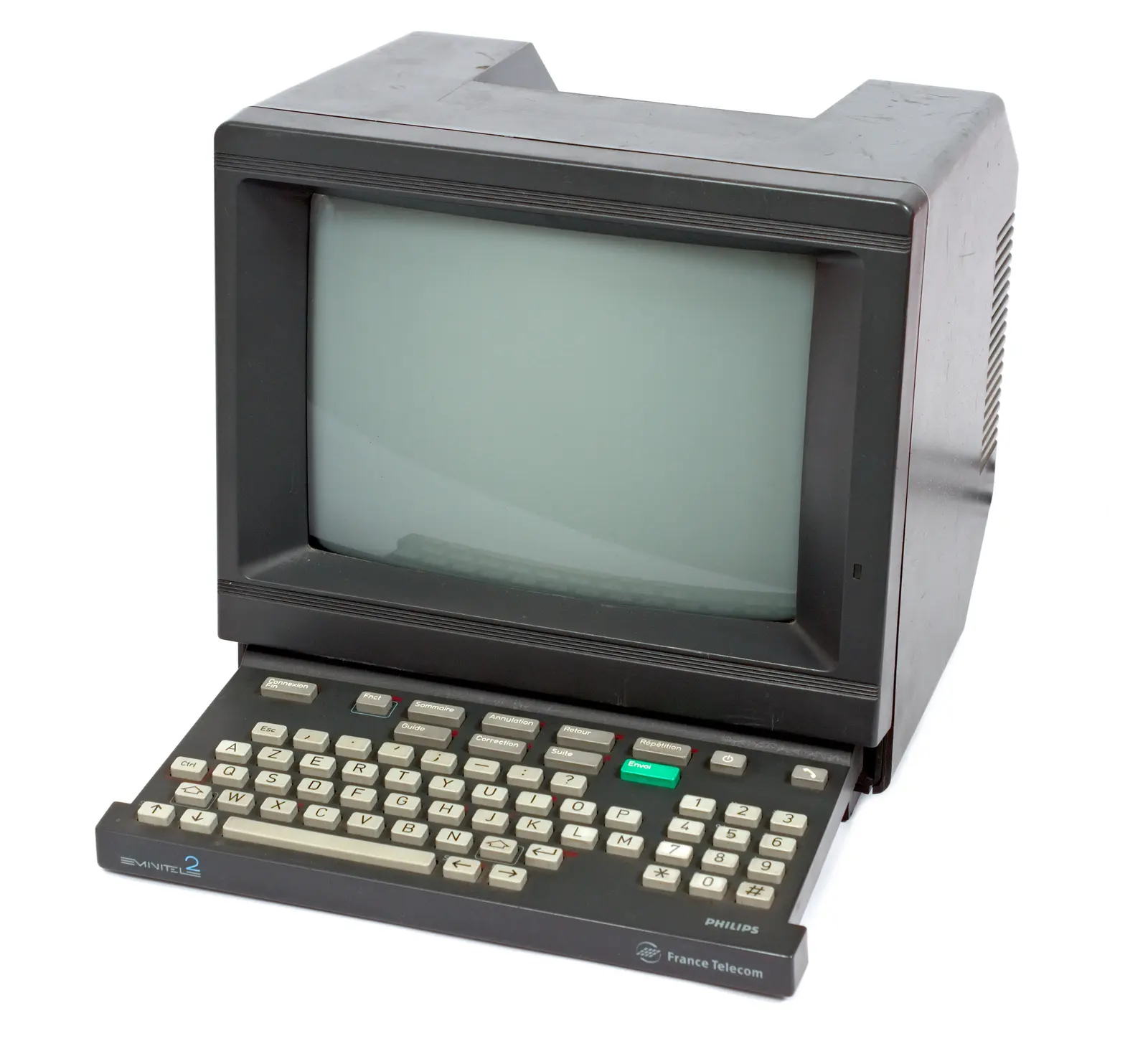
France Télécom supplied simple terminals to telephone subscribers at no charge. The devices were called Minitels; the official service was Télétel. Households did not need to buy an expensive computer. The terminal was already there.
Users paid through their phone bill for time spent on a service. Part of the charge went to the provider, so entrepreneurs could earn revenue without organising subscriptions, payments and invoices themselves.
French users looked up telephone numbers, read news, reserved train tickets, banked, sent messages and visited chat and dating services. By the 1990s, the network had tens of millions of users.
Its success proved that videotex could become part of everyday life — provided access was simple and cheap and the network offered enough worthwhile services.
07 / The walled garden
Why videotex was not the internet
A national operator controlled the gate, route, technology and payment system.
Videotex networks were highly centralised. Users moved through numbered menus and predetermined routes. National systems did not always share standards: a service on Prestel, Viditel or Bildschirmtext was not automatically accessible from every other network.
The later web behaved differently. Anyone with a server could publish a website. A hyperlink could point to a page on the other side of the world without asking permission. Open technical agreements joined different computers and networks into a larger whole.
Videotex was a walled garden: orderly, controlled and clear, yet dependent on its gatekeeper. Centralisation enabled uniform controls, quality assurance and billing. As personal computers and modems spread, users wanted more than retrieval. They wanted to publish, exchange files, discuss and jump between networks.
08 / From information to encounter
People became the most compelling content
The designers thought in pages and databases. The most popular online activities often turned out to be social.
On Minitel, messages, chat and personal advertisements drew large audiences. People wanted more than train times or share prices. They wanted to meet, ask questions, flirt, trade and argue.
The same lesson emerged from bulletin boards and commercial services such as CompuServe. A simple message area could be more attractive than an impressive electronic encyclopaedia. The value of a network was not only the information on its central computer, but the other people it made reachable.
Videotex could support communication, but still looked like an electronic reference work. The web made participation far more open: one user could be reader, writer, seller and publisher at once.
09 / Why it failed
Many small brakes on the same future
Outside France, videotex failed through several limitations that reinforced one another.
Access cost too much. Hardware, subscriptions, call charges and page fees discouraged curious home users.
Content grew too slowly. Suppliers would not invest without users; consumers would not connect without services.
Existing alternatives were good enough. Newspapers, phones, catalogues and travel agencies were familiar and available.
The technology was restricted. Slow links, small text displays and block graphics struggled as computers became more powerful.
National systems remained islands. Different standards and operators obstructed a genuinely international network.
The user remained mainly a consumer. Publishing and communication were less open than they would be on the internet.
The business model discouraged discovery. Paying by the minute or page made exploration a financial choice.
10 / What remained
Another road to digital society
Videotex correctly predicted that the telephone line and screen could combine into a new information medium.
- PROMISEEverything through the television
News, directories, bookings and messages came from a central database.
- BARRIERExpensive access
Hardware and a ticking phone bill kept the public away.
- EXCEPTIONMinitel
Free terminals and simple billing created a French mass market.
- LEGACYOnline daily life
Banking, booking, chatting and digital platforms later became ordinary.
Viditel was succeeded by Videotex Nederland in 1989; that network closed in 1997 as the internet advanced. Minitel survived until 30 June 2012. The failed promise was not online services themselves, but their costly, closed and centrally organised form. Someone checking weather or share prices on a blocky Viditel screen in 1980 was not looking at the internet. But through a tiny window, they could already see almost everything that would later become normal.
11 / Sources & images
Read and explore
- Dutch Ministry of Transport — Interactive videotex in the Netherlands (1984)
- HomeComputerMuseum — Viditel / Videotex
- Computer History Museum — Europe and the First Mass-Market “Webs”
- Computer History Museum — The First Mass “Web”: Minitel Goes Public
Image credits
Viditel at Firato — Hans van Dijk / Anefo / Nationaal Archief, CC0; resized and converted to WebP
Viditel seminar — Anefo / Nationaal Archief, CC0; resized and converted to WebP
Minitel 2 — Frédéric Bisson, CC BY 2.0; resized and converted to WebP


