Failed promises / Part 4
The videophone that kept failing
For decades, every phone call was supposedly about to acquire pictures. The technology worked — but people did not seem to want a telephone with a camera.
01 / The promise
A conversation in which nobody disappears
The telephone had liberated voices from distance. The next step seemed inevitable: faces would travel down the wire too.
Movies and world’s fairs had made the image familiar. A mother would see her children, a doctor examine a patient, and a business executive show documents without travelling. The videophone promised a warmer, more complete conversation than the invisible contact of an ordinary call.
The promise returned for almost a century. In 1927, AT&T demonstrated a one-way link between Washington and New York. Germany opened public video calling booths in the 1930s. After the war, television cameras and coaxial cable made the dream look increasingly plausible.
Yet the videophone did not become the telephone’s natural successor. Every generation improved the image, lowered the cost and announced the breakthrough again. Each time, the mass audience stayed away.
02 / Picturephone
A window onto the future
At the 1964 New York World’s Fair, visitors could finally look at somebody through a telephone.
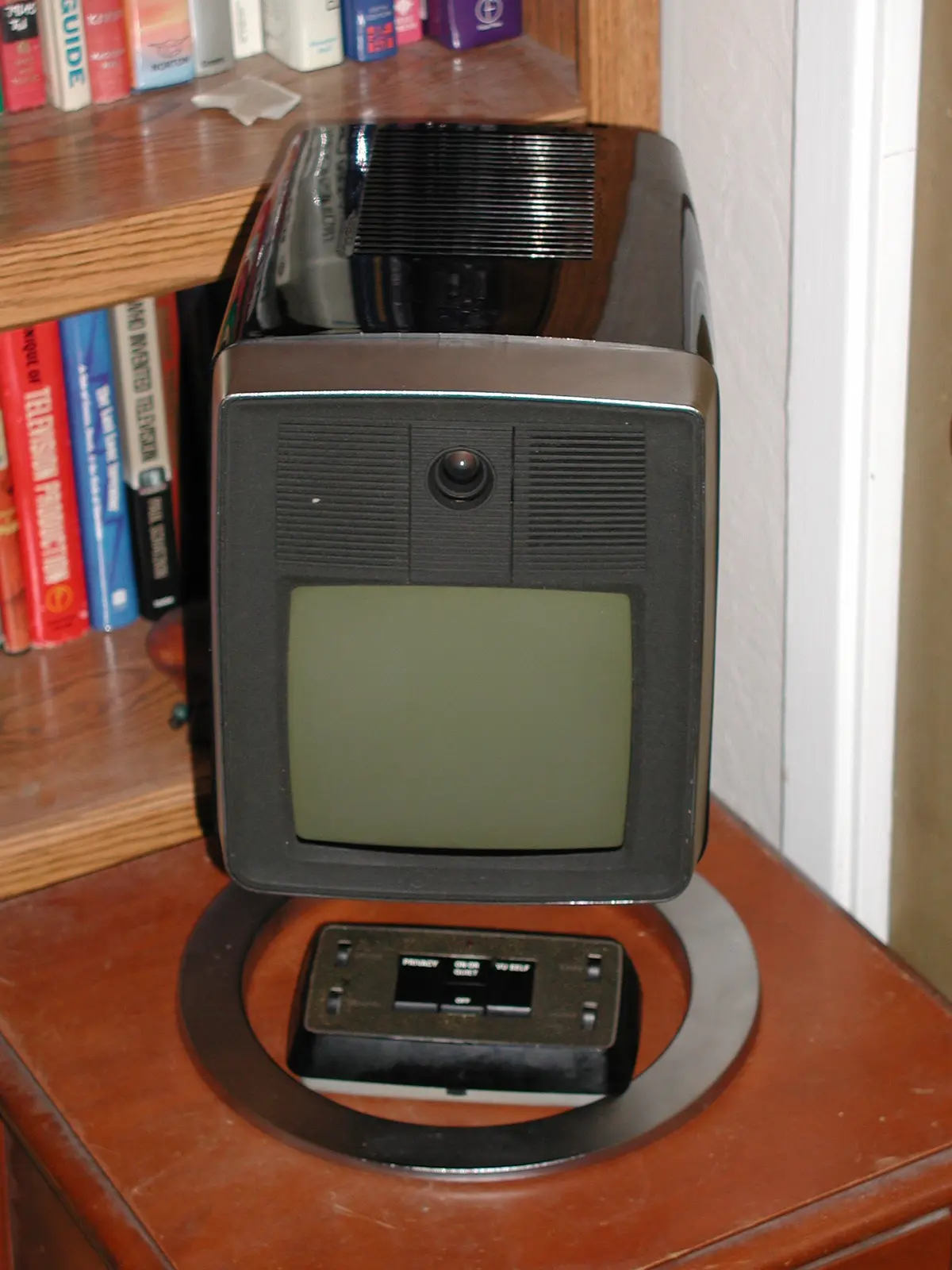
AT&T installed Picturephone booths in New York, Washington and Chicago. Visitors spoke to someone in another city through a small monochrome image. The display showed roughly thirty frames per second, while a separate camera looked back. To millions of fairgoers it was science fiction that actually worked.
The demonstration concealed an elaborate infrastructure. Video required hundreds of times more capacity than speech. Existing local telephone lines were not enough, so dedicated cables and equipment were needed. Picturephone was not a device that could simply be plugged into any socket. It was an entire service that AT&T had to build almost from scratch.
The promise, meanwhile, was enormous. The company did not see a curiosity but a new medium that would transform business and domestic communication.
03 / The commercial trial
One million sets by 1980
Picturephone went on commercial sale in Pittsburgh in 1970. The future now had a monthly charge and a per-minute rate.
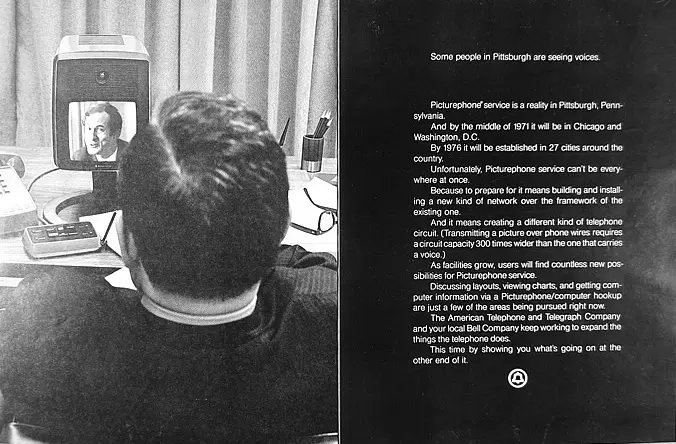
A connection cost $160 a month for thirty minutes of video, plus 25 cents for each additional minute. That was a substantial business expense. Worse, the service only worked between connected locations. A Picturephone without other Picturephones was an expensive monitor.
AT&T expected hundreds of thousands of users and dreamed of one million sets by 1980. Reality was nearly empty: only a few dozen sets were installed in Pittsburgh, and Chicago grew to a few hundred. The predicted network effects never began.
Price was not the only problem. Customers had to know whom they could call, arrange a time and remain seated in front of the camera. The telephone, valued precisely for its convenience, had acquired rules.
04 / A network without people
The device that only works when everybody owns one
A videophone is not an independent product. It is one half of a connection.
An early television could receive programmes on its first evening. A microwave could heat food by itself. But the first Picturephone owner could only reach people who subscribed to exactly the same costly service. That made buying unattractive and kept the network small.
Every new customer also required AT&T to install special equipment and provide additional network capacity. The company had to invest before demand existed, while customers would only join after the network had become useful. The ordinary telephone had once overcome this dilemma, but Picturephone now had to compete with a telephone network that already reached everywhere.
Pictures added less than engineers expected. For a short message, an order or an appointment, hearing was usually sufficient. The extra channel made a call more expensive without making it proportionally more useful.
05 / The advantage of invisibility
The ordinary telephone left out something valuable
Without video, people could call from the kitchen, in pyjamas, among piles of paper, or without looking attentive all the time.
The telephone asked for a voice, not a performance. Silence, glancing away and doing something else remained invisible. The videophone turned informal contact into a small broadcast. Users had to sit correctly, remain inside the frame and provide a suitable background.
That did not always feel like progress. Facial expressions could help in business calls, but the tiny, grainy picture carried little nonverbal information. For private conversations, the camera could come too close. The promise was more presence; the experience could produce more self-consciousness.
The failure was therefore social as well as technical. Designers treated the missing picture as a defect. Many users experienced the same absence as freedom.
06 / The return
Every new generation thought the moment had arrived
Digital compression made video cheaper. In 1992, AT&T tried again with the VideoPhone 2500.
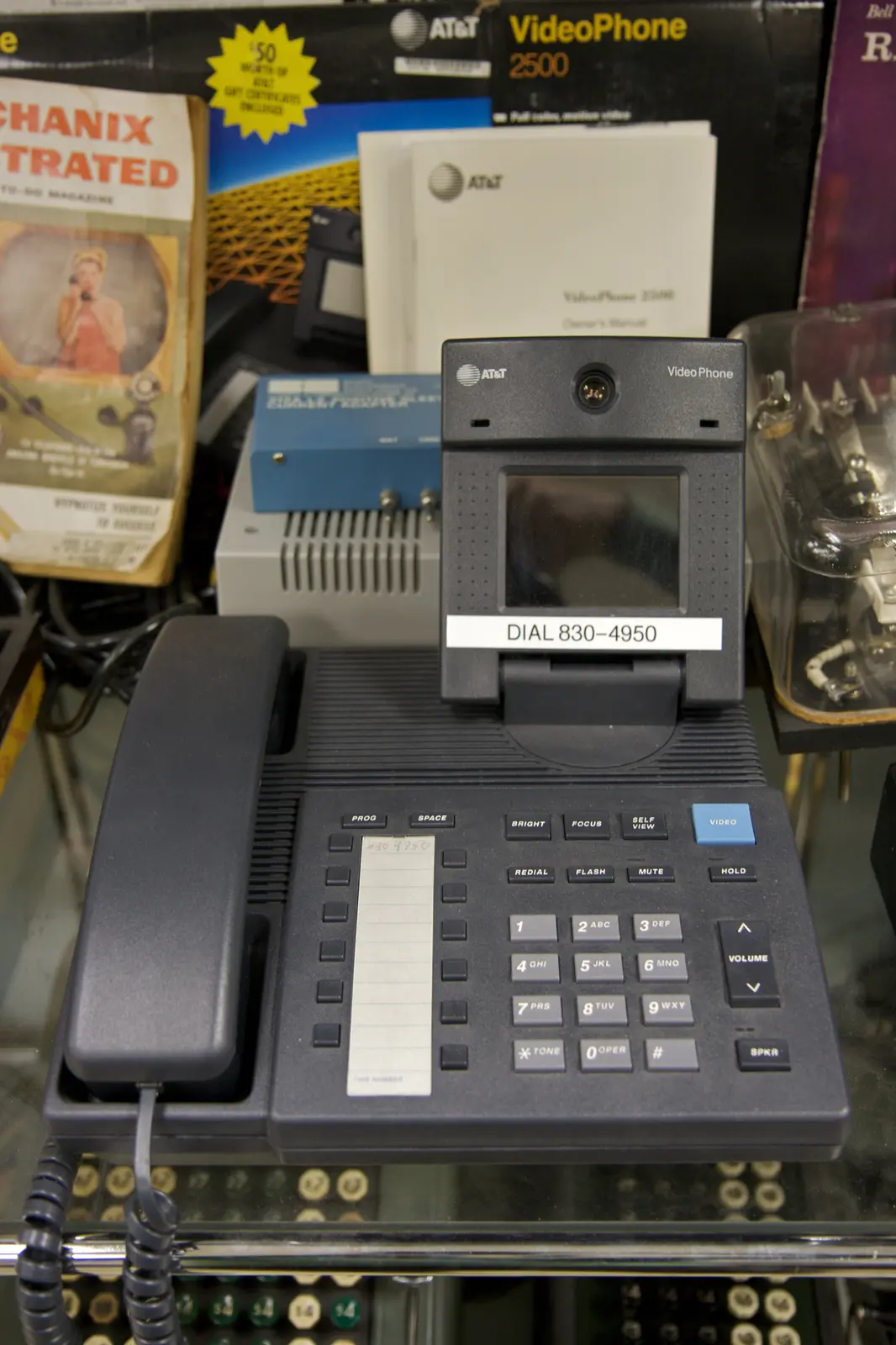
The set used a conventional analogue line and displayed colour, removing two major Picturephone objections: no special network and no monochrome screen. Yet the resolution was low and motion remained jerky. With a launch price of $1,495, this future was still expensive.
Other manufacturers followed with desktop videophones, ISDN sets and corporate conference systems. Demonstrations steadily improved. Most products remained niches for businesses, deaf users, telemedicine or families with a particular reason to see one another.
The standalone videophone was still a solution that required both a new appliance and a compatible person at the other end.
07 / The computer takes over
Video became software
The decisive step was not a better telephone, but the disappearance of the videophone as a separate product.
Personal computers acquired sound cards, webcams and internet connections. Programs such as CU-SeeMe, NetMeeting and later Skype could add video to machines people already owned. Broadband made a permanent connection possible without per-minute telephone charges.
Skype, founded in 2003, made internet calling simple and international. When Microsoft announced its intended acquisition in 2011, Skype had 170 million connected users, and more than 207 billion minutes of voice and video conversations had taken place in 2010.
The network economics changed. Users no longer needed a specialised video appliance and software could spread around the world. The videophone lost its casing and became a button in a program.
08 / The camera moves
The right device was already in our pockets
Apple introduced FaceTime with the iPhone 4 in 2010. The videophone was back, but nobody called it that any more.
Smartphones combined camera, screen, microphone, speaker and internet connection in one personal device. They also had an address book, notifications and apps. A video call no longer required a special place at home: users decided when pictures were useful.
That proved essential. Video did not replace the ordinary call. It became one option beside text, voice message, photograph and audio. People could decline the camera, switch it off or turn it on later. The old videophone had imposed one function; the smartphone offered a choice.
The network problem shrank too. WhatsApp, FaceTime, Skype and other services could give millions of existing users video through a software update.
09 / The compulsory trial
2020 made video calls ordinary — and revived the old objections
During the coronavirus pandemic, work, education and family visits abruptly depended on video conferencing.
The technology finally did what demonstrations had promised for decades: meetings and lessons continued without travel. But “Zoom fatigue”, cameras-off policies and virtual backgrounds simultaneously proved that visibility demands effort.
The videophone therefore did not win as a replacement for the telephone. Video calls succeeded in moments when the extra picture justified the extra effort: seeing a grandchild, discussing a design, assembling a remote team or showing something to a doctor.
The error was not the belief that people wanted to see one another at a distance. It was the assumption that they wanted to do so in every conversation — through an expensive appliance that did nothing else.
10 / What survived
The failed videophone became a successful feature
It was not the camera but the form of the product that held the future back.
- PROMISEPictures in every call
Faces would humanise the telephone and make travel unnecessary.
- BARRIERCost and network effect
A special device was useless while almost nobody else owned one.
- INSIGHTInvisibility has value
Audio is quick and informal, and requires no continuous performance.
- LEGACYVideo as a choice
Computers and smartphones made video universal without making it compulsory.
Picturephone correctly predicted that distance would matter less and less. It wrongly predicted that this required a new kind of telephone, and that pictures were always better than sound. The future arrived only when video calling stopped being a destination and became a button — available when we want to see one another, silent when a voice is enough.
11 / Sources & images
Read and see more
- Engineering and Technology History Wiki — Picturephone
- Computer History Museum — AT&T Announces PC Video Phone
- Apple Newsroom — Apple Presents iPhone 4
- Microsoft — Microsoft to Acquire Skype
Image credits
Picturephone Mod II — Richard Diehl / LabguysWorld.com, CC BY 3.0; resized and converted to WebP
AT&T Picturephone advertisement (1970), public domain in the United States; converted to WebP
VideoPhone 2500 — Marcin Wichary, CC BY 2.0; resized and converted to WebP


