Console Outlier B02 / 1977–1978
RCA Studio II:
the console that tethered its players to the machine
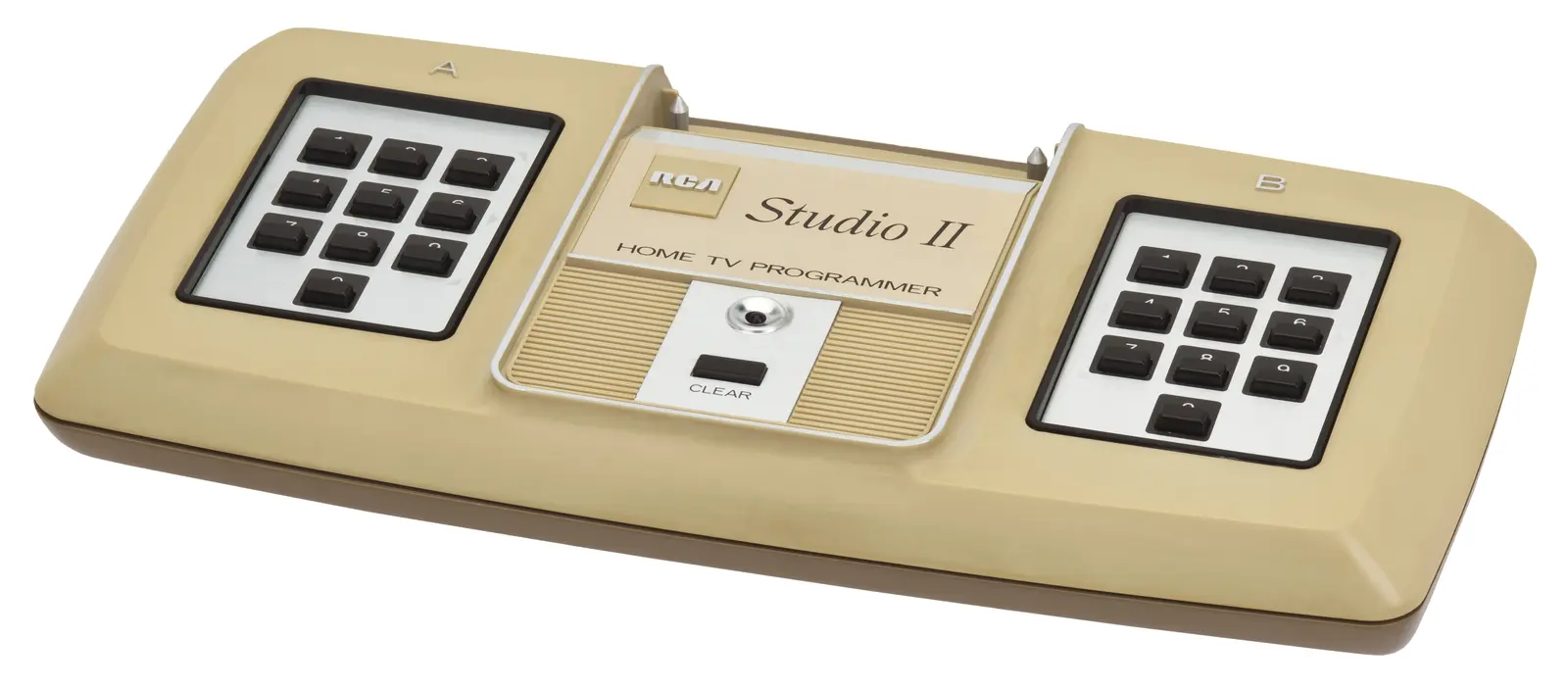
Beneath the beige shell lived a surprisingly modern family of computers. Outside, two number pads forced players to sit shoulder to shoulder around the same object.
01 / Together at one box
Posture tells the story before the screen turns on
In a two-player game, nobody could lean back with a controller. Both players had to bend towards the console: ten numbers for player A on the left and ten for player B on the right.
It sounds like an awkward detail. In fact, it exposes RCA’s entire idea of the product. Studio II was not a free-moving game machine that adapted to the room, but an electronic tabletop game that happened to use the television as its board. While rivals were separating players from the box, RCA kept human, keys and hardware together.
02 / A computer from the living room
The family tree began not in marketing, but at Joseph Weisbecker’s home
RCA engineer Joseph Weisbecker began building small computers of his own in the late 1960s. FRED — Flexible Recreational and Educational Device — was intended to be affordable, understandable and suitable for both play and education.
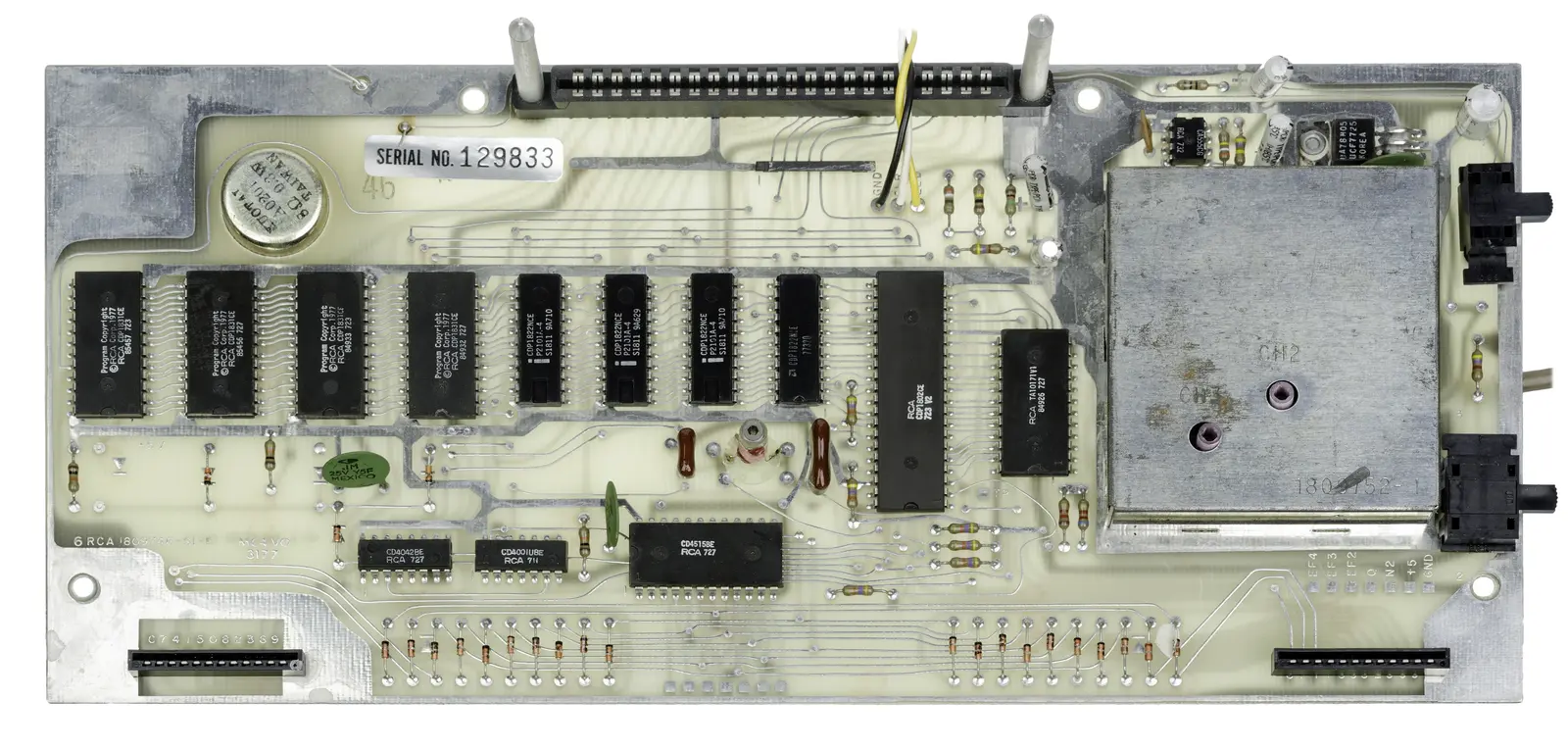
Studio II was therefore not a hastily conceived Pong clone with a processor added afterwards. It was the reduced retail child of a much more ambitious personal-computer idea. That is the source of its tragedy: RCA put a rich experimental lineage on sale in a form that looked simpler than its ancestry.
03 / A sequel without a predecessor
‘Studio II’ sounded as though the future had already completed a first draft
No RCA Studio I ever reached the shops. Still, the name gave the machine the confidence of a second generation and recast the television area as a studio: a place not just for watching, but for doing.
Even ‘Home TV Programmer’ was cleverly ambiguous. Owners did not program software; they programmed what happened on their television by choosing a built-in game or cartridge. RCA was selling the transition from passive viewing to active control — while almost demonstratively avoiding the new phrase ‘video game’.
04 / Twenty digits as game controls
Without a joystick, every game had to explain what its numbers meant
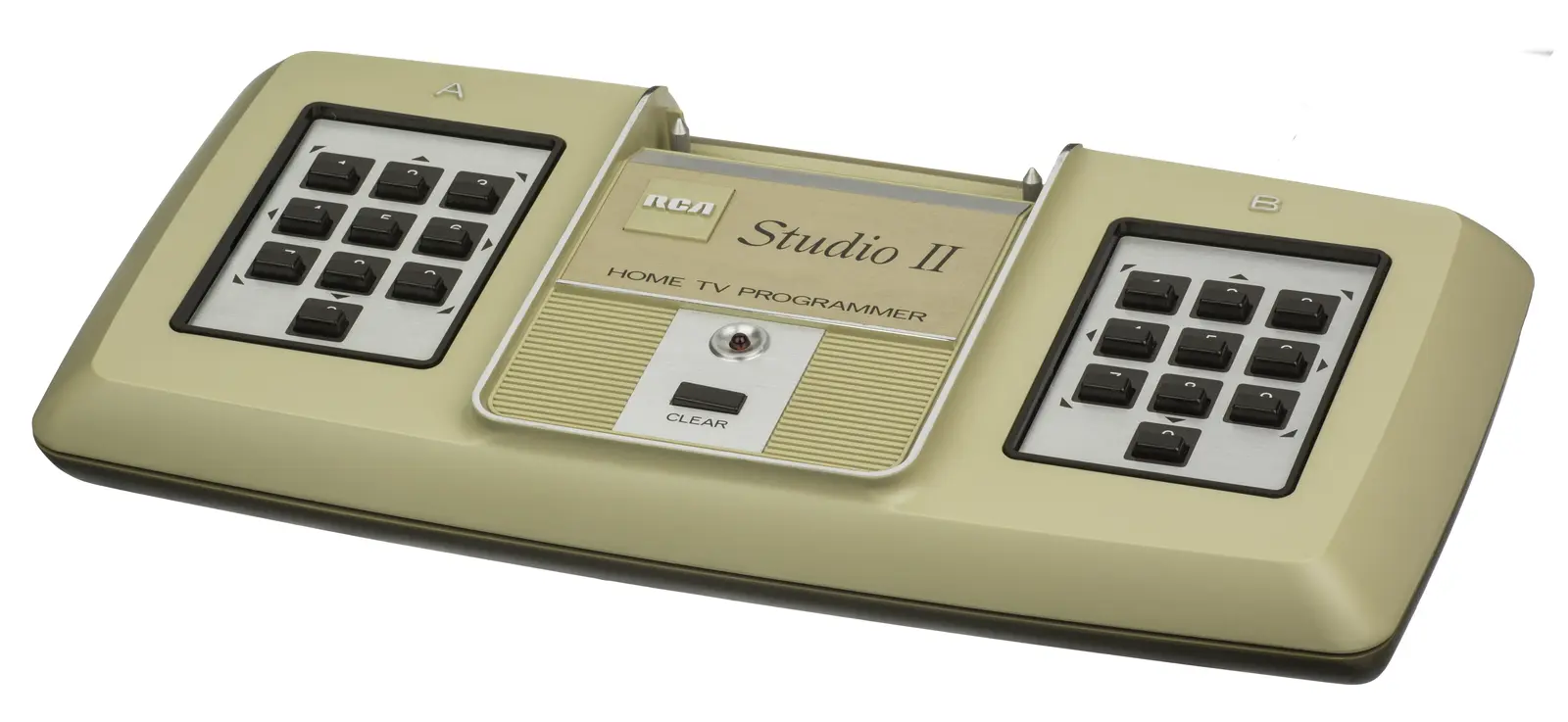
The two keypads were identical, but their meaning changed with each game. A digit might select direction, speed, an option or an answer. The manual therefore became part of the interface.
Freewayselect speedBowlingset directionSchool Housegive an answer
This worked reasonably well for quizzes, arithmetic and games of chance. Fast action felt stiff: players had no natural direction beneath their thumb. RCA had chosen a cheap universal input, but shifted the design burden onto paper and memory.
05 / A television of 2,048 dots
At 64 × 32 pixels, one rectangle had to be car, ball and human
The CDP1861 video circuit offered each picture element one choice: on or off. No colour, no grey levels and no separate sprites. A complete screen held 2,048 bits — exactly 256 bytes.
Half of all RAM was needed merely to hold the visible picture.
Joyce Weisbecker later recalled that drawing recognisable objects was especially difficult. In her racing game Speedway, cars had to be rectangles. Players did not see the distinction in detail; they inferred it from movement, rules and context.
06 / The picture borrows the processor
Almost half of every frame was spent showing the picture itself
The simple ‘Pixie’ video chip fetched picture data directly from memory using DMA. The CDP1802 could not execute game instructions during that transfer. Developer Andrew Modla calculated that screen generation consumed about 49 per cent of processor time.
This makes Studio II a mirror image of Atari VCS. Atari made programmers juggle each scanline; RCA provided a true framebuffer, but made the processor surrender almost half its time to it. The technology made programming clearer and action slower.
07 / A thousand-byte cartridge
Games stayed small because an interpreter already knew the hard work
Many cartridges contained only 1,024 bytes. A compact interpreter and shared routines lived in the built-in ROM. The cartridge did not need to spell out every movement and picture operation again in 1802 machine code.
interpreter + five games+1 KBcartridge
rules in compact pseudocode= PROGRAMMABLE CONSOLE
After Fairchild Channel F, that made Studio II one of the earliest consoles whose ROM cartridges genuinely added new behaviour. It looked like a fixed game appliance; internally it already worked as a platform with a shared software layer.
08 / Five programs before the cartridge
The built-in selection was games room, drawing pad and arithmetic lesson at once
Turn on Studio II without a cartridge and the keypad selected one of five programs. Together they reveal Weisbecker’s idea of a recreational as well as educational computer.
Doodle
Draw with points of light.
Patterns
Create visual patterns.
Bowling
Choose direction and force.
Freeway
A simple car race.
Addition
Solve sums.
Notice what is missing: no built-in Pong variation as an inevitable centrepiece. RCA was not merely copying the arcade’s success, but presenting the television as a general interactive surface. The execution was austere; the idea was broader.
09 / The first independent voice
Joyce Weisbecker made history outside RCA’s payroll
Joseph’s daughter Joyce had learnt to program on FRED as a child. In August 1976, just out of high school, she created TV School House I as an independent contractor. RCA paid her $250.
No department and no permanent job, but one young programmer delivering complete commercial games.
She followed it with Speedway/Tag, again for $250. Historians regard her as the earliest known female commercial game developer; she has also observed that she may have been the first independent game developer. Her story makes Studio II more than a footnote: inside this limited machine appeared a form of work that would be called ‘indie’ decades later.
10 / One cable, two directions
The video signal went to the television while power returned through the same cable
A single fixed cable emerged from the back. RCA’s unusual switchbox routed the RF signal to the aerial socket and accepted the power adaptor. Picture and electricity therefore travelled in opposite directions through one connection.
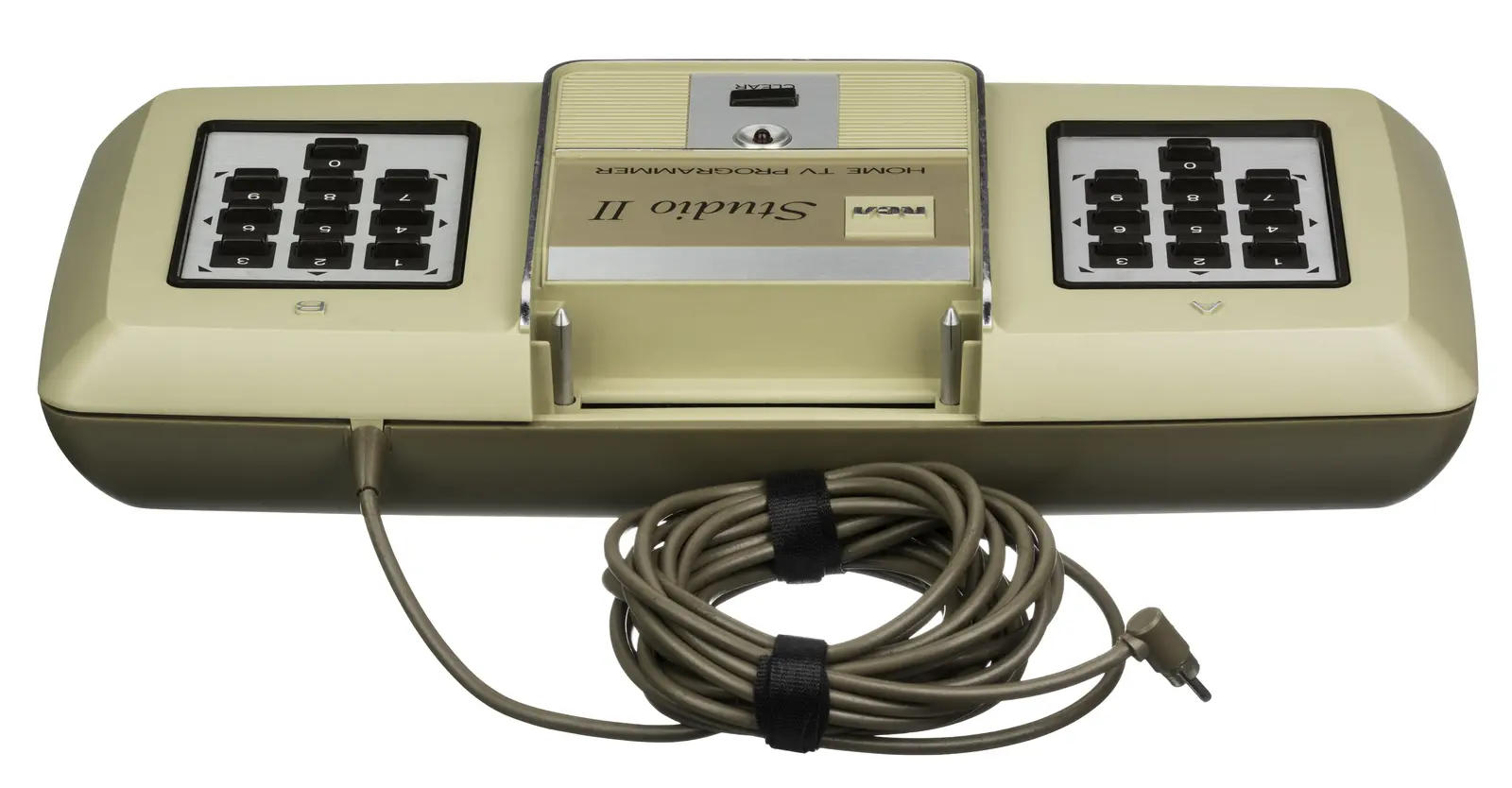
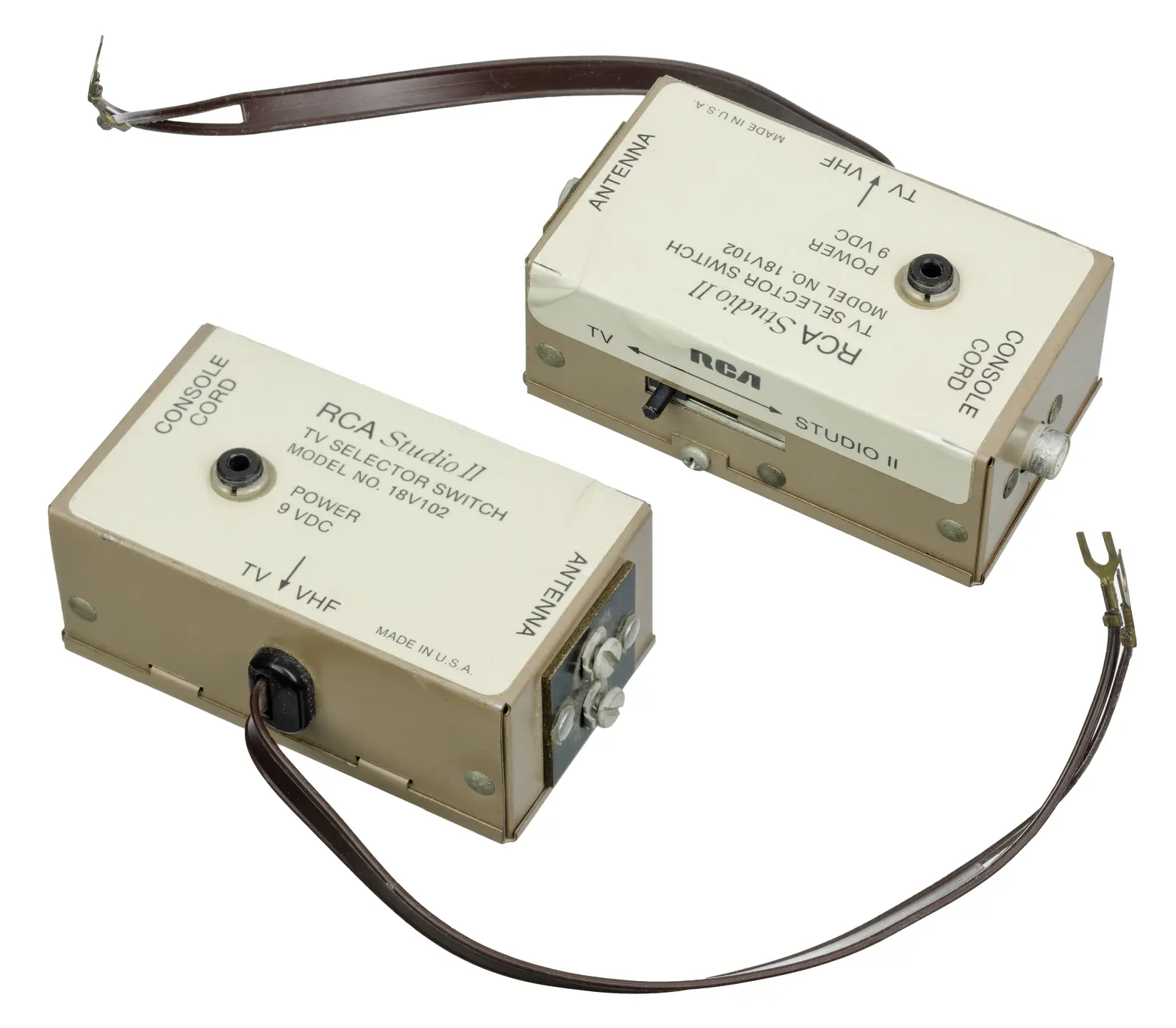
Technically elegant, it made the system dependent on a box that is difficult to replace. Even its cable confirms the central theme: nothing about Studio II came apart easily.
11 / The colour future moves abroad
RCA stopped, but an improved Studio III family still appeared outside America
A colour version with better controls never reached American shops. The technology survived in related and licensed systems, including Hanimex and Soundic MPT-02, Conic M-1200 and Toshiba Visicom.
The names and compatibility are untidy, but the direction is clear: the very qualities Studio II lacked in 1977 surfaced later in its overseas relatives. Its cancelled future was not discarded; it was scattered across several brands.
12 / From home computer to clearance sale
A long gestation ended in less than a year of retail combat
The ideas matured for years; the commercial window closed almost immediately.
FRED emerges
Joseph Weisbecker builds a small recreational and educational computer at home.
COSMAC becomes a product
Weisbecker’s architecture grows into RCA 1802 and the simple Pixie display chip.
Joyce sells her first game
TV School House I earns her $250 as an independent programmer.
Studio II arrives
For $149.95, American buyers receive five built-in programs and a cartridge slot.
Atari VCS arrives
Colour, separate joysticks and a growing library make RCA’s limitations painfully visible.
The project stops
After weak sales, RCA internally cancels the Studio II programme.
RCA withdraws
Production winds down; remaining consoles later reach Radio Shack at clearance prices.
The family survives elsewhere
Colour variants and related Studio III systems appear under other names outside the US.
13 / Sources & further reading
Explore further
- RCA — Game Instruction Manual for Studio II and Studio III (1977), Hagley Digital Archives
- RCA — Studio II Owners Manual
- Andrew Modla — Studio II/III emulator, technical notes and game history
- The Strong National Museum of Play — Joyce Weisbecker as the first female commercial game developer
- Benj Edwards — interview with Joyce Weisbecker
- The Sarnoff Collection — Joseph Weisbecker, COSMAC and the home computer
- iFixit — RCA Studio II teardown
Image credits
RCA Studio II — Evan-Amos, CC BY-SA 3.0; resized and converted to WebP
RCA Studio II motherboard — Evan-Amos, public domain; resized and converted to WebP
RCA Studio II, front-left — Evan-Amos, public domain; resized and converted to WebP
Rear of RCA Studio II — Evan-Amos, public domain; resized and converted to WebP
RCA Studio II switchbox — Evan-Amos, public domain; resized and converted to WebP


