Console Outlier B03 / 1982–1984
Atari 5200:
the console that played better on paper than in the hand
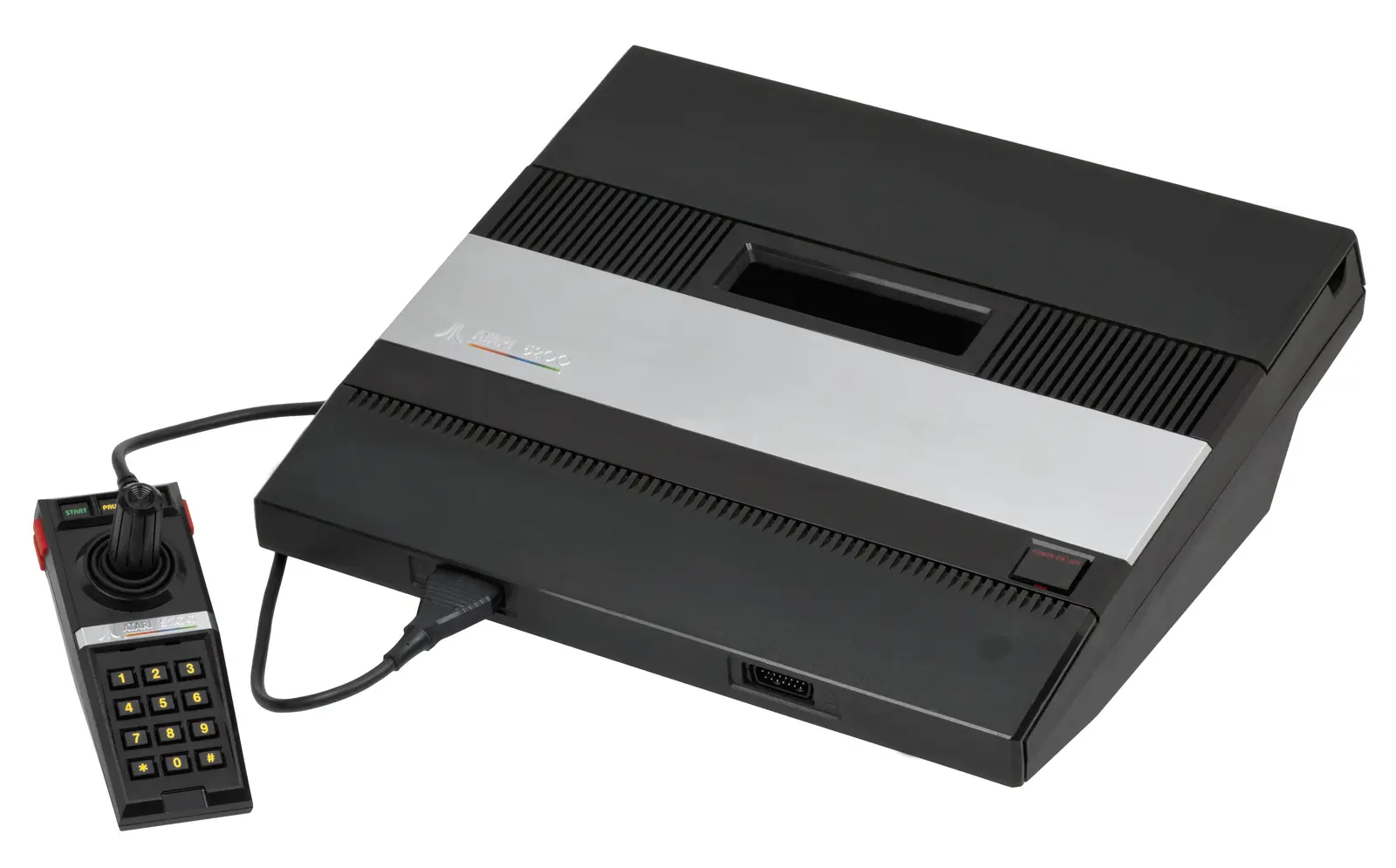
An analogue stick, pause button, keypad and four controller ports: almost every idea pointed forward. Yet history remembers the distance between the drawing board and the thumb.
01 / The hand as test bench
The specification promised nuance; the thumb mostly searched for centre
The stick could measure a full 360 degrees and many positions. That was richer than the eight digital directions of Atari VCS. But when players let go, it did not return to centre by itself.
Standing still was therefore not a mechanical certainty but an action. A racing car could steer in beautifully gradual arcs; Pac-Man merely wanted four unambiguous intentions. The 5200 was judged not just by what its controller could measure, but by what the player constantly had to correct.
02 / The computer that lost its keyboard
A familiar Atari family lived inside the new case
The 5200 shared its 6502 processor, ANTIC display processor, GTIA graphics and POKEY sound with Atari 400 and 800. It was not literally a computer in disguise, but its colour, scrolling and sound spoke the same technical dialect.
That made adaptations of existing computer games relatively quick, but not cartridge-compatible. Atari had built an advantage and a border at once: developers recognised the machine, while consumers could not insert the software they already owned.
03 / A piece of furniture for the future
The enormous black case tried to make cables and clutter disappear
At roughly 15 inches wide, the 5200 was far larger than its circuitry required. The extra space was part of the idea: behind the cartridge slot, a lid concealed controllers and their cables.
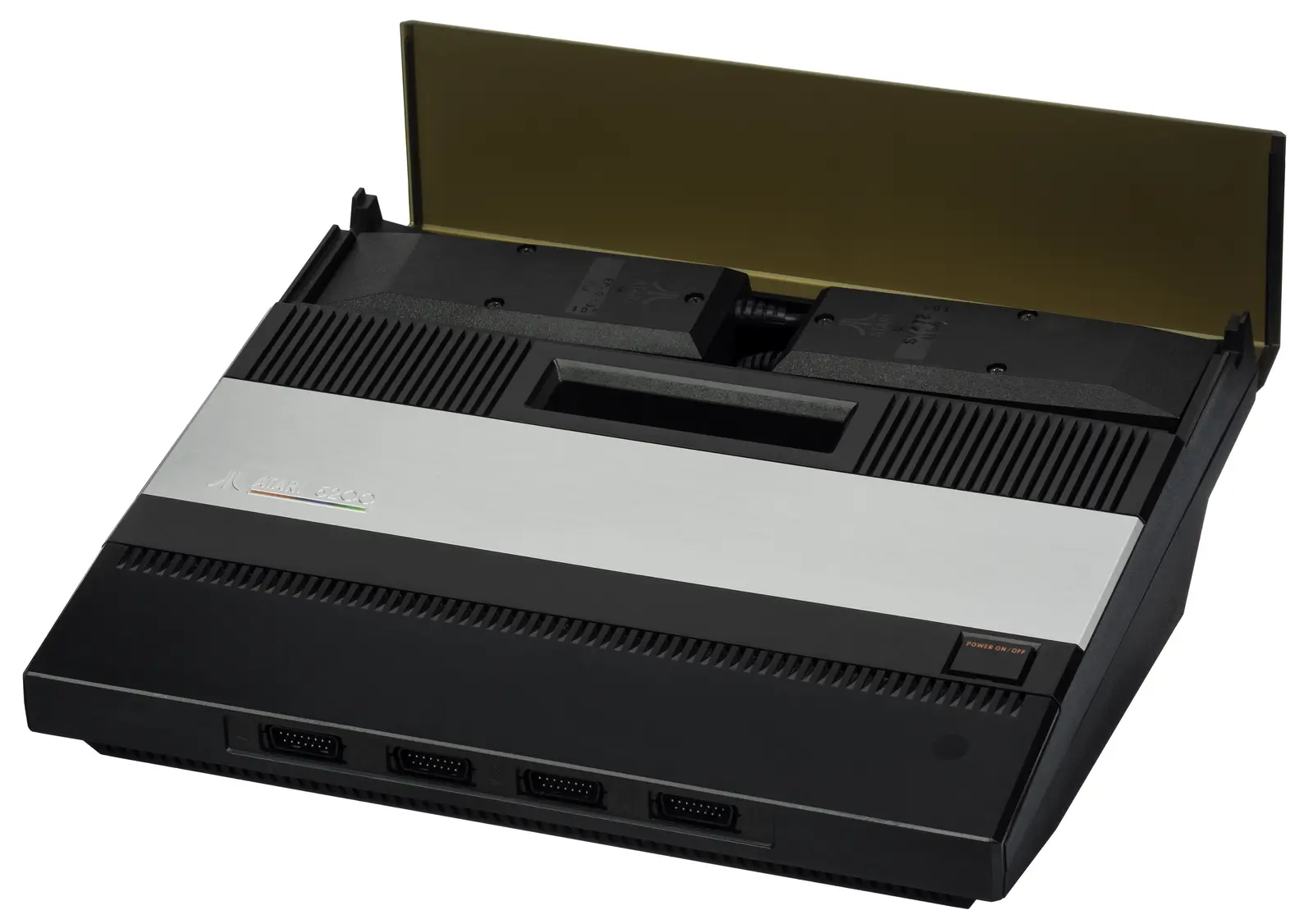
The original four-port version also hid complexity elsewhere. A special automatic switchbox near the television combined power and antenna signal. It looked tidy in use, but made one essential part unusually difficult to replace.
04 / A cockpit in one hand
Atari put almost an entire arcade control panel into the controller
Alongside the analogue stick sat twelve keypad buttons, two fire buttons on either side and separate Start, Pause and Reset controls. Plastic overlays could give the numbers a new meaning for every game.
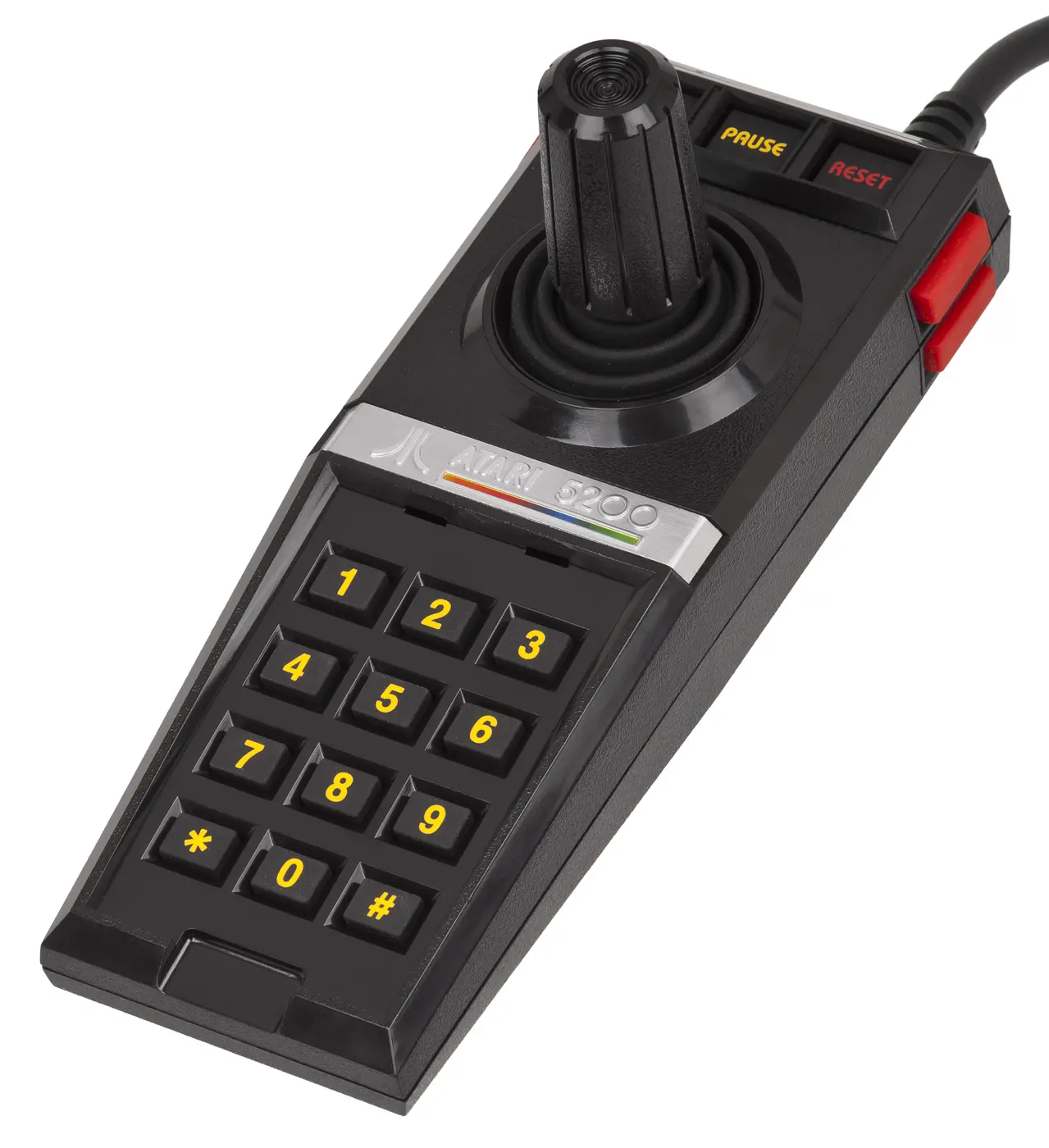
This was no conservative joystick but a programmable control panel. Pause — on the controller and available to every game — was particularly forward-looking. The fault was not the number of ideas, but the amount of friction between them and the fingers.
05 / Centre is a number
The neutral position existed in software, not in a spring
Two potentiometers measured horizontal and vertical travel. The rubber boot resisted movement but did not reliably centre the stick. A game therefore had to choose a ‘dead zone’ around the measured middle value.
Make it narrow and age, dirt or a crooked hand could cause movement. Make it wide and part of the promised precision vanished. Flexible contact circuits also became notorious for failing keys and fire buttons. Control feel and reliability fused into one problem in public memory.
06 / Three games, three verdicts on one controller
The controls were neither simply good nor bad; each game exposed a different part
Super Breakout
As the pack-in game it used absolute analogue position almost like a paddle. Technically apt, but hardly a dazzling demonstration of a new generation in 1982.
Pac-Man
Four digital directions collided with a stick that measured every position in between and did not return to neutral on its own.
Star Raiders
Flying, selecting speeds and switching displays turned stick, keypad and overlay into one convincing cockpit.
The controller became a design test that software visibly passed or failed. Games closely following their Atari 8-bit versions did not automatically inherit suitable controls. The best 5200 games started with the hand, not the source code.
07 / Two sticks for one player
Space Dungeon inverted four ports: not more players, but more hands
Taito’s manual required two controllers in ports 1 and 2. The left stick moved the ship; the right fired independently. A holder locked both controllers side by side into an early twin-stick arrangement.
Here, the 5200’s excess became character. What felt awkward in an ordinary maze game could feel remarkably modern in one built around two independent directions. The machine did not need one universal control scheme; it needed software willing to exploit its peculiarity.
08 / Trak-Ball frees the analogue idea
With a ball the size of a billiard ball, absolute movement finally felt natural
CX53 Trak-Ball was nearly a second console: wide, heavy and fitted with two keypads. In Centipede and Missile Command, the motion connected directly to their arcade origins.
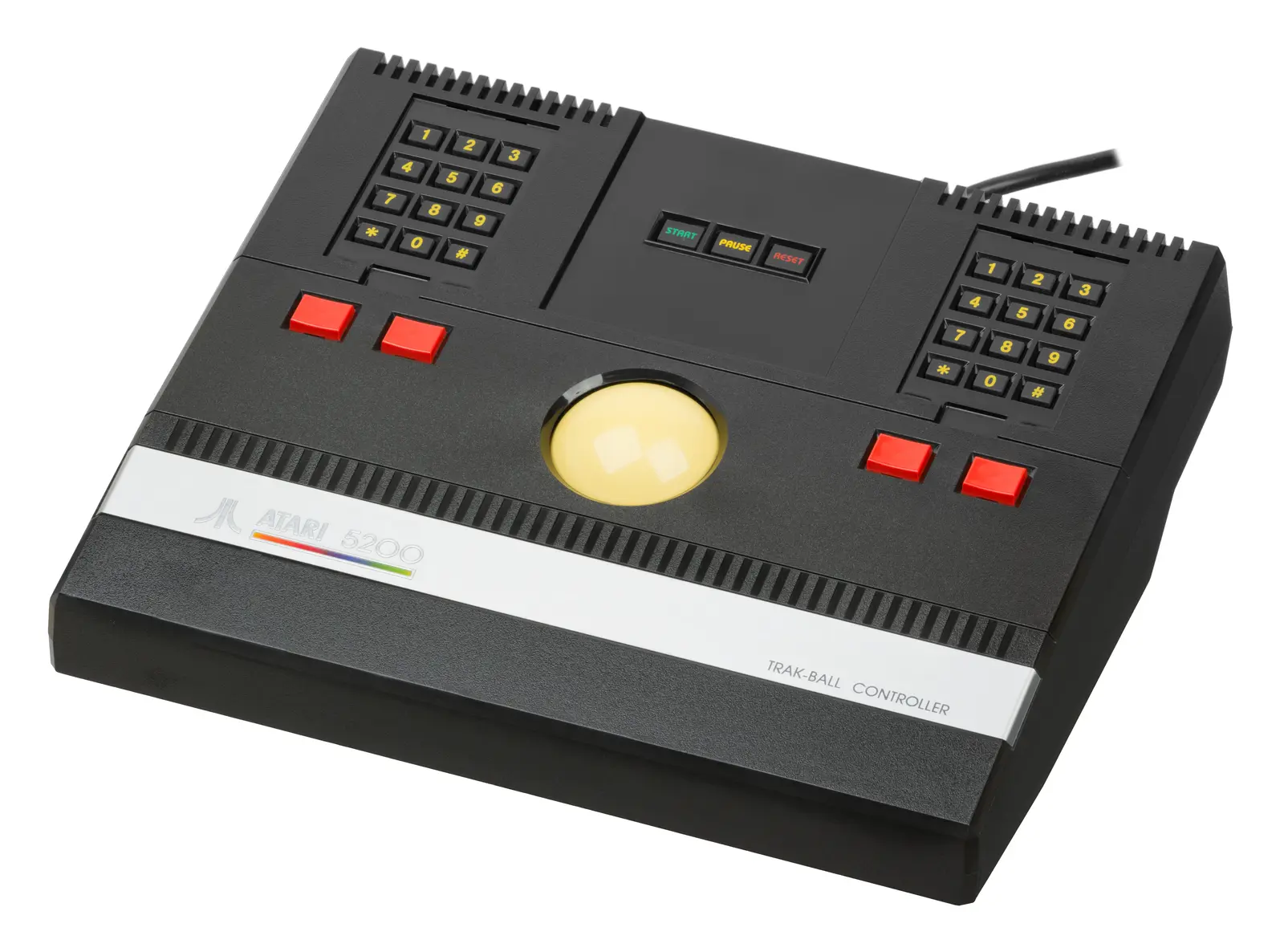
In hindsight, Trak-Ball proves that the 5200 did not lack direction. Atari understood that different games could use different physical instruments. Its standard instrument simply was not neutral enough to carry the whole library.
09 / A successor without an inheritance
The 5200 followed VCS but recognised not one VCS cartridge
Atari’s new system arrived beside a vast 2600 library and a home-computer line with related technology. Yet software from neither world plugged directly into 5200.
The later VCS Cartridge Adapter effectively put 2600 hardware into an intermediary. Early four-port consoles additionally required modification to use it. The solution therefore highlighted the very problem it was meant to hide: Atari had not built its greatest asset, continuity, into the original design.
10 / The pared-back second version
Two ports and ordinary connections made it more practical, not less ambitious
Atari replaced four controller ports with two and separated power from the television connection. Pac-Man replaced Super Breakout as the pack-in. The console became easier to live with while its most conspicuous part — the controller — remained fundamentally unchanged.
Super Breakout
Pac-Man
The revision arrived as the American market collapsed and Atari itself changed owners. The 5200 had little time to benefit from its first lessons. It disappeared in 1984; the smaller 7800 would place compatibility and digital control back at the centre.
11 / Not the worst, but the least forgiving
5200 punished every game that treated it like an ordinary joystick console
Its reputation is often reduced to one defective controller. That is understandable but too easy. The machine demonstrates something more interesting: innovation becomes progress only when the common case remains pleasant.
A centring spring would have made the 5200 less spectacular on the drawing board and much friendlier in the living room. Its good ideas still deserve recognition: system-wide pause, game-specific labels, analogue nuance and controller storage all returned in other forms. The 5200 was no dead end; it was a collection of futures without shared ergonomics.
12 / A short super time
From ambitious successor to orphan in two years
The hardware looked ahead; the market gave it almost no time to mature.
Atari 400 and 800
ANTIC, GTIA and POKEY establish the technical family 5200 will later draw from.
Atari 5200 arrives
The four-port SuperSystem launches in the United States with Super Breakout.
The library takes shape
Star Raiders, Space Dungeon and arcade conversions expose both the power and friction of its controls.
Two ports, new connection
A revised model makes television hookup and the VCS adapter more practical.
The market breaks
Price pressure, the American games crash and turmoil around Atari shorten its life.
7800 is announced
Atari chooses digital joysticks and built-in compatibility with 2600 games.
5200 production ends
Less than two years leave behind a small, idiosyncratic library.
13 / Sources & further reading
Explore further
- Atari — Atari 5200 Owner’s Manual, revision A (1983)
- Atari — CX 5200 Field Service Manual
- AtariAge — Atari 5200 system overview
- AtariAge — hardware, two- and four-port systems and accessories
- Atari — Star Raiders manual
- Taito — Space Dungeon manual
- iFixit — Atari 5200 device and repair overview
Image credits
Atari 5200 set — Evan-Amos, public domain; resized and converted to WebP
Atari 5200 controller — Evan-Amos, public domain; resized and converted to WebP
Atari 5200 with storage compartment open — Evan-Amos, public domain; resized and converted to WebP
Atari 5200 Trak-Ball — Evan-Amos, public domain; resized and converted to WebP


