Console Outlier B04 / 1990–1991
Commodore 64 Games System:
the C64 that lost its greatest strength
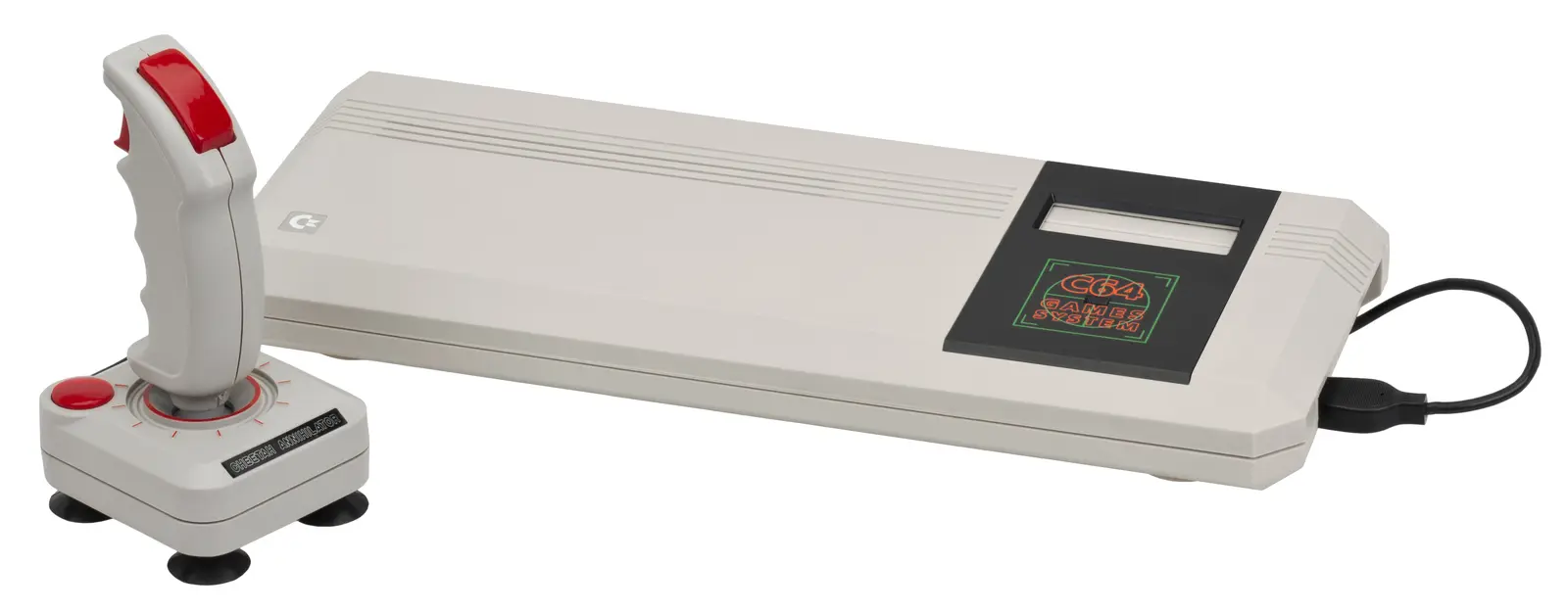
Commodore did not build a new game console. It removed the keyboard, storage ports and BASIC environment from a familiar computer. What remained started faster — and did less.
01 / READY disappears
C64’s most famous invitation was replaced by a rejection
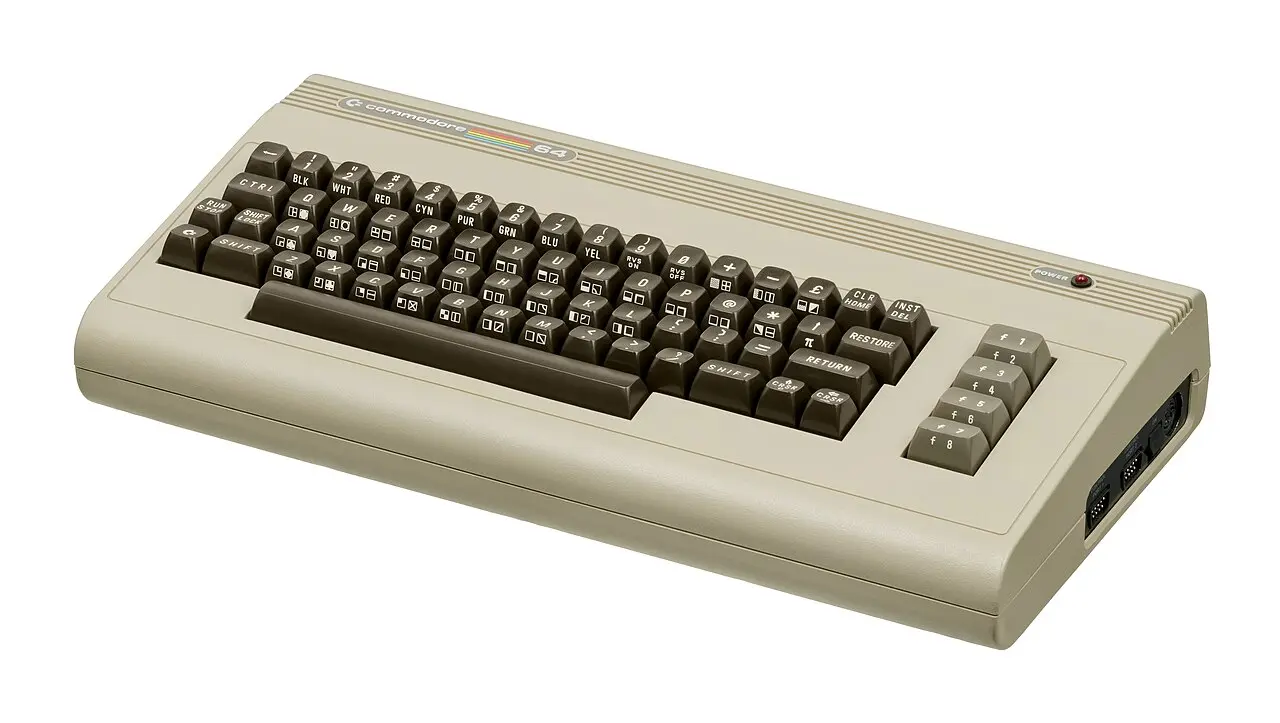
An ordinary Commodore 64 greeted its owner with READY. and a blinking cursor: type something, load something, make something. Without a cartridge, Games System merely instructed the user to insert one.
That single start-up screen tells the entire story. C64 had thrived as an open invitation: game console, typewriter, musical instrument and first programming space at once. C64GS turned that versatility into one narrow route from retail box to cartridge slot.
02 / Designing by subtraction
Commodore built its console not around a new strength, but around what could disappear
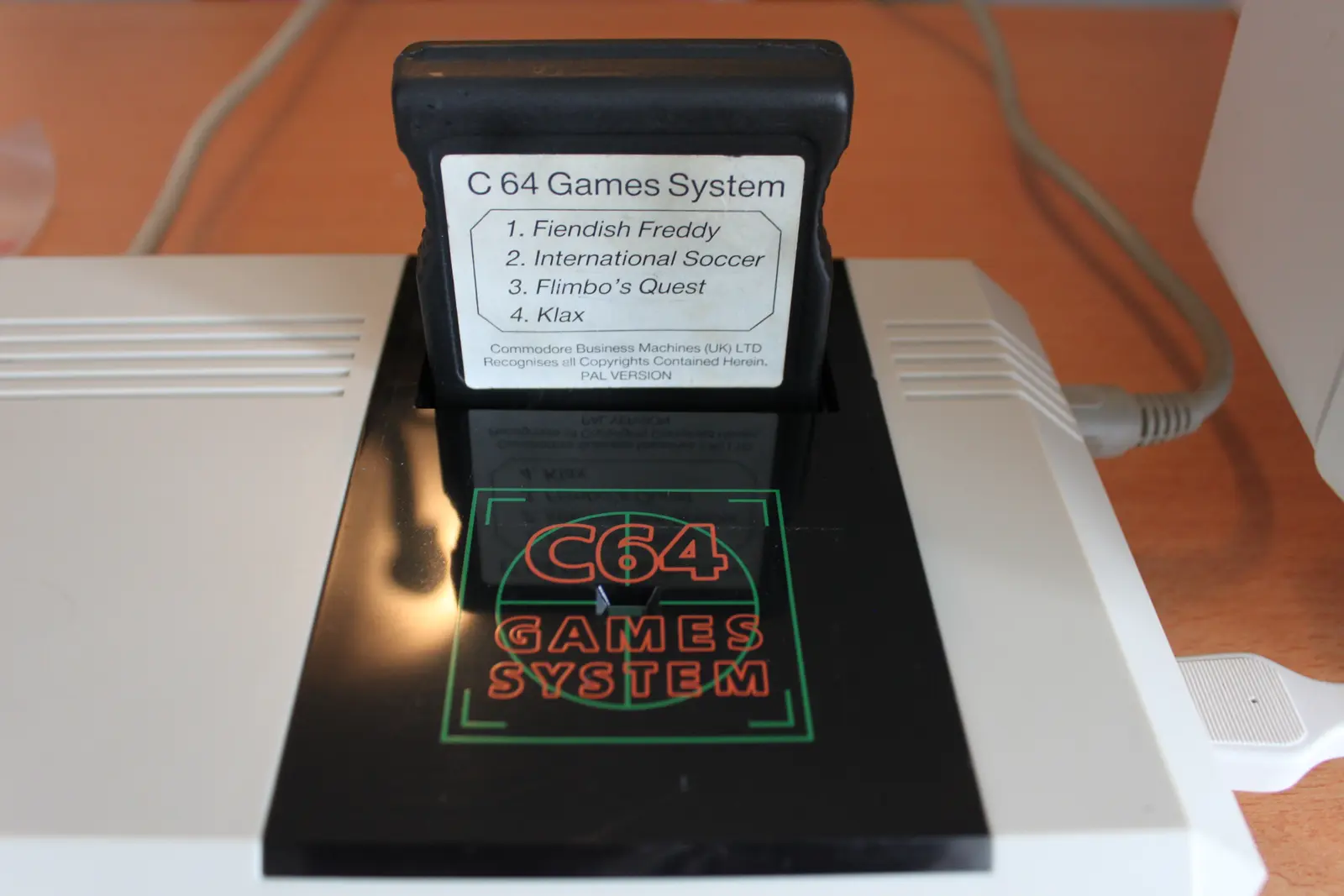
Under the low cream-coloured shell sat largely the electronics of a C64C. The new shape turned the cartridge upright and removed the keyboard. Processor, 64 KB RAM, VIC-II video and SID sound remained familiar.
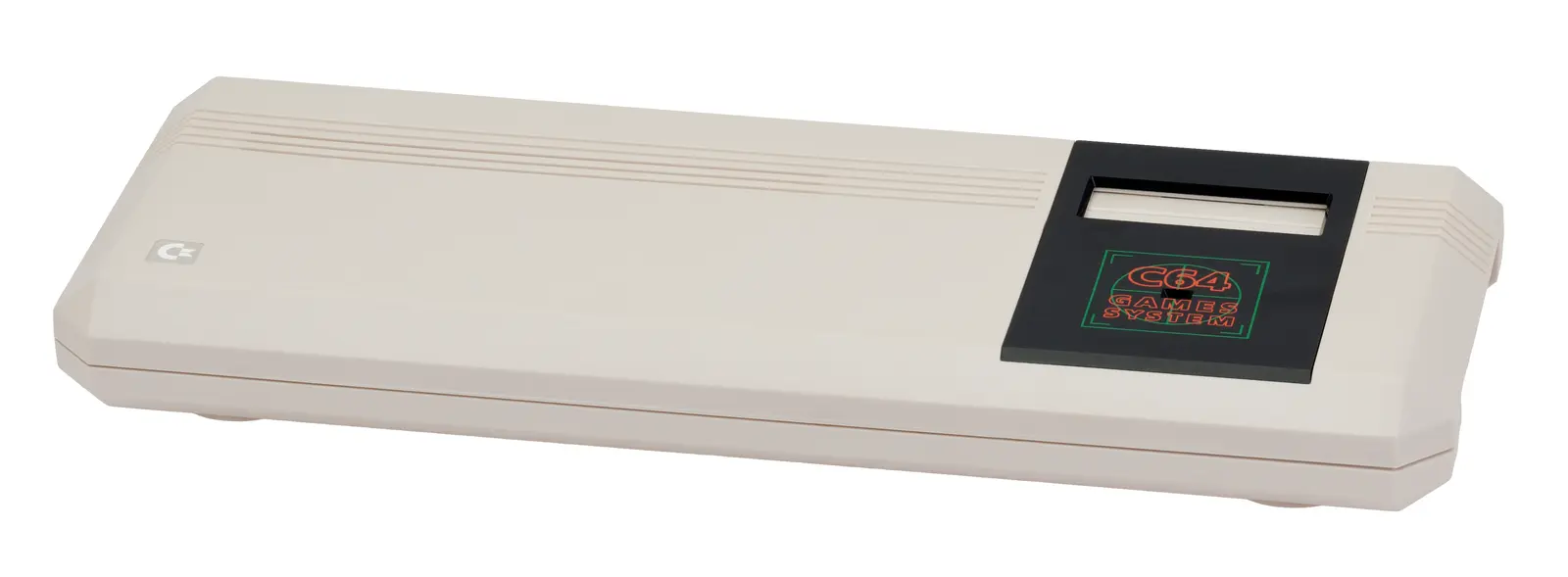
A successful console often abstracts away the computer inside it. Here, the computer remained palpable as a missing shape: the empty upper surface still looks like the place where a keyboard might have been.
03 / Same chips, different promise
VIC-II and SID were a breakthrough in 1982; by 1990 they were an inheritance
C64 could still produce colourful sprites, smooth scrolling and characterful sound. Games System, however, arrived eight years after the original computer, against consoles designed specifically around cartridges, gamepads and newer display technology.
The problem was not simply that the hardware was ‘old’. Game Boy had proved a year earlier that modest technology could win through a clear form and new use. C64GS offered less use without returning a persuasive new experience.
04 / Ports behind plastic
The connections disappeared from view, though not always from the circuit board
A regular C64 connected to a datasette, disk drive, printer, modem and expansions. Games System did not expose its cassette, serial or user ports. What remained were chiefly power, video, two joystick ports and the cartridge slot.
The distinction matters. Commodore did not first design an efficient console board; it encased an existing computer architecture and made parts inaccessible. The saving was external, while the hidden capability had no value for the buyer.
05 / A side door becomes the front door
Cartridge port was an expansion on C64; on C64GS it had to carry an entire market
Standard cartridges could place 8 or 16 KB directly into C64’s address space. Larger games used bank switching: the cartridge repeatedly put a different block of memory into the same window.
16 KB⇄
Technically, this enabled instant start-up and larger cartridge games. Economically, it inverted the familiar C64 world: tape was slow but cheap, disk rewritable, cartridge fast but expensive to manufacture. C64GS chose precisely the medium in which Commodore held the smallest advantage.
06 / Four games as a sales pitch
The pack-in cartridge had to prove at once that an old machine was still broad enough
Fiendish Freddy
A sequence of circus acts with different forms of play.
International Soccer
An old cartridge classic from C64’s earliest years.
Flimbo’s Quest
A colourful platform game that put scrolling and sprites to good use.
Klax
A current arcade puzzle game with instant name recognition.
The selection was smarter than its reputation suggests: sport, action, puzzle and mini-games on one cartridge. Yet the compilation exposed the lack of a distinct identity. None of the four was designed as an exclusive reason to own this new console.
07 / Compatible until a key is requested
Software can start technically and still be unusable in practice
Existing C64 cartridges fitted the slot but had been written for a computer with keys. A title screen asking for F1, a number or ‘any key’ became a locked door on C64GS.
This made ‘C64 compatible’ a misleading half-truth. New games also needed rearranging: menus to the joystick, pause to a button, loading to ROM. A library of thousands of C64 games did not automatically become a console catalogue.
08 / The second button that did add something
Cheetah Annihilator used a hidden possibility of the joystick port
The bundled joystick had a regular trigger beneath the index finger and a second red button on its base. That extra button used a paddle input and could replace jumping or a special action previously assigned to the keyboard.
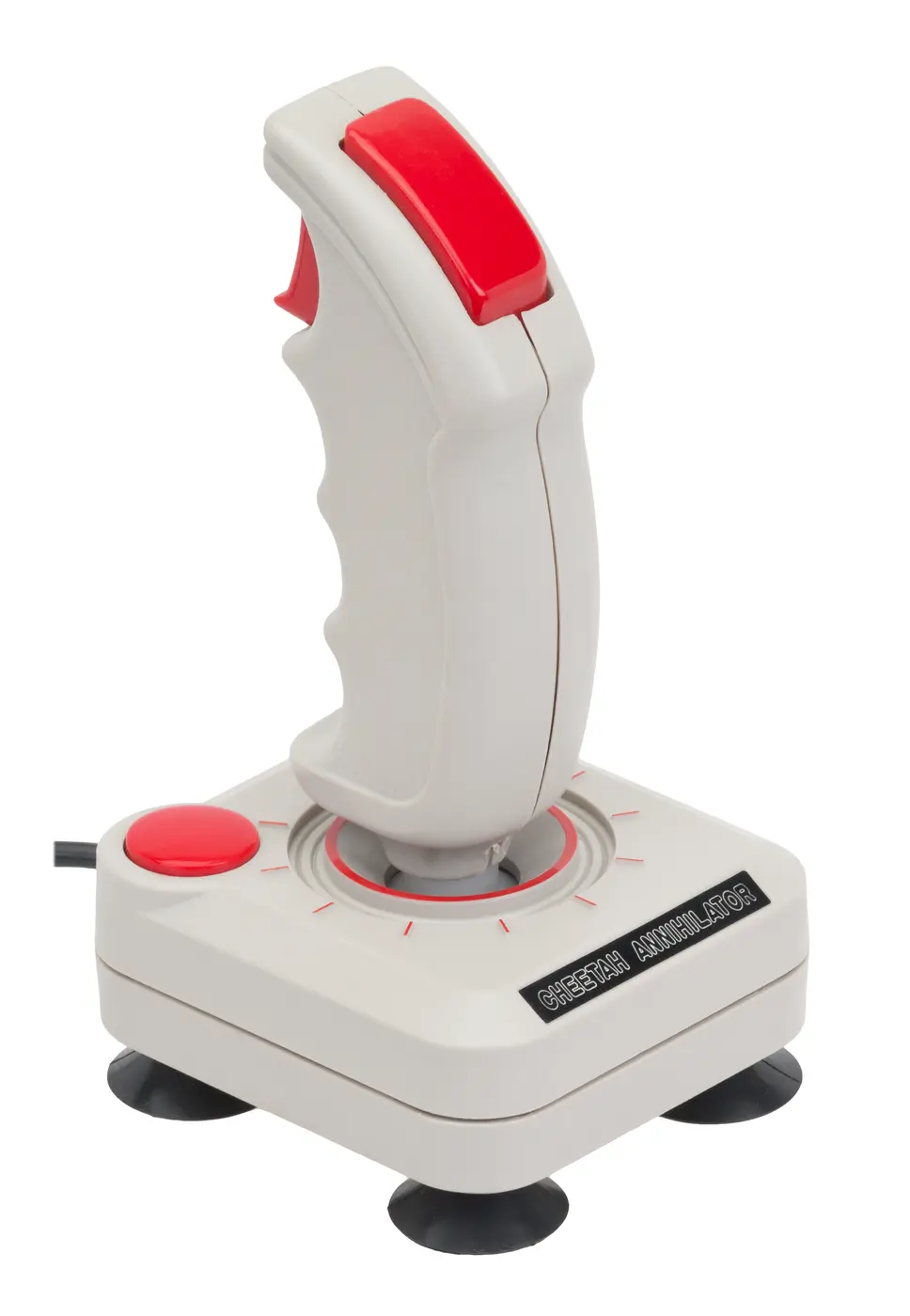
Here C64GS genuinely changed the language of play. A new problem followed: ordinary C64 joysticks lacked the second signal and Annihilator never became a widely supported standard. The improvement belonged to a console that lived too briefly to establish its convention.
09 / A safety net for publishers
Cartridges also working on a regular C64 chiefly reduced risk for software companies
Ocean, System 3, Domark, Codemasters and MicroProse could offer C64GS cartridges without relying entirely on the new console. The much larger C64 audience remained a potential buyer.
This explains why interesting releases appeared despite weak hardware sales, including Pang, RoboCop 2, Navy SEALs, Last Ninja Remix and compilations. For the console itself, however, the safety net worked in reverse: every cartridge proved that C64GS was unnecessary.
10 / The wrong cheap machine
At £99.99 C64GS looked affordable — until buyers considered the whole ecosystem
In the European Christmas season of 1990 the console faced NES and Master System, while Mega Drive was already demonstrating 16-bit games. The same shops also carried the ordinary C64C with cheap tapes, disks and years of accumulated knowledge.
expensive cartridges
small selection
cheap software
vast selection
own catalogues
clear future
The price of a device is not the price of ownership. Commodore made the box cheaper by removing possibilities, but made play dependent on the costliest and scarcest C64 medium.
11 / The paradox of specialisation
A product does not automatically improve at one task when every other task disappears
C64GS loaded instantly, looked tidy and required no knowledge of LOAD commands. Yet a regular C64 played the same cartridges and almost everything the console could no longer use.
COMPUTER≠MORE
CONSOLE
This is therefore more than a story of bad timing. The machine asks a sharp design question: which friction do you remove, and which value disappears with it? Commodore removed the waiting and the keyboard, but also the curiosity that began behind READY. Games System sold C64 as a finished product when its success had come from openness.
12 / From open computer to closed slot
Eight years of history compressed into one Christmas season
C64GS inherited a famous past but had almost no time to build its own future.
Commodore 64 arrives
An affordable computer combines cartridges with tape, disk, keyboard and BASIC.
MAX Machine
Commodore already sells a stripped-down, cartridge-oriented relative of C64 technology in Japan.
C64GS is announced
Commodore UK presents a keyboardless console priced at £99.99.
The press weighs its chances
Zzap!64 asks whether the new cartridge catalogue can compete with Sega and Nintendo.
European launch
The console arrives with Annihilator joystick and four games on one cartridge.
Support dries up
A small group of publishers still releases cartridges; a self-sustaining market never forms.
Commodore tries again
CDTV presents Amiga technology as a living-room appliance — once more with a difficult identity.
Amiga CD32
Commodore’s final console repeats the idea with CD-ROM and more powerful Amiga hardware.
13 / Sources & further reading
Explore further
- Zzap!64 66 — ‘The C64 Console!’ (October 1990)
- Commodore Format Archive — the history of C64GS
- Commodore Format Archive — which games were released for C64GS?
- HomeComputerMuseum — Commodore 64 GS
- Bo Zimmerman — Commodore C64 Games System
- C64-Wiki — cartridges, memory windows and bank switching
- Individual Computers Wiki — DE-9 joystick and C64GS two-button controls
Image credits
C64GS set — Evan-Amos, CC BY-SA 3.0; resized and converted to WebP
C64GS console — Evan-Amos, CC BY-SA 3.0; resized and converted to WebP
C64GS controller — Evan-Amos, CC BY-SA 3.0; resized and converted to WebP
C64GS cartridge — Thomas Conté, CC BY-SA 2.0; resized and converted to WebP
Commodore 64 — Evan-Amos, public domain; previously resized and converted to WebP


