Console Outlier B05 / 1990–1991
Amstrad GX4000:
yesterday’s future
Amstrad finally gave its 8-bit computer hardware the colours, sprites and instant cartridges of a real console. It was a credible answer to the question Europe had been asking—just as buyers began asking for 16-bit.
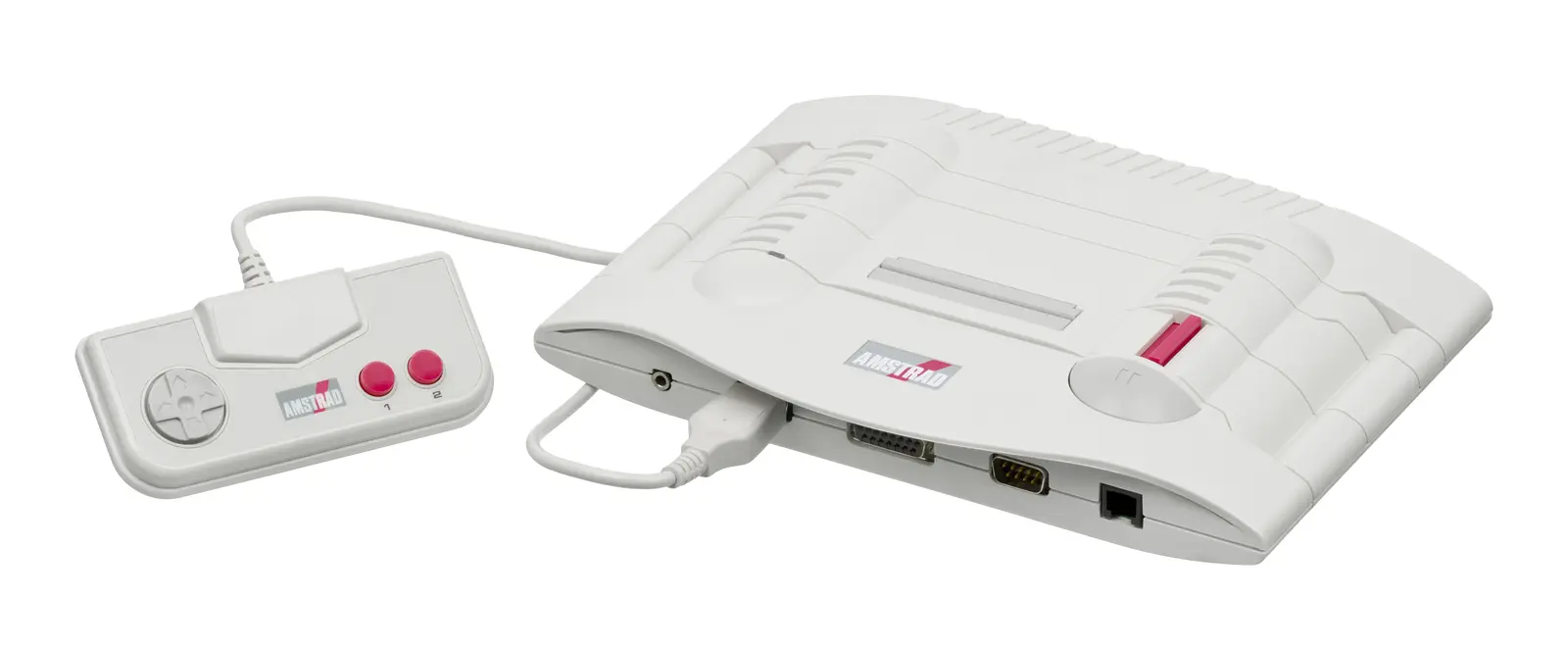
01 / One second on the shelf
The case promised a decade that the circuitry could only partly enter
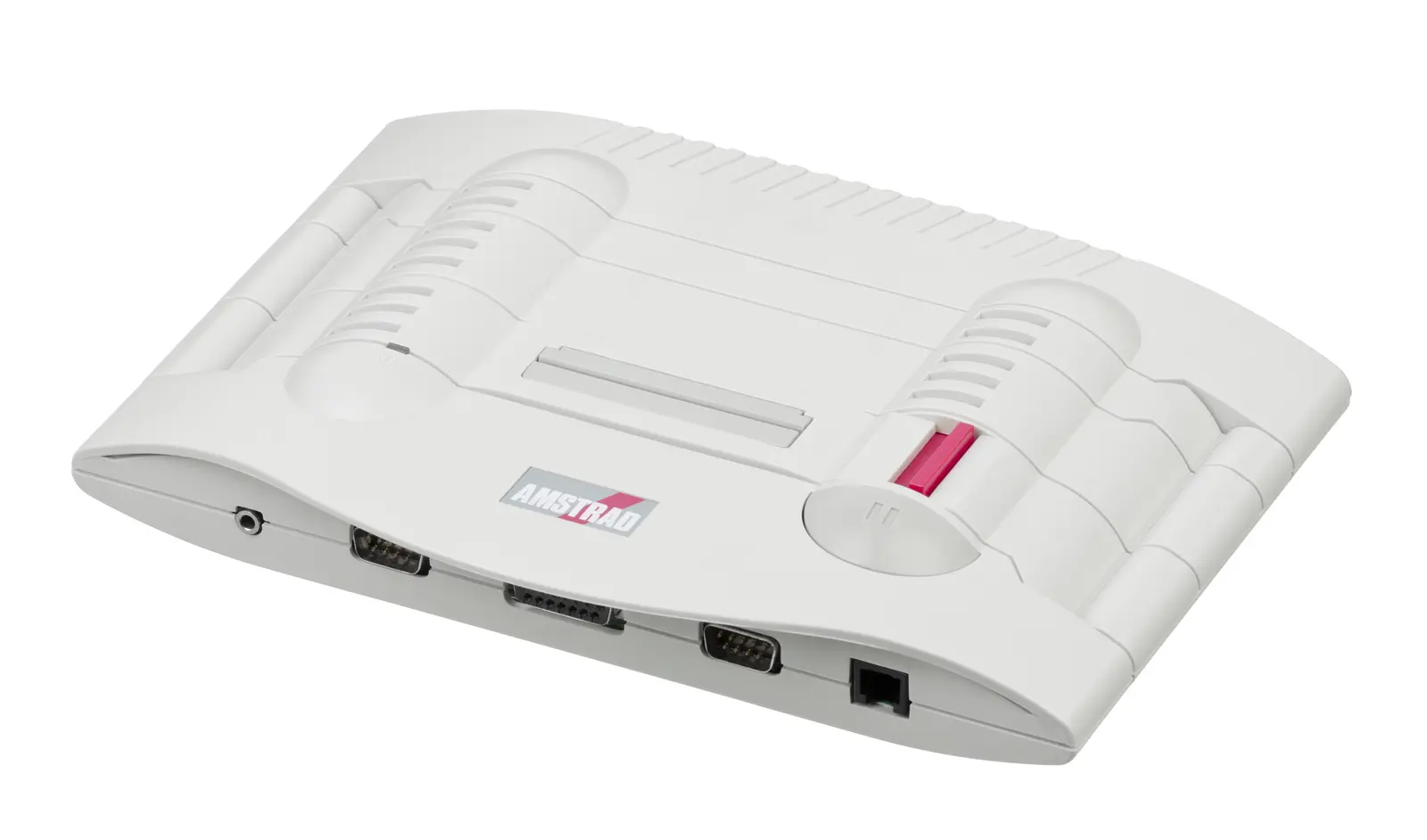
GX4000 looked unlike the beige computers Amstrad had built its reputation on. Its low white body, sweeping ribs and magenta switches suggested a machine sent forward from the 1990s.
HOME COMPUTER→GX4000→1990s
GAME CONSOLE
That styling was not a disguise for completely unchanged hardware. Inside was a serious attempt to repair the old CPC’s weaknesses as a games machine. The GX4000’s peculiarity is subtler: Amstrad built a convincing future for its past.
02 / Three bodies, one Plus generation
The console was one branch of a family, not an orphaned computer with its keyboard sawn off
Amstrad announced the GX4000 alongside the 464 Plus and 6128 Plus computers. All three shared the new ASIC and cartridge format; the computers retained keyboard and storage, while the console connected directly to a television.
This matters because it distinguishes GX4000 from Commodore’s C64GS. Amstrad had developed genuinely new game-oriented silicon. Its mistake was not merely subtracting the computer, but dividing a small new software market across three identities.
03 / The upgrade was real
A custom chip supplied the tricks the original CPC had always performed the hard way
The Plus ASIC added sixteen 16×16-pixel hardware sprites, fine hardware scrolling, programmable raster interrupts and a 12-bit palette of 4,096 colours. Three DMA channels could feed the familiar AY sound generator without occupying the processor.
Those were not brochure inventions. They removed work from the Z80 and enabled smoother motion, more colourful objects and split-screen effects. A developer who treated GX4000 as new hardware could make it visibly outperform an ordinary CPC.
04 / New muscles, old heartbeat
The graphics moved forward while the machine’s basic rhythm remained in 1984
The CPU was still a Z80A at 4 MHz, paired with 64 KB RAM and the AY-3-8912 sound chip. The ASIC accelerated important tasks, but it did not turn eight-bit code into a Mega Drive or Amiga.
4 MHz+PLUS ASIC=old code
new effects
This hybrid could have been a virtue. Console generations are not decided by the width of a processor alone. The problem was communicative: GX4000 had to demonstrate why its particular combination mattered, game after game, before the 16-bit label swallowed every comparison.
05 / Cartridge as a restart button
Instant loading was meant to transform the CPC experience—and the economics around it
A cartridge removed cassette waits, disk commands and casual copying. It also let Amstrad lock the new features behind a deliberately obscure ASIC-unlocking sequence and control a clean, console-like software format.
minutes→CARTRIDGE
seconds→PLAY
immediately
Speed came with a price. A typical GX4000 game launched around £25, while older CPC games could be sold cheaply on cassette. Publishers therefore had to justify a more expensive physical object for a small audience—not just convert code.
06 / Burnin’ Rubber as evidence
The bundled racer was less a killer app than a guided tour of the upgrades
Burnin’ Rubber arrived with the console and two controllers. Its road bends smoothly, roadside objects use the expanded palette and the screen keeps moving without a tape deck or keyboard entering the ritual.
As a demonstration it did its job: this was recognisably more fluid and colourful than the old CPC baseline. As a reason to build a whole library around GX4000, it was weaker. The game introduced capabilities, not a new world.
07 / The conversion trap
Compatibility made software easier to produce and harder to value
Publishers already knew the CPC and could move existing games onto cartridge quickly. But a title that ignored sprites, palette and scrolling still looked like the cheaper cassette version—only inside a faster and more expensive shell.
old presentation
small audience
GX4000’s technical continuity therefore worked against its identity. The easier it was to reuse the past, the less visible the new machine became. Cartridge delays then undermined the one thing a console launch cannot postpone: a convincing shelf of games.
08 / A familiar controller with a hidden argument
Two buttons said “console”; the ports still remembered a computer laboratory
The flat gamepad offered a directional disc and two red action buttons. On the console itself sat Pause. Around the back and sides, however, were RGB, composite video, two digital controller sockets, analogue input and a light-gun connection.
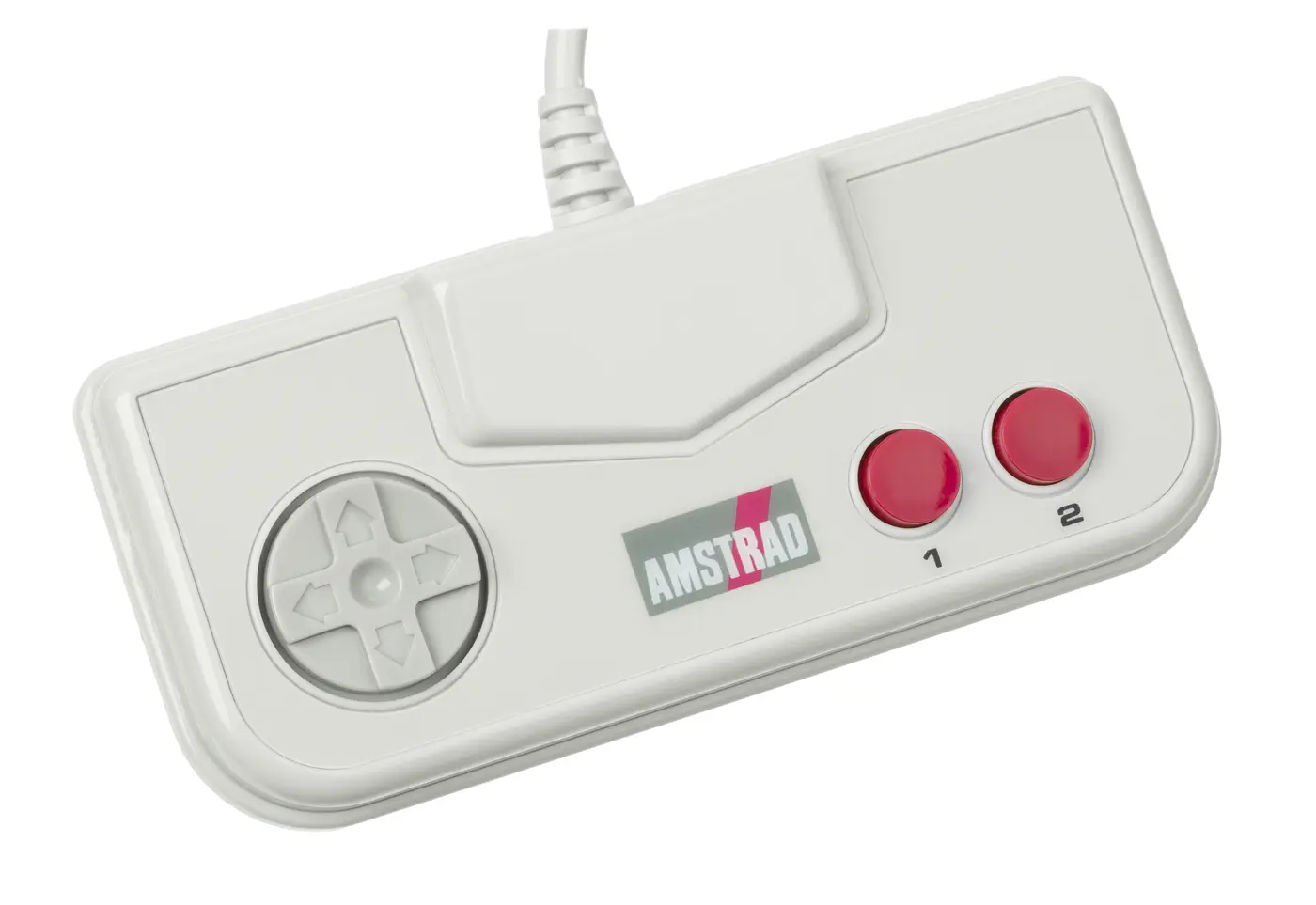
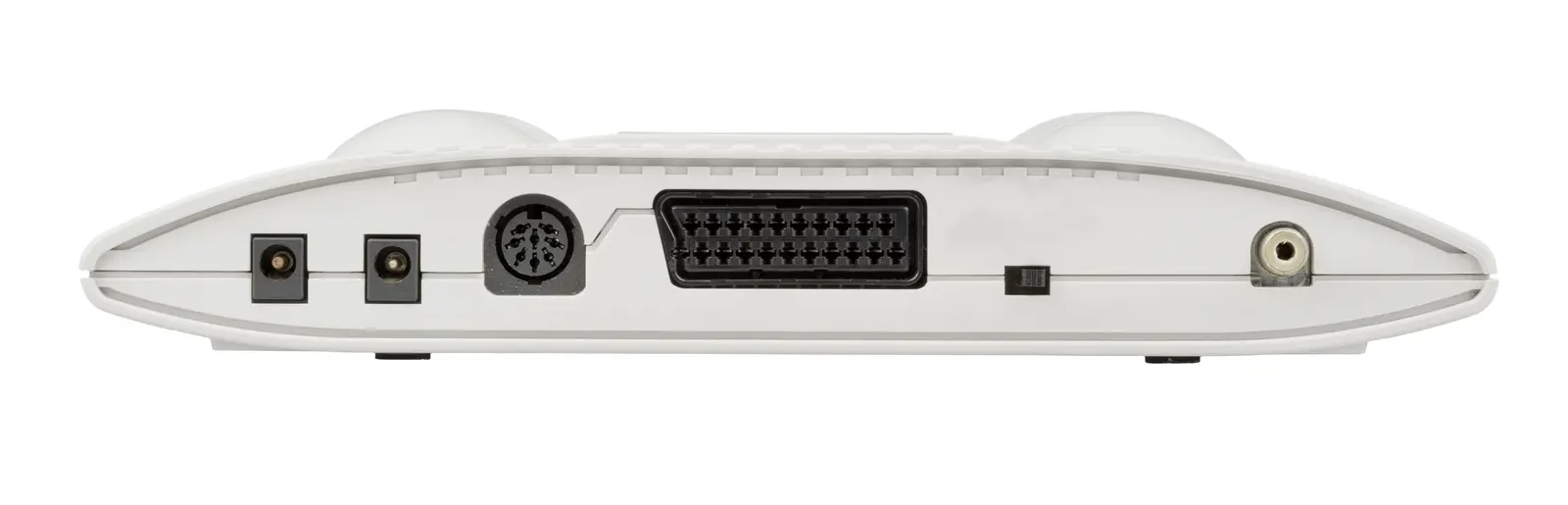
The rarely used analogue and light-gun facilities reveal how broadly the hardware had been imagined. GX4000 was simple to operate, yet its designers had left doors open for a future catalogue that never arrived.
09 / £99.99 bought the machine, not the future
Amstrad priced the hardware sharply and left buyers to calculate the ecosystem
Console, two pads and a game for £99.99 made a strong first impression. Yet the Master System and NES already had recognisable catalogues; the Mega Drive reached Europe in November 1990 with a clearer claim on the coming decade.
Hardware value is a promise about tomorrow. Every missing or late cartridge discounted that promise more severely than a shop could discount the plastic.
10 / Caught between two kinds of cheap
It was too expensive as an old software machine and too modest as a new dream machine
Europe’s established 8-bit computers offered mountains of inexpensive tapes. New 16-bit machines and consoles offered aspiration. GX4000 sat between those markets: affordable hardware tied to cartridges that often resembled budget computer games.
CPC · C64 · SPECTRUMGX4000NEW PRESTIGE
AMIGA · MEGA DRIVE
Calling it simply “too late” misses the design achievement. Amstrad had made a sensible 8-bit console. The market did not reject that category everywhere—the Master System continued to thrive in Europe—but it demanded a distinctive stream of games that Amstrad could not assemble.
11 / The future of the wrong past
GX4000 answers a question that product history had already stopped asking
What if the CPC gained the console features it should have had from the start? The GX4000 is a surprisingly good answer: fast cartridges, proper sprites, fine scrolling, richer colour and uncomplicated controls.
UPGRADE×WRONG
MOMENT
Its short life is not proof that the machine was incompetent. It shows that technical repair and market renewal are different acts. Amstrad modernised a platform; Nintendo and Sega were already building worlds around theirs.
12 / A future measured in months
The Plus generation arrived and disappeared between two Christmases
Its chronology makes the central contradiction visible: development moved forward, while the market moved sideways.
Amstrad CPC 464
An integrated, affordable home computer gives Amstrad a major European platform.
“Arnold V” specification
Amstrad documents the enhanced ASIC while insisting on backward compatibility.
The Plus family appears
GX4000, 464 Plus and 6128 Plus are unveiled together in Paris.
European launch
GX4000 costs £99.99 in Britain, bundled with two pads and Burnin’ Rubber.
Mega Drive reaches Europe
The language of 16-bit becomes a powerful shorthand for the future.
Cartridge crisis
Slow manufacturing and a thin release schedule erode confidence in the format.
Prices collapse
Some British retailers advertise remaining machines for £29.99.
The experiment ends
Amstrad withdraws its only dedicated games console after a brief commercial life.
13 / Sources & further reading
Explore further
- Amstrad PLC — “Arnold V” hardware specification, issue 1.4 (12 March 1990)
- Amstrad Action 60 — contemporary launch coverage of the Plus range and GX4000
- CPCWiki — Amstrad Plus and GX4000 hardware
- The Centre for Computing History — Amstrad GX4000
- Amstrad GX4000 — user manual
- Old-Computers.com — GX4000 museum entry
- Wikimedia Commons — Amstrad GX4000 image collection
Image credits
GX4000 set — Evan-Amos, public domain; resized and converted to WebP
GX4000 console — Evan-Amos, public domain; resized and converted to WebP
GX4000 controller — Evan-Amos, public domain; resized and converted to WebP
GX4000 connections — Evan-Amos, public domain; resized and converted to WebP


