Console Outlier B01 / 1978–1985
Bally Astrocade:
the console that hid code inside its picture
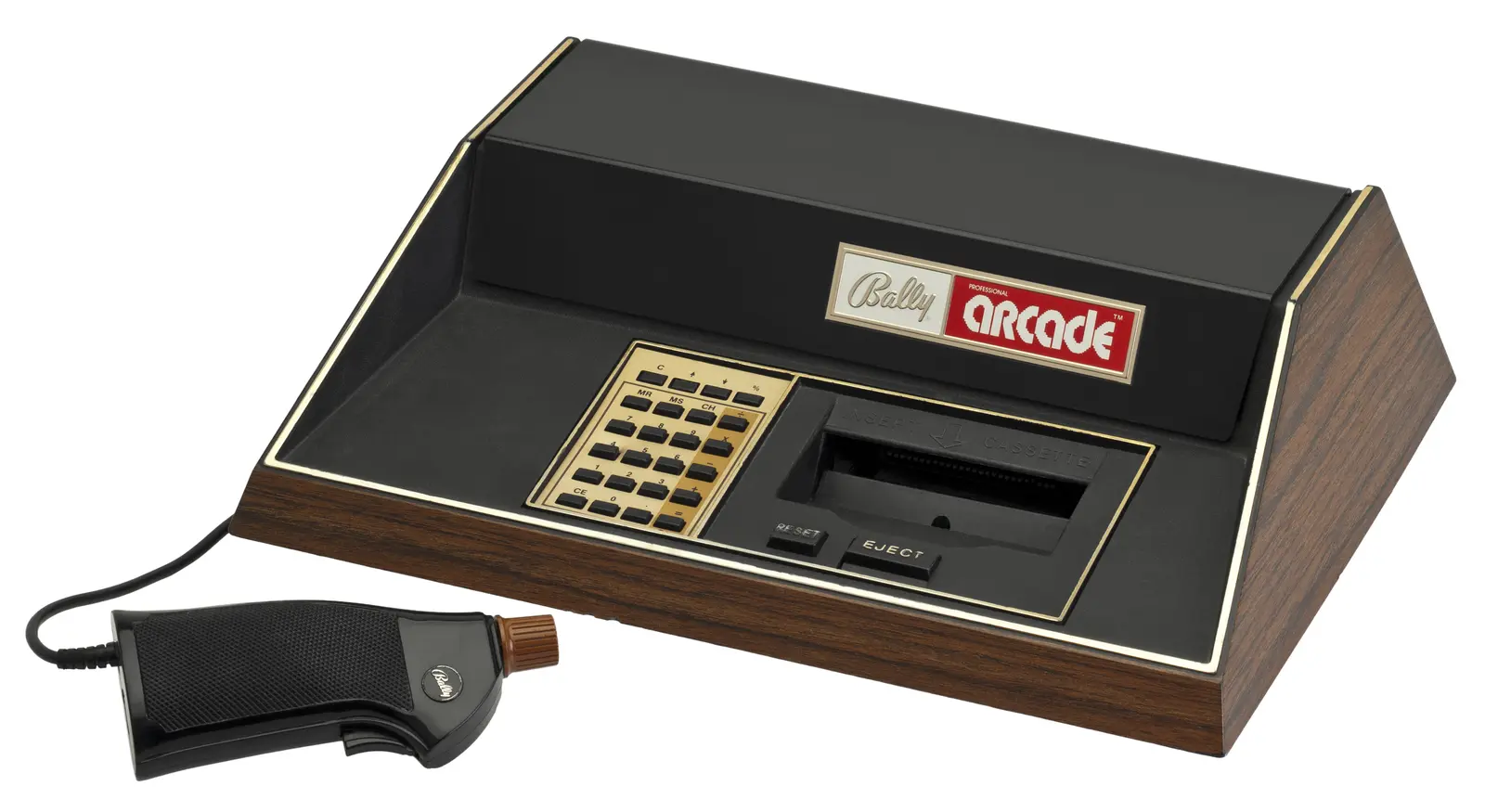
A pistol grip with rotary knob, four connectors, arcade technology and BASIC programs between the pixels: Astrocade never became one clearly defined product. That is precisely why it could become more than an ordinary console.
01 / A name seeks a machine
Astrocade could not decide whether it was a toy, an arcade or a computer
Before a single unit reached a shop, the machine was called Bally Home Library Computer. Its first real release turned it into Professional Arcade. Bally Computer System and, finally, Astrocade followed.
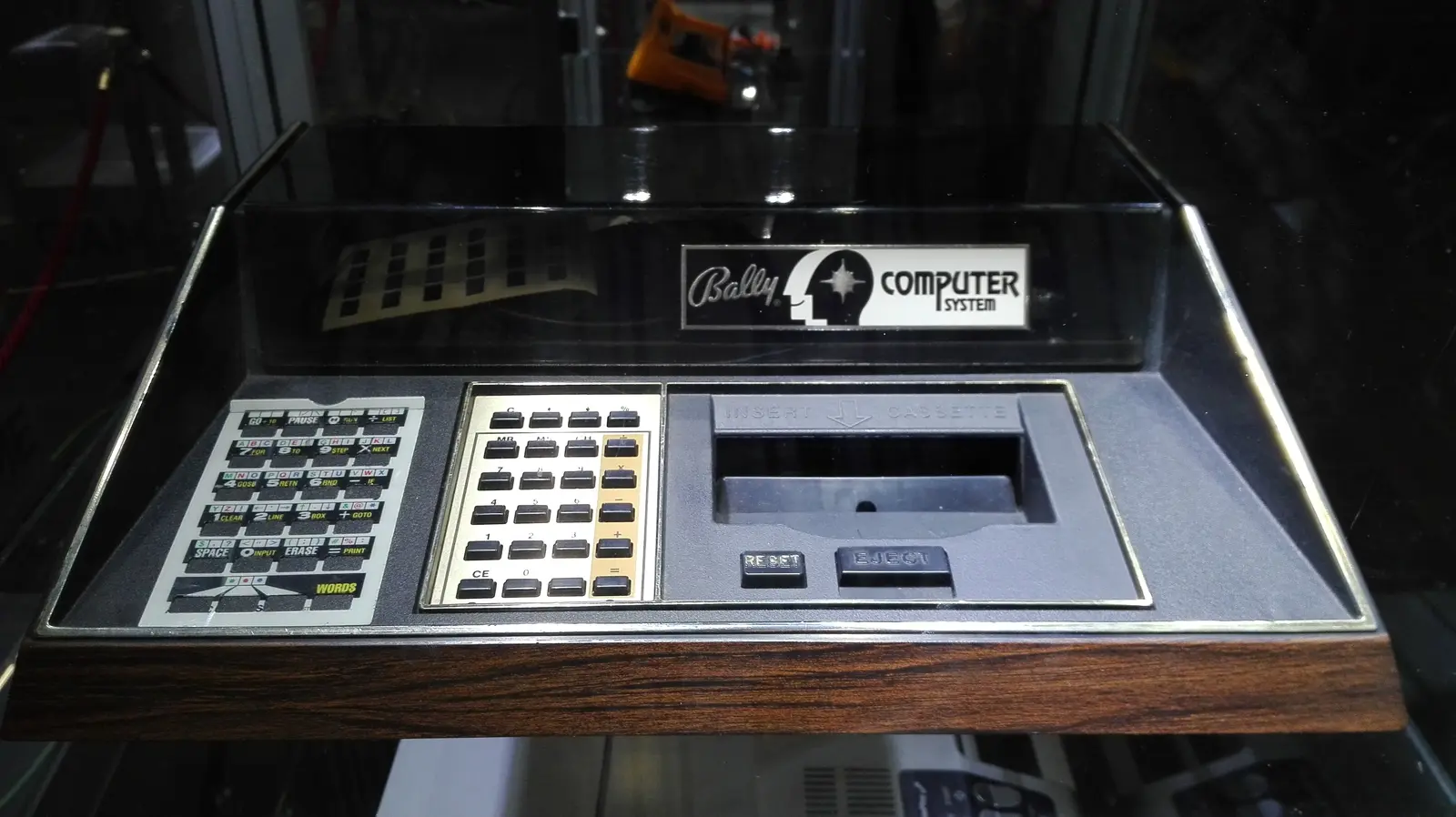
This is more than a row of brand names. Every owner and campaign brought a different possibility to the foreground. The hardware remained largely the same, while the answer to ‘what exactly are you buying?’ kept changing. Astrocade was an outlier before it had that name.
02 / From arcade to living room
The architecture began not with the television, but with Bally and Midway
Dave Nutting Associates designed a powerful visual architecture around the Z80 for Bally’s games division Midway. The idea was broader than one home console: the same knowledge was meant to serve arcade games and other video systems.
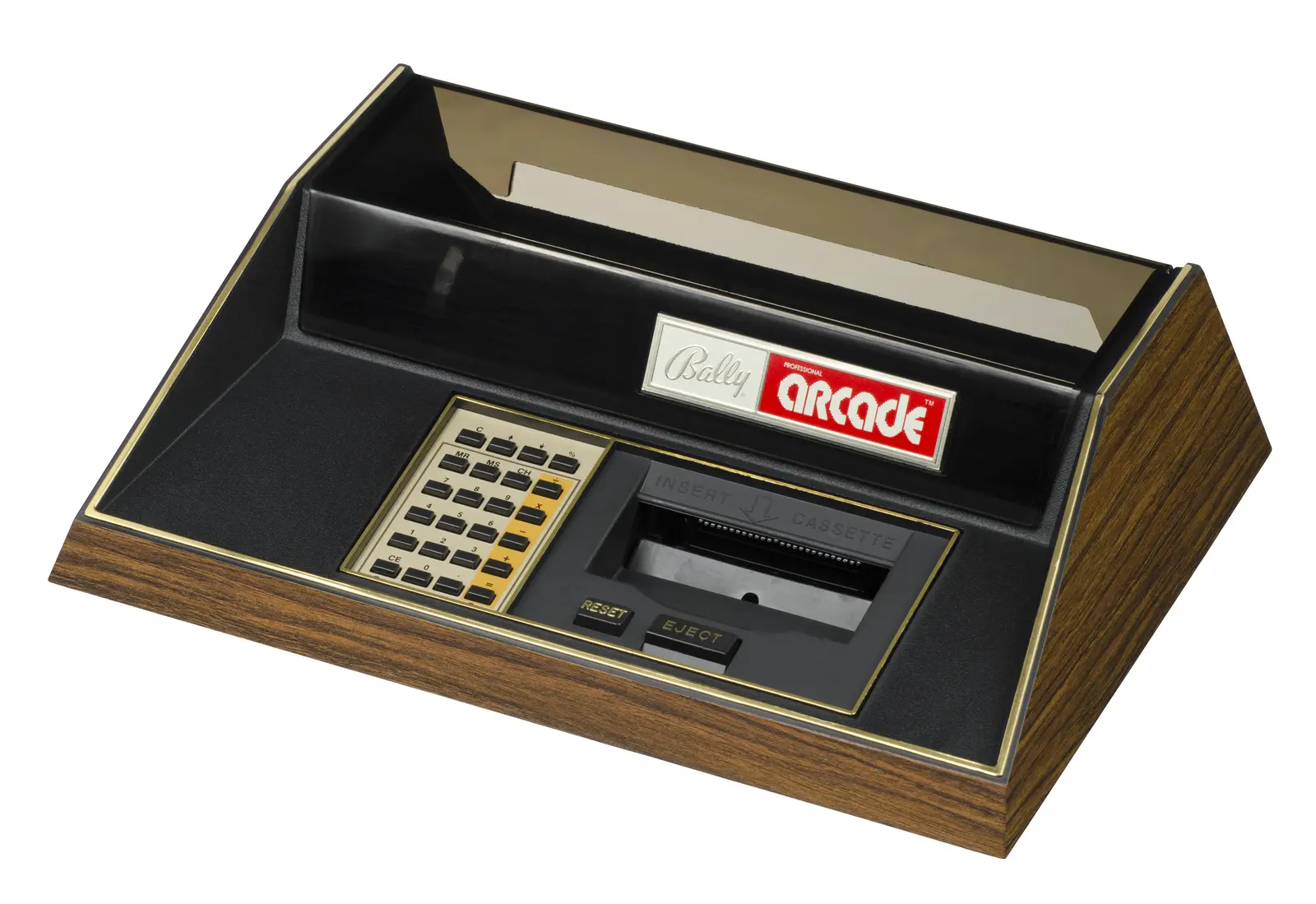
The machine therefore felt different from consoles mainly engineered to assemble one simple picture as cheaply as possible. Astrocade could deliver colour, several sound voices and rapidly moved picture blocks. Its price was arcade-like too: about $300 at launch, considerably more than Atari VCS.
03 / The console as foyer
Even without a cartridge, a small house of programs was waiting
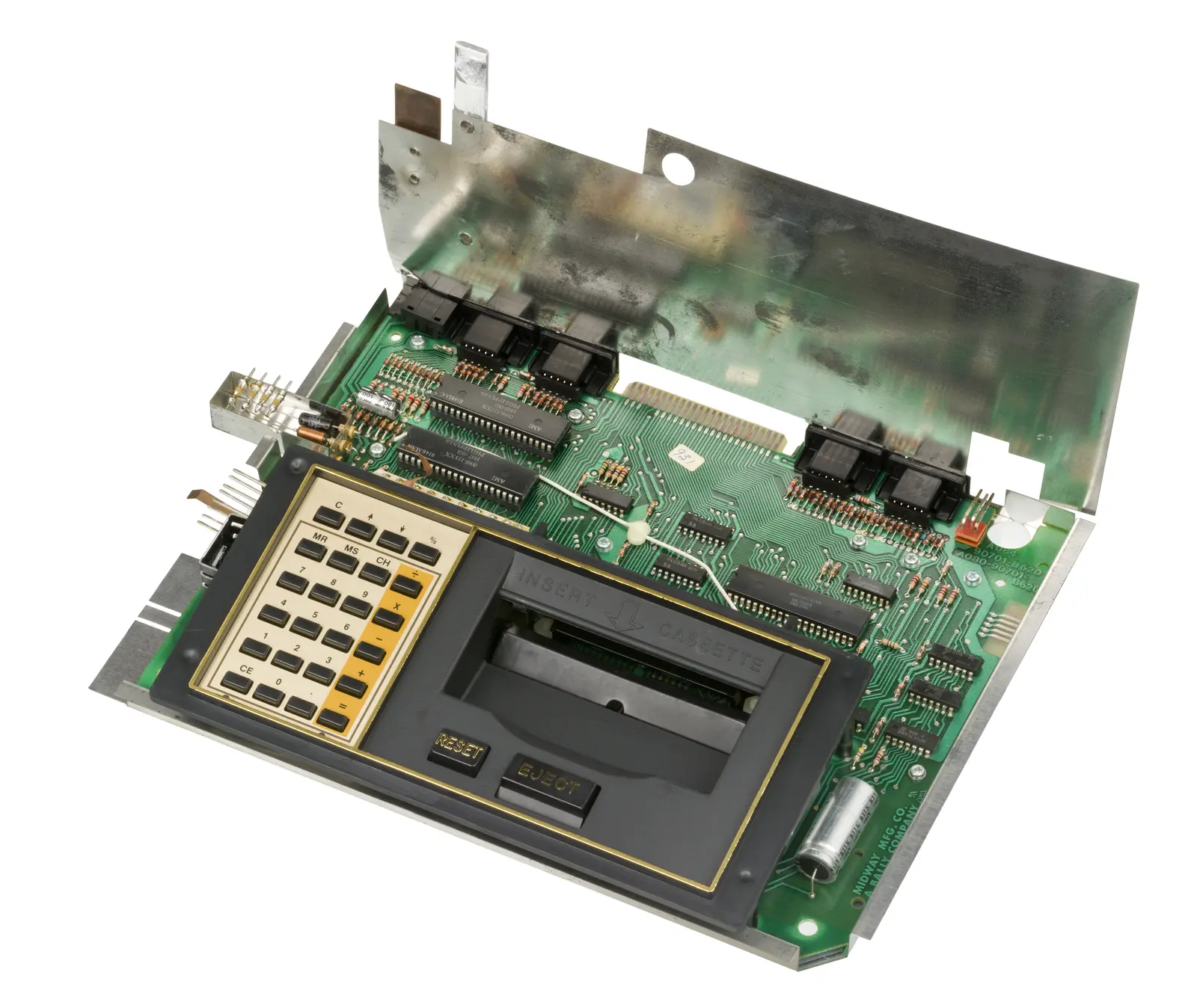
Switching on did not start one game immediately. The built-in menu provided access to Gunfight, Checkmate, drawing program Scribbling and a calculator.
Gunfight
A duel from Midway’s arcade past.
Checkmate
Four players try to enclose one another.
Scribbling
Drawing turned the screen into material.
Calculator
The keypad acquired a serious task.
The 24 front keys were therefore not a decorative computer promise. They selected games and variations, set player numbers and operated the calculator. The machine presented software as a collection of functions — almost like a later home screen.
04 / Three controllers in one hand
The hand controller spoke three different game languages
Bally did not call it a joystick, but a ‘hand control’. Its pistol grip had a forefinger trigger. On top stood a knob that could tilt like a joystick and rotate like a precise paddle.
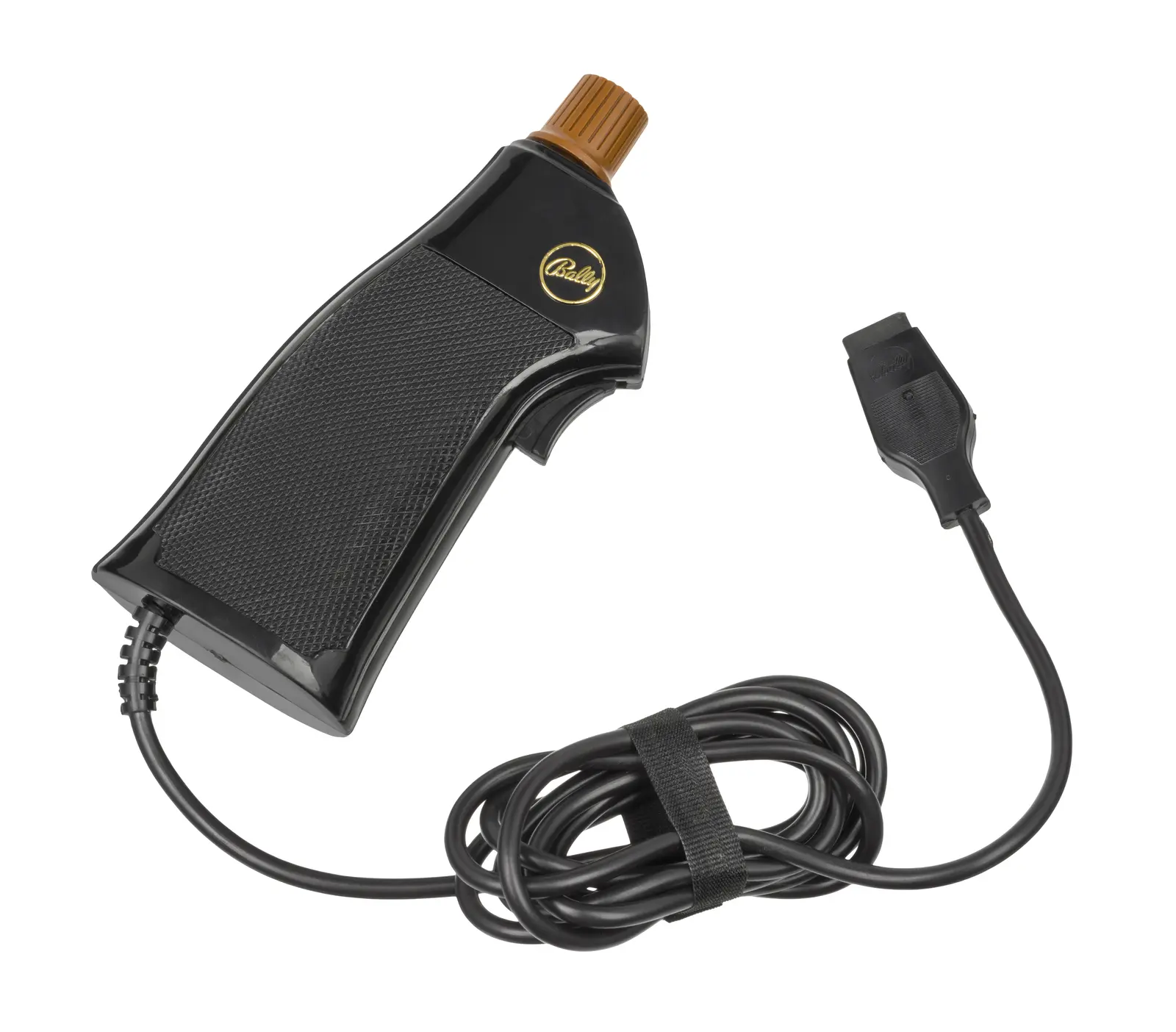
- 018 directions
The top knob tilts like a joystick.
- 02Analogue rotation
The same shaft doubles as a paddle.
- 03Trigger
The forefinger fires without moving the thumb.
Four ports came as standard. Checkmate and other games could gather four people around one television without a multitap. The strange grip was not eccentricity for its own sake; it tried to capture an arcade control panel’s variety inside one object.
05 / The screen eats the computer
One complete picture left sixteen bytes
Astrocade had 4 KB of RAM. A picture of 160 × 102 points at two bits per point demands 4,080 bytes. That is almost the entire working memory — before a game has stored variables, a stack or temporary data.
Games therefore drew fewer picture lines and used routines from the 8 KB system ROM. The limitation did not sit beside the graphical power, but inside it: the more screen you claimed, the less computer remained.
06 / Code between the pixels
Bally BASIC made program text invisible by making colours identical
Jamie Fenton had to fit a language inside a machine whose screen consumed nearly all RAM. The solution was as unlikely as it was elegant: every pixel shared its two bits with the program.
One bit contained program code, the other determined the visible picture. Giving colour pairs the same value meant the code bit changed nothing the viewer could see.
BASIC also used 88 rather than 102 picture lines. That created room for programs entered through a keypad overlay. The language did not live behind the screen, but literally in the same memory as the screen.
07 / Programming without a keyboard
Four coloured shifts turned 24 keys into a compact programming machine
A plastic overlay assigned several letters, symbols and BASIC commands to every key. Long words did not need to be entered letter by letter: one colour key plus one button could produce GOTO directly.
4 SHIFT COLOURS
Not as comfortable as a full keyboard, but compact enough to make the console programmable.
A cassette interface let users save and load programs on ordinary audio tape, initially at 300 baud. Its awkwardness became a social system: code was typed from newsletters, improved, recorded to tape and shared by post.
08 / Users become the publisher
As the shop shelf stayed small, the library grew on paper and cassette
Newsletter The Arcadian published listings, technical discoveries and expansions. The border between player, programmer and producer became porous.
Artillery Duel shows this reverse route beautifully. John Perkins first wrote it for Bally BASIC and sent it into the user world around The Arcadian. The result was liked so much that a commercial machine-language cartridge followed. The company did not feed the community; the community eventually returned a shop product.
09 / A console as unstable image instrument
A malfunction became material for early glitch art
In 1978, Jamie Fenton, Raul Zaritsky and Dick Ainsworth made Digital TV Dinner. They manipulated Astrocade and fed video signals back in unexpected ways, producing abstract imagery synchronised with sound.
The work is now recognised as an early example of intentional glitch art. It fits this machine remarkably well: Astrocade was already built as an unstable boundary between game and computer. Here, even the error became not an endpoint but a new function.
10 / The computer that was meant to sit underneath
ZGRASS promised to complete the half-finished product
A large ‘add-under’ with keyboard, extra memory, storage and a graphical programming language was meant to turn the console into a full computer. The ZGRASS project emerged around computer artists and programmers in Chicago.
NOT MASS-RELEASED
The expansion never reached the ordinary market. Prototypes and derivative systems did appear, while independent makers later built memory modules of their own. The pattern repeated: an official promise stalled, after which users tried to construct the missing future themselves.
11 / Four names, one restless machine
Its life resembles a succession of restarts rather than one product generation
Every name tried to explain the same hardware again.
Home Library Computer
Bally announces a programmable living-room machine, but delivery is delayed.
Professional Arcade
The first retail systems arrive with built-in games, four ports and the motto ‘Fun & Brains’.
Bally BASIC
Jamie Fenton’s interpreter turns the keypad into a minimal programming environment.
Digital TV Dinner
Astrocade becomes a source for experimental electronic images.
A new owner
Astrovision takes over and presents the system again as Bally Computer System.
Astrocade
The best-known name appears, with catalogues full of existing and announced Videocades.
The market collapses
Astrovision encounters financial trouble as the American console market crashes.
The shops disappear
The commercial life ends; newsletters, tapes and expansions keep the user machine alive.
12 / Sources & further reading
Explore further
- Computer History Museum — Bally Astrocade Professional Arcade
- Bally — Professional Arcade: Fun and Brains (1978)
- Bally — Bally BASIC Manual (1981)
- 8bitworkshop — architecture, built-in software and BASIC’s memory trick
- Bally Alley — advertisements and cartridge catalogues from 1978–1982
- Atari Archive — console BASIC and the Astrocade user community
- Jamie Fenton — personal account of Bally Arcade and Digital TV Dinner
Image credits
Bally Professional Arcade with controller — Evan-Amos, CC BY-SA 3.0; resized and converted to WebP
Bally Computer System — Artistosteles, CC BY-SA 4.0; resized and converted to WebP
Bally Professional Arcade, front angle — Evan-Amos, public domain; resized and converted to WebP
Bally hand controller — Evan-Amos, public domain; resized and converted to WebP
Open Bally Professional Arcade — Evan-Amos, public domain; resized and converted to WebP


