Failed promises / Part 15
The multimedia living-room computer
One elegant box beneath the television would unite music, film, games, learning and information. CDTV, CD-i and 3DO could do a great deal, yet were exactly right for almost nobody.
01 / The promise
At last, the computer would belong to the whole family
The home computer of the 1980s usually stood on a desk, in a bedroom or in a separate computer corner. It had a keyboard, a tangle of cables and software loaded from cassette or floppy disk. Using it required some knowledge of commands, filenames and memory.
The living room followed different rules. Its machines did what their names promised after a single press of a button. The television showed programmes, the CD player played music and the VCR recorded broadcasts. They were controlled by remote and intended for the whole family.
The multimedia living-room computer would unite those worlds. It offered the processing power and interactivity of a computer, but the appearance and ease of consumer electronics: not a beige office box and monitor, but a low black player that fitted between the amplifier and VCR.
The word multimedia sounded like a new category. Text, still images, animation, music, speech and video would no longer live on separate carriers. A CD could combine them all, while the user decided what happened.
The television screen would acquire a new role. Viewers no longer had to passively accept a broadcaster’s schedule. They could select a subject, replay a scene, choose a route through a museum or determine how a story continued.
The device would move the computer out of its technical corner and into daily life. The future was not behind a desk but on the sofa, remote control in hand.
02 / The disc that held everything
The compact disc seemed the perfect memory for the living room
From 1982, the audio CD made digital technology tangible. The shining disc was small, quiet and simple. Nothing needed rewinding and any track could be selected instantly. It looked modern and dependable too.
If the same carrier could contain music, why not photographs, text, maps, games and films? A CD-ROM held hundreds of megabytes, vastly more than a computer floppy. For publishers that seemed sufficient for complete encyclopaedias, language courses, museum collections and interactive children’s books.
LaserDisc had already demonstrated that images and sound could be combined with interactive control. Museums, shops and training centres used image discs from which a computer could retrieve a particular scene. But the large discs and costly players never became everyday living-room products.
The compact disc promised to make the same idea smaller and cheaper. Manufacturers devised CD-ROM for computer data, CD-i for interactive programs, Photo CD for pictures and Video CD for moving images. Every coloured specification in the CD family appeared to open another use.
The idea was seductive. Once a family owned a suitable player, it would only need to buy new discs. Hardware could remain beneath the television for years while publishers supplied an endless stream of content.
Yet storage capacity is not an experience. The CD held a great deal, but fed it slowly into machines with little memory. Good digital video required compression and additional processing. A large collection became useful only when somebody added a clear route, an interface and a reason to return.
The disc had room for almost everything. It did not decide what people wanted to do with it.
03 / The computer learns to speak, sing and film
Multimedia began on the desk
By the late 1980s, ordinary personal computers were gaining colour displays, sound cards and CD-ROM drives. The term multimedia PC told buyers that a computer could do more than word processing and calculation.
Demonstrations were impressive. A click started music, revealed a photograph or made a historical figure speak. Where a floppy mainly carried programs and simple graphics, a CD-ROM seemed to open a complete audiovisual world.
Reality was less fluid. Sound cards required different settings, CD-ROM drives needed drivers and video often appeared in a small, stuttering window. Installing a new title might mean freeing memory or editing configuration files.
Even so, a thriving market developed. Microsoft Encarta made the encyclopaedia colourful and searchable. Games such as Myst used photographic scenes, music and short films to create an atmosphere that was barely possible on floppy disks. Educational software brought voices and animation into children’s rooms.
The multimedia PC proved that people wanted digital combinations of images, sound and interaction. But it remained a PC: relatively expensive, rapidly ageing and usually intended for one person sitting close to the screen.
Manufacturers therefore saw room for something simpler. Hide the complicated parts in a sealed box and multimedia could move to the television. Users would not need to own or understand a computer.
The PC supplied the material and technology. The living-room machine was supposed to turn it into a mass medium.
04 / Commodore disguises the Amiga
The CDTV looked like a CD player but contained a computer
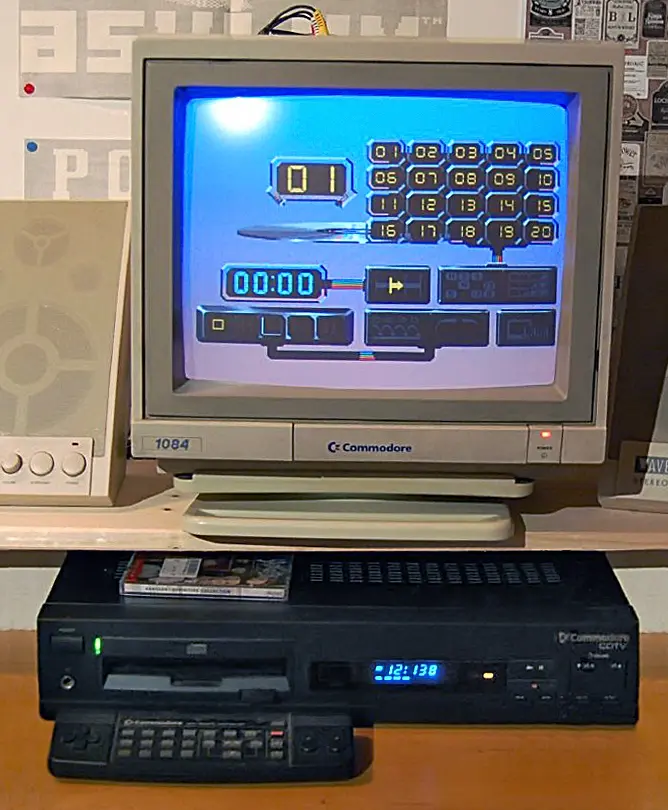
In 1991 Commodore introduced CDTV, the Commodore Dynamic Total Vision. It was essentially an Amiga 500 with a CD-ROM drive in a black case designed to sit among audio and video equipment.
That ancestry was deliberately played down. The front did not prominently identify it as an Amiga. Users operated the system from an armchair with a remote. A keyboard, mouse and floppy drive were available as extensions, but they turned the elegant player back into an obvious computer.
Its catalogue offered music, games, reference works, travel guides and educational titles. A disc could combine spoken explanations with maps and images. The family would supposedly no longer need a different device or book collection for every purpose.
Technically, Commodore had a head start. The Amiga handled sound and images well, and developers already understood it. But CDTV largely used hardware dating from 1985 in a rapidly advancing market. Moving video remained limited and many titles felt like adapted computer programs.
Its position was equally unclear. CDTV was expensive for a CD player. As a console, it lacked the recognisable games catalogue and straightforward controllers of Nintendo and Sega. As a computer, it was less complete than an ordinary Amiga unless the buyer connected those optional accessories.
The black enclosure solved the computer’s appearance. It did not explain why a family needed this particular machine.
05 / Philips makes the compact disc interactive
CD-i was intended as a new medium, not a games console
Philips and Sony established the technical basis for Compact Disc Interactive in the Green Book standard. The first consumer CD-i players appeared in late 1991 and, like CDTV, resembled CD or video players rather than PCs.
Philips presented CD-i as a broad interactive medium. Users could browse an art collection, practise a language, listen to music, follow a children’s story, play a game or look up information. A digital video card and Video CD later made full-length films possible.
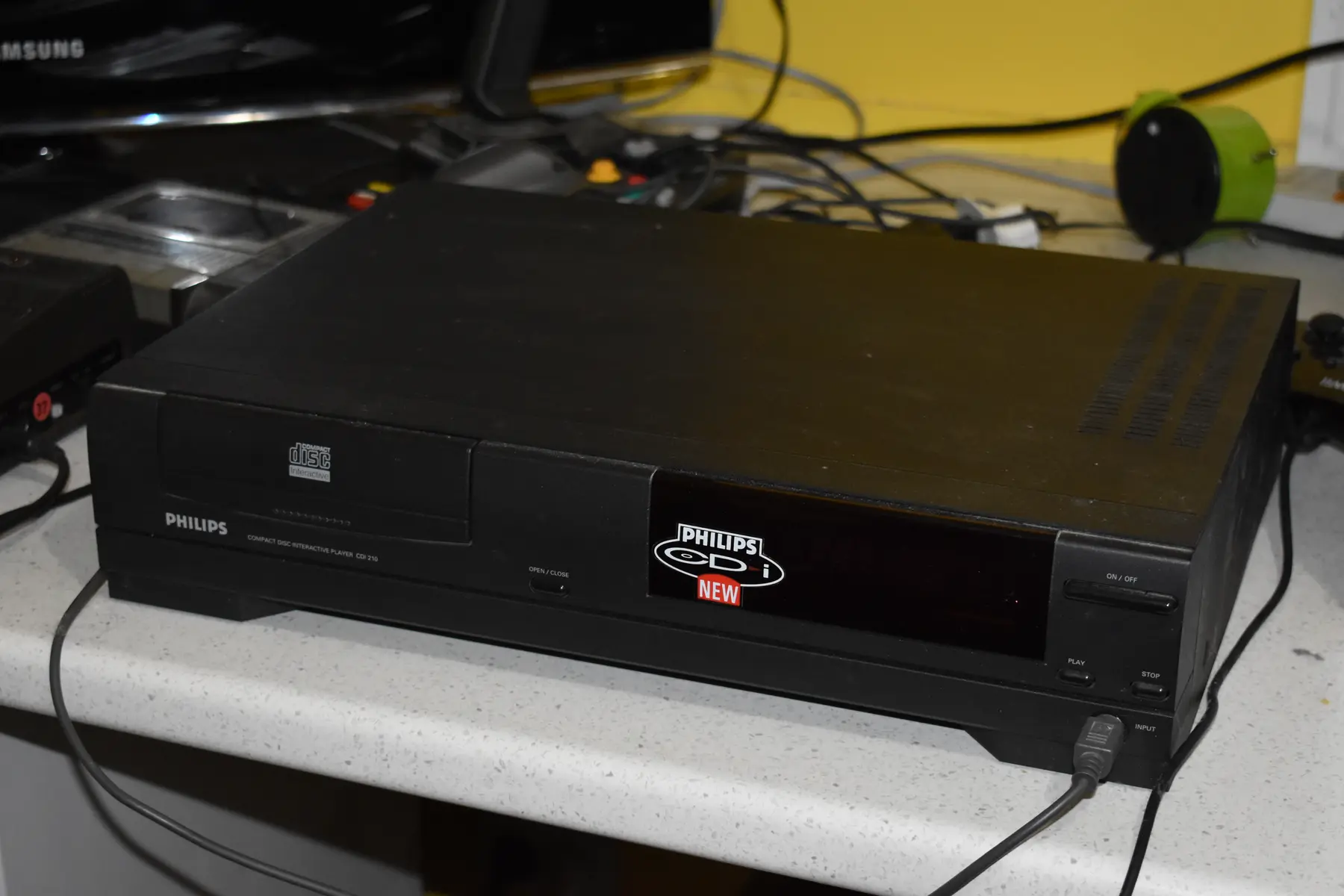
The concept suited Philips. The company understood televisions, audio players and standards. It did not want to sell a computer that owners continually modified, but a stable platform on which every disc simply worked.
The first encounter could be persuasive. Image, speech, music and choice met on the television. Before widespread broadband, an interactive museum tour or encyclopaedia felt like entry to an immense digital library.
But CD-i always required explanation. Was it a luxury CD player, video player, learning computer or games console? Its remote suited menus but not fast games. The players were costly and good video initially needed extra hardware.
As games became more important, CD-i acquired the reputation Philips had tried to avoid. Weak Nintendo-licensed titles featuring characters such as Mario and Zelda became better remembered than its serious cultural and educational discs. A system that could be anything was remembered for what it did not do well enough.
CD-i truly was multimedia. The problem was that multimedia was not a clear reason to buy a device.
06 / 3DO sells a standard for entertainment
Hollywood, computers and games were going to become one industry
In the early 1990s, the technology business loved the word convergence. Computer makers, film studios, music companies, publishers and telephone networks would supposedly create a new interactive market together.
Electronic Arts founder Trip Hawkins made that idea central to 3DO. The 3DO Company did not manufacture a single closed console. It designed a standard that electronics companies could license for their own machines. Panasonic released the first model in 1993.
The name Interactive Multiplayer again avoided calling the system a mere toy. It processed games, music, photographs and video, while major media and electronics companies joined the venture. In the boldest predictions, 3DO would become the common platform for interactive entertainment.
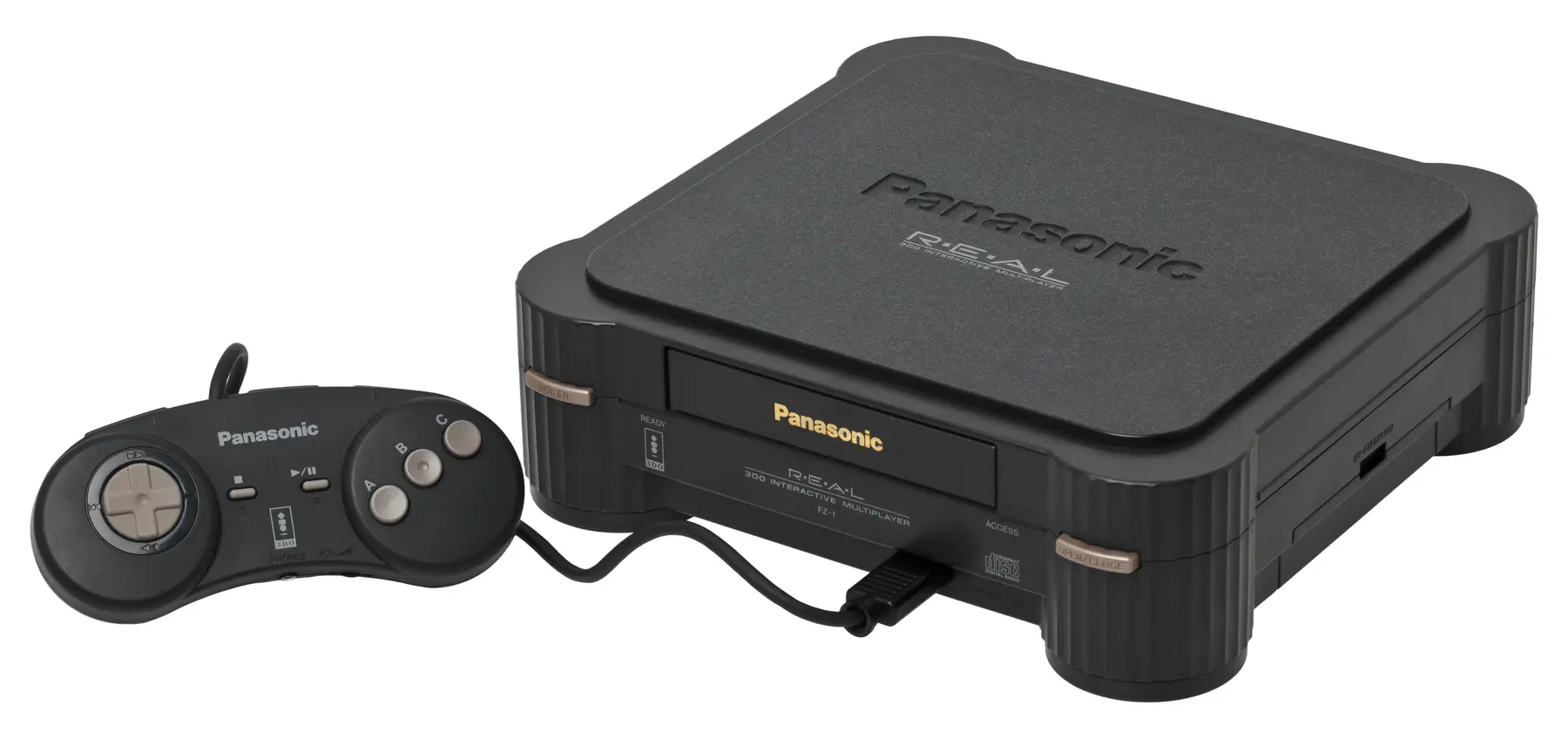
The first American player cost roughly seven hundred dollars, far more than established consoles. Manufacturers also needed to profit on the hardware, whereas Nintendo and Sega could sell machines more cheaply and earn money through software licences.
3DO offered impressive games and better video than many rivals, but the same question returned: what kind of product was it? Its broad multimedia promise did not justify the price for people who mainly wanted games. Film viewers already had a VCR and would soon have DVD.
The industry wanted one platform for every form of content. Consumers preferred an affordable machine that performed one favourite activity particularly well.
07 / The difficult word ‘interactive’
Users could choose, but often only from menus
On packaging and in demonstrations, interactive was a powerful word. Instead of undergoing a story, users would participate in it. Every choice made the experience personal.
Many applications really offered a branching menu. Select a painting for an explanation, choose a country for a map, answer a question and continue. That was more useful than a linear videotape, but less revolutionary than the advertising implied.
Full-motion video gave producers a cinematic tool but consumed storage and offered little freedom. Actors could respond only to situations recorded in advance. So-called interactive movies often consisted of short clips separated by a simple, precisely timed choice.
Conventional games were far more interactive. A good platform or strategy game responded continually to skill and decisions. Yet multimedia producers tried to distance themselves from ‘games’ because they hoped to reach an adult family market.
Encyclopaedias and museum discs also suffered from a return problem. The first exploration impressed, but the disc often stayed in the cupboard afterwards. A paper reference work could serve for years and a game offered mastery and challenge. Many multimedia CDs mainly supplied a tour that became familiar after an evening or two.
Interactivity was not created automatically by adding buttons. It needed to be designed as meaningful exchange. The living-room computer contained many media, but not always enough to do.
08 / The sofa was not a desk
A television demanded a different interface from a monitor
A computer user sat close to a sharp display with a keyboard and mouse. In the living room, the family watched a comparatively low-resolution television from several metres away.
Small type that looked clear on a monitor became fuzzy on TV. A mouse was awkward on the lap and a remote with a few direction keys made long lists and complex menus slow. Entering text without a keyboard was almost impossible.
The living room was shared space too. Consulting an encyclopaedia or practising a language is generally individual; watching television or listening to music can be communal. When one person spent a long time navigating menus, everyone else had to wait.
The machines also carried the limitations of their period. Discs loaded, video was coarse and memory was scarce. Experienced PC owners quickly noticed what was missing, while non-technical viewers did not always see why their familiar appliances needed replacing.
Manufacturers correctly understood that a living-room interface must be simple. But simplicity meant more than removing a keyboard. It required large type, quick responses, few steps and material that remained attractive from the sofa.
Streaming services and consoles would refine those interfaces much later. Early multimedia players had to invent the medium, its controls and the audience’s habits simultaneously.
09 / Too expensive, too early and too many formats
No player acquired a library by itself
A new media platform depends on a loop. People buy the player when it has appealing titles; publishers produce titles when enough players have been sold. CDTV, CD-i and 3DO had to build both sides at once.
That was expensive. A strong multimedia production required writers, programmers, designers, musicians, voice actors and sometimes a film crew. The market remained small, so development costs had to be recovered from few buyers.
Formats were not interchangeable. A CDTV disc did not simply run on CD-i or PC. A family investing hundreds of pounds or dollars could not know whether new releases would still appear a few years later.
The devices aged while still trying to break through. Better computers gained faster CD-ROM drives and stronger video cards. New consoles delivered fluid 3D images. Separate CD players and then DVD players became cheaper and better at their own jobs.
The universal living-room machine became yet another box beside all the others. The VCR was still needed, the PC remained better for work and the internet, and players chose a platform with a larger games catalogue.
The promise was integration. Reality brought rival standards, optional extensions and products that partly overlapped.
10 / The internet makes the disc old
A sealed world could not compete with material that kept changing
The multimedia CD was designed as a complete world. All text, images and audio were fixed on the disc at purchase. That made an experience dependable, but also unchanging.
From the mid-1990s, the web offered something different. Information could be updated, links led to unexpected sources and users could publish for themselves. An online encyclopaedia did not need to wait for a new edition on CD-ROM.
WebTV tried in 1996 to combine the simplicity of a living-room appliance with the internet. A set-top box made by companies including Sony and Philips connected to a television and phone line. With a remote and optional wireless keyboard, people could open websites and email without a PC.
Again, two environments collided. Web pages were made for monitors, not televisions with few display lines. Typing from a sofa remained awkward and a telephone modem made rich media slow. Yet WebTV pointed towards the future more accurately than a cupboard of discs: value lay not only in the player but in the connection.
The first multimedia machines sold content as individual products. The internet turned multimedia into a continuing service. News, games, video and music no longer had to fit together on one physical disc.
The living-room computer did not merely lose to better hardware. It lost to a network that was never finished.
11 / The games console wins by remaining itself
PlayStation offered multimedia without making it the main reason to buy
Sony released PlayStation in late 1994 as an unambiguous games console. It used CD-ROMs, produced high-quality sound and also played audio CDs. But its advertising did not centre on a vague multimedia future: people understood why they were buying the machine.
The disc gave developers abundant space and was quick and inexpensive to manufacture. Sony paired those advantages with capable 3D hardware, a recognisable controller and a growing catalogue. The platform sold millions because it did games well, not because it also wanted to be an encyclopaedia.
PlayStation 2 made the pattern clearer. It was first and foremost a desirable console, but it could also play DVD movies. For many households, that extra function was a persuasive reason to choose one machine. Multimedia worked as a bonus attached to a clear product.
The DVD player succeeded through limitation as well. It offered full films with better pictures and simpler operation than early interactive video discs. Extra scenes and menus were welcome, but viewers did not have to direct the medium continually.
Apple TV followed similar logic in 2007, bringing iTunes films, programmes, music, photographs and podcasts to a widescreen television. It did not try to replace an entire PC, but formed a simple bridge between digital material, the internet and TV.
Successful successors delivered much of what the multimedia living-room computer had promised. They simply stopped presenting it as one new medium destined to swallow all others.
12 / What remained
The all-rounder arrived, but was divided among devices and services
A modern television streams films, plays music, shows photographs, runs apps and can make video calls. A console contains a digital store and video services. A media player retrieves content from the cloud. The smartphone controls all of them and is itself the most powerful personal multimedia computer in the home.
Technological convergence has therefore largely happened. Image, sound, text and interaction are digital and move easily between screens. What did not appear was the separate product category predicted in the early 1990s under the name multimedia player.
Instead, people divided the functions again. The television became smart, the console remained primarily for games, the laptop for work and the phone for personal communication. Streaming services replaced the disc with continually changing catalogues.
That brought another kind of fragmentation. Subscriptions rather than hardware standards now determine which film, song or match is available. One universal box became unnecessary, but we did not receive one simple gateway either.
- PROMISEOne digital centre for the whole family
A simple player beneath the television combines music, films, games, learning, information and communication.
- BREAKTHROUGHImage, sound and interaction on the same carrier
CD-ROM, CDTV, CD-i and 3DO showed that separate media could form one digital experience.
- BRAKEAn all-rounder without a clear main purpose
High prices, weak controls, competing formats and an uncertain software supply made the machines difficult to explain and risky to buy.
- LEGACYMultimedia became a feature, not a device
Consoles, smart televisions, streaming boxes and phones inherited the possibilities without calling themselves multimedia living-room computers.
The multimedia living-room computer did not fail because nobody wanted images, sound and interaction together. It failed because the industry tried to sell that combination as a product in itself. Once multimedia became ubiquitous, the special machine invented for it disappeared.
13 / Sources & images
Read and explore further
- Commodore — CDTV Catalog of Titles (1991)
- C2DH — The Rise and Fall of CD-i
- Wired — 3DO: Hip or Hype?
- Wired — WebTV Opens the Web
- Sony — history of PlayStation
- Apple — Apple TV Coming to Your Living Room
Image credits
Commodore CDTV setup — Andrea & Stefan / Ubcule, CC BY 2.0
Philips CD-i 210 — Matthew Paul Argall, CC BY 2.0
Panasonic 3DO FZ-1 — Evan-Amos, CC BY-SA 3.0
All images resized and converted to WebP.


