Failed promises / Part 14
Education by computer
A tireless private tutor for every child: personal, patient and available everywhere. Teaching machines, terminals, laptops and AI kept coming closer, but the human teacher never disappeared.
01 / The promise
A tireless private tutor for every pupil
A teacher addresses a group, but pupils do not learn as a group. One understands immediately; another needs a different example. Some are afraid to ask, while others grow bored because the class moves more slowly. Miss a few lessons and a small gap can become a lasting disadvantage.
The computer seemed to offer an elegant answer. Software could divide a subject into small steps, check every response and decide what exercise should come next. A mistake produced extra explanation; a correct answer opened harder work. Nobody had to wait or feel embarrassed.
In the ideal future, the machine knew every learner. It remembered which fractions caused trouble, which words were often misspelled and when attention faded. Practice lasted exactly long enough, while assessment became part of a continuous learning process.
The best lesson by the best teacher could also be used anywhere. A child in a remote village would gain the same knowledge as a pupil at a celebrated school. Shortages of teachers, books and classrooms would matter less if one network could reach millions.
In the friendlier version of the vision, teachers did not vanish. Computers took over explanation, repetition, paperwork and marking, freeing people for guidance, discussion and inspiration. But many forecasts slowly moved the machine to the centre and the human being to the edge. Education became a stream of information to be delivered efficiently. Its hardest part — making someone want to understand — remained out of view.
02 / The machine that administered a test
Sidney Pressey built a mechanical teacher in 1924
Long before schools owned computers, American psychologist Sidney Pressey tried to automate part of education. His device resembled a typewriter with a window and several keys. A multiple-choice question appeared in the window and the pupil pressed the key for the presumed answer.
The machine could count correct answers as a testing device. Pressey also added a teaching mode: the mechanism advanced only after the right key had been pressed. A wrong answer brought no progress, forcing the learner to think again.
Pressey imagined more than convenient marking. Machines would free teachers from repetitive work and give pupils instant feedback, leaving human judgement for tasks that needed it. The idea arrived too early. The devices had to be built, maintained and filled with suitable questions; schools had little money for machines of unproven educational value, especially during the Great Depression.
Yet Pressey's box already contained almost every element of later educational software: a question, an input, immediate checking, a score and a route determined by the answer. The teaching machine did not begin with the computer. Computers merely made a much older educational model easier to reproduce.
03 / Skinner programs the learner
Small steps and instant rewards were meant to make learning predictable
In the 1950s, American behavioural psychologist B. F. Skinner brought the teaching machine renewed attention. Pupils should not wait to learn whether an answer was correct: behaviour reinforced immediately would be more likely to recur.
Skinner's machines presented material in carefully ordered steps. Learners composed a short answer and then compared it with the solution. Each correct step supplied a small reward and prepared the next.
This was programmed instruction: not the pupil but the sequence of questions and feedback was programmed. Supporters saw a dependable educational product whose quality no longer depended entirely on whichever teacher happened to be in the room. One carefully designed sequence could be used in thousands of machines, workbooks and, later, computer programs.
Immediate feedback and gradual practice can work well for facts and procedures. But the model reduced learning to visible, measurable behaviour. A machine could tell whether a word or number matched the expected response. It did not necessarily know why the learner chose it, what misconception lay behind it or whether that knowledge could be used outside the exercise.
The teaching machine made education orderly. It also risked confusing education with a long row of correctly filled boxes.
04 / PLATO builds a digital school
In 1960 the computer became more than an automatic filing cabinet
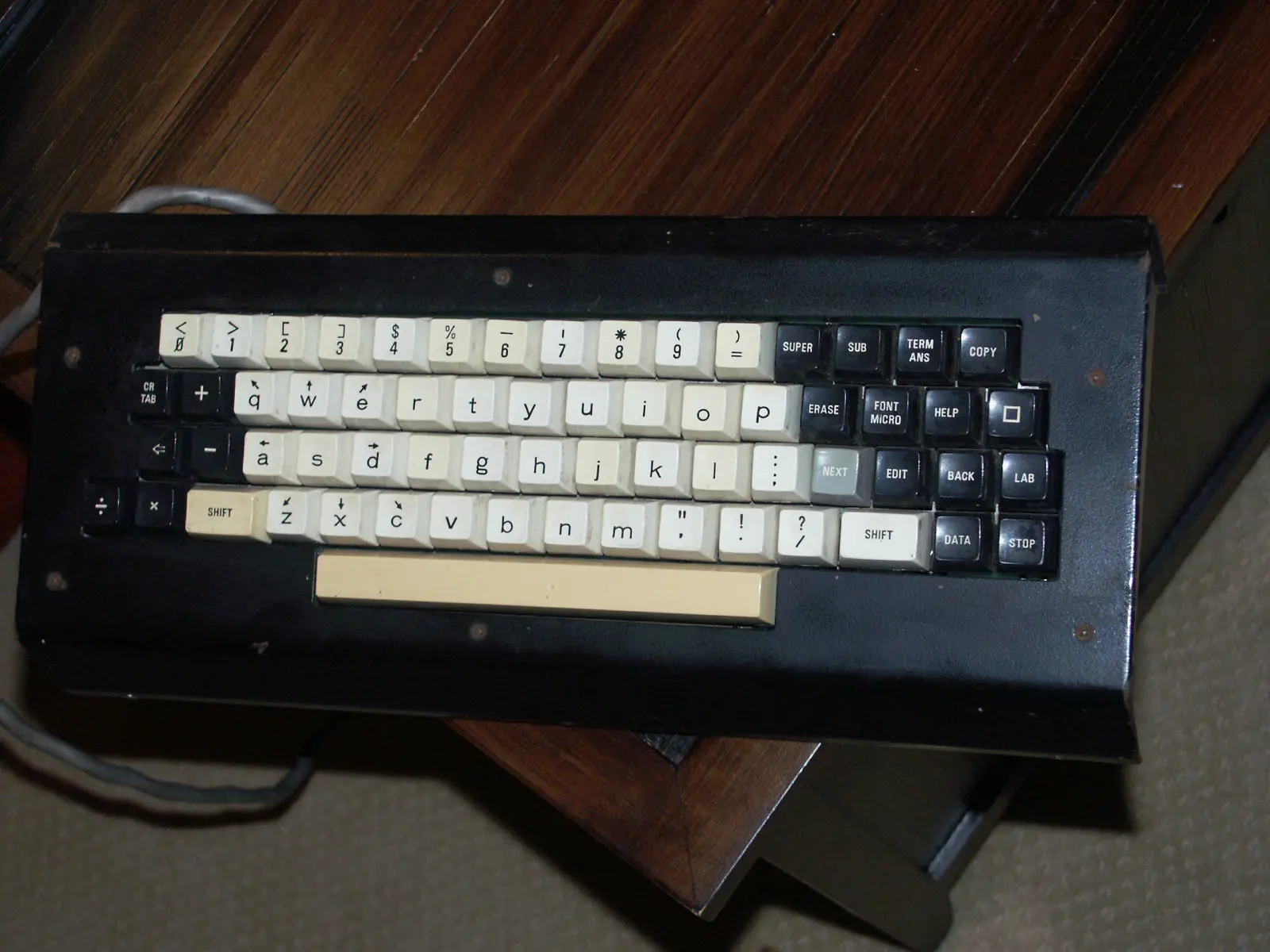
At the University of Illinois, a team led by Donald Bitzer developed the first version of PLATO in 1960. A pupil worked at a terminal connected to a central computer; later, many users could follow different lessons simultaneously.
PLATO offered far more than multiple choice. Its remarkable plasma screens displayed text and graphics, and special terminals gained touch capability. Teachers built lessons in mathematics, languages, chemistry, music and other subjects. The system analysed answers, offered hints and stored progress.
Because the hardware was expensive, users shared a central computer. That constraint unexpectedly created a social space: people sent messages, discussed topics in forums, shared notes and played multiplayer games. PLATO was not merely a remote school but an early online community. A computer could serve a learner individually and connect learners and teachers to each other.
PLATO also showed why such systems were hard to scale. Terminals, connections and computing time cost money. Good lessons demanded subject knowledge, programming and extensive testing, while an ordinary textbook could be printed cheaply and adapted by any teacher.
Technically, PLATO was decades ahead. Economically, it remained a world for institutions able to afford its infrastructure. The digital school existed, but not yet as a mass product.
05 / The microcomputer enters the classroom
One machine on a trolley was expected to change a school
From the late 1970s, an educational computer no longer needed a university mainframe. The Apple II, Commodore PET, BBC Micro and other microcomputers fitted on a desk and could be bought by individual schools.
In Britain, the BBC linked its Computer Literacy Project from 1982 to television programmes, books, courses and the BBC Micro. Its aim was broader than instruction by machine: children and adults should understand computers and learn to program them.
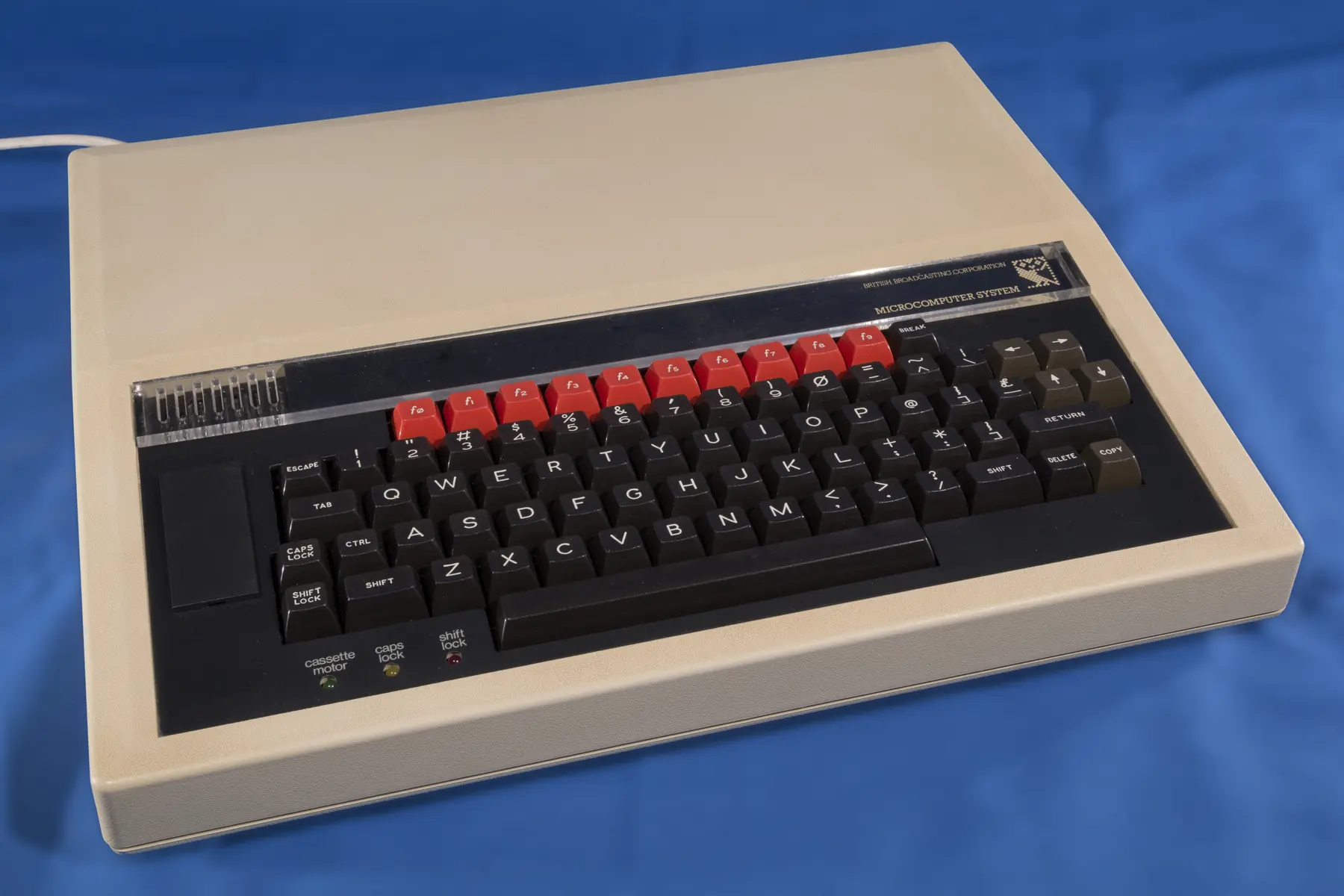
Dutch schools also acquired computers during the 1980s. At first there was often one in a separate room, or a machine travelled from class to class on a trolley. An enthusiastic teacher or technician determined whether it was really used.
Expectations exceeded the number of devices. Computers would practise arithmetic and language, compile timetables, record marks, run simulations and prepare pupils for a digital labour market. Every school wanted to appear modern, even when nobody quite knew what children should do with the machine.
Reality began with cables, boot disks and schedules. Thirty pupils could not sit behind one computer. Programs ran only on particular systems and disappeared when a school changed brands. Breakdowns and missing manuals turned the enthusiastic teacher into a technician as well.
The microcomputer made educational software accessible. It did not automatically explain what good computer education was.
06 / The workbook acquires sound
Much educational software mainly automated practice
The simplest programs closely followed Pressey and Skinner. A sum appeared, the pupil typed an answer, and a beep, star or smiling face reported the result. After ten questions came a score.
For spelling, multiplication tables and vocabulary, this could be useful. Computers had endless patience, varied the order and responded immediately. Practice felt more attractive when a right answer produced points, sound or a short animation.
But many programs were little more than digital worksheets. The form changed without improving the lesson; a badly chosen question did not become better because a rocket crossed the screen.
During the 1990s, edutainment became a market. CD-ROMs combined voices, music, photographs, animation and video. Children explored an atlas or virtual museum and learned with colourful characters. Packaging promised to make learning fun automatically, but the game layer could be detached from the subject. A child mastered the quickest route to a reward, not necessarily the logic of a fraction or the importance of an event.
Producers also needed expertise in content, teaching, programming, visual design and games at once. Good educational software was expensive to make, while schools and parents expected it to be cheap. The computer could make a workbook speak. It could not guarantee that the workbook became a better teacher.
07 / The pupil programs the computer
Logo reversed the relationship
Not everyone wanted computers to deliver ready-made lessons. Seymour Papert, who had worked with Jean Piaget, saw them as material with which children could think and build. With Wally Feurzeig, Cynthia Solomon and others, he developed the Logo language in 1967.
Its most famous feature was the turtle. Commands such as forward, right and repeat made a physical robot or screen symbol draw lines. Geometry became movement: to draw a square, the child had to imagine how the turtle turned.
An error was not merely a red cross. The unexpected drawing revealed what the program had actually done. The pupil edited the commands, tried again and gradually built an understanding.
This constructionism differed fundamentally from programmed instruction. The machine did not keep posing questions with one correct answer; the child instructed the machine and made something that could be discussed, changed and shared.
Games could also support discovery. The Oregon Trail, first made for a history lesson in 1971 and later distributed by MECC, asked pupils to decide about food, routes, risks and speed during a nineteenth-century journey west.
Logo and The Oregon Trail became influential, but required guidance. An open environment permits curiosity, yet not every child discovers the same ideas unaided. The teacher did not disappear; the role shifted from lecturer to designer, questioner and guide. Sometimes the most successful educational computer was precisely the one that did not pretend to be the teacher.
08 / Multimedia and the internet open the world
The disc and the web brought a library into the classroom
A CD-ROM could hold hundreds of megabytes of text, images and sound. Encyclopaedias, language courses, atlases and simulations replaced cupboards of books, maps, slides and videotapes.
The internet made the supply almost limitless. Pupils could consult current data, visit museums, compare sources and work with a class abroad. The school computer became less a teaching machine than a window onto knowledge.
That introduced a different problem. Access to information is not the same as knowing which information is reliable and relevant. A search engine returns thousands of results but does not judge the best explanation for the learner.
Teachers acquired new duties: teaching search strategies, evaluating sources, discussing plagiarism and designing assignments that copy and paste could not complete.
Inequality changed shape too. First the question was which school owned a computer; later it was who had a fast device, quiet workspace and parental help at home. The digital divide ran not only between connection and no connection, but between different ways technology could be used.
Computers democratised access to knowledge. They did not automatically democratise the time, guidance and prior knowledge needed to learn from it.
09 / The intelligent tutor
The machine tries to understand why an answer is wrong
From the 1970s, researchers worked on intelligent tutoring systems. These programs would not merely check answers but maintain a model of a learner's knowledge and reasoning.
An algebra tutor might recognise a repeatedly misapplied operation. Instead of simply reporting “wrong”, it could offer a targeted hint or select a problem exposing that misconception. Carnegie Mellon researchers later developed Cognitive Tutors for subjects including mathematics and programming. Software followed intermediate steps and offered help when the pupil became stuck.
This came close to the original dream of personalised education, but exposed how much work the dream required. Experts had to describe the steps, strategies and common errors for every domain. What could be formally modelled in algebra became harder in a historical essay, literary conversation or creative task.
A tutor also saw only what happened inside its program. Fatigue, insecurity, trouble at home, group dynamics or a brilliant explanation by a classmate did not fit easily into the learner model.
An intelligent tutor could be highly precise within one bounded field. A human teacher worked simultaneously with knowledge, motivation, trust, order and relationships. The difference was not merely intelligence, but the size of the reality to which that intelligence had to respond.
10 / One laptop per child
A cheap device was meant to transform education worldwide
In 2005, Nicholas Negroponte of the MIT Media Lab presented One Laptop per Child. The distinctive green XO laptop was to be robust, energy-efficient and eventually cost about one hundred dollars. Governments would distribute the devices to schoolchildren at scale.
The project extended Papert's belief that children learn by exploring and making. The laptop was not a digital textbook prescribing every step. With its Sugar environment, programming tools and wireless links, pupils would build knowledge independently and together.
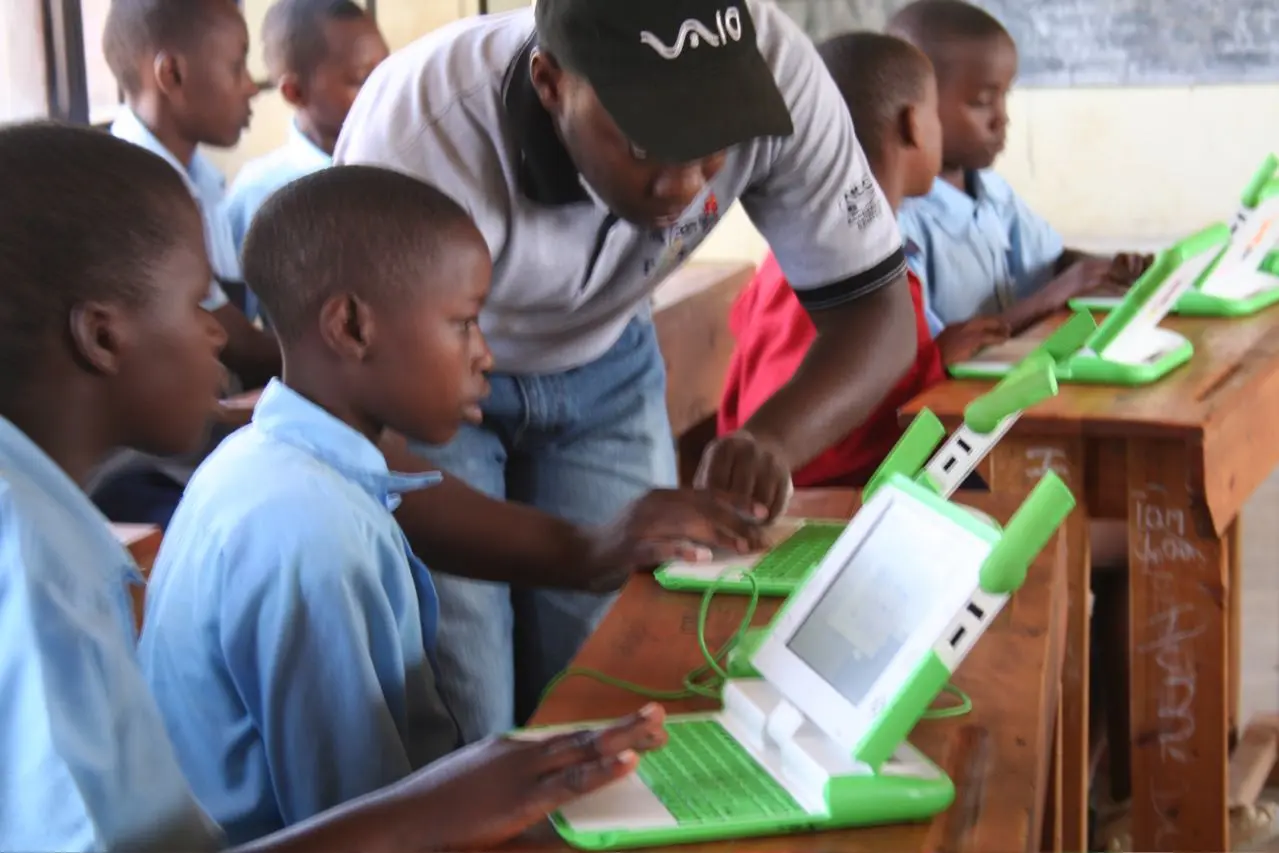
The image was powerful: a child in a remote area received a library, typewriter, laboratory, communication device and programming environment of their own. Countries could leap forward without first building expensive facilities everywhere.
More than three million educational laptops eventually reached children. The hundred-dollar price was not achieved, and distributing hardware proved only the beginning. Devices needed charging, repair, security and integration into lessons; teachers required training and suitable material.
A large evaluation in rural Peru found more computer use and some improvement in general cognitive skills, but initially no clear gains in language and mathematics. Long-term research produced a nuanced picture, not a simple educational revolution.
The XO was an impressive design that gave millions access to technology. The mistake was expecting access to turn almost automatically into learning. A laptop can contain an entire library. It cannot build a school system by itself.
11 / Why the promise failed
Education is not a program that only needs to run faster
Computers did not replace teachers. The same reasons returned in new forms.
Learning is more than producing answers. A correct answer can demonstrate understanding, but also a guess, shortcut or memorised step.
Motivation is not a menu setting. Pupils do not all begin voluntarily, persist automatically or dare to try again without reassurance.
Good software is difficult and expensive. Every lesson needs subject knowledge, pedagogy, design, technology, accessibility and long-term maintenance.
Hardware without an educational plan changes little. A computer, tablet or network helps only when teachers know why and when to use it.
The machine sees only part of the pupil. A teacher notices confusion, boredom, anxiety and social relationships that do not appear in an answer box.
Open education does not automatically increase equality. Those with prior knowledge, time, a quiet place and support often benefit most from independent digital learning.
Technology ages faster than schools. Devices, connections, operating systems and licences change while curricula take years to introduce and evaluate.
More use is not better use. In 2015 the OECD found no clear improvement in reading, mathematics or science in countries that had invested heavily in school ICT. How technology was used and the quality of teaching mattered more than the number of screens.
The promise treated education as a distribution problem: deliver the best explanation to every child and learning would follow. In reality, learning grows from explanation, practice, curiosity, feedback, relationships and meaning together.
12 / What remained
The computer did not become the teacher, but it did become a new layer of education
Around 2012, massive open online courses again promised top-university teaching for everyone with internet access. Courses attracted tens of thousands, but only a small share completed every assignment. The door was open; persisting alone remained difficult.
During the pandemic, digital education proved indispensable and inadequate at once. Video calls and learning environments kept lessons going, while screen fatigue, home circumstances and the loss of contact became immediately visible.
Generative artificial intelligence now returns the old dream as a conversation partner. An AI tutor can explain an idea in several ways, supply endless examples, comment on writing and apparently adapt to a learner's level.
The risks are equally familiar. A system can confidently provide false information, reproduce bias, collect sensitive data or perform the thinking pupils were supposed to practise. UNESCO therefore argues that educational technology should be introduced on evidence, equity and human responsibility.
- PROMISEPersonalised education for every child
A tireless machine continually adapts pace, explanation and practice to the individual learner.
- BREAKTHROUGHInstant feedback and worldwide access
Teaching machines, PLATO, microcomputers, the internet and AI made practice, simulation and remote learning possible.
- BRAKELearning is human and social
Motivation, context, trust, creativity and equal opportunity cannot be completely captured as steps in software.
- LEGACYThe teacher with a digital toolkit
Learning platforms, simulations, intelligent tutors and AI support education, but work best when a person determines the purpose, context and guidance.
The computer did not replace the teacher. It changed almost every lesson — and repeatedly showed that education is not only about what is offered, but what happens between people when someone is trying to learn.
13 / Sources & images
Read and explore further
- Smithsonian — Teaching Machines and Mechanical Learning
- University of Illinois — history of PLATO
- Logo Foundation — history of Logo
- BBC — Computer Literacy Project
- Carnegie Mellon — Cognitive Tutors
- MIT News — the hundred-dollar laptop
- IDB — OLPC in rural Peru
- OECD — Students, Computers and Learning
- UNESCO — Technology in education
Image credits
PLATO IV terminal, public domain
Acorn BBC Micro — Simon Inns, CC BY 2.0
OLPC in Kigali — cellanr, CC BY-SA 2.0
All images resized and converted to WebP.


