Failed promises / Part 13
The electronic newspaper
The same familiar newspaper every morning, but on a screen: always current, with no printing press, stacks of paper or delivery rider in the rain. News did become digital. The electronic newspaper as originally imagined never quite did.
01 / The promise
The newspaper appears on the screen every morning
The printed newspaper is a marvel of daily repetition. While most people sleep, reports are gathered, written, edited, laid out, printed, bundled, transported and pushed through the letterbox before breakfast. For one price, the reader receives a complete package: world news, politics, business, sport, culture, advertising, cartoons, puzzles and weather.
That process has a hard limit. Once the presses start, the contents are fixed. An election result, market crash or disaster that comes too late must wait for an extra edition or the following morning. Every additional reader also requires paper, ink, transport and delivery.
The electronic newspaper would solve both problems. It came directly into the home by cable or telephone line. Nothing needed to be printed or delivered, and breaking news could be added at any moment. Instead of turning through dozens of pages, readers could select subjects, search older reports and perhaps even respond.
The most optimistic forecasts retained everything people valued in a newspaper: reliability, editorial selection, a clear edition and a calm moment of reading. Only the paper disappeared. The newspaper became cheaper, faster, more personal and more current.
For publishers, this sounded almost ideal. They could leave expensive production and distribution behind without surrendering their central position. The same newsroom, the same title and the same subscriber — but with a wire to the screen instead of a route to the letterbox.
Replacing the printing press proved much easier than preserving the newspaper's package, ritual and business model in digital form.
02 / News without a newspaper
Teletext proved that on-screen news could work
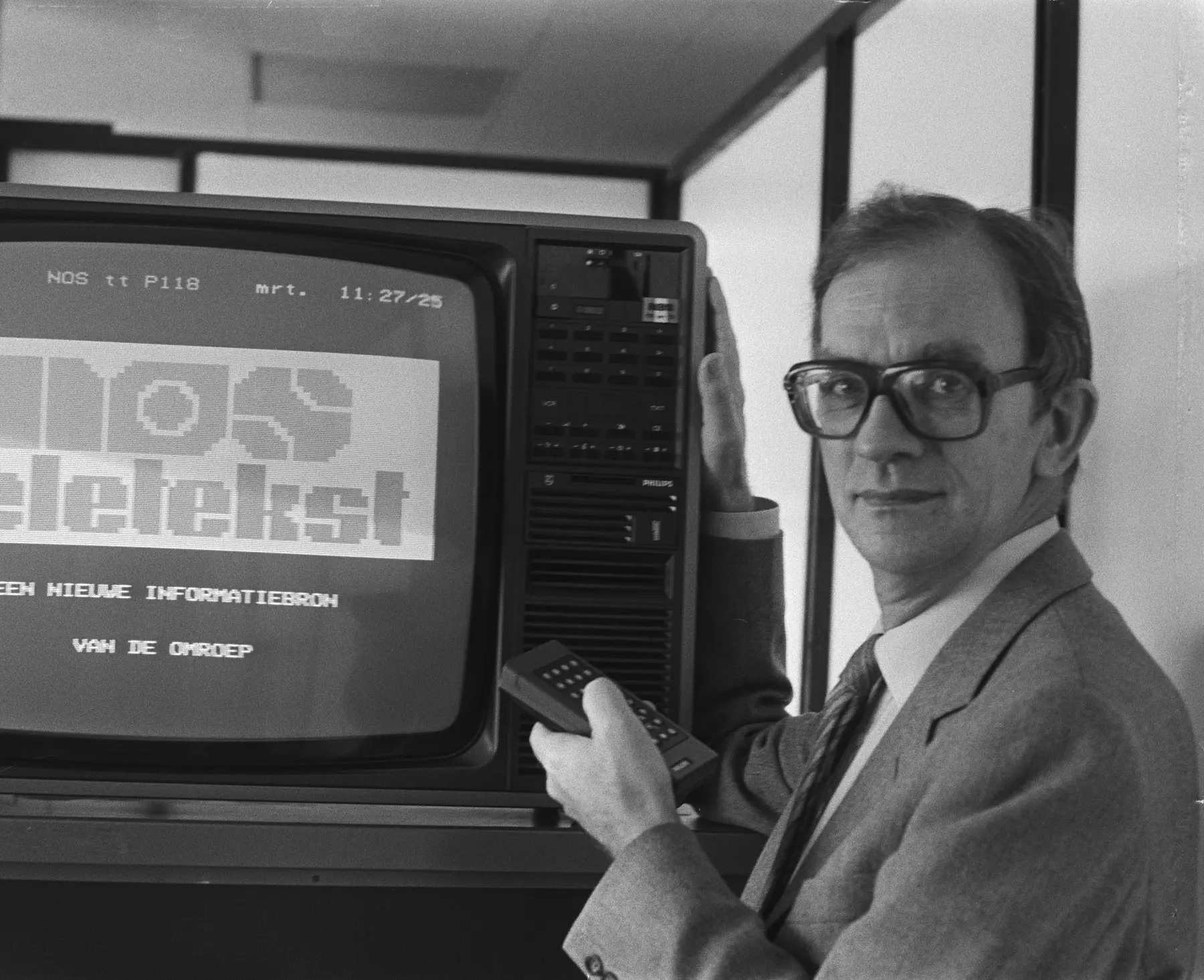
One of the earliest electronic news products scarcely resembled a newspaper. Teletext used spare capacity in the television signal to carry pages of letters, numbers and simple block graphics. Viewers entered a page number and waited for the requested information to come around.
BBC Ceefax began experimentally in 1974 and grew into a service for news, sports results, weather, market prices and subtitles. NOS Teletekst launched in the Netherlands in 1980. Page 101 became a rapid gateway to current events for millions; page 818 acquired a special status among football supporters.
Teletext had almost none of the visual character of a newspaper. There were no large photographs, long reports or elegant columns. Stories had to fit into a few lines. That limitation demonstrated something important: people were willing to read news from a screen when it was immediate and easy to find.
The service was constantly changing. A sports score or headline could be updated without printing a new edition. For the first time, a living room could receive a text page more current than the newspaper on the table.
Teletext was one-way communication, however. Viewers could only choose from what the broadcaster transmitted and sometimes had to wait for a page to return in the cycle. There was no personal archive, search function or direct relationship between reader and newspaper.
It was electronic news, but not yet an electronic newspaper. That required the telephone line as well.
03 / Videotex takes the press to the telephone line
Prestel, Viditel and Minitel promised information on demand
With videotex, a terminal called a central computer through a modem. Users requested pages by entering numbers or commands. Unlike teletext, the system worked in both directions: information could be searched, messages sent and, on some services, reservations, banking and purchases completed.
British Telecom launched Prestel in 1979. France built the much larger Minitel network from the early 1980s. The Netherlands gained the PTT's Viditel in 1980. A special adapter and modem turned a television into an information window.
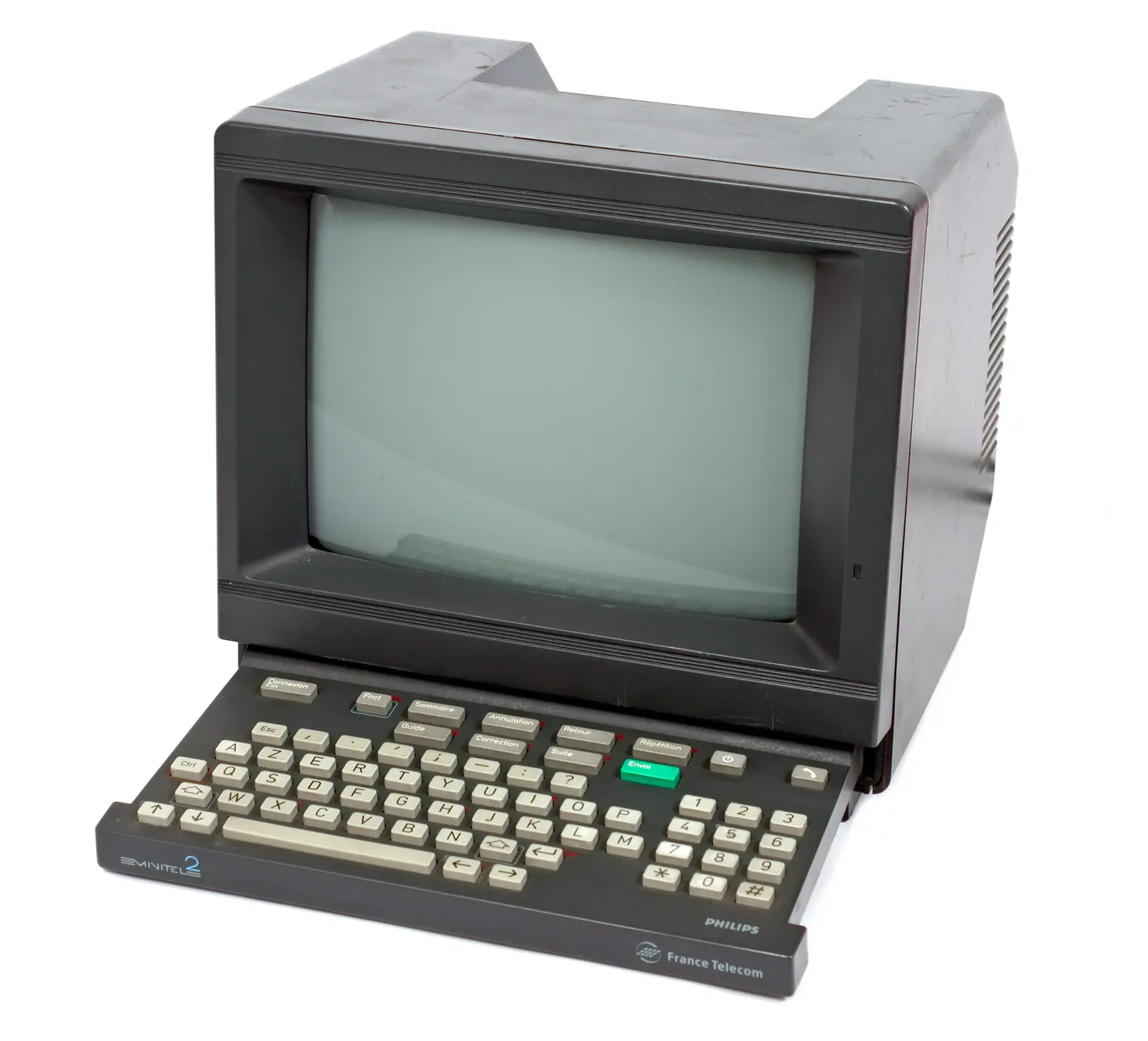
To newspaper publishers, videotex resembled a printing press without paper. A newsroom could send news, weather, prices and advertising to a central database. Readers then chose their own section. The report no longer had to be physically transported to each household.
The screens were coarse, the connections slow and the controls far from intuitive. A page consisted of short blocks of text and angular colours. Long articles were tiring to read. One wrong number could lead into a dead end of menus.
Costs also accumulated. Users needed a terminal or adapter, paid for the connection and sometimes per page or minute. A printed newspaper supplied a large quantity of information for one price, immediately visible and easy to browse.
Videotex made information on demand possible, but treated every article as a destination the reader had to seek deliberately. Paper casually revealed things nobody had intended to search for.
04 / Viewtron: fifty million dollars for the future
Knight Ridder tried to reinvent the newspaper
The American newspaper company Knight Ridder began an ambitious videotex project with AT&T in the late 1970s. Viewtron became commercially available in South Florida in 1983. A dedicated terminal allowed subscribers to read news, check stock prices, bank, book travel, shop and send messages.
Its colour display made Viewtron more attractive than plain-text terminals. Pages carried simple illustrations and clear categories. Behind the service stood a publisher accustomed to organising large quantities of reliable information every day.
Access was nevertheless expensive and awkward. The dedicated AT&T terminal initially cost hundreds of dollars, while subscribers also paid for the service and telephone use. For households that had no other reason to go online, the electronic newspaper was not a cheap replacement for print but an expensive extra appliance.
A more fundamental problem emerged from actual behaviour. Knight Ridder invested heavily in journalism, yet subscribers spent a striking amount of time using email, message areas, games, banking and other interactive features. Online, they did not merely want to read what an editor had selected. They wanted to do things and communicate with other people.
Viewtron closed in March 1986. Knight Ridder had invested six years of research and an estimated fifty million dollars in the project. For years, the experiment was treated as proof that consumers did not want electronic information.
It had almost demonstrated the opposite. People did want to be online — just not chiefly to imitate a newspaper.
05 / The newspaper as a metaphor
Publishers saw printing presses and delivery vans inside the computer
Designers of early electronic newspapers took the existing paper as their model. The central computer was the press, the telephone line the delivery van and the screen the sheet of paper. The comparison made unfamiliar technology understandable, but also restricted the imagination.
A printed newspaper has to be a bundle. Sport, politics, advertising and culture are printed and distributed together even when a reader only wants part of them. Digitally, that package is unnecessary. Every story can be opened, forwarded, updated and found separately.
The rhythm of the day changes too. Morning and evening editions make sense on paper because printing and delivery take time. A network has no deadline. News can appear immediately and remain available afterwards. The newspaper changes from a finished product into a continuous flow.
That threatened precisely what publishers hoped to preserve. When stories circulate separately, readers may arrive through a search engine, link or later a social network. They do not automatically see the front page, other sections or the advertising that paid for the whole edition.
Viewtron tried to transfer the economic order of print to a new medium. The digital environment was not a cheaper street for the same van. It had different routes, different habits and far more competitors.
The electronic newspaper was technologically advanced but still thought in paper.
06 / The Netherlands goes online
First through digital cities, then on an independent website
Viditel had already brought information to Dutch television screens, but only the public internet allowed newspapers to publish without a special closed network. De Digitale Stad, opened in Amsterdam on 15 January 1994, made the internet visible to a broad public as a place with squares, houses and civic facilities.
Newspapers and magazines experimented inside such early communities. Eindhovens Dagblad placed an internet edition in Digitale Stad Eindhoven on 31 December 1994 and is regarded as the first Dutch daily publisher with such an edition. NRC Handelsblad opened its own complete website on 1 July 1995, becoming the first national daily with an independent web newspaper.
The earliest sites were austere. Images took a long time to load and most readers used a modem. Articles appeared as simple text pages, often after first being produced for print. The website was an additional shop window, not yet a full second newsroom.
The web nevertheless changed the relationship between paper and reader more profoundly than videotex had. No special terminal or publisher-specific network was required. Anyone with internet access and a browser could visit several newspapers, broadcasters, foreign outlets and new digital publications.
That openness encouraged rapid adoption. It also made the newspaper vulnerable. Publishers no longer owned the distribution channel. Competitors were one click away, and a news site without any printing press appeared on exactly the same screen.
The electronic newspaper was finally within reach. In the process, it ceased to be obvious that it still had to be a newspaper.
07 / Paper is placed on the screen
The digital edition retained every column and advertisement
As faster internet and better displays arrived, publishers found a simple way to sell papers digitally: reproduce every printed page exactly on screen. Subscribers could leaf through the same issue with the same headlines, photographs, advertising and supplements.
Such replica editions offered reassurance. The newsroom did not need to produce a second product, advertisements retained their position and subscribers recognised the familiar paper. Legally and commercially, the edition also remained a clearly defined whole.
This worked reasonably on a large computer monitor. On a laptop or later a phone, readers had to zoom, move and shrink repeatedly. The page design had been created for a large sheet that reveals much information at a glance, not for a small window.
The digital edition also retained the deadline. While the website changed throughout the day, the replica remained the frozen issue of that morning. It surrendered one of digital news's greatest advantages.
Yet this form still exists. Some readers value its completeness and order. They want to know that they have “finished” the paper and encounter subjects that a personal algorithm might never select.
The replica proved that paper could be reconstructed on a screen. It did not prove that the shape of paper created the best experience there.
08 / The screen finally tries to resemble paper
E Ink made long reading more comfortable
An ordinary monitor emits light, consumes power continuously and was for years heavy and inconvenient. Electronic paper tried only to hold the visible state of a page. Text remained in place without constant refreshing, was easier to read outside and used far less battery power.
Sony introduced the LIBRIé in Japan in 2004, the first commercial reader with an electronic-paper display developed by Philips, Toppan and E Ink. Its size and weight were closer to a paperback than earlier terminals. The technology seemed ideal for daily papers too: one thin device could contain a fresh edition every morning.
Amazon made the idea more practical with the Kindle in 2007. Books, magazines and newspapers could be downloaded wirelessly without connecting the device to a computer first. New issues of subscriptions appeared automatically.
E Ink worked extremely well for long text. Its limitations were clearer for a complete newspaper. Early displays were monochrome, relatively small and slow to change. Photojournalism, advertising, large infographics and a dynamic front page scarcely came into their own.
E-readers were also primarily book devices. People bought them for novels that lasted days or weeks, not automatically for news that aged within hours. At the same moment, mobile phones became faster, more colourful and increasingly connected at all times.
Electronic paper came technically close to the dream. The daily newspaper was not the content for which the mass audience chiefly wanted the device.
09 / The tablet appears to fulfil the prediction
Knight Ridder had already imagined something close to an iPad in 1994
Roger Fidler and Knight Ridder's Information Design Lab produced a film in 1994 about a flat electronic newspaper of the future. The reader held a thin colour screen, moved through reports and saw text, photographs, sound and moving images converge. The prototype mainly existed as a vision, but in hindsight its form looks remarkably familiar.
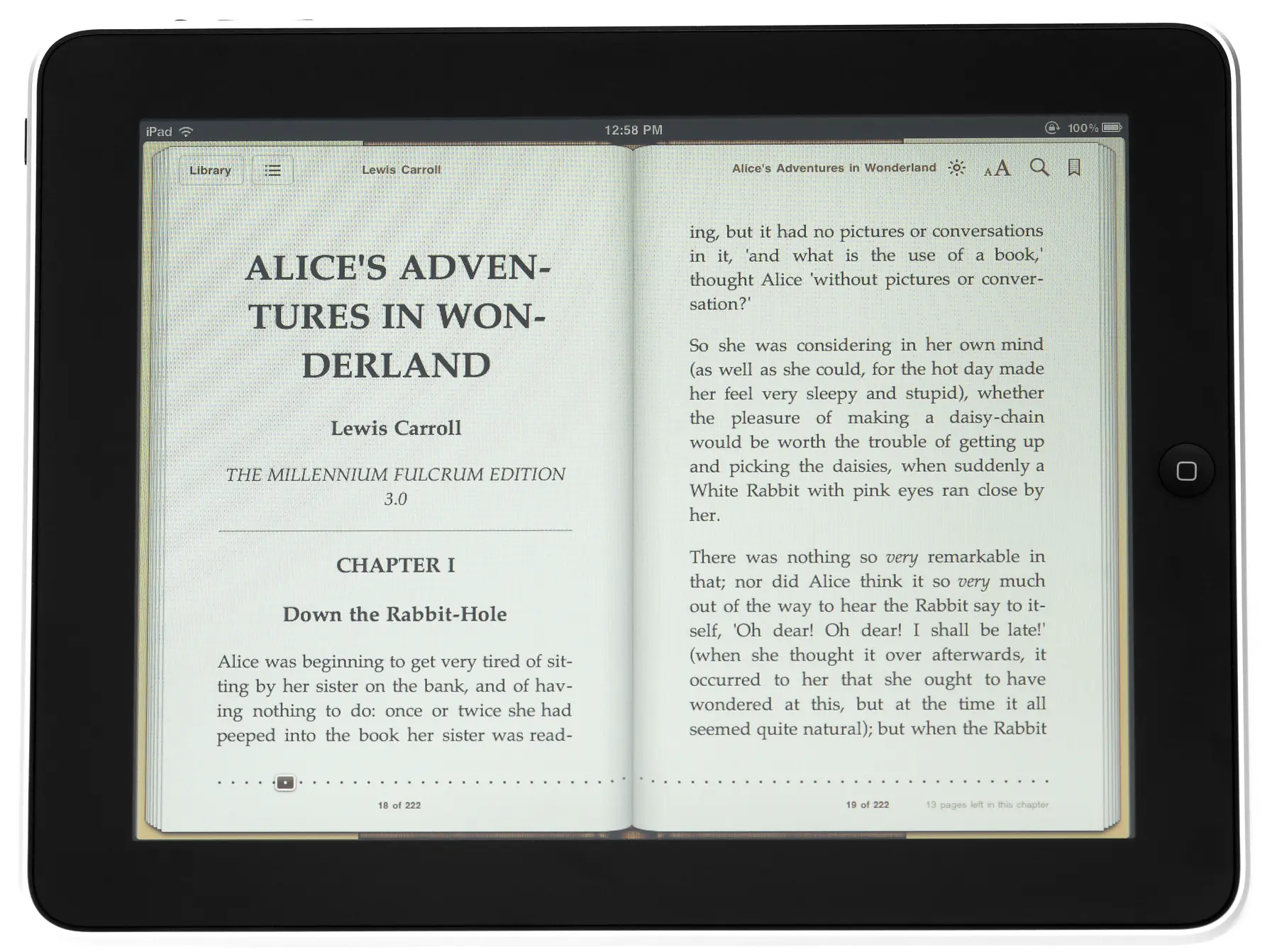
When Apple unveiled the iPad in January 2010, the long-awaited newspaper tablet seemed to have become real. It was portable, fast, colourful and pleasant to operate with the fingers. Publishers built rich apps with turning pages, video, interactive graphics and advertisements that were almost small programs.
Rupert Murdoch called the iPad a game changer for news media. His News Corporation launched The Daily in February 2011, a newspaper created specifically for the tablet with no print edition. For 99 cents per week, subscribers received a new and visually polished issue every day.
The Daily employed journalists and designers and included video and interactive elements. It nevertheless closed in December 2012, less than two years after launch. Its audience did not grow quickly enough to support the expensive newsroom.
The iPad was not an electronic newspaper but a general computer that also ran games, video, email, websites and social media. The dedicated newspaper app had to compete for attention every day.
The prediction had understood the device and misunderstood its use. People did not buy a tablet to receive one newspaper; they bought access to almost everything.
10 / Why the promise failed
News became digital, but the newspaper came apart
The electronic newspaper did not fail because people rejected news on screens. It failed as an attempt to transfer the complete printed product, its rhythm and its revenues almost unchanged to a new medium.
Early equipment was expensive and awkward. Videotex required a terminal, modem, subscription and telephone charges for a service that looked worse than paper.
Screens were unsuitable for calm reading for a long time. Low resolution, limited colour, small sizes and slow responses made long reports and complex pages unattractive.
Digital media have no edition boundary. News can be updated at any moment, making a completed morning issue feel old quickly.
The bundle lost its inevitability. Readers reached a single article directly and did not automatically take sport, business, culture and advertising with it.
Free news became normal. Broadcasters, portals, search engines and newspapers themselves supplied abundant information without payment. Reversing that expectation later was difficult.
Advertising followed different rules. Online advertising became measurable, personal and traded through technology companies. Publishers did not automatically earn what a full printed advertisement had provided.
Interaction mattered more than expected. Email, forums, comments and social networks drew people in. The public wanted not only to receive an editorial page but to talk, share and publish.
The device became general rather than dedicated. PCs, phones and tablets did everything. A terminal for receiving one newspaper lost to a screen containing the whole digital world.
The original promise confused electronic delivery with preserving the newspaper as a closed whole.
11 / The newspaper becomes a stream
Website, app, newsletter, podcast and notification
The modern newspaper no longer appears in one place at one time. A report begins as a short alert, expands into a live blog, receives analysis, is discussed in a podcast and may appear in a printed or digital edition the following morning.
The smartphone made current affairs truly portable. Readers no longer fetch the newspaper; the news announces itself with a vibration in the pocket. Search results, timelines, newsletters, widgets and push notifications partly replaced the front page.
Many newspapers restored payment through digital subscriptions and paywalls. Part of the old relationship returned: the reader pays a newsroom for selection, verification and interpretation. But the subscription generally grants access to a continuously updated service, not just one daily issue.
At the same time, publishers became dependent on companies they did not control. Google, Facebook, Apple and other platforms determined how reports were found and displayed. One change to an algorithm could remove a large share of visitors overnight.
In 2025, the Reuters Institute found that traditional news media still struggled to connect with audiences while digital subscriptions stagnated in many countries. Younger users increasingly encountered news through social and video platforms and individual creators.
Removing paper solved the costs of printing and delivery. It created a more difficult question: how can a journalistic newsroom remain recognisable and sustainable in an endless stream where every report sits beside every other kind of content?
12 / What remained
The future arrived without a front page or deadline
Almost everything promised by the electronic newspaper has become technically real. News travels instantly, archives are searchable, articles can combine text, video, sound and graphics, and subscribers read on phones, computers, tablets or e-readers.
Only the central image changed. The electronic newspaper did not become a thin device on which one recognisable edition appeared every morning. It became a collection of websites, apps, stories, newsletters, podcasts and alerts that continues all day.
- PROMISEThe familiar newspaper without paper
A complete, current and orderly edition appears automatically on a portable screen every morning.
- BREAKTHROUGHNews can reach the reader directly
Teletext, videotex, websites, E Ink and tablets made printing and physical delivery unnecessary.
- BRAKEDigital breaks apart the bundle
Individual stories, continuous updates, free alternatives and new platforms did not fit the rhythm or economics of print.
- LEGACYJournalism as a continuous service
Digital subscriptions, apps, newsletters and podcasts preserve the newsroom, but not the fixed form of one daily product.
The electronic newspaper therefore did arrive. It simply did not appear as a printed paper with a plug attached. Once news became fully digital, the meaning of a newspaper changed too.
13 / Sources & images
Read and explore further
- BBC — the history of Ceefax
- Computer History Museum — videotex, Prestel and Viewtron
- Poynter — Before the Web, There Was Viewtron
- KB — De Digitale Stad
- NRC — preserved website from 1995–2001
- Sony — first-generation electronic paper
- Amazon — introducing Kindle
- Apple — introducing iPad
- Reuters Institute — Digital News Report 2025
Image credits
NOS Teletekst trial — Koen Suyk / Anefo, CC0; resized and converted to WebP
Minitel 2 — Frédéric Bisson, CC BY 2.0; resized and converted to WebP
First-generation iPad — Evan-Amos, public domain; resized and converted to WebP


