Failed promises / Part 16
3D television in the living room
Television would finally stop being a flat window. Around 2010, glasses, Blu-ray and dedicated channels promised a cinema with depth in every living room.
01 / The promise
The screen would cease to be a screen
Television brought the world into the living room, but kept it behind glass. No matter how large or sharp the picture became, it remained a flat rectangle on the other side of the room. Three-dimensional television promised to remove that final boundary.
A football match would feel as though the viewer were sitting beside the pitch. In a nature documentary, a bird might appear to fly through the room. A concert acquired a stage with visible distance between singer, drummer and audience. Films would no longer merely become larger or sharper, but spatial.
Around 2010, the industry presented 3D as the next logical step. Television had first been black and white, then colour, widescreen and high definition. Now came depth. Anyone who had only just bought a flat HD television was given another reason to consider a more expensive model.
The promise went beyond an occasional film. Manufacturers demonstrated sports, documentaries, games and television programmes. Special Blu-ray discs brought the 3D cinema home, while games consoles could calculate two perspectives on a virtual world.
The technology also appeared almost ready. Many new televisions only had to show rapidly alternating images or two different polarisations. A pair of glasses ensured that each eye received the correct picture. The brain did the rest.
But television is not a fairground attraction that a visitor deliberately chooses. It is on every day, sometimes watched attentively and sometimes left in the background. People watch alone, with the family, over dinner or while doing something else. A technology that required preparation and glasses for every session had to be more than spectacular. It also had to be effortless.
The 3D television promised to turn the living room into a cinema. The industry forgot that the living room is precisely not a cinema.
02 / Two eyes, two pictures
The basic idea was older than photography
The illusion of depth begins with a small difference. Our eyes sit a few centimetres apart and therefore see the world from slightly different angles. The brain combines those images into a single spatial perception.
The British scientist Charles Wheatstone described this principle in 1838 and demonstrated it with his stereoscope. Two drawings, each made from a slightly different viewpoint, were shown separately to the left and right eye through mirrors. Together they appeared to have depth.
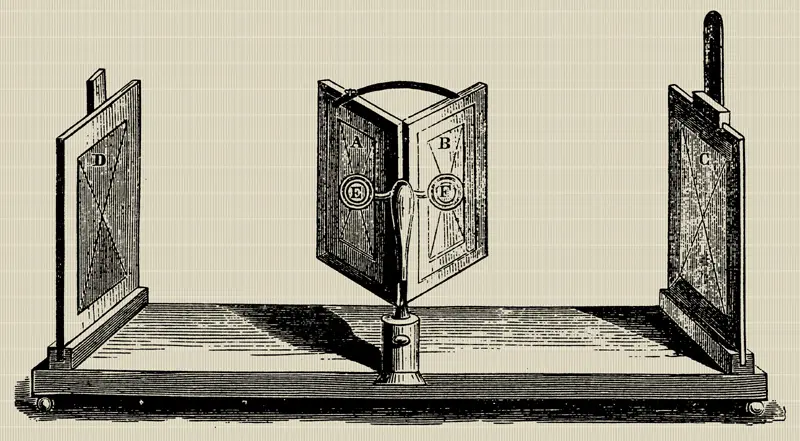
When photography emerged, the stereoscope became a popular form of living-room entertainment. People viewed cityscapes, landscapes and distant countries in three-dimensional photographic pairs. The device proved early on that a still image could seem remarkably spatial when each eye received the right information.
Later viewers used lenses instead of mirrors. Stereo cards, View-Master reels and other systems changed the form, but not the principle. There were always two images and a method of keeping them separate.
For moving pictures this was more difficult. A film camera had to record two perspectives at the same time. Cinema projection had to keep the images perfectly synchronised and the audience had to separate them correctly. A small error in position, timing or brightness could disturb the illusion and become tiring.
The fundamental problem of 3D was therefore visible from the start. The spatial effect did not arise in the device alone, but in a chain of recording, editing, display, glasses and human vision. Every link had to be right.
A century and a half later, the television industry would still be performing the same optical trick—only faster, brighter and for millions of living rooms at once.
03 / Cinema rediscovers depth, again and again
Every 3D wave began as an answer to competition
3D film was demonstrated early in the twentieth century, but experienced its first major commercial wave in the 1950s. Cinema had to compete with a new device in the living room: television. Widescreen, colour and stereoscopic films were meant to give visitors something unavailable at home.
For many productions, audiences wore cardboard glasses with differently coloured filters. Anaglyph technology was cheap, but distorted colour and could be uncomfortable to watch. Other systems used polarised light and two carefully aligned projectors. That produced a better image, but placed high demands on the equipment and screen.
The films often sold the technology as spectacle. Objects flew towards the auditorium, monsters thrust out their claws and titles seemed to float above the audience. Depth was not merely a storytelling device, but a demonstration that continually shouted: look what this format can do.
Once the novelty faded, the inconveniences weighed more heavily. Projectors slipped out of alignment, glasses were awkward and not every film improved with the effect. The wave subsided, though it never vanished completely. Theme parks, IMAX cinemas and occasional horror and adventure films kept 3D alive.
New revivals followed in the 1980s and 1990s thanks to better cameras, computer-controlled projection and special attractions. From the 2000s, digital cinema made far more precise presentation possible. The two images could remain synchronised without mechanical film reels.
The same pattern kept repeating. A new technology made 3D more convincing, a few striking productions attracted attention and the industry predicted a lasting revolution. Then it became clear that audiences would pay for a special experience, but did not need to see every film through glasses.
Cinema could turn 3D into an event. The question was whether television could repeat that event every evening.
04 / The first attempts at home
The living room gained depth through flickering glasses and rare tapes
Long before the 3D television of 2010, producers tried to bring spatial images to existing sets. One simple route was again the red-and-blue anaglyph lens. Broadcasters could announce a special transmission and viewers collected a cardboard pair of glasses from a magazine or shop.
The advantage was reach: almost any colour set could display the picture. The disadvantages were equally clear. Colours became distorted, red and blue fringes remained visible, and the result seemed more like a pleasant stunt than a new television standard.
More advanced home systems used a field-sequential image. The television or videotape rapidly alternated the left- and right-eye pictures. Electronic shutter glasses darkened one lens at a time so that each eye saw only its own images.
That required a suitable player, precise synchronisation and expensive glasses. At a low image frequency the flicker was visible. The glasses were heavy, needed batteries and darkened the picture. There was also very little material to watch.
Video games were a logical testing ground. The computer could calculate a scene from two positions and the player already sat directly in front of the screen. Sega, for example, released electronic 3D glasses for the Master System. The effect worked, but only with a small group of specially produced games.
These early systems proved that 3D at home was technically possible. They also proved that compatibility alone was not enough. Viewers had to buy extra equipment for a handful of titles and received a darker, sometimes flickering image in return.
The first home 3D wave did not fail because of a single insoluble technical problem. It failed because the inconveniences accumulated.
05 / Avatar makes the future visible
One film gave the television industry a new story
In 2009, 3D grew from a niche into an industry plan. James Cameron's Avatar was carefully designed for stereoscopic presentation and became a worldwide cinema success. Digital projection and modern glasses provided a more stable and colourful image than many earlier waves had managed.
Its success came at an opportune moment for television manufacturers. The transition from cathode-ray tubes to flat LCD and plasma televisions had persuaded many households to make a new purchase. High definition was quickly becoming ordinary. To set the market moving again, the industry needed another visible improvement.
3D offered an easy in-store demonstration. Put on the glasses, watch a clip, and the difference was immediately obvious. A salesperson had to explain resolution, contrast or colour range; an object that seemed to float in front of the screen sold itself.
The rest of the chain moved at the same time. The Blu-ray Disc Association completed a Blu-ray 3D standard at the end of 2009. New players could store and transmit two HD images. The PlayStation 3 received support through software, allowing millions of existing devices to serve as a 3D player or games console.
Sony announced that it would bring an entire 3D world into the home in 2010, from cameras and films to Bravia televisions and games. Samsung, Panasonic, LG and other brands followed. Film studios prepared 3D editions and sports producers experimented with special coverage.
For a moment, the chain appeared complete: camera, cinema, disc, player, cable and television. After decades of isolated experiments, there was an industrial ecosystem.
But Avatar had something a technology standard could not prescribe: a film conceived for depth from the beginning. The market assumed that the rest of the catalogue would naturally reach the same level.
06 / The shop fills with 3D televisions
In 2010, depth became a tick on the specification sheet
3D screens dominated consumer-electronics shows in 2010. Manufacturers presented large televisions with fast panels, broadcasters announced trials and salespeople placed stacks of glasses beside demonstration models.
Many sets used active shutter glasses. The television very rapidly alternated a complete picture for the left and right eye. The glasses received a synchronisation signal and made the opposite lens opaque each time. In this way each eye could receive a full HD image.
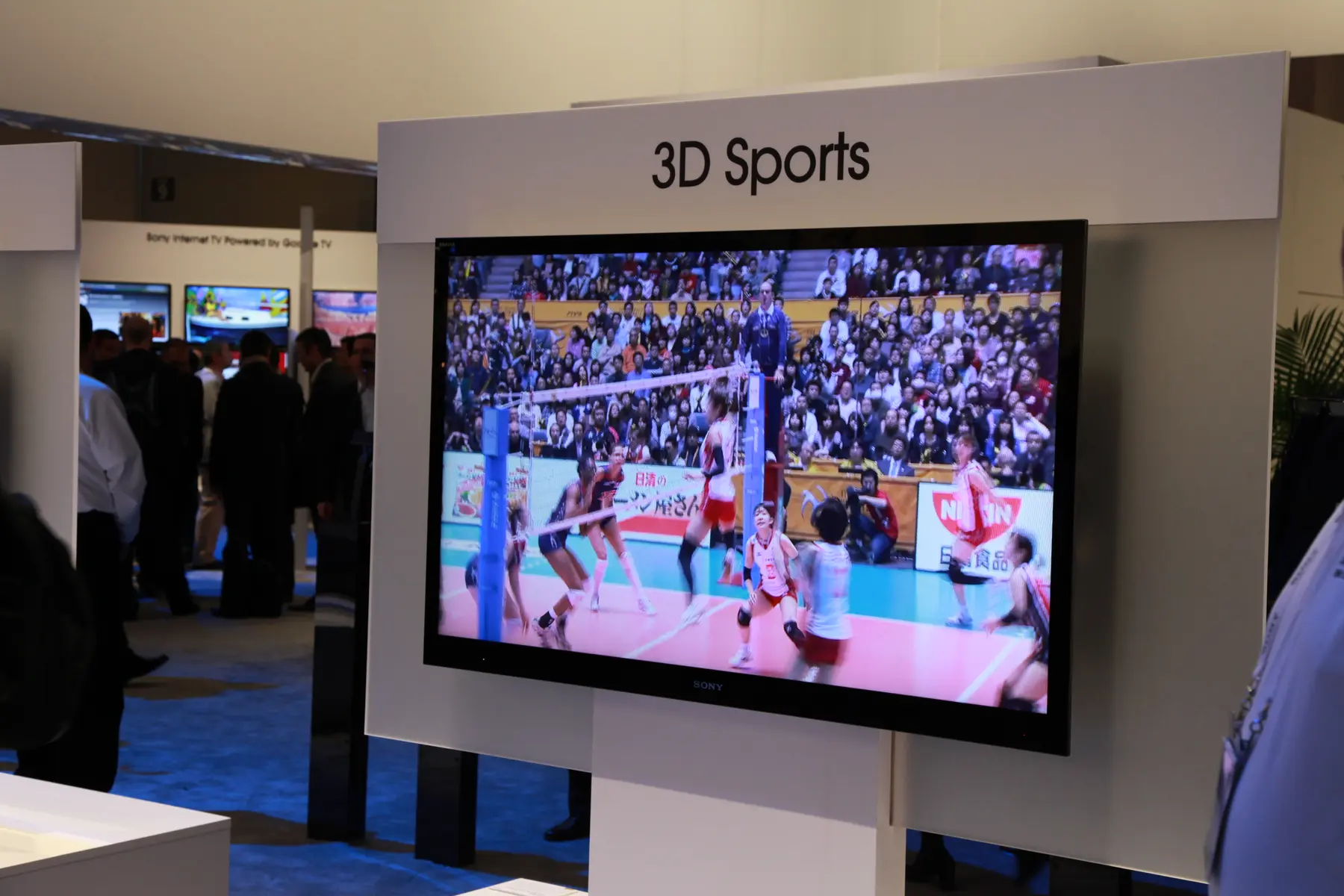
The technology demanded a great deal from the screen. It had to display two image streams without a remnant of one becoming visible to the other eye. This leakage was called crosstalk and produced double outlines. Faster panels and more accurate glasses reduced it, but not every model performed equally well.
The first glasses were expensive and often brand-specific. A family needed a pair for every viewer. Anyone inviting friends over for a football match could not simply hand out a few cheap spares. Batteries had to be charged or replaced.
Passive systems took another route. A filter on the television divided the image lines between two polarisations. The lightweight plastic glasses resembled those used in the cinema and cost much less. The trade-off was that, on many sets, each eye saw only half the vertical resolution.
The contest between active and passive made the purchase no easier. Manufacturers defended their own solution with measurements, demonstrations and new terminology. Even active glasses from different brands did not always work together at first; in 2011 major companies tried belatedly to agree on a common standard.
3D was therefore not a single feature, but a collection of technologies, each with its own advantages and disadvantages. Only the short logo on the price tag was the same.
07 / Sport must provide the breakthrough
Live broadcasts promised a reason to return again and again
A 3D film on Blu-ray was a one-off attraction. A lasting television market needed regular new material. Sport appeared ideal: a pitch had natural depth, and supporters were willing to pay for the sensation of being closer to the action.
The 2010 FIFA World Cup became an important showcase. Sony worked with FIFA on a worldwide 3D production of selected matches. In Japan, matches including the Netherlands–Japan game and the final were offered live in 3D. Cinemas and pay-TV channels showed matches in other countries.
Good 3D sports coverage, however, required more than placing two lenses beside one another. Camera positions that worked for ordinary television did not always produce comfortable depth. Rapid cutting between sharply different distances could be tiring. Directors had to switch more slowly and consider the point on which the eyes were converging.
Separate cameras and a separate production were therefore often needed alongside the normal broadcast. That increased costs for an audience that was still small. A sports channel could invest heavily only once there were enough 3D viewers; consumers would buy a set only once there were enough broadcasts.
ESPN launched a dedicated 3D channel in the United States. Discovery, Sony and IMAX planned a fully programmed 3D network. The BBC experimented with Wimbledon, the 2012 Olympic Games and other events.
The demonstrations showed that live 3D could be impressive. At the same time, they exposed the economic problem. Every broadcast cost extra, while almost every viewer was also satisfied with the ordinary HD version.
Sport was supposed to become the everyday engine of 3D. Instead it became a series of expensive test drives.
08 / The glasses between viewer and programme
A small accessory changed the entire way of watching television
In the cinema, visitors accept glasses because the film is a self-contained outing. Television works differently at home. Someone turns on the set for the news, leaves to make coffee, glances at a phone or joins a programme halfway through.
For 3D, viewers had to deliberately choose a suitable title, activate the television mode and find the glasses. With active models they also had to switch them on and check the battery. Anyone unable to find their own pair saw a blurred double image.
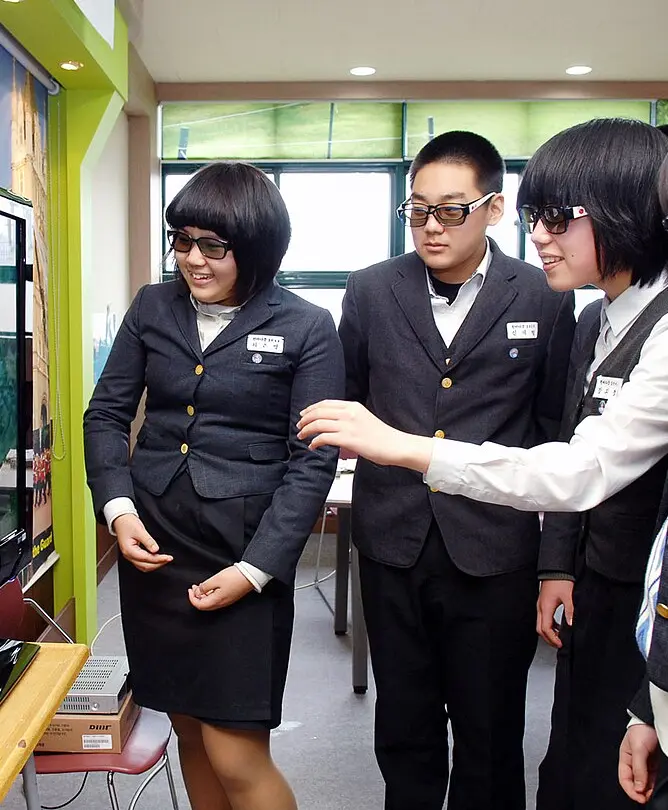
The glasses made social viewing less natural. There had to be enough pairs for everyone and they had to fit over prescription glasses. Some people found shutter glasses heavy or noticed flicker. Others developed headaches, tired eyes or nausea.
That discomfort had a physical cause. In the real world, both eyes converge on an object and focus at the same distance. With stereoscopic television, the eyes may converge on a virtual point in front of or behind the screen while focusing on the screen itself. This conflict causes no short-term problem for many people, but strong or poorly edited depth can become tiring.
Posture mattered too. The effect was best directly in front of the screen, at a suitable distance and with the glasses properly positioned. A child sitting on the floor or someone watching from the side might see a less convincing picture.
Technically, the glasses were merely the final filter in an ingenious system. In everyday use, they became the visible symbol of everything that separated 3D from ordinary television.
The industry thought viewers would put on glasses in exchange for depth. Viewers discovered that they often gave up depth to avoid putting on glasses.
09 / Too little to watch
The 3D button could not create programmes
Anyone who bought a 3D television in 2010 usually received an impressive demonstration disc and a small selection of films. Then the search began. Not every cinema film appeared in a good 3D edition and ordinary channels remained almost entirely two-dimensional.
The classic chicken-and-egg problem returned. Producers did not want to pay for expensive stereoscopic recording and editing for a small audience. Consumers saw little reason to buy glasses and equipment while there was so little available.
Some televisions could automatically convert an ordinary 2D picture to 3D. Image analysis estimated which objects sat in front or behind and artificially created a second perspective. In calm scenes this could suggest some depth, but the electronics did not truly understand the world. Edges warped, objects were assigned to the wrong layers and the result varied from shot to shot.
Many films also carried a 3D label without having been shot as a stereoscopic production. Studios converted existing footage afterwards to benefit from the higher cinema ticket price. Rushed conversions produced flat layers, like cardboard figures standing behind one another.
Mediocre material therefore damaged the reputation of good 3D productions. From the packaging, buyers could hardly tell whether a film had been carefully designed for depth or hastily converted.
Meanwhile, television was becoming richer without a third dimension. Streaming services offered a growing choice, HD channels became ordinary and on-demand viewing changed habits. A 3D catalogue of a few dozen special titles had to compete with thousands of easily available programmes.
The television had the button. The industry had no persuasive answer to the question of what the viewer should watch with it tonight.
10 / An improvement that made other improvements worse
Greater depth often meant less brightness and convenience
Every 3D method sacrificed something. Active glasses blocked each eye part of the time and darkened the picture. On many televisions, passive filters divided the resolution. Crosstalk could create double outlines, especially in scenes with strong contrast.
This was unfortunate because televisions were rapidly improving in other ways. Screens became brighter, thinner and larger. Full HD revealed details that were sometimes lost again in 3D. In the shop, a buyer could choose between a calm, bright 2D picture and a more spectacular but darker 3D image.
The spatial effect also depended on screen size and viewing distance. On a small screen, the depth remained trapped inside a rectangle. Images that seemed to come forward were abruptly cut off at the edges. A larger television was more convincing, but cost more.
For creators, artistic limitations arose. Too much depth or rapid changes made viewing uncomfortable. Subtitles had to sit on a logical depth plane. Graphics, channel logos and menus could not collide with the spatial scene.
3D therefore did not add a straightforward quality in the way higher resolution did. It changed the entire visual language and could damage existing qualities. A poor 4K picture is still sharper than a poor HD picture; poor 3D can actually be harder to watch than 2D.
Consumers did not need to understand these technical trade-offs. They only had to notice that the ordinary picture was often calmer, brighter and easier.
The miracle worked. But it did not work for free.
11 / The revolution disappears from the catalogue
Around 2013, the industry lost faith faster than the sets became obsolete
The turn came early. In 2013, ESPN closed its 3D channel because of limited interest. After Wimbledon, the Olympic Games and other events, the BBC put its two-year trial on indefinite hold. Even among households with suitable sets, special broadcasts reached only a small audience.
Manufacturers continued to include 3D in more expensive televisions for a few years, but it disappeared from advertising. At trade shows, 4K resolution, high dynamic range and smart features took the leading role. Those improvements worked with every programme and required no glasses.
The decline was unusually quiet. Owners received no message saying that their television could now do less; there were simply fewer new films and broadcasts. The glasses vanished into a drawer. When the set was eventually replaced, the feature was often absent without anyone asking about it.
Samsung dropped 3D from its new television range in 2016. LG and Sony released no new 3D models in 2017. The feature had thereby all but disappeared from the major brands, scarcely seven years after it had been presented as the next television revolution.
The failure was not caused by one inferior standard, because both active and passive systems disappeared. Nor was it due to a complete absence of content; there were films, sports trials, games and documentaries. The problem was that the extra experience offered too little everyday benefit for the extra actions and costs.
3D television was not rejected en masse. Most people simply stopped using the feature.
The revolution ended not with a bang, but with a missing tick on the specification sheet.
12 / What remained
Depth found a place where viewers deliberately choose it
Stereoscopic film did not disappear from cinemas. Major animated, science-fiction and spectacle films still appear in 3D and IMAX. There the glasses are part of a chosen experience, the screen is enormous and the presentation is controlled.
Virtual reality uses the same principle far more intensively. A headset shows each eye a separate image and adjusts the perspective as the head moves. The user deliberately puts on the device to enter another space. What was too cumbersome for everyday television is the core of a defined simulation.
Glasses-free displays also keep returning. Lenticular lenses and other autostereoscopic techniques direct different images towards different viewing angles. They work well for one viewer in a known position, as with portable devices or professional displays. A sofa full of viewers who move around remains much more difficult.
The 3D wave left useful knowledge about cameras, image processing, high frame rates and spatial editing. Televisions that needed fast panels for 3D could also use that speed for smoother 2D images.
- PROMISEA cinema with genuine depth in every living room
Films, sports, documentaries and games would break through the flat television screen.
- BREAKTHROUGHA complete digital 3D chain
Modern cameras, Blu-ray 3D, fast televisions and synchronised glasses made stable stereoscopic HD images possible at home.
- BRAKEThe glasses and the lack of everyday content
Extra costs, a darker picture, viewing discomfort and few broadcasts made 3D a feature for special occasions.
- LEGACYDepth as a deliberate experience
3D survived in cinemas, virtual reality and specialised screens, where users choose it with a clear purpose.
The technology behind 3D television worked better than ever. That was precisely why it became clear that technical possibility is not the same thing as a new habit. Viewers were happy to enter a world with depth from time to time, but did not want to search for glasses every evening before they could watch television.
13 / Sources & images
Read and explore further
- Royal Society — 180 years of 3D
- Charles Wheatstone — Contributions to the Physiology of Vision (1838)
- Blu-ray Disc Association — Blu-ray 3D specification
- Sony — Sony Brings 3D Home in 2010
- Sony — 3D coverage of the 2010 FIFA World Cup
- Sony, Discovery and IMAX — 24-hour 3D channel plan
- The Guardian — BBC shelves 3D broadcasting trial
- Totaal TV — LG and Sony discontinue 3D televisions
Image credits
Students wearing 3D glasses at an LG 3D television — LGEPR, CC BY 2.0
Wheatstone mirror stereoscope — unknown artist, public domain
Sony Bravia 3D at CES 2011 — ETC@USC, CC BY-SA 2.0
All images resized and converted to WebP.


