Failed promises / Part 17
The portable computer nobody wanted to carry
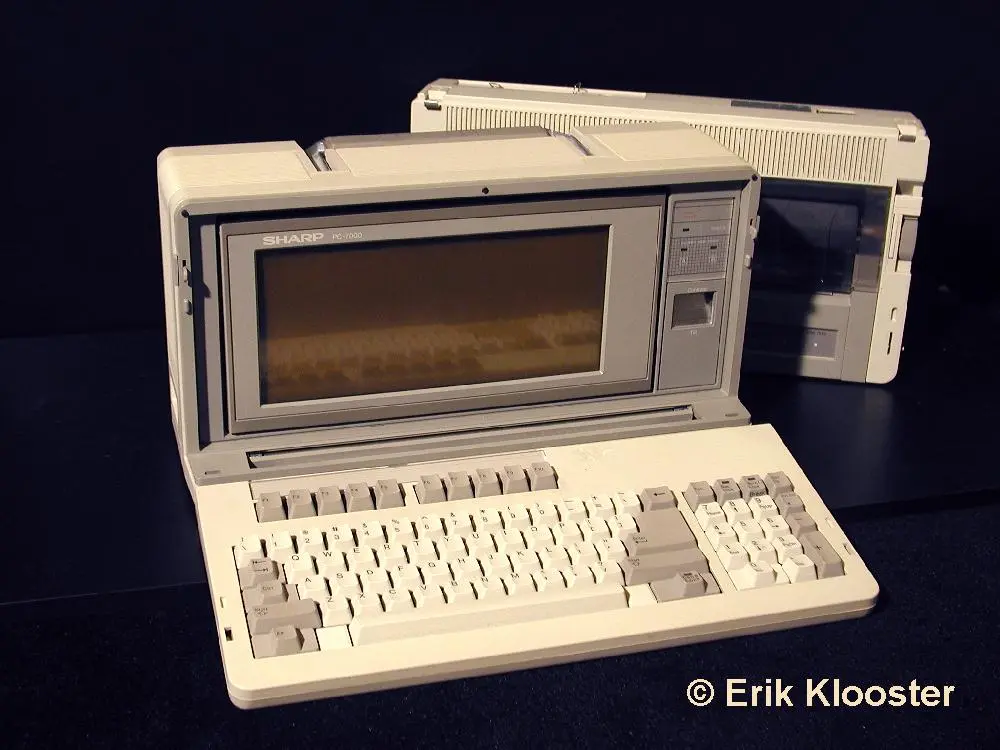
The computer would break free from the desk. Early portables fitted into one case with a handle, but sometimes weighed more than ten kilograms and worked only near a wall socket.
01 / The promise
The office would fit in one hand
The personal computer liberated computing power from the computer room, then immediately fixed it to a desk. A monitor, system unit, keyboard, printer and disk drives formed a personal workplace, provided its user remained in the same place.
The portable computer promised the next step. Information would no longer have to wait until someone returned to the office. A salesperson could bring customer records, an accountant could continue at home and a journalist could write on location. Presentations, calculations and letters would travel with their author.
Advertisements offered an attractive image: a relaxed businessman walked through an airport with a computer in one hand. At his destination he opened the machine and instantly recovered his familiar programs and files. The office was no longer a room. It had become luggage.
The word portable was flexible. A device did not have to be light enough to use while travelling. It already qualified if one person could move it without an installation crew. Add a handle to an eleven- or thirteen-kilogram case and it became a portable.
The first generation solved a real problem. Computers were expensive, and organisations wanted to use one machine at several sites. Users wanted to take their own files with them, while software companies supplied increasingly useful office programs. Even a heavy computer was valuable if it could be at a customer on Monday and at headquarters on Tuesday.
But the handle did not conceal the limitations. Users carried not only a computer but also cables, floppy disks, manuals and sometimes a printer. Without a wall socket the machine remained a closed case. Once it stood on a table, the mobile office looked remarkably like a small and uncomfortable desk.
The portable computer arrived. Almost nobody wanted to carry it farther than absolutely necessary.
02 / A book that could not yet be built
Alan Kay imagined mobility without a suitcase
Before the microcomputer became a consumer product, Alan Kay was already thinking about a far more personal machine. In 1968 the idea that would later be called the Dynabook began to take shape: a light, flat computer about the size of a notebook, with a screen, keyboard, pen input and wireless connections.
Kay did not see the computer merely as a business tool. His “dynamic book” was intended primarily for children. They would read, write, draw, make music and build models with it. The machine had to adapt to the user’s learning process and go anywhere.
The design looked surprisingly like a later laptop or tablet. That was precisely why it could not be built in the early 1970s. Processors, memory, storage and displays were too large, expensive and power-hungry. A battery capable of running the entire combination for long enough would have made it heavy again.
Xerox PARC did develop portable prototypes. The 1978 Xerox NoteTaker combined a screen, keyboard, mouse and disk drive in a case that could be moved. Yet it weighed more than twenty kilograms and never became a commercial product.
The Dynabook therefore set a standard that real devices could not meet for years. To Kay, mobility did not mean bolting a desktop into a suitcase. The device had to become an effortless part of everyday life, like a book or exercise pad.
Industry had little choice but to take the opposite route first. Instead of designing a new light computer, manufacturers packed existing technology tightly enough for one strong user to lift it.
The future looked like a book. The first products looked like carry-on luggage for which a baggage trolley would have been welcome.
03 / IBM makes fifty pounds portable
The 5100 could travel, as long as the journey was short
IBM introduced the 5100 Portable Computer in 1975. Six years before the IBM PC, it combined a processor, keyboard, five-inch display and tape drive in one enclosure. For engineers, scientists and companies this was impressive. A system that had previously required a fixed installation could now move to another department or work site.
The 5100 ran APL and BASIC and, depending on the configuration, offered between 16 and 64 kilobytes of memory. Its price started at about nine thousand dollars and could rise to almost twenty thousand. This was not a computer for a travelling copywriter but a specialised professional instrument.
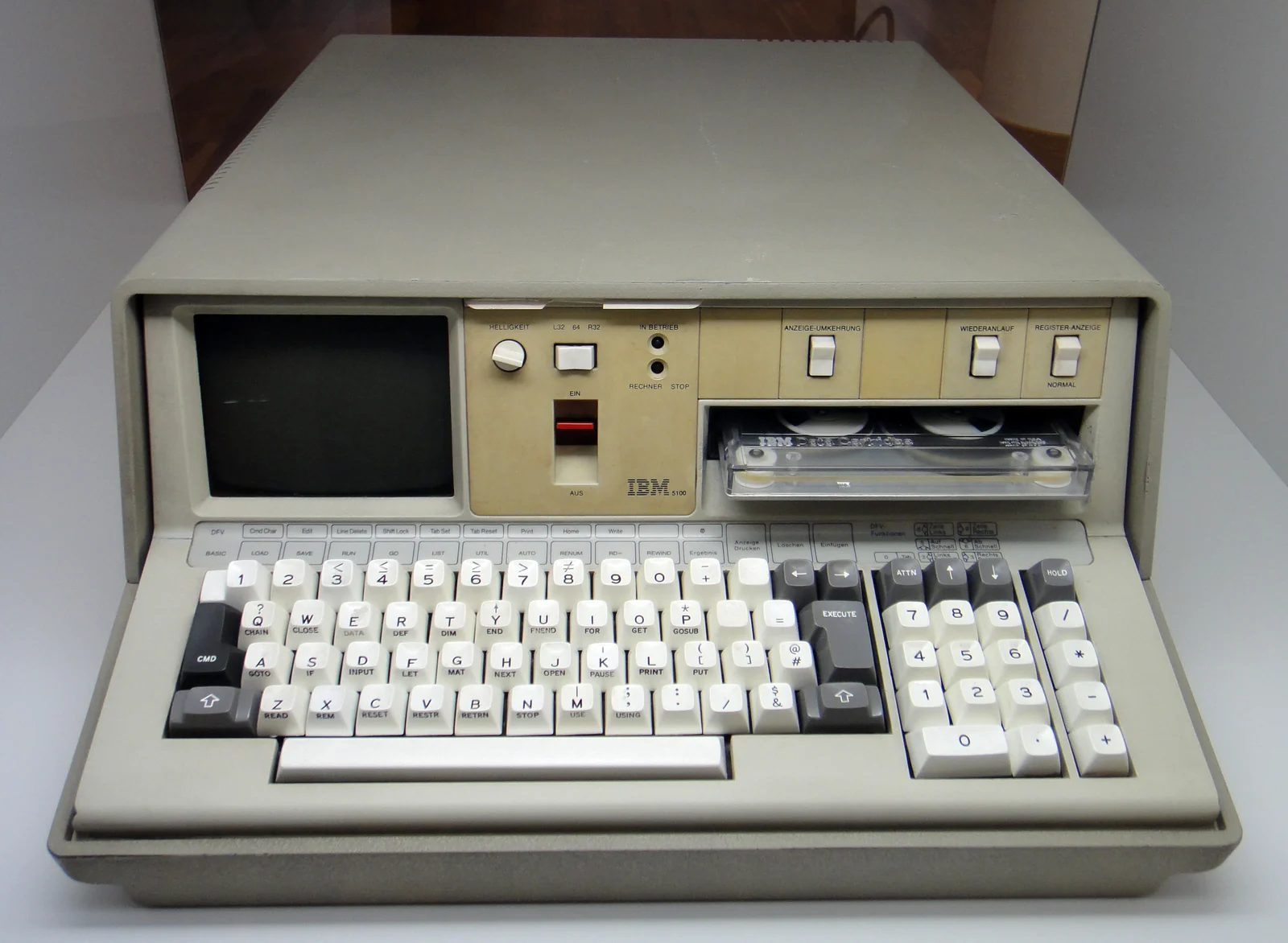
At roughly 22 to 25 kilograms, portable was mainly a comparison with even larger computers. One person could theoretically carry the case, but nobody tucked it under an arm for pleasure. It also required mains power. Working in transit was not the point; the system travelled from one wall socket to another.
Even so, the handle was more than a marketing gesture. The 5100 showed that a complete computer no longer had to fill a room or equipment rack. For organisations that needed calculations at different locations, it could save time and infrastructure.
This established a pattern that later portables would repeat. Early buyers accepted weight and price because transportability offered an exceptional advantage. As soon as lighter alternatives appeared, yesterday’s miracle quickly became a burden.
The IBM 5100 proved that a computer could travel. It did not prove that its user would enjoy travelling with it.
04 / The Osborne 1 turns the suitcase into a market
A small screen, two disk drives and a very large idea
In April 1981 the machine that made the portable personal computer a recognisable product category appeared. Lee Felsenstein designed the Osborne 1 for entrepreneur and author Adam Osborne. The computer weighed about eleven kilograms and closed like a suitcase: during transport, the keyboard formed the front of the case.
Behind the keyboard were two disk drives and a screen only five inches across. The display showed about 52 characters per line, forcing users to scroll sideways through wider documents. The Osborne had 64 kilobytes of memory and ran CP/M, the widely used operating system for business microcomputers.
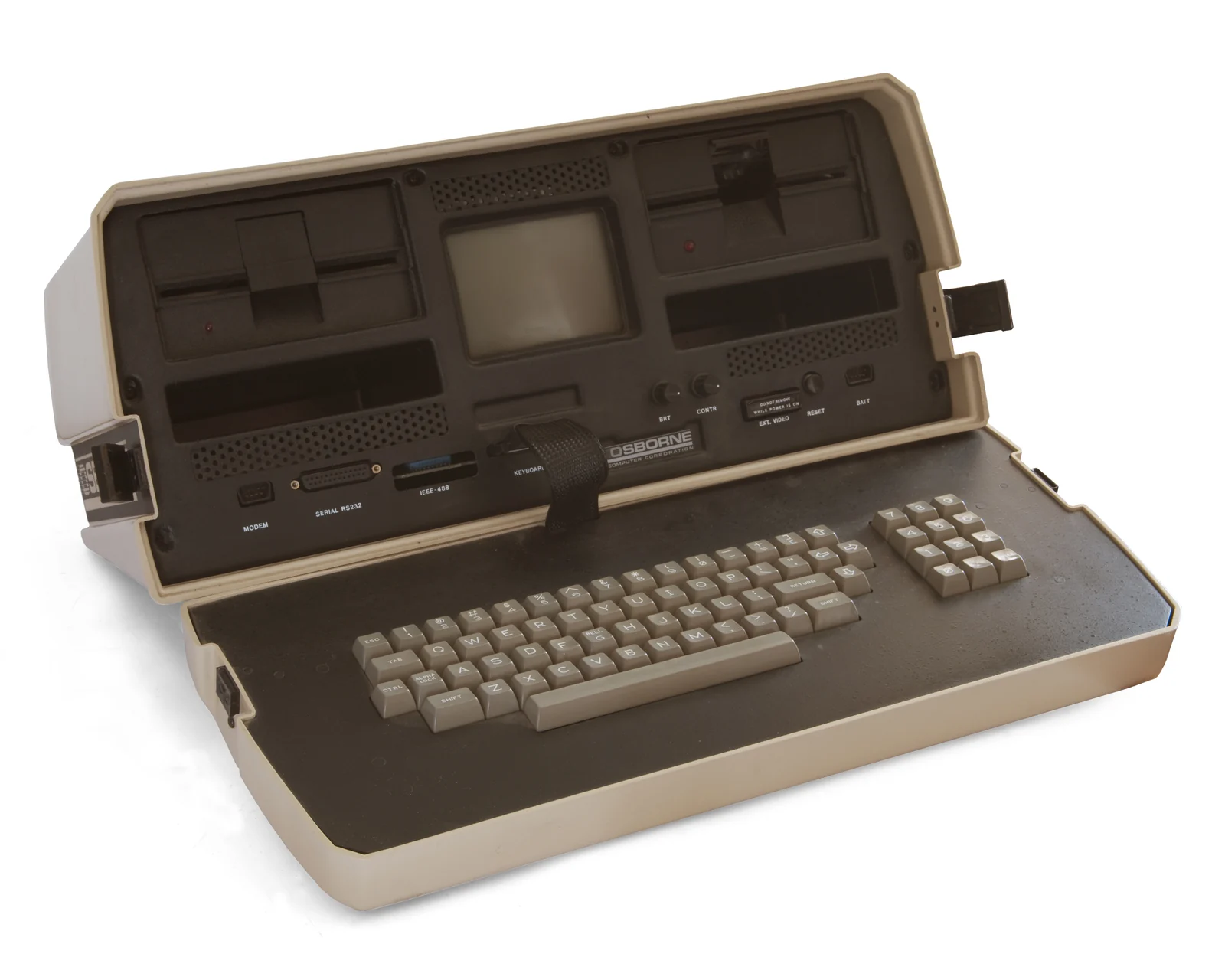
The price of $1,795 was attractive, especially because of the bundled software. WordStar, SuperCalc, programming languages and other applications were advertised as being worth almost as much as the computer itself. Anyone buying an Osborne received an office that was ready to work.
That bundle mattered more than the shape. A portable computer without suitable programs remained a technical demonstration. With word processing and a spreadsheet, a consultant, salesperson or small-business owner could genuinely take work along.
The Osborne 1 became a commercial success and showed that users would accept discomfort in return for continuity. They worked on a document at the office, latched the keyboard across the case, carried the system to the car and continued at home.
But the photograph of a relaxed pedestrian was misleading. Eleven kilograms becomes heavy in one hand. The case was wide, the handle hard, and for longer distances a car, taxi or baggage trolley made more sense than walking.
The Osborne was portable in the way a sewing machine was portable: it could come along when necessary, but nobody forgot that they were moving something heavy.
05 / The computer as a software bundle
What was inside the case sold better than the case itself
Adam Osborne understood that a new computer brand could not easily compete on hardware alone. Processors, memory and disk drives were available to other manufacturers too. Combining hardware with a generous software bundle made his machine distinctive.
The strategy also reduced another problem surrounding early personal computers: uncertainty. Buyers did not have to discover for themselves which word processor, spreadsheet or programming language worked. The computer was sold as a complete business tool rather than an empty box for hobbyists.
Competitor Kaypro adopted the idea and built sturdier portable CP/M computers in metal cases. The 1982 Kaypro II offered a larger display than the Osborne and felt robust enough for professional transport. Kaypro also included a substantial collection of software.
The machines found buyers among small companies, independent professionals, technicians and writers. They went to trade fairs, temporary offices and customer sites. They were not mass products for every living room, but they gave a growing group access to the same digital workplace at several addresses.
Success nevertheless carried an expiry date. CP/M was a logical choice in 1981, but after the introduction of the IBM PC the business software market quickly shifted towards MS-DOS and IBM compatibility. A portable unable to use the same programs and files as the office PC lost much of its purpose.
Osborne Computer Corporation also proved vulnerable. The familiar story says Adam Osborne announced successors too early and destroyed sales of his existing model—the “Osborne effect”. Research into the company’s collapse points to a more complicated mix of production problems, internal conflict, inventory decisions and stronger competition. The warning became more famous than the nuance.
The portable computer had proved that a market existed. The question was no longer merely whether it could travel, but whether it could do exactly the same work as the computer waiting at the destination.
06 / Compaq carries the IBM PC outside
Compatibility mattered more than saving a few kilograms
The Compaq Portable, announced in 1982 and delivered from 1983, decisively changed the market. At roughly thirteen kilograms it was no lighter than its predecessors. Its most important property was invisible: it could run software written for the IBM PC.
Compaq had carefully and legally recreated the behaviour of IBM’s BIOS. The company could therefore sell a nearly fully compatible computer without copying IBM’s own code. Programs, expansion cards and files from the rapidly growing PC ecosystem became usable on a machine from another brand.
The enclosure followed the familiar suitcase design. The keyboard clipped across the system unit, protecting a nine-inch display and the disk drives. On a table the package became a full business PC. During travel it remained a heavy rectangle that mainly moved from car to desk.
The Compaq nevertheless caught on. In its first year of sales the company earned $111 million in revenue, then a record for a young American firm. That success demonstrated the value of both portability and compatibility.
Business users did not mind the weight when the machine could run Lotus 1-2-3, WordPerfect and other familiar software. A lighter computer with a different operating system or restricted display offered less practical freedom.
The Compaq Portable also made the computer industry more open. If a new company could build a credible IBM-compatible machine, other manufacturers could do the same. The PC became a platform rather than a single brand.
Ironically, the most important legacy of this portable computer was not that people enjoyed carrying it. It chiefly helped create the large market for PC clones.
07 / The weight behind the handle
The user carried a desktop without its desk
The term luggable emerged as a more honest alternative to portable. To lug something is to haul it with effort. The machine could be moved, but the exertion was explicitly part of the description.
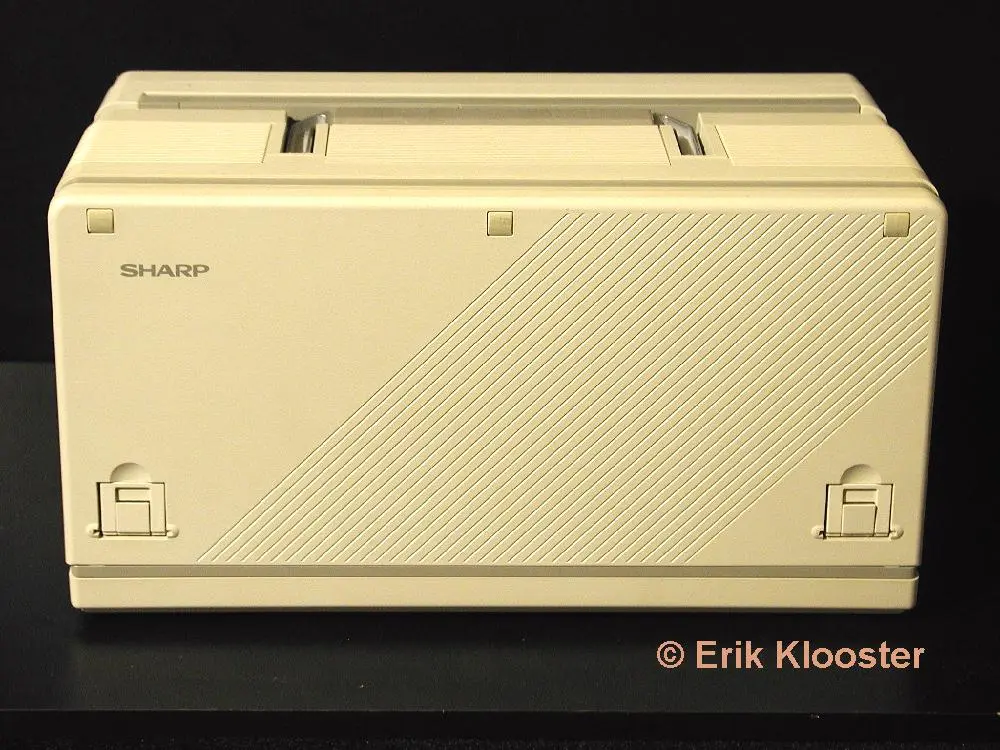
The weight did not result from bad intentions on the part of designers. Cathode-ray tubes were deep and heavy. Disk drives required sturdy mechanical parts. Power supplies, fans and metal frames had to combine every desktop function in a case that could also survive transport.
A built-in handle solved only one part of the journey. The user still needed power leads, floppy disks and manuals. Communication required a modem or acoustic coupler. Anyone who wanted a printout still depended on a printer at the destination.
The machines were rarely suitable for a lap. They had to stand upright on a solid table, with the display recessed into the case. A train or aircraft offered barely enough space for the keyboard. Without mains power most models did nothing at all.
The result was a different culture of use from the one suggested by advertising. The portable was mainly a personal computer that commuted between fixed workplaces. It stood in the office by day, went into the car and was connected on the dining table in the evening. Mobility consisted of the transfer; while work happened, everything was stationary again.
That was still valuable. Exchanging files across networks was difficult, and working from home often meant moving the same machine. A portable prevented conflicting versions on different floppy disks and gave its user the same configuration everywhere.
The system demanded physical labour in exchange for digital continuity. The office had become smaller, but not lighter.
08 / The light computer gives up features
Epson and Radio Shack chose batteries over completeness
Not every manufacturer tried to package an entire desktop. The Epson HX-20 and similar “flat-top” computers chose a different balance. They were much lighter, ran on batteries and fitted more easily into a bag.
The HX-20 had a tiny four-line LCD, a compact keyboard, an integrated microcassette drive and even a narrow printer. It could work for hours away from a wall socket, but it did not offer the screen space, storage or software of a CP/M or IBM PC.
The 1983 TRS-80 Model 100 became one of the most successful examples. The flat machine weighed less than two kilograms, ran for roughly twenty hours on four AA batteries and stored word processing, an address book, a diary and communications programs in memory. Its screen displayed eight lines of forty characters.
For journalists this was not a defect but a focused solution. They could write a story, send it to the newsroom through the built-in modem connection and continue travelling. The machine started instantly and did not forget the text when switched off.
These devices showed that real mobility demanded choices. A smaller screen, restricted memory and simple programs were acceptable if they made a computer genuinely usable on the move.
The market was now divided. The heavy luggable provided complete office software without a battery. The light flat-top provided mobility without full PC compatibility. Neither combined every feature of the original dream.
The computer people did want to carry could not yet do everything they needed at the office.
09 / The laptop finds its shape
GRiD and Gavilan folded the screen over the keyboard
The familiar laptop shape emerged when designers placed the screen on a hinge above the keyboard. Closed, the display protected the keys; opened, everything stood in the right position for work. The computer became flatter and fitted more easily into a briefcase.
The 1982 GRiD Compass was an influential early example. Its magnesium enclosure, flat electroluminescent display, modem and non-volatile bubble memory made it technically advanced. It looked like a device from the future.
That future was expensive. The Compass cost many thousands of dollars, and early models had no battery. Its principal customers were governments, armed forces, large companies and the space programme. The laptop form was real, but the everyday laptop market was not.
The 1984 Gavilan added battery power and MS-DOS. It was explicitly presented as a laptop and even had a touch-sensitive pad above the keyboard. Yet it was only partly IBM-compatible. At the very moment compatibility was becoming more important, that was a severe limitation.
Flat LCDs introduced problems of their own. Early screens had low contrast, narrow viewing angles and slow response. Graphics software was less pleasant to use and colour was absent. Storage remained expensive, while batteries occupied considerable space and added weight.
The shape was ready before the full experience. A closed computer could finally slip into a bag without a test of strength, but users still had to choose among price, battery life, readability and software.
The laptop looked like the future. Inside, it still had to catch up with it.
10 / The T1100 makes the compromise marketable
A normal PC became small enough for ordinary business travellers
Toshiba introduced the T1100 in 1985. It is often described as the first widely accepted laptop PC—not because no earlier machine had used the form, but because Toshiba found a workable combination of size, battery power, MS-DOS and compatibility with mainstream business software.
The T1100 used a low-power version of the Intel 8088, had 256 kilobytes of memory and a 3.5-inch disk drive. There was no hard disk; programs and files lived on floppy disks. The monochrome LCD could display text and CGA graphics.
At about four kilograms the computer was hardly featherweight, but it differed dramatically from an Osborne or Compaq. It fitted in a bag, worked without a wall socket and showed familiar DOS programs on its display.
Toshiba had to convince software companies that their programs were usable on the T1100. Technical specifications alone were not enough; a mobile PC needed an ecosystem. The 3.5-inch disk format, unusual screen and memory management could all create compatibility problems.
Its success opened the European and later the global laptop market. Other manufacturers followed with lighter machines, better LCDs, hard disks and more capable batteries. By the end of the 1980s, the question was no longer whether a laptop could be a real PC, but how much compromise a buyer would accept for mobility.
The portable computer became attractive only when it stopped being a desktop with a handle.
11 / The suitcase disappears, the work keeps travelling
Mobility became a property instead of a demonstration
Laptops improved rapidly during the 1990s. Colour LCDs became easier to read, hard disks grew and processors became more efficient. Manufacturers developed sleep modes, docking stations, compact power supplies and keyboards that felt familiar despite their reduced size.
Business users no longer had to choose between a full PC and a portable aid. The same word processor, spreadsheet and presentation software ran at the office and on the road. Network cards, modems and later Wi-Fi made exchanging files easier.
The meaning of portable changed with them. A ten-kilogram machine no longer counted as portable once a three-kilogram laptop could perform the same work. What had been a technical marvel became an awkward intermediate stage within a few years.
The old luggables did not disappear completely. Technicians, armed forces and field services still needed robust transportable systems with expansion cards, many connectors or a large display. Rugged case computers for measurement and emergencies still exist today.
For ordinary users the ideal moved on. First a computer had to fit in a bag, then weigh less than two kilograms, run for a working day on its battery and connect instantly. The standard was no longer “one person can lift it” but “the user forgets it is there”.
The mobile computer succeeded by making the definition of portability steadily stricter.
12 / What remained
The failed suitcase made the successful laptop imaginable
The first portable computers were not pointless mistakes. They brought office software to customers, temporary workplaces and homes before networks or cloud storage made that simple. They showed that people wanted to take their digital working environment with them.
Their failed promise lay in the assumption that a handle would be enough. Transportability was not the same as mobility. A device becomes truly personal and portable only when weight, battery life, display, software and connectivity work together.
The heavy Osborne, Kaypro and Compaq machines also revealed what users would not give up. Mobility without familiar programs was too limited; full compatibility without a battery was too cumbersome. The laptop emerged by bringing those two directions together.
- PROMISEA complete office in one hand
The same computer, programs and files could be used anywhere.
- BREAKTHROUGHEvery desktop component in one lockable case
IBM, Osborne, Kaypro and Compaq made complete computers transportable and proved that a business market existed.
- BRAKEWeight, a wall socket and a small screen
The machines could travel, but were barely usable during the journey and demanded a great deal from whoever carried them.
- LEGACYFrom movable desktop to genuinely mobile PC
Flat-tops, clamshells and laptops combined battery power, lower weight and compatibility into a new standard.
The portable computer nobody wanted to carry was a necessary intermediate stage. It made the office small enough to move and thereby revealed how much smaller it still needed to become. The real revolution did not begin with the handle, but when the computer disappeared into a bag without a second thought.
13 / Sources & images
Read and explore further
- Computer History Museum — Portable Computers
- Computer History Museum — The First Wave of Portables
- Computer History Museum — Laptops Emerge
- Computer History Museum — Timeline of Computer History
- Computer History Museum — Osborne Computer Corporation
- Computer History Museum — Radio Shack TRS-80 Model 100
- Computer History Museum — Pioneering the Laptop: Engineering the GRiD Compass
- Columbia University — The IBM 5100 Portable Computer
- The Henry Ford — The Rise and Fall of the Osborne Computer Corporation
- IEEE / ETHW — Toshiba T1100
Image credits
Sharp PC-7000, open and closed — photographs by Erik Klooster
IBM 5100 — Sandstein, CC BY-SA 3.0
Open Osborne 1 — Bilby, CC BY 3.0
All images cropped or resized and converted to WebP.

