Failed promises / Part 18
Artificial intelligence in the 1980s
The computer would do more than calculate: it would reason like a specialist. Expert systems, LISP machines and Japan’s Fifth Generation project turned AI into a billion-dollar promise—until the rules proved too rigid, the knowledge too expensive and the expectations too high.
01 / The promise
The computer would bring the best expert into every workplace
At the beginning of the 1980s, artificial intelligence finally appeared ready to move from the laboratory into the office. The grand dream—a machine that could genuinely think—was exchanged for a more concrete and therefore more credible promise. A computer did not have to understand everything. It only had to reason like an experienced doctor, geologist, technician or financial adviser within one field.
This new approach became known as the expert system. A specialist’s knowledge was divided into facts and rules: if this is true, and that is true as well, draw this conclusion. A separate inference engine searched through the rules and asked follow-up questions. There was no metal robot on the screen, only a businesslike dialogue. Yet the text seemed to conceal a knowledgeable adviser.
Companies saw systems diagnose faults, configure computers and assess laboratory results. Governments funded ambitious research programmes. New firms sold special workstations, programming languages and empty “shells” with which any organisation could supposedly build its own digital expert.
Expectations rose quickly. Knowledge would become as reproducible as software. An expert would explain years of experience to a knowledge engineer once; the computer could then apply that expertise everywhere, at any time and without fatigue.
The 1980s were going to be the decade of the intelligent computer. By their end, the decade had mainly demonstrated how difficult it is to imprison human knowledge in rules.
02 / From general intelligence to a narrow field
A smaller promise suddenly made AI useful
The term artificial intelligence had been coined in 1956. During the following decades researchers built programs that proved theorems, solved puzzles, played chess and processed simple sentences. The demonstrations were impressive but generally took place in carefully bounded environments. As soon as the world became messier, the program became lost.
Instead of immediately trying to reproduce common sense, researchers chose a narrower objective. A human specialist does not merely know many facts within a field, but recognises patterns and exceptions. Perhaps that knowledge could be made explicit and applied by a computer.
DENDRAL, developed at Stanford from the 1960s onwards, helped chemists infer molecular structures from measurement data. It showed that specialised knowledge could matter more than a universal reasoning method. Edward Feigenbaum and his colleagues therefore spoke of knowledge engineering: the central task was not building a more mysterious machine, but collecting and structuring expertise with great care.
The idea fitted the business culture of the 1980s. A company did not need to buy an artificial human. It could begin with one expensive problem: incorrect orders, broken machines, risky loans or a shortage of experienced staff. If a program demonstrably saved money there, it was intelligent enough.
Narrowness was the strength of expert systems. It would later become their greatest limitation as well.
03 / MYCIN asks the questions
Medical knowledge became a chain of rules
One of the most famous forerunners of commercial expert systems was MYCIN, developed at Stanford during the 1970s. It was designed to advise doctors about bacterial infections of the blood and meningitis and to recommend appropriate antibiotic treatment.
MYCIN conducted a question-and-answer dialogue. It asked about the patient, symptoms, possible sites of infection and laboratory results. About 450 rules and a large collection of medical facts formed its knowledge base. Conclusions were not assigned absolute certainty, but certainty factors: a practical method of dealing with incomplete information.
Importantly, MYCIN could explain its reasoning. A doctor could ask why a particular question had been posed or how a recommendation had been reached. It thereby provided something many later AI systems struggle to offer: a visible trail of rules and conclusions.
MYCIN nevertheless did not become an autonomous digital doctor. Medical and legal responsibility remained unclear, computers were not yet routinely placed beside every hospital bed, and entering patient data took time. The program also operated only inside its narrowly defined territory. A doctor understood when information was strange, missing or impossible; MYCIN did not possess that broader common sense.
The system demonstrated that a computer could appear convincingly expert inside a small world. The unresolved question was whether thousands of such small worlds would ever add up to general intelligence.
04 / XCON saves real money
One successful application set business in motion
The breakthrough into business came with XCON, originally known as R1. Digital Equipment Corporation sold VAX computers assembled from large numbers of components and options. Incorrect combinations led to missing cables, unsuitable power supplies and expensive corrections after an order had been placed.
XCON used production rules to assemble a valid configuration. Developed in collaboration with Carnegie Mellon University, it became one of the best-known commercial successes of symbolic AI. In the mid-1980s, DEC reported that the system was saving approximately 18 to 20 million dollars a year in manufacturing costs.
That figure impressed managers more than a chess game or laboratory demonstration. XCON did not replace an entire organisation and did not discuss every subject. It performed one complicated, repetitive task better and more consistently. This offered a persuasive model: find a decision that currently depends on scarce specialists and capture their working method in rules.
The success had a less photogenic reverse side. The knowledge base grew to contain thousands of rules. New products, exceptions and changed components constantly had to be added. Rules could contradict one another or produce unexpected consequences. What had begun as capturing expertise became a substantial maintenance task.
XCON proved that expert systems could deliver real value. It also proved that knowledge software was not finished simply because its first version worked.
05 / The knowledge engineer becomes a new profession
Someone had to extract experience from the expert’s mind
A new role emerged around expert systems: the knowledge engineer. This person interviewed specialists, observed their decisions and translated often implicit experience into formal rules. The job was far harder than copying a manual.
An experienced mechanic might say that an engine “sounds wrong”. A doctor notices that a patient does not fit the expected pattern. Such judgements rest on years of examples, context and subtle signals. The expert can act correctly without being able to name every intermediate step. The knowledge engineer still had to ask precisely which observation led to which conclusion, when the rule did not apply and which exception took priority.
Software companies sold expert-system shells in which the inference engine was already present. Customers only had to supply their own knowledge base. In theory, this made AI accessible to banks, factories and government departments. In practice, “only entering the knowledge” was the most expensive part.
There was an organisational difficulty too. Expertise provides status. Not every specialist felt enthusiastic about making an entire working method transferable. Others changed their explanation once they were forced to reflect on their intuition. When professionals disagreed, the software still had to follow a single rule.
The bottleneck therefore did not lie in processor power alone. It lay in language, cooperation and the question of whether human experience can ever be made completely explicit.
06 / A computer built specifically for LISP
AI received its own expensive workstation
Many symbolic AI programs were written in LISP, a language developed by John McCarthy in 1958. LISP could flexibly manipulate lists, symbols and programs that modified other programs. Researchers loved it, but this style of computing could be slow and memory-hungry on conventional machines.
Researchers at MIT therefore designed computers that ran LISP directly and efficiently. Their work gave rise to companies including Symbolics and Lisp Machines, Inc. In the early 1980s, complete LISP workstations appeared with large displays, mice, networking and an exceptionally rich development environment.
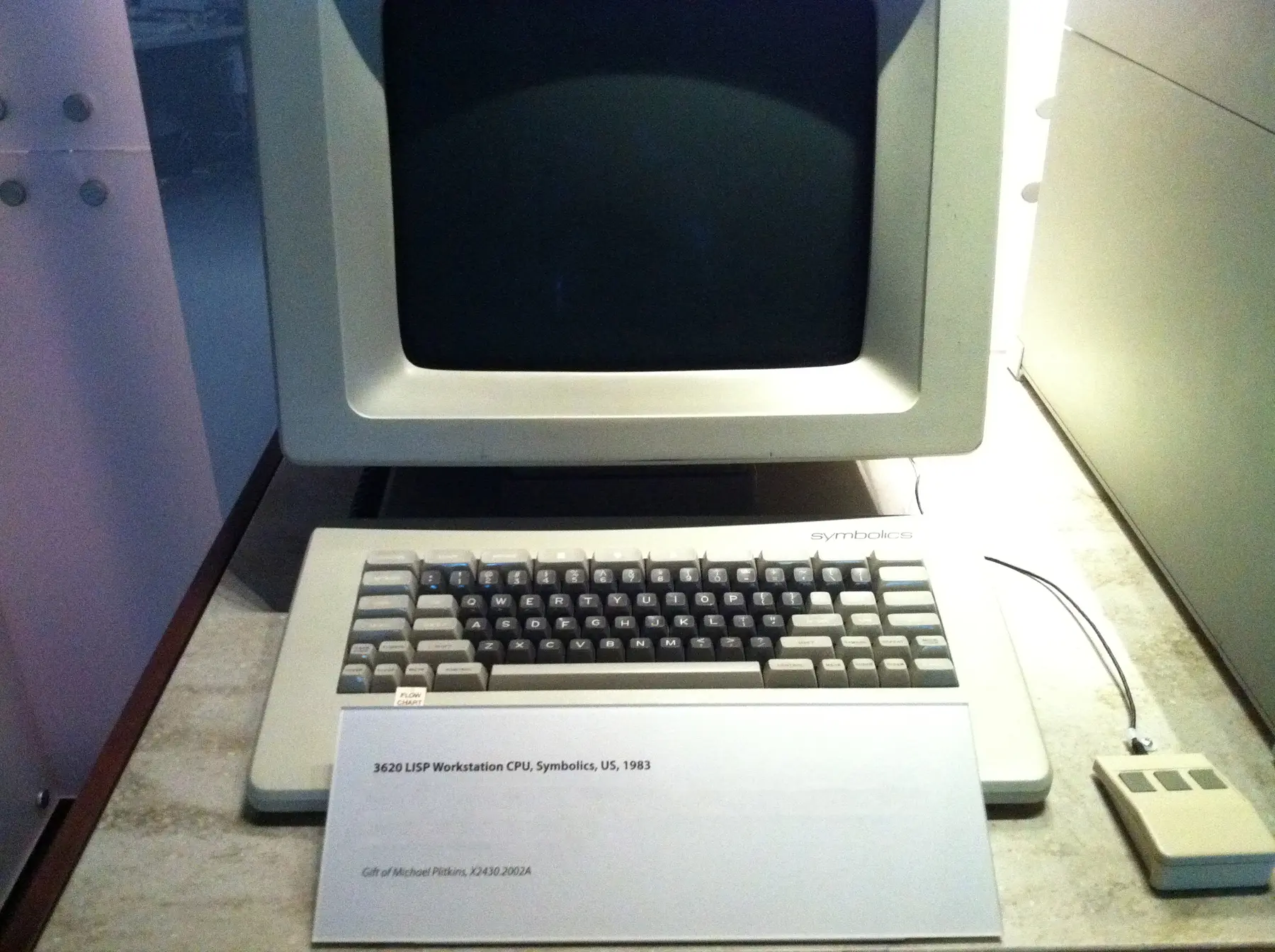
The machines made rapid experimentation possible. A developer could change code while the system was running, inspect objects and search large knowledge bases interactively. To universities and specialist AI firms, this felt like a glimpse of the future of software development.
But the workstations were expensive and formed a world of their own. General-purpose Unix workstations from Sun, Apollo and other manufacturers were becoming faster and cheaper. LISP compilers on standard hardware improved. The special machine thereby lost its main economic argument.
The LISP machine had been built for a future in which symbolic AI would dominate the computer industry. When that future failed to arrive, specialisation became a weakness.
07 / Japan announces the fifth generation
A national project turned AI into a geopolitical contest
In 1982, Japan’s Ministry of International Trade and Industry launched the Fifth Generation Computer Systems project. The name suggested a new step after valves, transistors, integrated circuits and microprocessors. The fifth generation would not merely calculate faster, but process knowledge, draw conclusions and communicate in natural language.
The Institute for New Generation Computer Technology, ICOT, coordinated the programme. Researchers concentrated on logic programming languages such as Prolog and parallel computers capable of performing large numbers of inferences simultaneously. Plans and demonstrations featured automatic translation, legal knowledge bases, medical consultation and software that partly wrote itself.
The Japanese announcement caused anxiety in the United States and Europe. Japan had already demonstrated its strength in cars, consumer electronics and semiconductors. If it now controlled the intelligent computer as well, an entire industry could fall behind. Governments and companies began their own research programmes and cooperative ventures.
Approximately 54 billion yen was invested over eleven years. ICOT built working parallel inference machines and produced valuable research. The broad public promise was not fulfilled, however. Natural language remained difficult, knowledge bases were labour-intensive and Prolog did not become the universal foundation of the next computer world.
When the project ended in 1992, the fifth generation had not become a new mass platform. It had nevertheless mobilised investment, fear and research around the world.
08 / AI even reaches SEGA
The future acquired a keyboard, speech and a touch pad
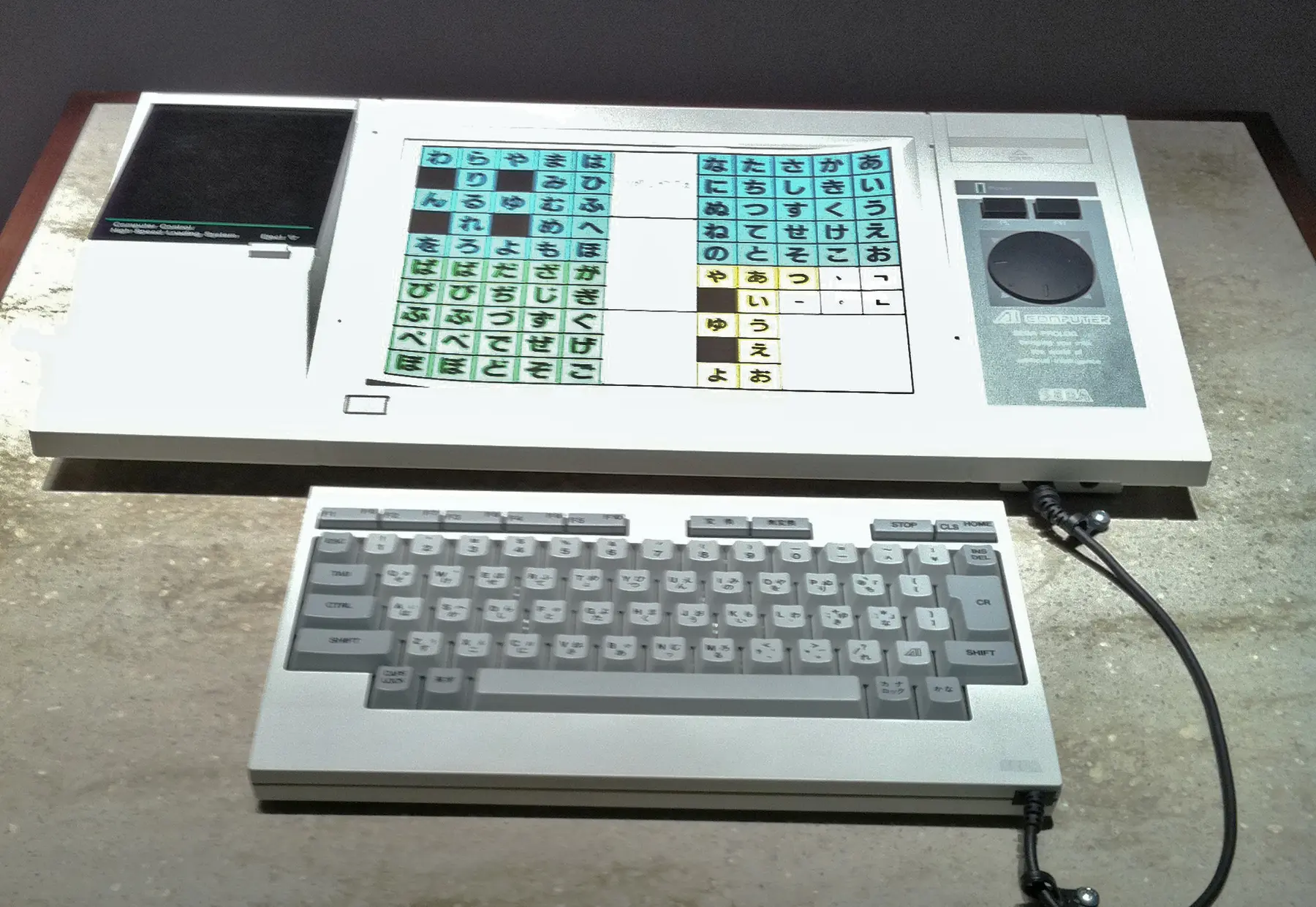
Japan’s AI wave was not confined to national research institutes. The SEGA AI Computer appeared in 1986, intended for education and experimentation. The flat system used a simplified version of Prolog and could be combined with speech recognition and a touch pad.
The device demonstrated how broadly the term AI was now being applied. A computer that recognised words, performed logic puzzles or accepted symbolic input could be presented as a gateway to a new style of programming. Working with knowledge and logic would become as natural to young users as BASIC on a home computer.
No large ecosystem developed around the SEGA AI Computer. Only a small number of programs appeared, and its abilities were limited compared with the national ambitions from which its design descended. Speech recognition worked only in simple situations; the computer did not understand free conversation. The term AI gave a coherent identity to a collection of interesting functions, but did not make them magical.
That is precisely why the device offers such a strong image of its period. Artificial intelligence was no longer only an academic term. It had become a marketable idea, recognisable from a logo, a futuristic shape and the promise that users would no longer have to program every step themselves.
09 / Tens of thousands of processors as an artificial brain
The Connection Machine made intelligence visible
Not every researcher believed that more rules would be enough. Some problems demanded enormous numbers of simple calculations performed at the same time. Thinking Machines Corporation, founded in 1983, built the Connection Machine CM-1 for this purpose.
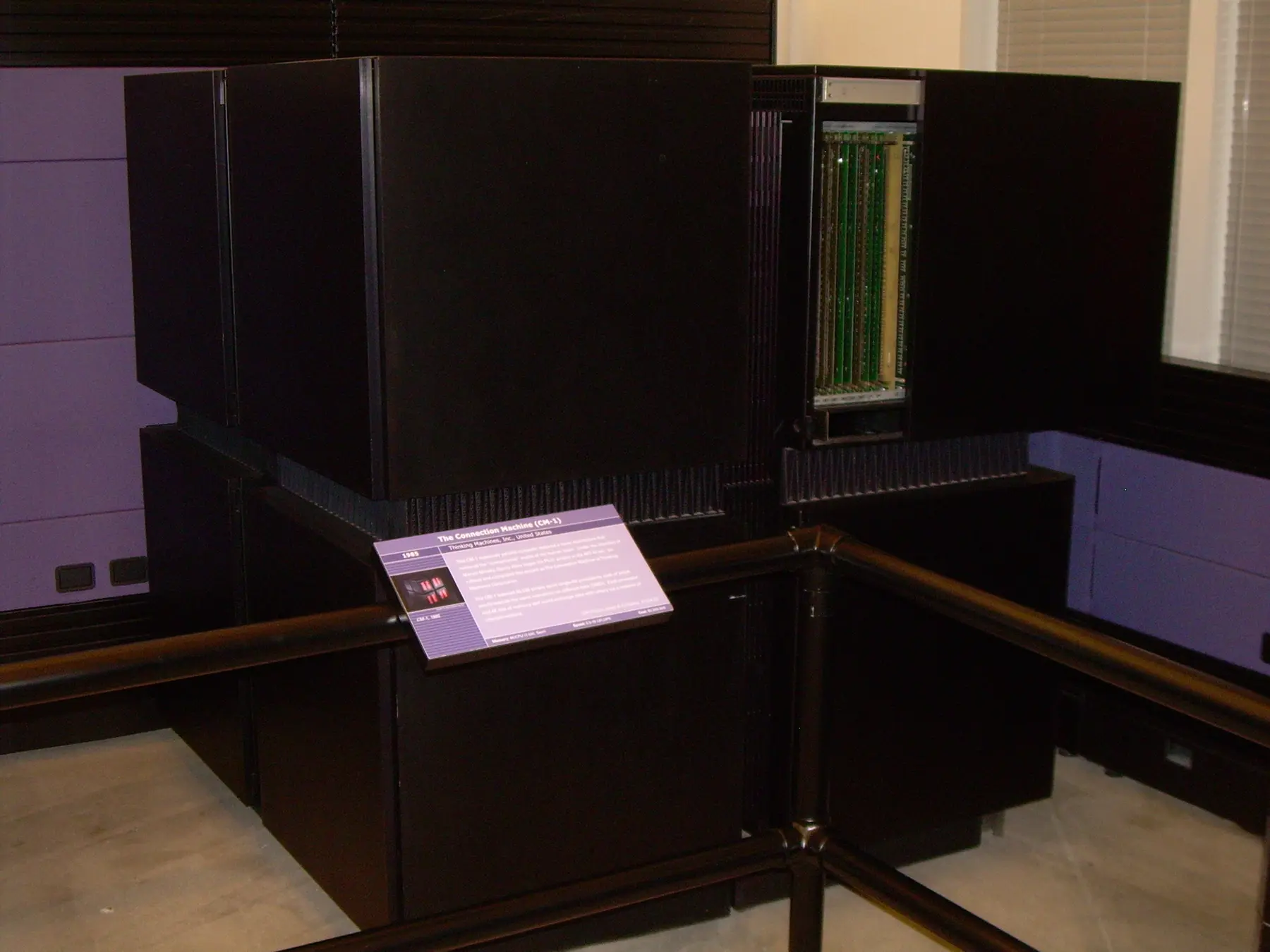
The black cube contained 65,536 simple processing elements connected in a network. Red lights displayed their activity. The machine was not literally an electronic brain, but its appearance and operation encouraged that association: intelligent behaviour might emerge from a great many small units processing information together.
The CM-1 was used for research into pattern recognition, search problems and simulations. It was technically fascinating, but expensive and unusual to program. Only a small number were sold, mainly to research institutions.
The Connection Machine nevertheless pointed forwards. The dominant AI of the 1980s dealt mainly in explicit symbols and rules. Modern AI relies heavily on vast numbers of parallel calculations. Today’s graphics processors are not direct descendants of the CM-1, but the basic idea—using many simple computing units at the same time—sounds remarkably familiar.
10 / Rules without common sense
The digital expert knew a great deal and understood very little
Expert systems could perform impressively while a problem remained inside their knowledge base. Outside it, they became brittle. A human specialist notices that a question is strange, that measurements contradict one another or that an exceptional situation calls for caution. A rule-based program saw only the conditions that had formally been encoded.
This problem was called brittleness. A system might handle hundreds of difficult cases correctly and then stumble over something that seemed obvious to a beginner. Adding more rules offered temporary help, but also increased the chance of conflicts and unexpected interactions.
There was also the knowledge acquisition bottleneck: gathering, checking and updating knowledge took a long time. Meanwhile, the world kept changing. Product lines were renewed, medical understanding shifted and regulations acquired exceptions. An outdated digital expert was particularly dangerous because its answer retained the same confident form.
John McCarthy observed that systems such as MYCIN could perform reasonably well as long as the user possessed common sense and understood their limitations. It was an uncomfortable conclusion. The computer did not replace the expert; it remained dependent on an expert who knew when not to trust its advice.
Rules made reasoning inspectable, but the meaning behind those rules remained human work.
11 / The market cools
The intelligent computer becomes ordinary software again
By the mid-1980s, market studies forecast enormous growth for AI. Companies purchased LISP machines, expert-system shells and consultancy projects. Not every pilot reached everyday use, however. The cost of hardware, knowledge acquisition, integration and maintenance proved higher than the demonstration had suggested.
At the same time, ordinary workstations improved rapidly. Software that had once required special hardware could run on cheaper general-purpose computers. The market for LISP machines collapsed. The AI label also lost its shine. Suppliers discovered that customers preferred to pay for a concrete configuration, planning or diagnostic system rather than for an abstract promise of intelligence.
At the end of the 1980s and the beginning of the 1990s, companies disappeared, research budgets were reduced and people once again spoke of an AI winter. This did not mean that all research stopped. Many applications continued under less burdened names: business rules, decision support, optimisation, pattern recognition or advanced software.
The failure lay mainly in the scale of expectation. A working expert system for one task was presented as a stepping stone towards machines that could master knowledge in general. When that leap did not occur, even the useful technology appeared disappointing.
AI did not disappear. For a while, the term was simply spoken more quietly.
12 / What remained
The rules disappeared into software, while learning began again
Expert systems left a lasting legacy. Rule-based software is still used for tax calculations, credit assessment, medical alerts, product configuration and fault diagnosis. It is often no longer called AI. Once a technology becomes reliable and ordinary, it quietly moves from “intelligence” to “automation”.
The idea that knowledge can be managed separately from the inference mechanism remained influential as well. Developers still build rules, knowledge graphs and decision trees that professionals can inspect. The demand for explainable decisions has only grown.
At the same time, a different route re-emerged during the same decade. In 1986, David Rumelhart, Geoffrey Hinton and Ronald Williams described how neural networks could learn internal representations by propagating errors backwards. This approach did not require every rule to be written in advance. It did require large quantities of data and computing power—the very resources that would only become abundant later.
The present AI boom therefore both resembles and differs from that of the 1980s. Companies once again promise digital experts and natural conversations. Knowledge, however, is now mainly stored in statistically learned parameters rather than readable IF–THEN rules. This makes systems more flexible, but their reasoning more difficult to inspect.
The 1980s did not produce the computer that understood everything. They did produce the questions that remain central: where does knowledge come from, who maintains it, when should we trust an answer, and what happens outside the examples the system knows?
- PROMISEThe knowledge of the finest specialist would become infinitely reproducible.
- BREAKTHROUGHExpert systems such as MYCIN and XCON proved that rules could reason usefully within a narrow domain.
- BRAKEKnowledge was expensive to capture, rules became brittle and special AI hardware lost to cheaper general-purpose computers.
- LEGACYRule-based decision systems survived, while parallel computing and learning networks prepared the next AI wave.
The failed promise of the 1980s was not that computers would never support expert work. It was that human expertise could easily be captured in a sufficiently large pile of rules. The digital expert proved not to be a product that could be completed, but a continuing negotiation between knowledge, software and responsibility.
13 / Sources & images
Read and explore further
- Computer History Museum — Solving the Riddle of AI
- Computer History Museum — Artificial Intelligence Enters the Mainstream (1985–1986)
- Stanford — Knowledge Engineering: Principles and Methods (1982)
- John McCarthy — Some Expert Systems Need Common Sense (1984)
- Information Processing Society of Japan — Fifth Generation Computer Project
- ICOT / AIST — What is FGCS Technology?
- Computer History Museum — 1992: Fifth Generation project ends
- Nature — Learning representations by back-propagating errors (1986)
- AI Magazine — CYC: Using Common Sense Knowledge to Overcome Brittleness and Knowledge Acquisition Bottlenecks (1985)
- Computer History Museum — AI and Play, Part 1
Image credits
SEGA AI Computer — Thomas Conté, CC BY-SA 2.0.
Symbolics LISP Workstation — Thomas Conté, CC BY-SA 2.0.
Connection Machine CM-1 — Carlo Nardone, CC BY-SA 2.0.
All images resized and converted to WebP. Their original aspect ratios have been preserved.


