Failed promises / Part 10
Virtual reality: the future that arrived too early
The computer would no longer show a window. It would build a world around us. Yet virtual reality did not arrive too early just once: its future was announced again and again.
01 / The promise
Not looking at the computer, but disappearing into it
Virtual reality promised to remove the frame around the digital world.
A headset placed a separate image before each eye. Turn your head and the view changed with you. A glove or controller carried your hands inside, while sound appeared to come from in front, behind or above.
Architects would walk through a house before the first brick was laid. Surgeons could practise without a patient, pilots without risking an aircraft and pupils could visit ancient Rome. At home, players would literally step into a computer game.
During the 1990s the VR helmet became a standard picture of the future. The interface itself would vanish, leaving users with the feeling that they were physically present in cyberspace. But that required more than convincing the eyes. A delay barely noticeable on a monitor could cause nausea in a headset.
Virtual reality did not merely ask a computer to draw an image. It had to tell the eyes, ears, muscles and balance system the same story.
02 / A motorbike that went nowhere
Sensorama simulated more than pictures
The first immersive machine did not come from the computer industry.
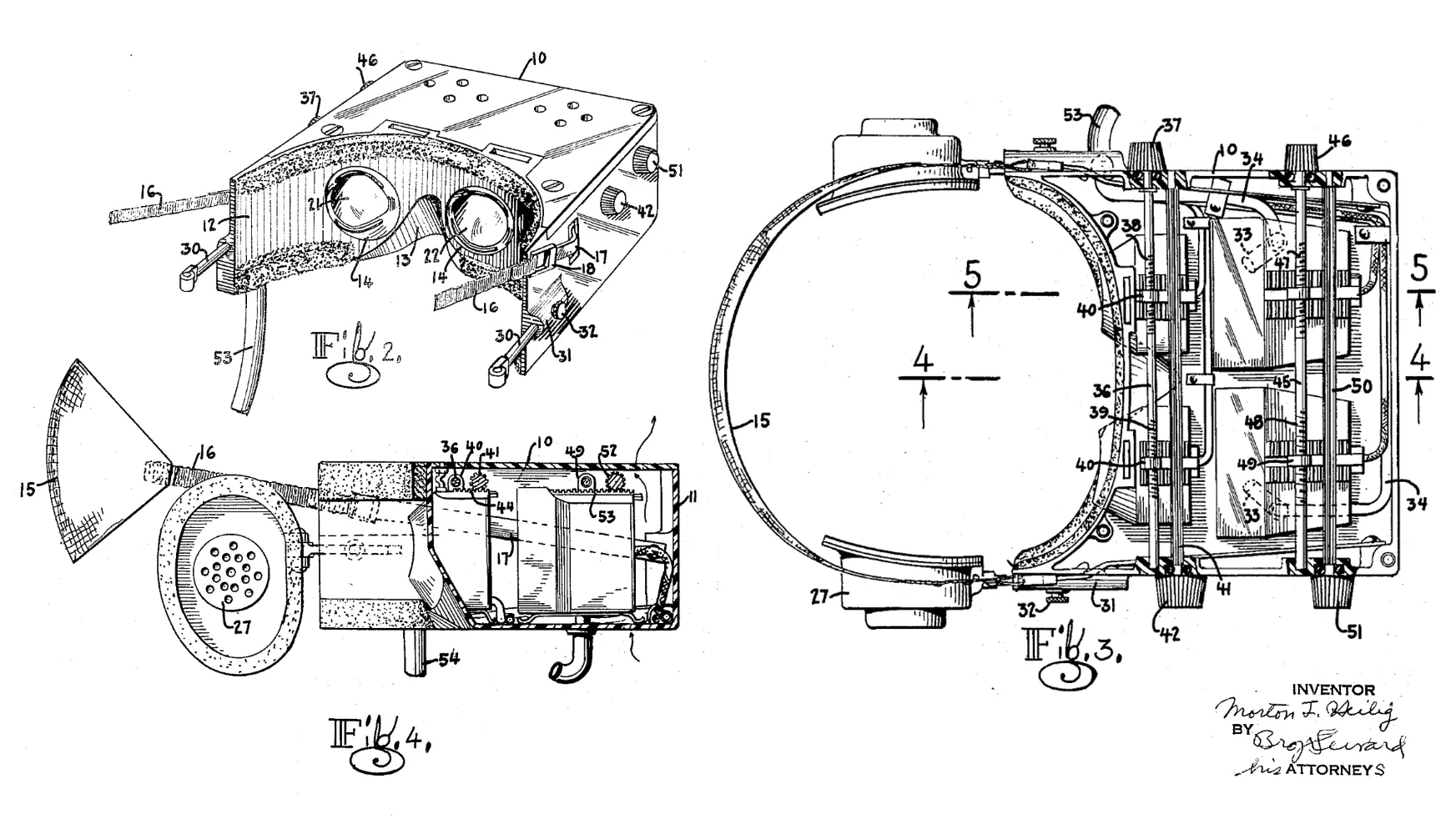
Filmmaker Morton Heilig developed Sensorama in the early 1960s: a large cabinet in which one visitor watched a stereoscopic colour film. One experience simulated a motorcycle ride through New York. The viewer heard stereo sound, felt the seat vibrate and had air blown into their face. Even scents could be part of the show.
The route was fixed. Users could not turn left or get off; in modern terms Sensorama was an immersive attraction rather than interactive VR. Yet Heilig understood that presence grows stronger when several senses suggest the same thing.
Sensorama did not enter mass production. Films had to be made especially for it, the machine was bulky and the business model unclear. It introduced a recurring problem: building a spectacular demonstration was easier than creating a versatile platform with enough content.
03 / The Sword of Damocles
The first computer headset hung from the ceiling
In 1968 Ivan Sutherland and Bob Sproull made perspective follow the user’s head.
Their head-mounted display showed simple wireframe objects over the real surroundings. Sensors tracked the head so that the computer could calculate a new view whenever the user moved.
The equipment was so heavy that a mechanical arm suspended part of it from the ceiling. This later earned it the nickname Sword of Damocles. Its user did not roam freely through a digital world, but stood beneath a piece of laboratory machinery.
Even so, the experiment contained the heart of modern VR. A virtual cube became spatial because users could look around it. The display was no longer a fixed perspective drawing but an immediate response to the body’s position.
The idea worked. It also showed how much technology was needed to make even a world of a few lines react convincingly.
04 / Virtual reality gets a name
VPL sold EyePhones and DataGloves
Faster computers and better sensors brought the separate ingredients together during the 1980s.
Jaron Lanier and VPL Research gave the field a recognisable language. Lanier is closely associated with popularising the term virtual reality. VPL sold the EyePhone, with separate displays for each eye, and the DataGlove.
Fibre-optic cables and sensors measured the bend of the wearer’s fingers. A digital hand moved on screen. Users could point at, grasp or move a virtual object. VR was no longer merely a film surrounding the head: visitors gained a body inside the computer world.
The equipment, however, cost many thousands of dollars and required powerful workstations, trackers and specialist software. Resolution and speed remained limited. VPL sold to companies, universities and research centres, not to families with home computers.
Photographs of the black glasses and colourful glove nevertheless became symbols of an imminent consumer future. The laboratory seemed just one price cut away from the living room.
05 / NASA builds a virtual workplace
An operator could acquire hands at a distance
NASA Ames treated VR not as a game but as an interface for dangerous and complicated work.
Research begun in 1983 grew into the Virtual Interface Environment Workstation, or VIEW. It combined stereoscopic vision, head tracking, three-dimensional sound and glove input.
Using cameras and a robot, an operator could work in a remote, inaccessible place. Turn the head and the camera view changed; move a hand and a robotic gripper could respond. This was telepresence: being present where the body was not.
A virtual cockpit could place instruments around a user without requiring a physical display for each one. These uses fitted the limitations. A space agency could justify costly equipment and specialised training. Cables and calibration were acceptable when the task mattered enough.
VR already worked — chiefly when one organisation could pay heavily for one precisely defined application.
06 / Cyberspace by the play
Virtuality brought the helmet to the arcade
From 1991 ordinary visitors could spend a few minutes inside a shared digital world.
British manufacturer Virtuality built stand-up systems in which players wore a large Visette headset, stood inside a circular rail and held a controller. The computer produced an image for each eye and tracked the head. Some installations connected several players.
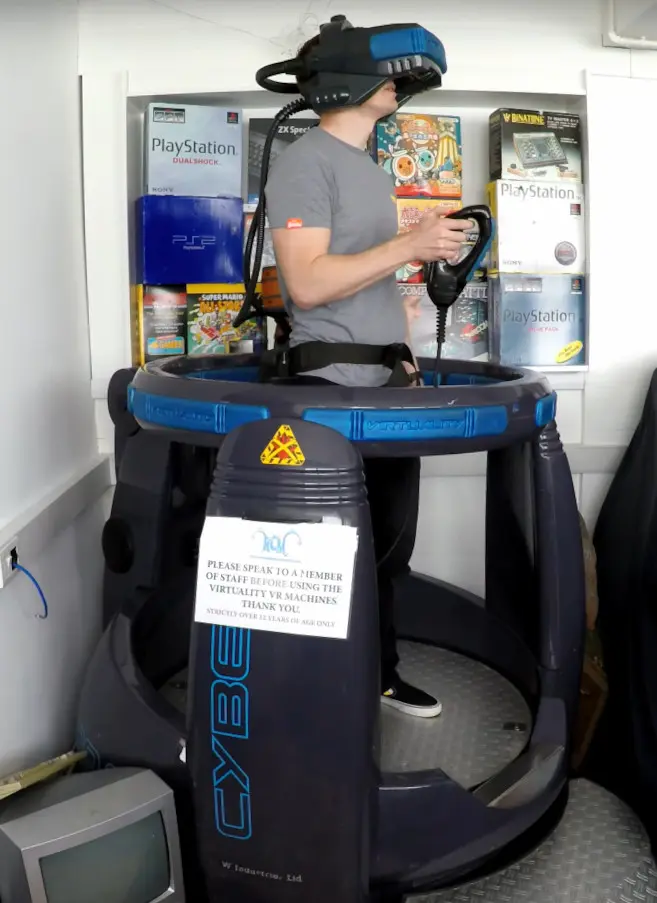
In Dactyl Nightmare, players crossed polygonal platforms, fired at one another and avoided a flying dinosaur. The picture was crude and the helmet heavy, but turning the head genuinely changed the direction of view.
The arcade suited the technology. Visitors paid for minutes, an attendant helped with the helmet and the machinery attracted an audience. A short demonstration concealed fatigue, weight and nausea. Virtuality proved that people wanted to try VR, not that they wanted to own it.
07 / The living room waits for a helmet
Sega and Nintendo mainly sold the idea
In the early 1990s VR became a promise for ordinary games consoles.
Sega announced a headset for the Genesis, known as the Mega Drive in Europe. Sega VR was meant to deliver colour, stereo sound and head tracking for about $200. Prototypes and games appeared at trade shows, but the product never reached shops.
The official explanation claimed the experience was so immersive that players might injure themselves. Technical limits were more persuasive: a 16-bit console had to produce two perspectives and respond instantly to head movements. Reconstructed software later showed each eye updating around thirty times per second while the game world could run more slowly still.
Nintendo did release Virtual Boy in 1995. Players looked into a hood mounted on a tabletop stand and saw red stereoscopic graphics. It created depth, but did not track the head or surround the user with a world. It was not full virtual reality.
The name showed how attractive “virtual” had become as a marketing word. After poor sales it also became a warning about discomfort, headaches and too few games.
08 / When the body does not believe
A few milliseconds could break the illusion
In VR, delay is not just irritating: it can become physically uncomfortable.
A headset continually measures the head and calculates two new views. The interval between real movement and the resulting picture is called motion-to-photon latency. If the image reacts late, the eyes report a movement that does not match the balance system and muscles.
Symptoms may include eye strain, disorientation, headache and nausea. Low frame rates, unstable tracking and unexpected camera motion make matters worse. Poor resolution blurs text, while a narrow field of view feels like looking through diving goggles.
All these limitations coincided during the 1990s. Small LCDs were expensive and coarse, processors could draw only simple worlds and sensors were slow or prone to interference. Modern VR has not eliminated cybersickness either. Sensitivity differs between people and experiences.
The weakest link was not the computer alone. Human perception tolerates very little contradiction.
09 / The empty world behind the glasses
Hardware needed software that worked nowhere else
Splitting an existing game between two eyes did not create a good VR experience.
Menus had to remain legible, the camera could not move unexpectedly and interaction had to work without a visible keyboard. This created a familiar problem: consumers would not buy an expensive headset without good software, while developers would not invest for a small audience.
There was friction at home too. Television viewers remain visible to other people; helmet wearers shut themselves away. Bystanders see someone grabbing empty air, while the user cannot see furniture, cables or other people. Lenses misted, leads tangled and every wearer had to readjust straps and focus.
The industry sold presence but underestimated every action before and after it. The portal into another world remained a bulky peripheral demanding space, installation and tidying up.
10 / Why the promise failed
The future did not yet fit comfortably on a head
A working demonstration did not mean everyone wanted to use it every day.
Computers were not fast enough. Two fluid perspectives with minimal delay required far more processing than one television image.
Screens were too coarse. Poor resolution and narrow fields of view made worlds pixelated and constrained.
Tracking was fragile. Delay and measurement errors broke the bond between head and image.
The body objected. Conflicting sensory information caused discomfort and sickness.
The equipment was heavy and expensive. Professional installations cost thousands; affordable versions sacrificed too much quality.
There was too little content. Without users, development did not pay; without software, users did not arrive.
The headset isolated its wearer. VR was difficult to share and awkward in an ordinary room.
The first five minutes were spectacular. Everyday use depended on comfort, setup and whether anyone wanted to put the helmet on again tomorrow.
11 / Oculus opens the door again
The parts had finally become cheap enough
Smartphones unintentionally solved much of the VR hardware problem.
They brought high-resolution compact screens, rapid motion sensors and efficient chips into mass production. Graphics processors could draw detailed 3D worlds more smoothly, while game engines and digital distribution simplified software development.
Oculus presented a Rift developer kit on Kickstarter in 2012. The campaign sought $250,000 and raised more than $2.4 million from 9,522 backers. Rift, HTC Vive, PlayStation VR and standalone headsets without separate PCs or external sensors followed.
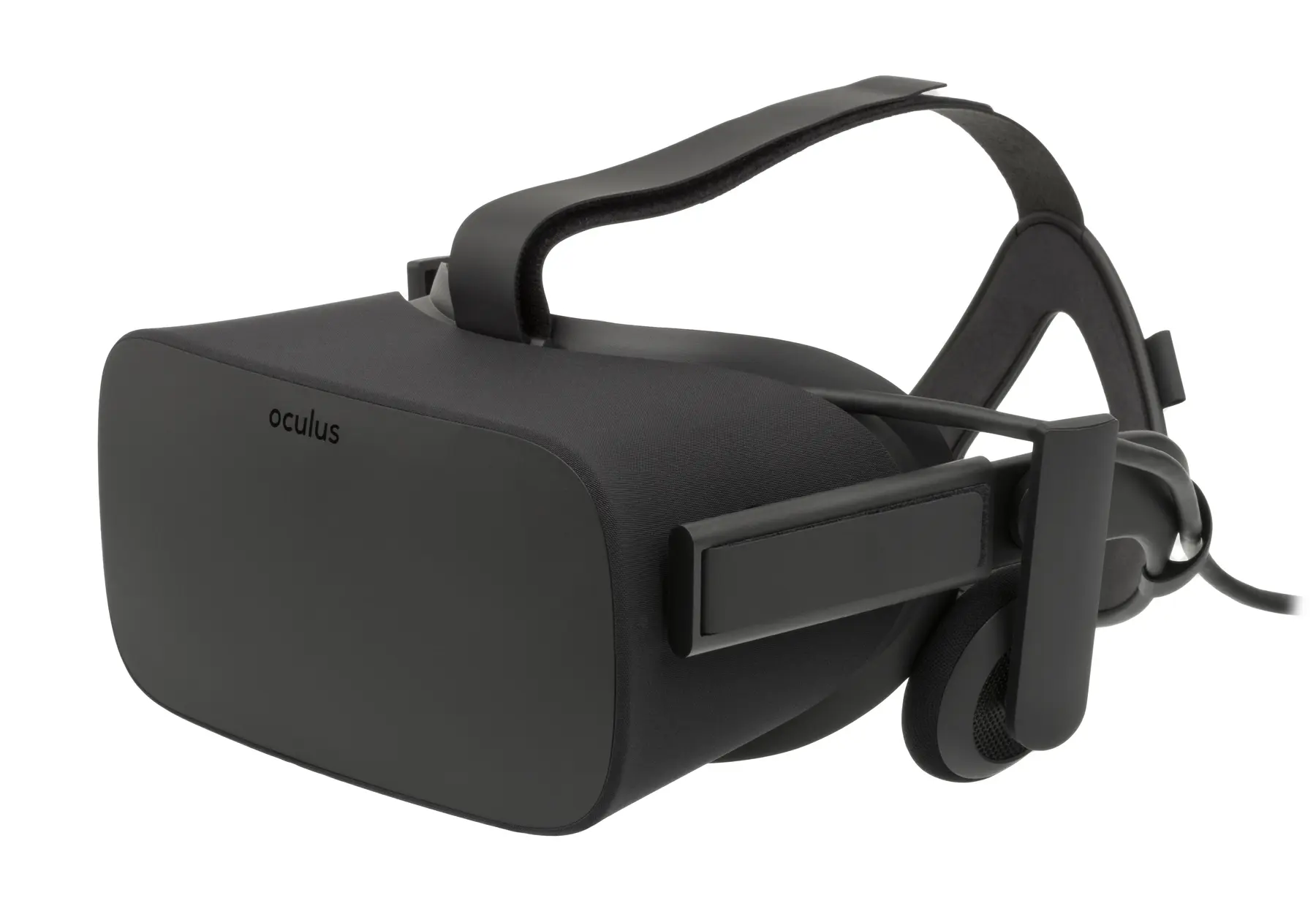
VR found strong uses in games, training, design, therapy, fitness and simulation. Yet it did not replace monitors, televisions or smartphones. Many people find it impressive but use it occasionally. Comfort, cost, isolation and a shortage of indispensable applications still set limits.
12 / What remained
VR did not arrive too early just once
Virtual reality is too successful to call a simple failure. What failed was the prediction that it would routinely replace our other screens.
- PROMISEStep inside the computer
The headset makes the digital world as convincing as the physical one.
- BREAKTHROUGHThe picture follows the head
Sutherland, VPL and NASA combined stereoscopy, tracking and hand movement.
- BRAKEThe body notices every error
Weight, latency, resolution, sickness, cost and missing software make the illusion fragile.
- LEGACYA powerful medium beside other screens
VR works for games, simulation, design, training and therapy, but not as a universal computer.
Each generation believed one more improvement would be enough. Each was right about part of the problem — but presence turned out to be a balance between technology and the human body.
13 / Sources & images
Read and explore
- Computer History Museum — Virtual Reality Before It Had That Name
- Ivan E. Sutherland — A Head-Mounted Three Dimensional Display, 1968
- NASA — A New Continent of Ideas
- Computer History Museum — Jaron Lanier
- HCI Museum — Virtuality
- Video Game History Foundation — Sega VR Revived
- Nintendo — Shigeru Miyamoto Talks Virtual Boy
- Kickstarter — Oculus Rift: Step Into the Game
- Saredakis et al. — research into VR sickness
Image credits
Stereoscopic television patent drawing — Morton Heilig, public domain; converted to WebP
Virtuality 1000CS — ctrl-alt-rees, CC BY-SA 4.0; converted to WebP
Oculus Rift CV1 — Evan-Amos, public domain; resized and converted to WebP


