Failed promises / Part 11
The flying car: almost ready for a century
No traffic jams, detours or transfers. The car of the future would simply take off when the road became crowded. Vehicles have genuinely driven and flown since 1917. So why is there still not one outside the house?
01 / The promise
From the street straight into the sky
The flying car combined two kinds of freedom: leaving whenever you liked and passing above roads, rivers and traffic jams.
In the ideal future, someone drove out of the garage, selected a destination and took off moments later. There was no bus to the station, no airport car park and no transfer. At the other end, the car descended, folded its wings and covered the final miles on ordinary streets.
It seemed a logical next step. Cars enabled individual mobility, aviation shrank the world and mass production brought complicated machines within reach of families. If both were improving so rapidly, surely their merger would follow.
The flying car kept returning: as a car with removable wings, a small aircraft that could use roads and later an electric vehicle that took off vertically. The technology changed, but the promise remained the same.
Machines that both drove and flew really were built. This is therefore not the history of a device that never worked, but of one that worked repeatedly without ever becoming ordinary.
02 / The limousine of the air
Glenn Curtiss built the Autoplane in 1917
An enclosed cabin, four wheels, three layers of wings and a propeller made the vision tangible.
The Curtiss Autoplane seated a driver and two passengers. Its detachable wings came from the young aircraft industry, while the aluminium cabin resembled an early motor car. It was promoted as a limousine of the air.
At the Pan-American Aeronautic Exposition in New York it must have looked persuasively futuristic. The automobile was still young and the first powered flight lay less than fifteen years in the past. The boundary between both worlds did not yet appear fixed.
The Autoplane may have made short hops, but it never completed a proper flight. When the United States entered the First World War, Curtiss concentrated on military aircraft.
Even so, it immediately revealed the basic compromise. A car must be compact and strong; an aircraft needs to be light and streamlined. What helps one function can obstruct the other.
03 / An aeroplane for Main Street
The Waterman Aerobile genuinely flew
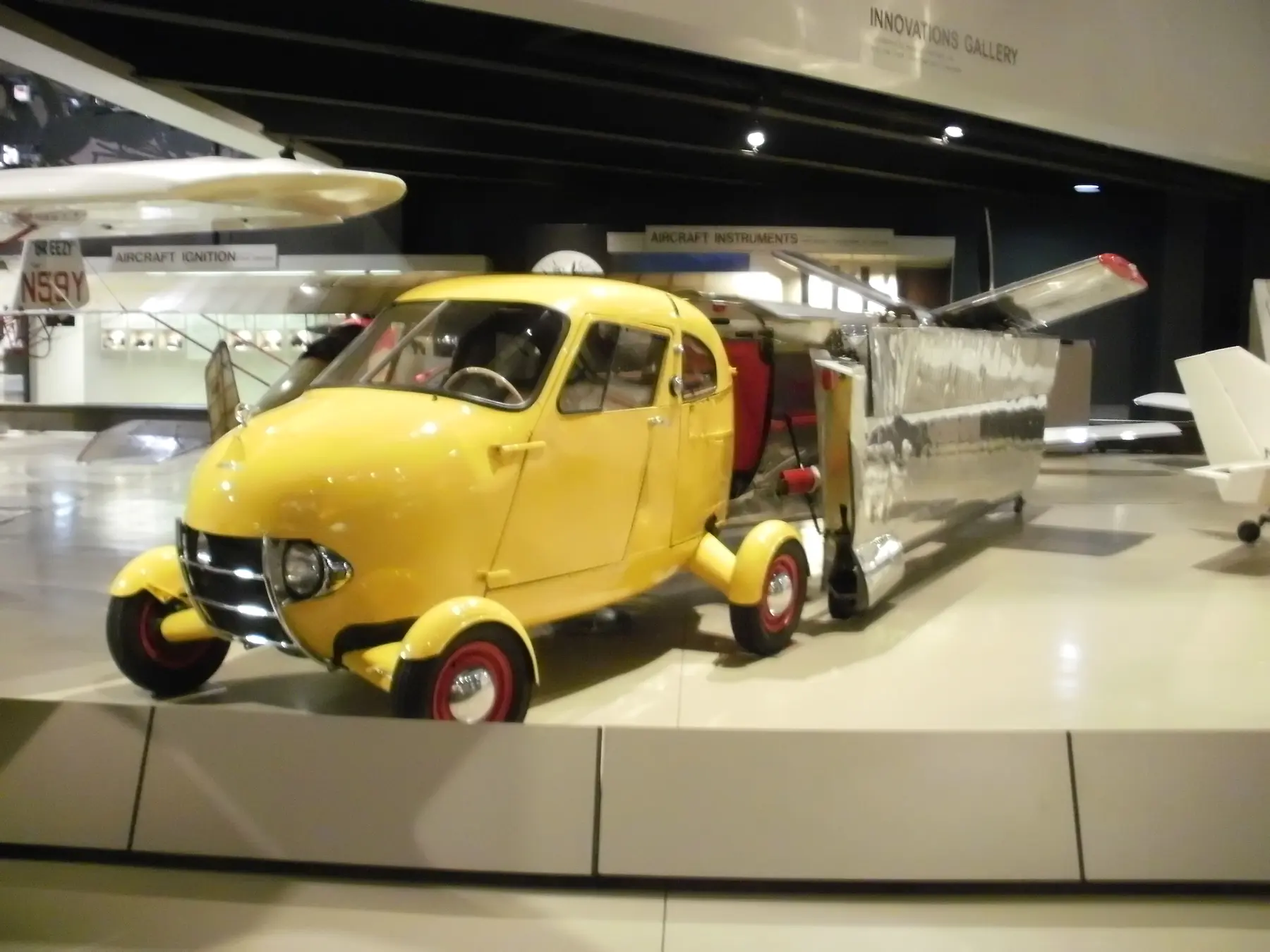
Waldo Waterman's Arrowbile, later called Aerobile, made its first test flight on 21 February 1937.
The two-seater had a high wing, a pusher propeller at the rear and three wheels. Its wings could be removed for road use. The engine then powered the wheels rather than the propeller. This was more than an aircraft that happened to taxi to its hangar.
Waterman hoped to make a machine easier to fly than a conventional aeroplane and suitable for car-like series production. Even the adapted engine came from Studebaker.
Removable wings, however, were convenient only when the pilot returned to the same place. Land elsewhere and the flying parts had to be carried along or left behind. Nor did a driving licence turn anyone into a pilot. Weather, navigation, radio communication and emergencies required separate skills.
The Aerobile solved part of the engineering puzzle while exposing the practical one.
04 / The aeroplane that left its tail behind
The Fulton Airphibian received official approval
After the war, personal aviation seemed ready for the same breakthrough as the family car.
Robert Edison Fulton Jr designed a vehicle that let pilots continue to a home or office without hiring a car. The Airphibian first flew in 1946. During conversion, its wings, tail and propeller remained at the airfield while the front section drove away as a car.
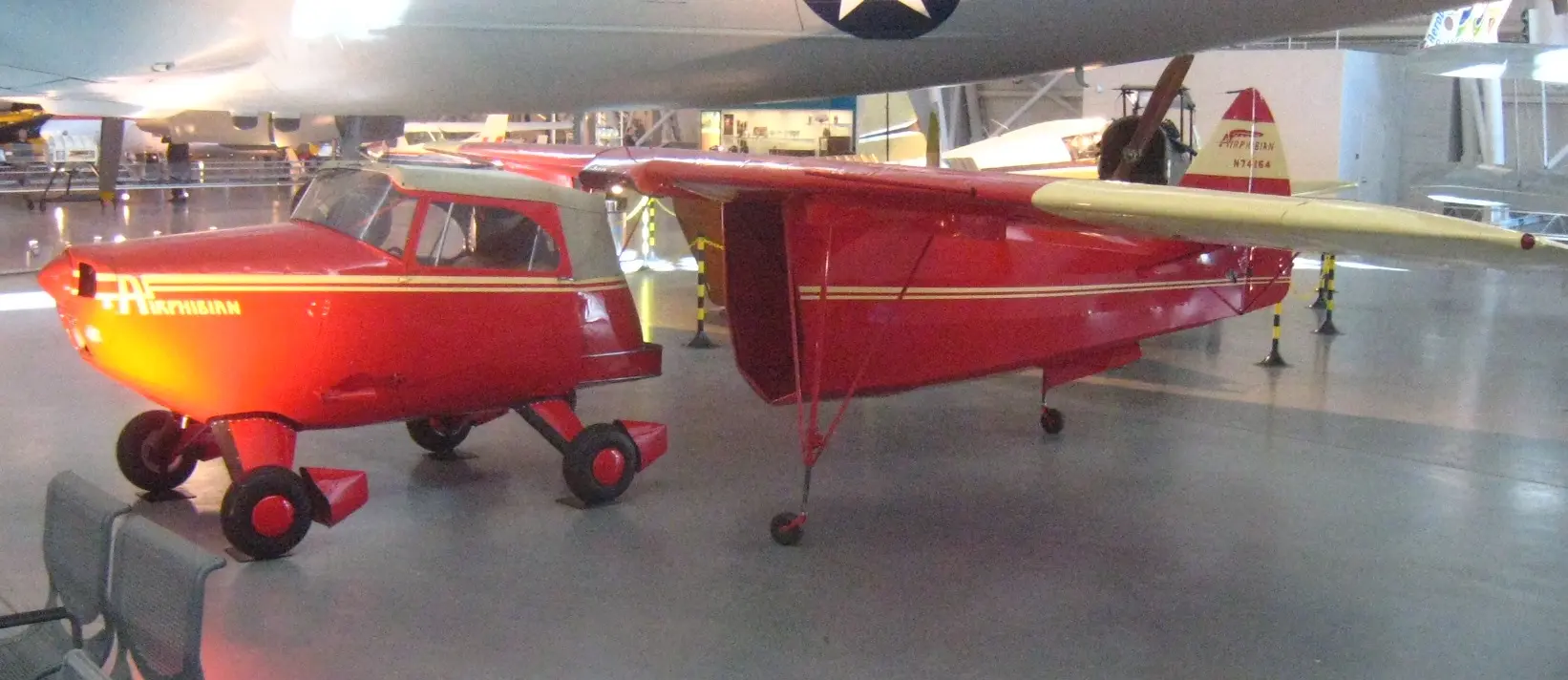
Certification was a major achievement, but series production never followed. The design was costly, remained a compromise and investors could not be certain that enough customers would buy it.
The Airphibian mainly solved transport after a flight. Its owner still drove to an airfield, attached the flying section and landed at another airfield. In practice it was a small aeroplane with a built-in answer to the hire car.
05 / The Aerocar comes closest
Six examples were not enough to create an industry
Moulton “Molt” Taylor did not leave the flying parts behind, but folded them into a trailer.
The first Aerocar flew on 8 December 1949. It gained road approval and aircraft certification. In photographs it looks surprisingly convincing: not a film prop, but a small two-seat car that truly became an aeroplane.
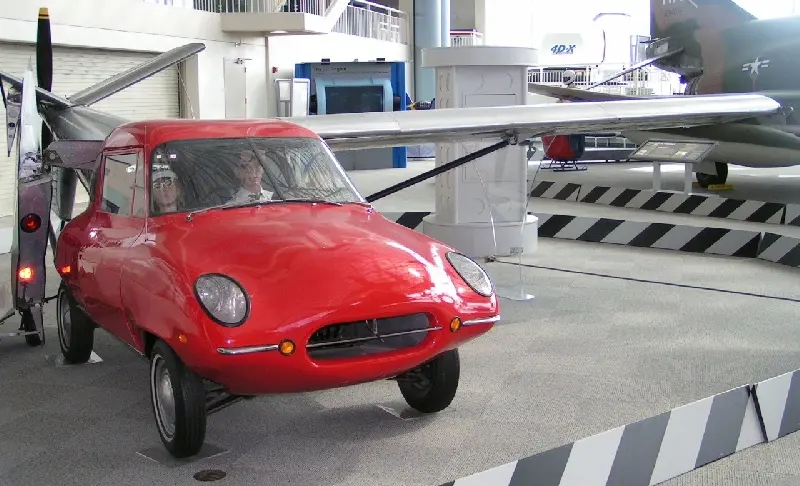
One Aerocar even spent years gathering traffic reports for an American radio station. Yet only six were built. Mass production required a substantial order. Buyers hesitated without a factory and service network, while investors would not fund those without proven demand.
The car also carried its aeroplane everywhere. Its trailer made it long and awkward on the road. The Aerocar proved driving and flying could be combined. It did not prove that enough people would pay for every compromise.
06 / Two machines that want opposite things
Weight is protection on the road and punishment in the air
Cars and aeroplanes both have engines, but they are designed for almost opposite conditions.
A car rests on the road. Crumple zones, airbags, strong doors, comfortable seats and sound insulation make it safer and more pleasant. An aircraft must lift every kilogram. More weight requires larger wings, extra power and more fuel — additions that themselves add weight.
The shapes conflict too. A compact car fits a lane and parking space; an aircraft needs wing area. Folding parts require hinges and couplings that must be secured correctly before every flight.
One engine driving both wheels and propeller needs complicated transmission. Separate systems force the vehicle to carry machinery that does nothing in one of its modes.
Then come two kinds of maintenance and regulation. Tyres, brakes and lamps belong to the road; propeller, controls and airframe to aviation. The result is rarely the best car or the best aircraft, but an expensive compromise for a small group that needs both.
07 / It will be outside tomorrow
Popular culture turned a niche into an expectation
Put ordinary cars in the air and a picture of the present instantly becomes futuristic.
In the 1962 cartoon The Jetsons, families flew between towers and aerial highways. George Jetson's car could even turn into a briefcase after arrival. Films and magazines simply omitted runways, licences, noise and bad weather.
During the 1980s and 1990s vertical take-off became another requirement. The Moller Skycar was supposed to rise vertically using several engines and ducted fans. It was displayed and announced for years, but never reached certified production.
The project became a classic example of a flying car that always seemed impressively close. Meanwhile, a working roadable aircraft such as the Aerocar no longer felt sufficient. The vehicle also had to be quiet, automatic, safe and about as easy as an ordinary car.
The dream became more attractive as its demands grew harder to combine.
08 / The Dutch route
PAL-V chose an autogyro instead of magic
The Dutch PAL-V Liberty deliberately surrenders part of the futuristic image in order to remain closer to existing technology and rules.
On the road, Liberty is a narrow three-wheeler. For flight, its rotor, tail and pusher propeller are unfolded. In the air it works as an autogyro: forward motion makes the main rotor turn while a separate propeller provides thrust.
Liberty does not take off vertically and needs a runway. This makes it less spectacular than many visions, but avoids the added complexity of helicopter-like propulsion.
Road approval was achieved in 2020. European aircraft certification is a separate process. In 2024 EASA said it was working on type certification; in March 2026 PAL-V announced that the Dutch RDW had recognised the company as an automotive manufacturer following an initial assessment. The company's own schedule targets first deliveries in 2028.
Even then, Liberty will be intended for owners with enough money, flight training and airfield access. It may succeed as a product without making flying cars a common street sight.
09 / The car disappears from the flying car
eVTOLs promise air taxis rather than private ownership
The newest wave is often called advanced air mobility and quietly abandons the road function.
Electric vertical take-off and landing vehicles use several rotors and electric motors. Promotional pictures show them flying between airports, rooftops and dedicated vertiports. Passengers book a journey as they would a taxi, while automation assists or eventually replaces the pilot.
Most eVTOLs cannot drive on the road. That lets them avoid the old compromise. They need not fit a parking space, pass a car crash test or carry wings along a motorway.
In October 2024 the US FAA issued rules for pilots of powered-lift aircraft. NASA studies safe integration, traffic management and noise, while EASA is developing European rules.
This makes the technology serious, but also shows how much is required beyond a prototype. A transport system needs routes, charging, maintenance, emergency procedures, traffic control and public trust. The flying car may be drawing closer by ceasing to be a car.
10 / Why the promise failed
The sky is not an empty motorway
The causes form a systems problem, not merely a shortage of engine power.
Cars and aircraft demand opposite things. Protection and comfort add value on the road but mostly add weight in the air.
The user needs more than driving skill. Weather, navigation, emergencies and three-dimensional traffic require training or exceptionally dependable automation.
Certification is doubled. The vehicle must be safe on streets and in the air, where a failure can have much more serious consequences.
Take-off and landing require space. A roadable aircraft needs an airfield; a vertical vehicle needs a safe landing site without people or obstacles.
Weather and noise remain limits. Fog, wind, ice and thunderstorms make daily journeys uncertain. Thousands of low-flying vehicles would create a very different noise burden from a single helicopter.
Congestion does not simply vanish. Mass air traffic requires separation, routes and control. Bottlenecks move to departure sites, landing sites and aerial corridors.
The old dream treated the sky as unlimited empty space. Air is infrastructure too — only without visible lanes and crash barriers.
11 / Not a complete failure
Parts of the dream found their own place
The future becomes more practical once the machine no longer has to do everything at once.
Roadable aircraft solve a real problem for a small group: pilots can continue their journeys without hiring cars. The combination can be useful over long distances in sparsely populated regions.
eVTOLs focus on particular routes and transport services instead of ownership. Whether they become affordable and socially acceptable remains uncertain, but their premise is more realistic than allowing millions of untrained drivers to roam the sky.
Drones show that small flying vehicles spread faster when nobody is aboard. Removing the cabin and comfortable interior reduces weight, energy needs and risk.
Sensors, automated route monitoring and precisely controlled electric motors may make future air taxis safer. Success lies not in one universal machine, but in separating the elements of the original promise.
12 / What remained
It really flew, but never landed in everyday life
The machine itself did not fail. What failed was the expectation that it would naturally become a logical mass product.
- PROMISEDoor to door through the sky
One personal vehicle drives along the street, takes off and lands near the destination.
- BREAKTHROUGHCar and aircraft could be combined
Aerobile, Airphibian and Aerocar proved that one vehicle could perform both functions.
- BRAKETwo transport worlds in one machine
Design demands, cost, training, weather, infrastructure and regulation complicated daily use.
- LEGACYRoadable aircraft and air taxis
The combination survived in niches, while eVTOLs turned the car into a transport service.
The prototypes defeated gravity. The promise was defeated by the complete system that had to be safe, affordable, quiet and simple enough for everyday use.
13 / Sources & images
Read and explore
- Smithsonian National Air and Space Museum — Where's My Flying Car?
- Smithsonian — Waterman Aerobile
- Smithsonian — Fulton Airphibian
- The Museum of Flight — Taylor Aerocar III
- EASA — Opinion No 04/2024
- PAL-V — company history and schedule
- FAA — Advanced Air Mobility and air taxis
- NASA — Advanced Air Mobility
Image credits
Taylor Aerocar — Chris857, CC BY-SA 3.0; resized and converted to WebP
Fulton Airphibian — FlugKerl2, CC BY-SA 3.0; converted to WebP
Taylor Aerocar III — JimCollaborator, public domain; cropped version by MarkWarren, converted to WebP


