Online before the web / Chapter 11
Beep, crackle, connect
Modems, acoustic couplers and the first bulletin boards brought computers together — one telephone call at a time.
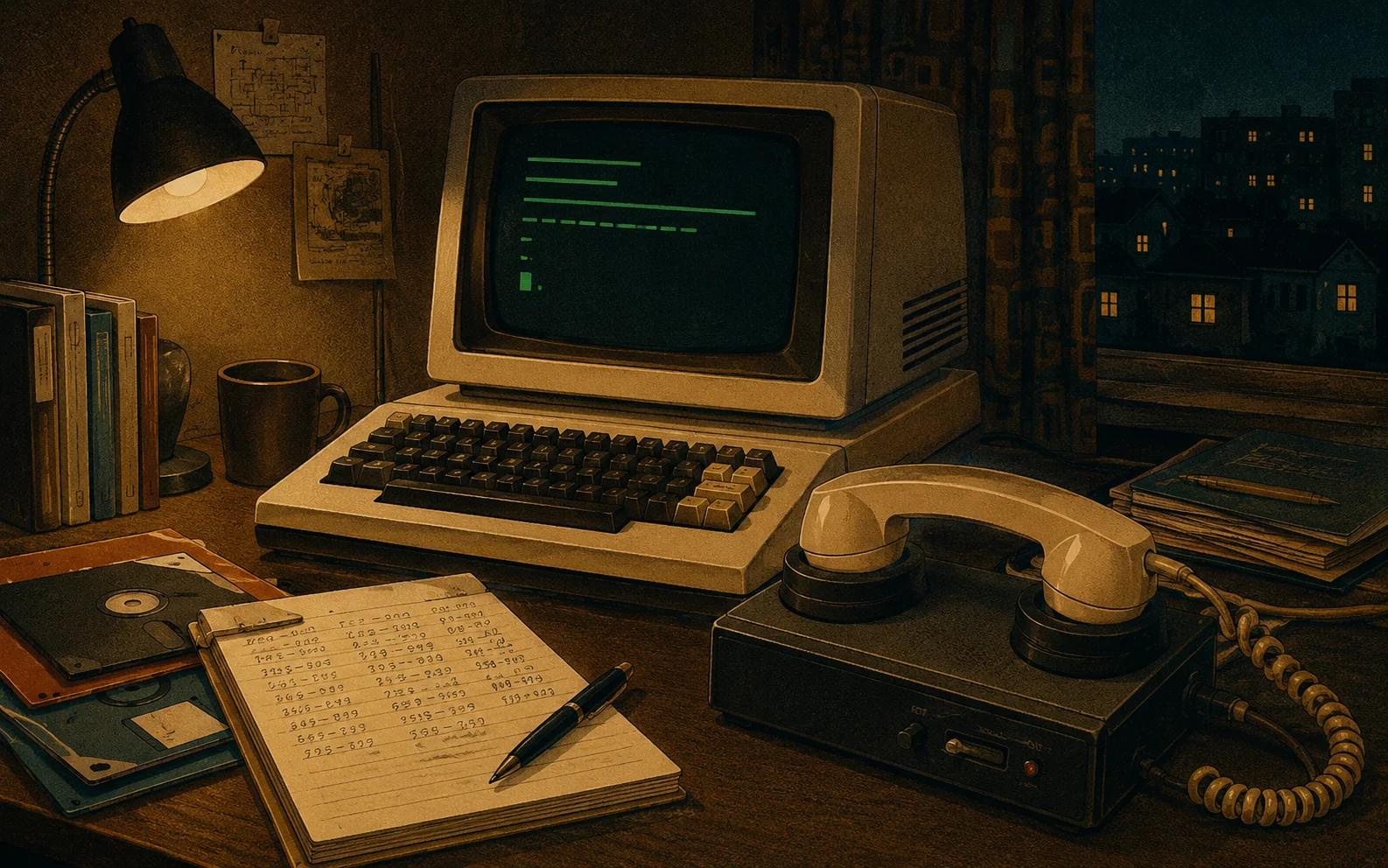
01 / A computer makes a call
The outside world arrived through the telephone line
Long before a browser opened millions of websites, one computer could already contact another.
It required a modem, a telephone number and patience. You launched a communications program, dialled the number and waited for an answer. A sequence of beeps, whistles and noise followed. If everything worked, a welcome line appeared on the screen.
At the other end was not a worldwide network, but usually a single computer in a bedroom, study or club room. It ran a Bulletin Board System, or BBS: an electronic noticeboard on which callers could read messages, collect software and sometimes play games. It was small, local and slow — yet it felt as though the computer had suddenly acquired a door to other people.
02 / The acoustic coupler
A telephone handset in two rubber cups
The acoustic coupler was a wonderfully literal bridge between telephone and computer.
The device had two rubber-lined openings. One held the earpiece of the handset and the other its microphone. The coupler listened to sounds from the telephone and converted them into electrical signals for the computer. In the opposite direction, it changed computer data back into sound.
The user generally placed the call by hand. As soon as a carrier tone sounded at the far end, the handset was pressed firmly into the cups and the coupler switched to the correct mode. Rubber edges kept out as much room noise as possible. A poorly fitting handset, a loud conversation or a knock against the desk could disrupt the connection.
The arrangement had a practical advantage: no direct electrical connection to the telephone wiring was required, and the coupler could work with many ordinary phones. It was fragile and slow, however. Many units operated at 110 or 300 baud. Even so, this was the device that made portable data communication possible: make a call, place the handset and the computer was online.
03 / Modulator and demodulator
Why a modem sounds the way it does
A conventional telephone line was designed for voices, not ones and zeroes.
A modem — its name comes from modulator-demodulator — therefore translated digital information into audible tones. The modem at the other end reversed the process. While establishing a connection, both devices tested which speed and technique the line could support. The familiar dial-up sound was not random noise, but a short negotiation between two machines.
Later modems connected directly to a telephone socket and could dial and answer for themselves. The Hayes Smartmodem of 1981 popularised text commands such as ATDT. Communications software could now dial, hang up and alter settings without the user repeatedly touching the handset. The idea proved so influential that variations of the Hayes command set survived in modems for decades.
04 / Speed
At 300 baud, you could almost watch the text arrive
The earliest home connections were slow enough to follow line by line.
A 300-bit-per-second connection delivered roughly thirty text characters each second. A simple menu felt usable, but downloading a program of several dozen kilobytes could require a long telephone session. Every increase changed the experience: from 300 to 1200 and 2400 bits per second, then to 14.4, 28.8 and 33.6 kilobits per second, and finally 56k.
Lines visibly assembled. Fine for messages, less inviting for large files.
Menus responded more pleasantly and downloads became more practical.
ANSI screens, larger archives and internet services worked much better.
The classic dial-up modem reached its practical peak during the 1990s.
Baud and bits per second are not always technically identical. Advertisements and everyday conversation nevertheless often treated them as interchangeable. For the caller, the more important question was simple: how long will the telephone line remain occupied?
05 / The first public dial-up BBS
CBBS turned a noticeboard into a destination
On 16 February 1978, Ward Christensen and Randy Suess placed Chicago’s Computerized Bulletin Board System online.
CBBS is generally regarded as the first public BBS that could be reached by dialling a telephone number. Christensen wrote the software; Suess assembled and organised the hardware. Their system was inspired by the physical noticeboard of their computer club, where members left questions, offers and announcements.
The idea was simple and powerful: why not put that noticeboard on a computer? Callers dialled in, read what others had written and left messages of their own. As the system had one telephone line and one modem, only one visitor could enter at a time. Everyone else heard the busy signal.
There had been earlier experiments in public computer communication, notably Community Memory in Berkeley from 1973. It used fixed terminals installed in public places. CBBS added something decisive: callers could connect from home using their own terminal or microcomputer.
06 / Inside the board
Messages, files and an identity of your own
A BBS consisted mostly of text, yet it could still feel like a place.
After logging in, callers found menus for public discussions, private mail and files. Some boards served one computer brand; others revolved around music, science fiction, politics or a local community. Colourful ANSI screens, polls, chat functions and door games — programs launched from inside the BBS — arrived later.
CONNECT 2400
WELCOME TO THE NIGHT LINE
[1] READ MESSAGES [2] LEAVE A MESSAGE
[3] FILE LIBRARY [4] DOOR GAMES
[Q] LOG OFF
YOUR CHOICE: █
Users often chose an alias. A small board could therefore develop a recognisable group of regulars. People argued, helped one another with hardware problems and exchanged software. The subjects and tone were strongly shaped by the person who operated the system.
07 / The sysop
There was an operator behind every number
The system operator, or sysop, kept the computer available day and night.
A sysop installed the software, created accounts, tidied message areas and answered questions. Often, that person personally paid for the computer, modem, storage and a separate telephone line. On a small board, the operator might notice that someone was online and suddenly open a live chat.
BBS numbers circulated through computer clubs, magazines, printed lists and other boards. Most callers chose a local number because long-distance charges could become expensive. A board consequently tended to have a strong regional identity. Going online meant meeting strangers, but often strangers from the same city or area.
08 / Files across the line
A download was an appointment with time
A file not only had to arrive; it also had to arrive demonstrably intact.
In 1977 Ward Christensen devised a simple method that became the basis of XMODEM. A file was sent in blocks. After each block, the receiver confirmed whether it had arrived correctly; an erroneous block was transmitted again. More elaborate protocols such as YMODEM and ZMODEM followed.
Boards accumulated large libraries of shareware, freeware, drivers, text files and games. A download nevertheless remained tense. Line noise, a lost connection or someone elsewhere in the house picking up the phone could end half an hour or more of progress in an instant.
09 / Boards begin calling one another
FidoNet turned separate islands into a network
From 1984, messages could travel automatically from one BBS to another.
Tom Jennings developed FidoNet to exchange mail between two Fido bulletin boards. The system expanded rapidly. Boards collected messages into packets and frequently called one another at night, when telephone rates were cheaper. By morning, users could read private mail and discussions that had passed through several intermediate systems.
This store-and-forward model enabled worldwide communities without requiring every individual user to make an international call. It was not an internet connection in the modern sense. FidoNet nevertheless joined local boards into a distributed social network.
10 / The Netherlands and the internet transition
From local boards to a worldwide web
Computer clubs, companies and private sysops became important gateways to the online world in the Netherlands as well.
Dutch BBSs began to flourish during the 1980s. Members of the HCC computer club could exchange messages through FidoNet from the middle of the decade. Companies operated boards for support and downloads; Microsoft Netherlands, for example, distributed product updates through its own BBS. Countless private systems had their own atmosphere, community and file collection.
As access to the internet and the World Wide Web became more affordable during the 1990s, many stand-alone boards lost their role. Some sysops stopped, while others converted their systems or became internet service providers. Part of BBS culture migrated to forums, chat services and websites.
Its principles did not vanish. Profiles, private messages, moderation, downloads and communities built around a shared interest had all existed on bulletin boards. The social web made that world larger and faster, but many of its habits had already formed in the screeching modem era.
11 / The line still sings
A connection that demanded attention
An acoustic coupler and a BBS required actions that have since disappeared: find a number, dial, listen and wait. Every successful connection consequently felt like a small achievement.
- PLACE HANDSETAcoustic coupler
Sound formed the bridge between telephone and computer.
- WAIT FOR CONNECTThe modem
Two machines negotiated their connection through a chorus of tones.
- LOG INThe BBS
One telephone number led to messages, files and people.
- FORWARDFidoNet
Local boards grew into an international network.
Today, we speak casually of being online. In the acoustic-coupler era, going online was literally audible. First the line crackled, then the letters appeared. At the other end, a computer was waiting — and sometimes an entire community.
12 / Sources & images
Read, watch and listen further
- Computer History Museum — Connecting Over Phone Lines
- Computer History Museum — Anderson Jacobson Acoustic Data Coupler
- Smithsonian National Museum of American History — Hayes Smartmodem 300
- Ward Christensen and Randy Suess — Hobbyist Computerized Bulletin Board, BYTE (November 1978)
- Ward Christensen — XMODEM Protocol Specification (1982)
- Randy Bush — FidoNet: Technology, Tools, and History (1993)
- HCC!CompUsers — Our history on the internet
- Wikimedia Commons — recording of a dial-up modem
Image credits
- Opening illustration of a computer and acoustic coupler — original work for Silicon & Joysticks