Failed promises / Part 1
The computer that was going to run the household
Storing recipes, managing the family accounts and even controlling the lights: the computer promised to organise domestic life for good.
01 / The promise
An electronic helper for the entire family
Picture an ordinary living room in the early 1980s. A brand-new home computer stands on the table.
Father uses it to track income and expenditure, mother looks up a recipe for dinner, the children do their homework and afterwards the whole family plays an educational game. The computer brings calm, order and efficiency into the home.
That, at least, was the picture manufacturers liked to present. The computer was still a strange machine and many people did not understand why they might need one at home. Saying that it could calculate and run programs was not enough. Advertisements therefore gave it an impressive job description. It was an accountant, filing cabinet, typewriter, encyclopaedia, teacher and domestic assistant all at once.
The name home computer did the rest. This was not a cold machine for an office or university, but an appliance for the family. It belonged with the television, stereo and video recorder. If the advertising was right, no modern household would soon be able to do without one.
02 / Beside the chopping board
The $10,600 kitchen computer
The dream of a digital household began before the home-computer boom.
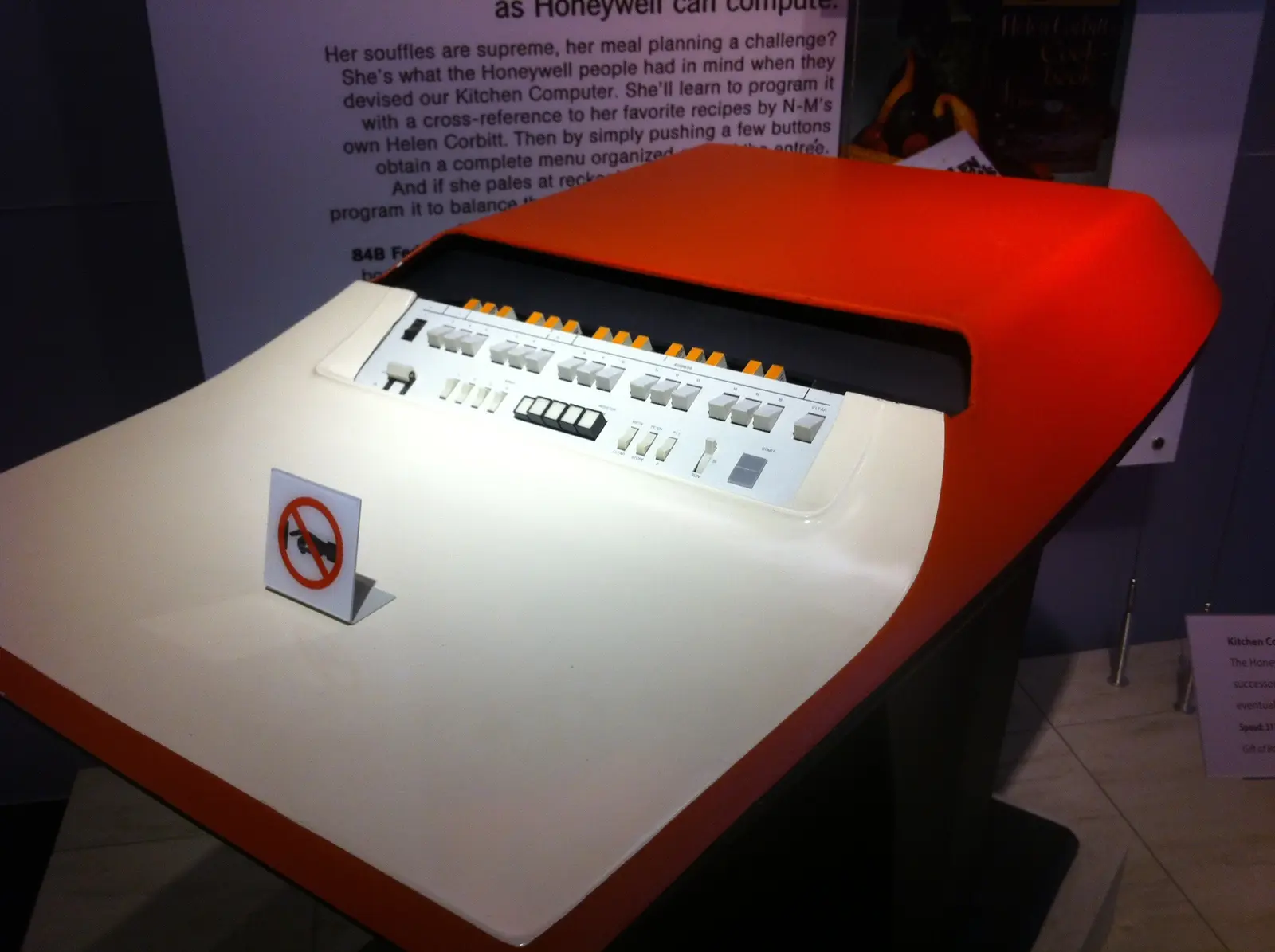
A famous example is the Honeywell Kitchen Computer of 1969. American department store Neiman Marcus offered this striking machine as an exclusive Christmas gift. It cost $10,600 and was meant to store and retrieve recipes.
It was not a practical appliance. There was no ordinary keyboard or screen. Its user had to enter and read data with switches and lights on the control panel. The price therefore included a two-week programming course. A built-in chopping board was supposed to make it clear that this small minicomputer really belonged in the kitchen.
There is no evidence that a single unit was sold. The idea nevertheless mattered: if a computer could hold recipes, there might be a place for one in the household. Recipes would remain a favourite example in computer advertising for years.
03 / A task for everyone
The ideal computer family
As computers became more affordable, manufacturers had to persuade a much larger public.
Advertisements therefore liked to place a complete family around the screen. The roles were usually strikingly traditional. Father completed the tax return, checked investments or brought work home. Mother managed the household budget and recipes. The children used the computer for school — and occasionally for a game, although serious advertisements did not always emphasise that part.
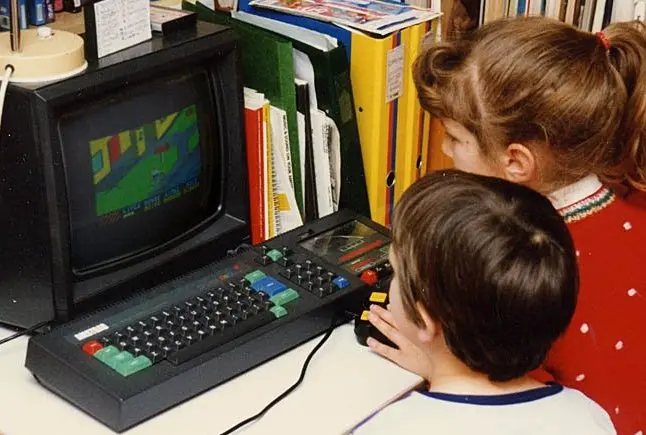
One machine could be sold to everyone this way. It was not an expensive toy for a single family member, but a sensible investment for the entire household. Even when a son mainly wanted a computer for games, its more respectable possibilities could justify the purchase to his parents.
The promise was seductive. Buying a computer meant buying not only technology, but a better-organised life and a head start on the future.
04 / Putting life in order
From household accounts to recipe index
Software catalogues and computer magazines overflowed with practical applications.
A home computer could record income and expenditure, prepare a budget, store recipes, manage addresses, remember birthdays, catalogue collections, produce letters and labels, count calories and calculate energy use.
There seemed to be a program for almost every everyday activity. Anyone unable to find ready-made software could type a BASIC listing from a book or magazine. After tens or hundreds of lines, the user possessed a cashbook, address file or recipe index — provided no typing error had crept in.
In 1984, for example, Commodore announced software for managing home budgets, recipes, sports statistics and business accounts. A Timex/Sinclair program compared twelve months of budgeted and actual expenditure. Programs for family administration and personal finance also appeared for the Apple II, TRS-80, Atari and Sinclair QL.
On paper, the digital household was getting closer all the time.
05 / Reality
Paper started faster
At home, a computer proved less patient than a paper cashbook.
Before entering a single amount, the television or monitor had to be available. The program then had to load from cassette or disk. A cassette might take minutes — and when loading failed, the whole process began again.
Entering the information also took time. A shoebox of receipts did not turn itself into a tidy financial report. Someone had to type every amount and keep doing so consistently. A recipe card was instantly readable; the digital alternative required switching on the computer, loading the program and finding the correct storage medium.
Many simple home computers had no built-in storage. Without a cassette recorder or disk drive, carefully entered data could not be saved at all. Even with storage, nothing felt entirely safe. A bad tape, damaged disk, wrong command or power failure could destroy hours of work.
Paper had its disadvantages, but it started instantly, rarely crashed and worked without a manual.
06 / Playing instead
Why the useful software stayed on the shelf
Programs designed for practical work were often slow, awkward and visually uninviting.
Games did something a paper cashbook or recipe binder could not: they brought movement, sound and immediate action into the living room.
A familiar gap therefore opened between the reason a computer had supposedly been bought and the way it was actually used. Officially it was for schoolwork, administration and learning BASIC. In practice it mainly ran games. The educational program was tried a few times; the favourite game returned every afternoon.
This does not mean that nobody organised a household with a computer. Enthusiasts really did track their spending, build address files and print letters. The same machine could be genuinely useful to small businesses and clubs. But its user had to be willing to understand the computer and adapt working habits to its limitations.
The promised domestic helper was therefore most helpful to people already prepared to devote considerable time and interest to computing.
07 / The smart home
Controlling the lights from BASIC
Some visions went beyond administration. The home computer would eventually control the house itself.
Lighting, curtains, heating, security and domestic appliances would all be operated from one central point. A surprising amount was technically possible. Expansion ports, relays and special interfaces allowed hobbyists to switch lamps, measure temperatures or build alarm systems. Computer magazines published circuits for skilled readers to try at home.
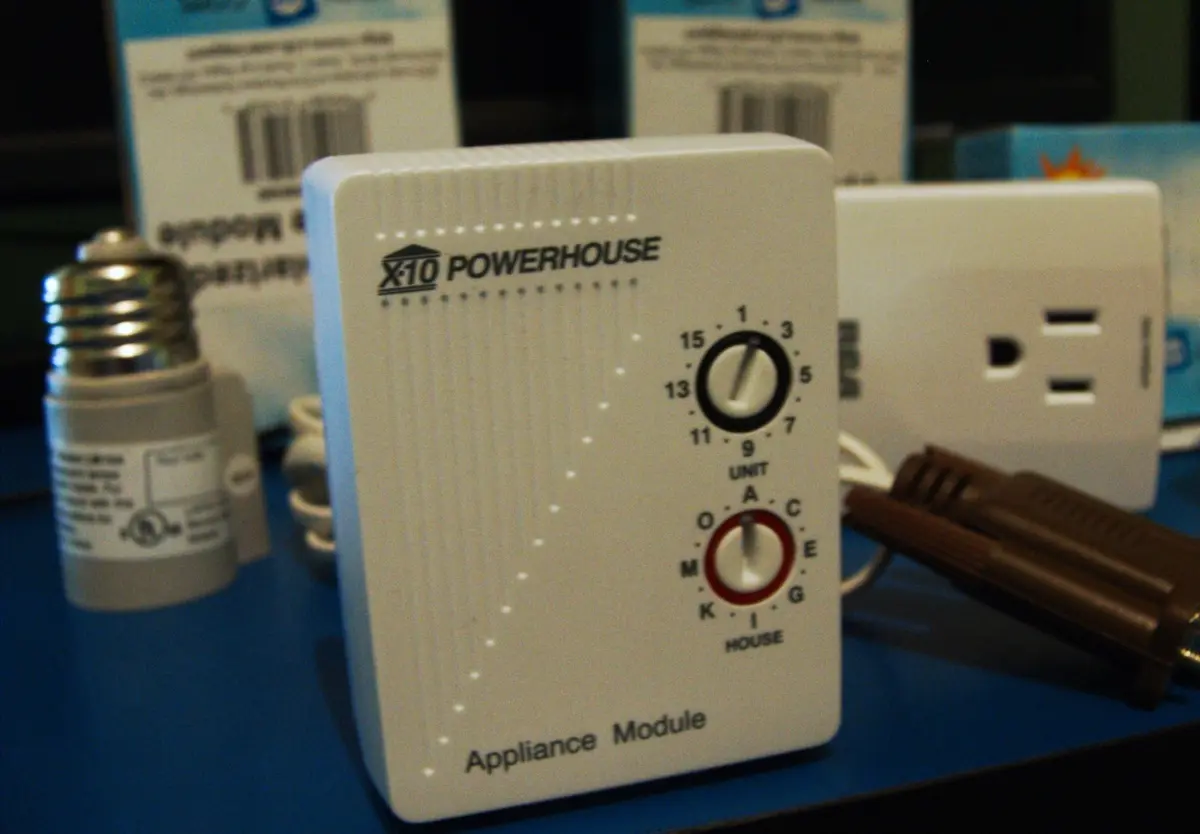
This was hardly practical for an ordinary household. The computer had to remain switched on, although many home computers were not designed for continuous operation. Installation required technical knowledge and the various parts did not automatically speak the same language. Connecting homemade circuits to appliances or mains electricity could also be dangerous without sufficient experience.
The smart home therefore existed mainly in demonstrations, magazine articles and the houses of dedicated hobbyists. For most people, the light switch on the wall remained considerably easier to use.
08 / Why it failed
Many small obstacles
There was no single fatal flaw. Many smaller difficulties prevented the computer from becoming a natural domestic assistant.
It often saved no time. Starting, loading and entering data required more effort than the old method.
It was not yet an appliance that could simply remain available. In many homes it occupied the only television and had to be packed away after use.
Storage was fragile and limited. Cassettes were slow and disks relatively expensive. Backups were sensible, but were not always made.
Programs were not interchangeable. Commodore 64 software would not run on a ZX Spectrum, Atari 800 or Philips P2000T. Buying a different computer could mean starting again.
The user did the real work. The machine could add amounts, but could not read receipts. It could sort recipes, but could not enter the ingredients itself.
The advertising family barely existed. Not every family member wanted to gather around the keyboard. The computer often became the territory of whoever understood it best.
09 / Fulfilled after all
The computer disappeared into the household
The prediction that computers would become permanent fixtures at home came true beyond doubt — just not in the expected form.
We store recipes, addresses and diaries digitally. We bank at home, order groceries online, track spending and control lights and thermostats remotely. The smart home is no longer only a hobby project built from relays and typed BASIC listings.
Yet we rarely use one central home computer in the living room. Its functions have spread across laptops, smartphones, tablets, smart speakers, thermostats and appliances with their own apps. Much of the information no longer has to be entered by hand. Banks record payments, shops remember orders and calendars issue reminders automatically.
The home computer was not too weak ever to become useful. It was mainly too early. Easy operation, reliable storage, networks, sensors and shared standards had not yet developed far enough.
10 / What remained
The right prediction in the wrong form
What remains of 1980s household software is found mainly on disks, cassettes, in manuals and in yellowed advertisements.
- PROMISEOne appliance for everything
The home computer would unite accounts, recipes, schoolwork and home control.
- REALITYMore work than paper
Starting, loading, entering and saving made simple tasks awkward.
- BREAKTHROUGHGames won
Games demonstrated more convincingly what made the new machine different and exciting.
- LEGACYEverywhere and invisible
The household computer arrived after all, distributed across apps, networks and smart devices.
Manufacturers correctly saw that digital information would change the household. They underestimated the number of steps between a blinking cursor and a computer that genuinely removed work. The computer eventually did begin to run the home — not as an obedient electronic servant beside the television, but by disappearing into almost every appliance we use.
11 / Sources & images
Explore further
- Computer History Museum — Bytes for Bites: The Kitchen Computer
- MIT — advertising personal computers in the 1980s
- WiderScreen — early home computing in the Netherlands, Finland and the United Kingdom
Image credits
Honeywell 316 Kitchen Computer — Federico Builes, CC BY 2.0; resized and converted to WebP
Children using an Amstrad CPC 464 — Adrian Pingstone, public domain; previously resized and converted to WebP
X10 adapter — phylevn, CC BY 2.0; resized and converted to WebP


