Digital culture / Chapter 06
The women who shaped early computing and video games
They programmed the first electronic computers, made software easier to understand, brought a computer into the living room and helped invent the language of video games. Yet their names often disappeared behind machines, companies and male colleagues.
01 / There from the beginning
Women programmed—but history forgot them
The familiar picture of computing history shows male inventors beside impressive machines. Just outside the frame were the women who made those machines calculate.
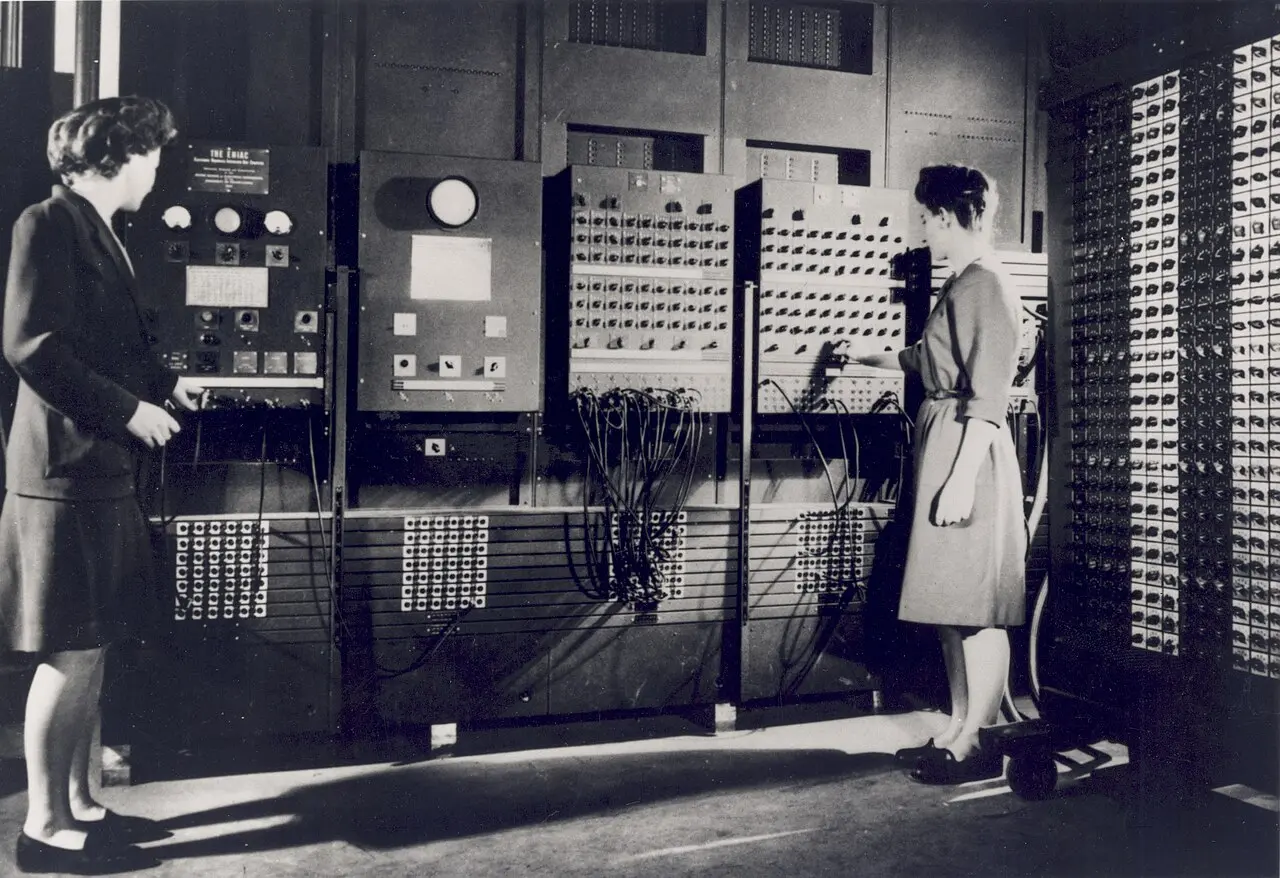
During the Second World War, large groups of women worked as human “computers”. Using pencil and paper or mechanical calculators, they calculated firing tables, projectile trajectories and scientific data. Six of the best were chosen to program ENIAC, the enormous electronic computer built by the University of Pennsylvania for the US Army.
Kathleen McNulty, Frances Bilas, Betty Jean Jennings, Ruth Lichterman, Marlyn Wescoff and Frances Snyder had no programming language, manual or operating system. They studied circuit diagrams, broke calculations into steps and configured ENIAC with switches and cables. Programming meant understanding the machine’s electrical logic in full.
At the public unveiling in February 1946, attention focused on the computer and its male designers. The programmers’ contribution was far less visible. Photographs of women beside ENIAC were even mistaken for publicity shots. Only decades later did historians bring the names and expertise behind those photographs back into view.
02 / Making software possible
Grace Hopper turned code into a language
The earliest computers expected programmers to think like machines. Grace Hopper spent her career working towards machines that people could understand.
Hopper joined the US Naval Reserve in 1943 and worked on the Harvard Mark I. After the war, she joined the company developing UNIVAC. In 1952, her team created A-0, an early compiler that translated symbolic instructions into machine code. FLOW-MATIC later made it possible to describe business problems using words resembling English.
That idea contributed to COBOL, the business programming language introduced in 1959. Hopper was an influential figure in its development and spent years advocating standards that would allow programs to run on different computers. Today, that sounds obvious. At a time when every manufacturer built a world of its own, it was revolutionary.
Other ENIAC veterans made that transition too. Jean Bartik worked on BINAC and UNIVAC, while Betty Holberton helped develop early programming tools and standards. Their careers bridged the gap between the plugboards of the 1940s and software that could be written, read and reused.
03 / To the Moon and the living room
From Apollo to a computer at home
In the 1960s, women helped demonstrate that software was not subordinate to hardware. Software could determine whether an entire mission succeeded.
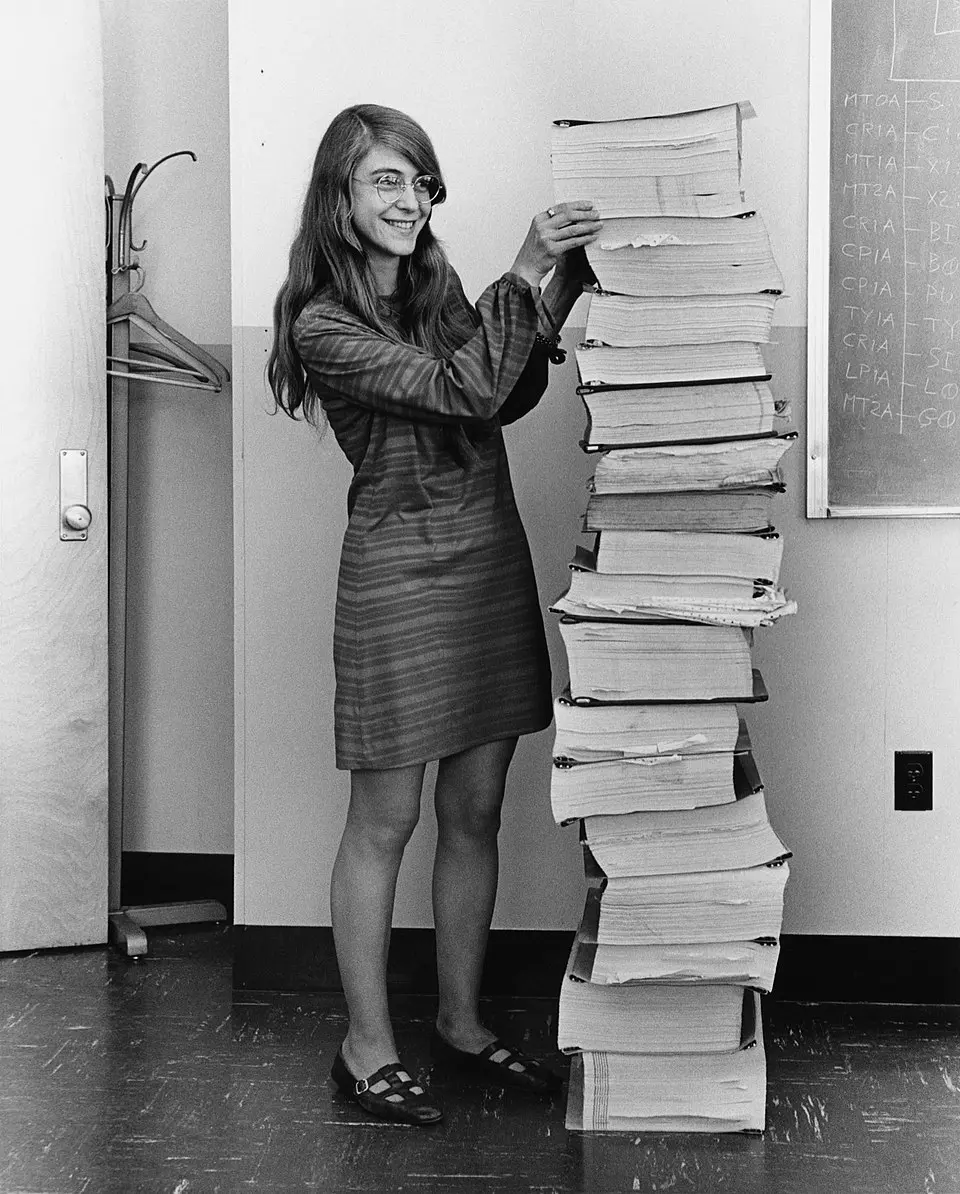
Margaret Hamilton led the Software Engineering Division at MIT’s Instrumentation Laboratory. The division developed the onboard software for Apollo’s command and lunar modules. Her team designed software that could recognise problems, set priorities and keep the most important tasks running. During the Apollo 11 landing, this allowed the computer to recover from overload alarms instead of simply crashing.
Around the same time, Mary Allen Wilkes wrote the LAP6 operating system for the LINC, a compact laboratory computer. In 1965, a LINC was installed at her parents’ home in Baltimore so that she could continue working from home. Long before “home computer” became a product category, Wilkes was programming one in the living room.
In the 1970s, Adele Goldberg helped develop and document Smalltalk at Xerox PARC. Its windows, icons, direct interaction and object-oriented approach influenced the graphical personal computers that followed. Women did more than use the earliest computers: they helped determine how later generations would interact with them.
04 / Games before the games industry
Mabel Addis and Joyce Weisbecker
Women were designing computer games before shops had shelves for them and before “game designer” was a recognised profession.
Teacher Mabel Addis worked with IBM programmer William McKay on The Sumerian Game, which was used in schools in New York in the mid-1960s. Pupils governed a Sumerian city, allocated grain and responded to changing events. Addis wrote the scenario and designed the educational structure. The result is often described as one of the earliest narrative computer games and one of the first classroom simulations.
Ten years later, teenager Joyce Weisbecker programmed games for RCA technology developed by her father, engineer Joseph Weisbecker. In August 1976, RCA paid her $250 for TV Schoolhouse I. She later made Speedway and Tag for the RCA Studio II, as well as type-in programs for the COSMAC VIP.
Working as a freelance contractor also places Weisbecker among the first independent game developers. Her story was absent from mainstream histories for many years. Researchers reconstructed it much later. It shows how easily pioneering work can disappear when nobody preserves the documents or asks who wrote the code.
05 / At the height of the arcade boom
Carol Shaw, Dona Bailey and the Atari years
By the late 1970s, video games had become an industry. Women joined the new studios, but were usually the only women in technical departments full of men.
Carol Shaw joined Atari in 1978, designing and programming VCS cartridges such as 3-D Tic-Tac-Toe and Video Checkers. At Activision, she created River Raid in 1982. The river was generated as the player flew along it, allowing a long and varied game world to fit into the tiny memory of an Atari 2600 cartridge. More than a million copies were sold.
Dona Bailey joined Atari’s arcade division in 1980 as its only female programmer. With Ed Logg, she developed Centipede, released in 1981. Bailey programmed much of the game and helped give it the bright colours that made it instantly recognisable. Its trackball, fast pace and inviting appearance attracted a wider audience than many other shooting games of the period.
Shaw and Bailey were more than token exceptions in Atari’s story. Their code and design choices produced two of the most enduring games of the period. Yet they worked in a culture that repeatedly treated women’s technical expertise as something unusual.
06 / A mystery on the Apple II
Roberta Williams made pictures part of the story
Text adventures left players to imagine the world for themselves. Roberta Williams wondered what would happen if the computer could show that world too.

After playing Colossal Cave Adventure, Williams devised a murder mystery inspired by Agatha Christie’s novels. Her husband Ken wrote the code for the Apple II; Roberta wrote the story, devised the puzzles and drew the scenes. Released in 1980, Mystery House became one of the first computer adventures to combine text and graphics.
The couple’s company grew into Sierra On-Line. With King’s Quest in 1984, Roberta Williams helped shape a new kind of animated graphical adventure in which players walked through a drawn world. The series gave stories, characters and visual staging a central place in home computer games.
Williams showed that a game designer did not have to begin as a hardware specialist. A fascination with stories, spaces and puzzles could be just as influential. Her work broadened the creative vocabulary of computer games.
07 / More names to remember
History is bigger than a single list
Many other women changed the machines, languages and games that followed. These four names connect the earliest computers with the age of the personal computer.
-
Frances Allen
Joined IBM and became a pioneer in compiler optimisation and parallel computing. She later became the first woman to receive the Turing Award.
-
Adele Goldberg
Helped shape Smalltalk and the graphical, object-oriented computing ideas developed at Xerox PARC.
-
Danielle Bunten Berry
Designed M.U.L.E., an influential multiplayer game about trade, scarcity and cooperation for Atari’s 8-bit computers.
-
Sophie Wilson
Designed the instruction set for the first ARM processor, an architecture that would later power billions of devices.
Women did not disappear from popular computing history because they lacked achievements. Programming began as loosely defined work with little status. As the software industry grew, the profession gained prestige—and became more male-dominated. Credits were incomplete, teams were reduced to a single famous name, and technical work behind the scenes was easily overlooked.
Recovering these stories changes more than a list of pioneers. It changes the history itself. The earliest computers were built by mixed teams of mathematicians, engineers, teachers, writers and programmers. The first games emerged from classrooms, laboratories, living rooms, arcades and tiny software companies.
The women in this chapter were not footnotes to somebody else’s revolution. They helped determine what computers could do, how people could communicate with them and what playing with a computer could become.
08 / Sources & further reading
Read more
- Computer History Museum — Women in Computing History
- Computer History Museum — Oral history of Jean Bartik
- Computer History Museum — Oral history of Grace Hopper
- Computer History Museum — Oral history of Mary Allen Wilkes
- NASA — Margaret Hamilton and the Apollo flight software
- The Strong National Museum of Play — Women in Games
- The Strong — Joyce Weisbecker, the first female commercial video game designer
- The Strong — Carol Shaw’s career
- AtariWomen — Dona Bailey
- The Strong — The genius of Roberta Williams
- The Strong — Danielle Bunten Berry and multiplayer games
- Computer History Museum — Sophie Wilson and ARM 1


