Everyday life with a home computer / Part 1
The computer corner at home
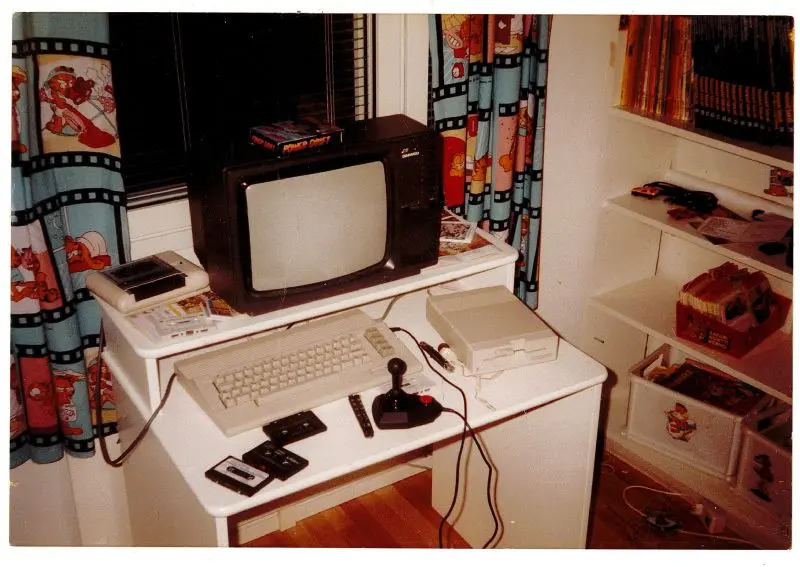
A small table, an old television and a tangle of cables became a gateway to an entirely new world.
01 / Something new among the furniture
Finding a place for the computer
A home computer rarely received an ideal workspace as soon as it entered a household. The machine was new, but the home had not been designed around it.
It ended up on a small table in the living room, on a bedroom desk or beside the television, squeezed between the video recorder and the stereo. Sometimes it appeared on the dining table for one afternoon only. Once the meal was finished, the tablecloth was rolled up and out came the computer, power supply, cassette recorder and handful of cables. Everything had to return to a cupboard or box at the end of the evening.
In other homes the machine acquired a permanent corner: an old school desk, a homemade shelf or a television trolley. At first there was only the computer. Then came a joystick, a box of cassettes, some magazines and a notebook full of commands. An unremarkable part of the house gradually became a small digital world.
02 / Everyone’s screen
The television had to be shared
A dedicated monitor was expensive, so the home computer was often connected to the family television.
This made the computer corner a subject for negotiation. A game had to stop because the news was about to begin. A program that had finally loaded from cassette gave way to a football match or favourite television series. With luck, the user could start again afterwards. Saving was not always possible, and pausing sometimes meant simply hoping that nobody touched the plug.
Many computers eventually moved to a bedroom or attic. An old black-and-white television no longer needed in the living room began a second life as a monitor. Its picture might be small and slightly blurred, but it offered freedom: nobody asked when the television would be available again.
03 / One more device
A table full of things
The computer itself was only one part of the arrangement. Around it grew a landscape of storage media, cables and paper.
A normal cassette recorder or dedicated data recorder stood beside it. Later, a disk drive might join the system: large, heavy and sometimes almost as expensive as the computer. Joysticks had to remain within reach. The table filled with cassettes, disks in paper sleeves and scraps of paper bearing commands.
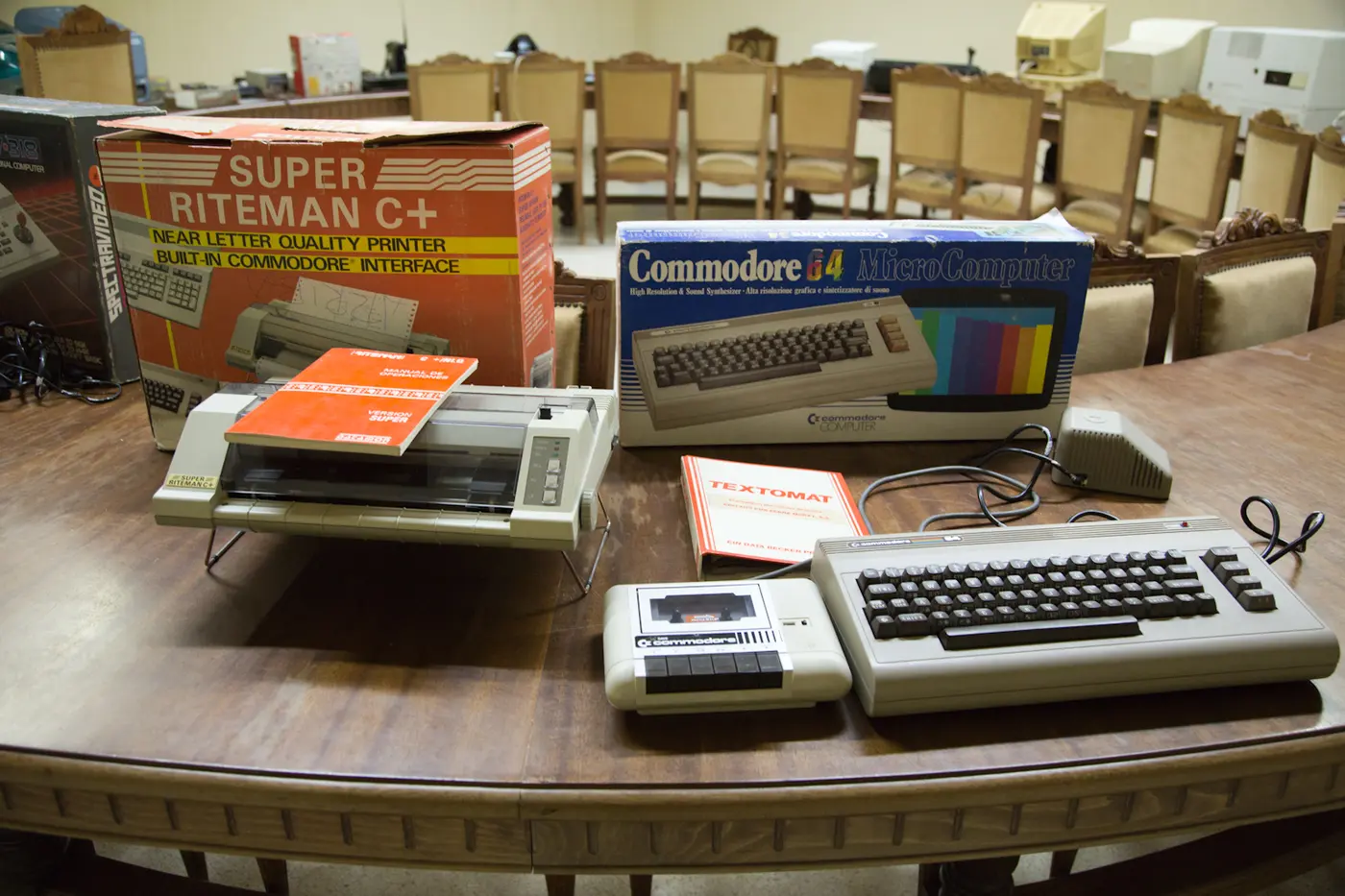
Titles were written on labels in pen, sometimes neatly numbered and sometimes hurriedly abbreviated. Later, nobody quite remembered what was on Games 4 or New assorted. A notebook held loading commands, passwords, game codes and the addresses of shops or other computer owners.
Manuals lay open beside the keyboard. Anyone typing a program from a magazine needed room for the pages, perhaps weighted down with a cassette to stop them turning. Beneath the table, cables gathered into a tangle. One careless movement could make the screen go black.
04 / Leaning towards the screen
Not designed for comfort
Ergonomics received little thought. The chair belonged to a different table, while the screen sat too high, too low or too far away.
People spent hours leaning towards a small television. Daylight reflected in the glass; at night the room could become too dark to read a manual. Curtains closed, lamps moved and the chair crept ever closer to the picture.
Yet the corner felt comfortable because it felt personal. As soon as the start screen appeared, the plain table became an office, arcade, programming room or spacecraft. The physical limits of the corner disappeared behind the screen.
05 / Audible throughout the house
The sounds of the computer corner
A computer corner was never completely quiet. Every action had its own sound.
Keys clicked, joysticks tapped against their microswitches and a disk drive chattered while loading. Cassette users sometimes heard the piercing sound of computer data from the recorder. A printer later added the insistent rattle of its print head and the regular movement of continuous paper.
These sounds travelled through the house. Parents upstairs knew exactly when a game had crashed or when the printer had been switched on late at night. Frustration was audible too: a sigh after an error message, a joystick shaken rapidly or a warning that nobody was to turn off the television.
For the user, all of this belonged to the ritual. The noise of a disk drive meant something was happening. Silence after starting a cassette could create uncertainty: was the program still loading, or had something gone wrong?
06 / More spectators than players
A place that attracted other people
Although computing is often remembered as a solitary activity, several people regularly gathered around the same screen.
Friends brought cassettes or disks and sat together on the floor. One person used the keyboard; the others offered instructions or waited for a turn. Games produced the kind of involvement usually associated with playing: a difficult jump, a new level or a sudden mistake prompted loud commentary from everyone.
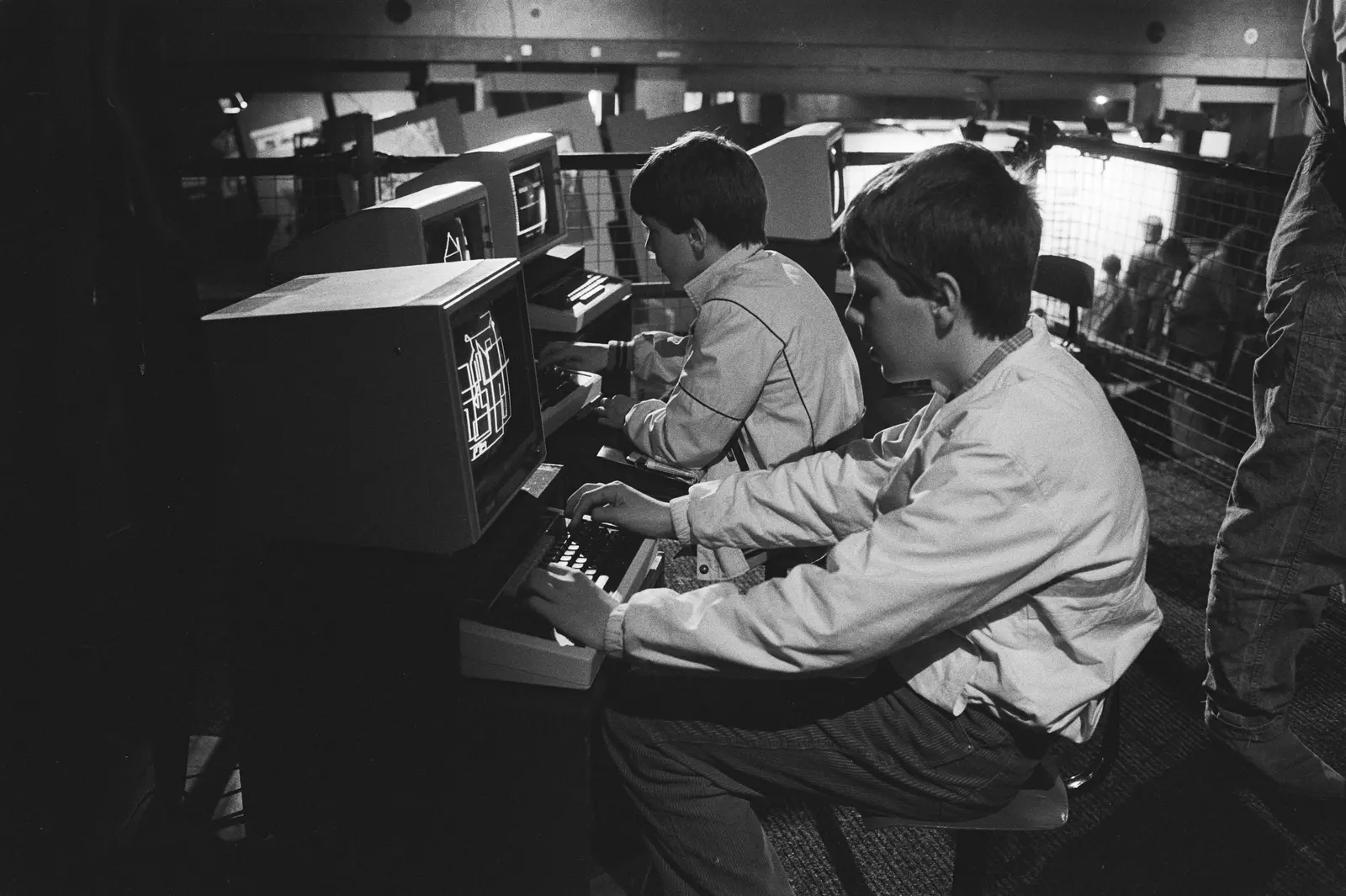
The computer corner became a meeting place. Games were swapped, tricks tested and solutions discussed. Sometimes a friend visited not so much for the owner as for the owner’s Commodore, Atari, MSX or Spectrum. Everyone understood.
07 / Part of the family
Parents watched — or stayed away
For many parents the home computer was a mysterious machine that was supposedly becoming important for school and work.
From a distance they mainly saw coloured figures, long program listings or a game consuming a suspicious amount of time. Some parents became interested themselves. They kept household accounts, tried a word processor or eventually played a simple game. Others avoided the keyboard for fear of deleting or breaking something.
The computer corner nevertheless remained part of family life. Someone called that dinner was ready, demanded that the sound be lowered or insisted that it really was time for bed. These interruptions showed that the digital world was not yet separate from everyday life. It sat right in the middle of it.
08 / A permanent place
From temporary corner to proper workspace
The arrangement became more serious over the years. An old television gave way to a monitor, and the improvised table to a proper desk.
There was room for a disk drive and perhaps a printer. Cassettes disappeared into drawers; disks acquired storage boxes with alphabetical dividers. The computer’s role also changed. What began as a games machine was now used for school reports, letters and administration. Other family members pulled up the chair.
Improvisation never disappeared entirely. The printer stood on a stool, paper waited in a box on the floor and every expansion required another power strip. The perfect workspace existed mainly in advertisements and computer magazines. At home, people made do.
09 / Bigger on the inside
A corner that felt larger than it was
A computer corner might occupy no more than one table and half a metre of floor. To its user, however, it provided access to much more.
- PLACEA territory of one’s own
A small table and screen formed a recognisable place to withdraw into.
- THINGSEverything within reach
Cassettes, disks, joysticks, magazines and scraps of paper found their regular home there.
- PEOPLEA small meeting place
Friends and relatives watched, waited for a turn and helped solve problems.
- WORLDMore than a corner
Games were explored, programs written and schoolwork completed from that one spot.
The memory therefore resides in more than the computer. It is also in the chair, the flickering television, the box of disks and the desk lamp burning in the evening. The computer corner was not a futuristic laboratory. It was a piece of living room, bedroom or attic transformed by cables, curiosity and imagination. For many people it was the first place where the digital world truly came home.
10 / Sources & images
Image credits
Commodore 64 in a boy’s room — Janne Rautiainen / Tampereen museot, CC BY-SA 4.0; resized and converted to WebP
Commodore 64 with printer and cassette recorder — Ismael Olea, CC BY-SA 2.0; resized and converted to WebP
Computer Festival Amsterdam — Marcel Antonisse / Anefo, Nationaal Archief, CC0; resized and converted to WebP


